Archive for 2012

Telling the Truth about Injuries

Thursday, February 9th, 2012

By: Edna Landau

To ask a question, please write Ask Edna.

Congratulations to Patricia Goodson who is Third Prize winner of the Ask Edna First Anniversary contest, affording her a free review of her resume. I am grateful to all of you who submitted questions and will be answering many of them in the coming months. Please keep them coming!

Dear Edna:

How should one handle having an injury? I recall a friend being advised to keep a hand problem quiet as presenters might avoid him, thinking he might cancel. He found himself unable to commit to concert dates because he did not know when, or even if, he would be up to playing again, and he felt nervous about revealing why. As it is not uncommon for musicians to suffer from some sort of career-slowing injury at some point, should we have contingency plans ready? — Patricia Goodson

Dear Patricia:

As with so many situations in life, I think that honesty is the best policy. I have heard of artists who were unable to perform due to a hand injury but who publicly canceled their concert due to the flu.  This can become problematical if the injury doesn’t heal as quickly as anticipated. The flu no longer seems like a credible reason. And who wants to stay home for weeks on end to cover up for a hand injury? Based on my experience, most presenters are very understanding about artists suffering injuries. They take it in stride and may agree to canceling or rescheduling the concert without giving a specific reason. However, they may be pushed by the press for more information, in which case a sprained wrist, infected finger or even tendinitis or a bone spur will not be a cause for alarm. Matters get a little more complicated if an artist has a chronic hand problem and the prognosis for complete recovery is uncertain. Even then, it is best for the artist or manager to be up front with the presenter, saying that they want to help them avert any last minute problems and therefore they are putting them on notice that the concert date could be in jeopardy. In such cases, the presenter might look for a substitute artist who is available, if needed. The presenter wouldn’t be booking the artist if they didn’t admire them and value having them on their series. Consequently, they will wholeheartedly hope for their recovery. If an artist or manager is dishonest with a presenter, only revealing the truth at the last minute, it could cause resentment and erode the trust that had existed between both parties, thereby making the presenter a bit hesitant the next time the artist’s name comes up.

As for contingency plans, I don’t think that most people go through life worrying about what they would do if they could no longer enjoy their current profession. They will hopefully have disability insurance, which will help to mitigate the potential financial loss that could accompany an injury. Artists should also have disability insurance. Beyond that, many artists also teach, or could turn to teaching, if necessary, in relatively short order. They might prefer to go in a totally new direction, such as artistic administration. I think there are enough pressures on any performing artist that they don’t need to live with the constant fear of possible impending injury.  They should trust that if faced with an unexpected disability that brings an end to their performing on stage, they will have many colleagues and friends who will offer their support and help them transition to the next phase of their career.

To ask a question, please write Ask Edna.

© Edna Landau 2012

A Genuine Jolt at the NY Phil

Wednesday, February 8th, 2012

by Sedgwick Clark

Alan Gilbert and the New York Philharmonic are on a European tour for a couple of weeks, and for a change I didn’t roll my eyes in despair when I saw the list of repertoire. His predecessors as music director, Kurt Masur and Lorin Maazel, for all their superb work at building the ensemble, utilized Dvořák’s “New World” Symphony (1894) as the orchestra’s calling card. But not only has Gilbert leapt ahead half a century to show off the ensemble with another Philharmonic commission conducted by its composer at its premiere, Stravinsky’s Symphony in Three Movements (1946), on February 17 he has included the U.K. premiere of Thomas Adès’s hot-off-the-press Polaris, which the Phil played in its New York City premiere only a month ago. Moreover, he has also programmed Composer in Residence Magnus Lindberg’s 1997 Féria three times.

The repertoire list below must come as a genuine jolt to anyone who has looked at how the orchestra presents itself to the world. Not even Zubin Mehta, who was not averse to contemporary music during his tenure, had the nerve to acknowledge the 20th century so thoroughly on tour. The only German chestnut here is the Beethoven Violin Concerto. And while Lang Lang plays the First Tchaikovsky Piano Concerto three times, he also plays Bartók’s Second Concerto thrice on a bracing program that begins with the Lindberg piece and ends with Prokofiev’s Fifth Symphony.

Don’t get me wrong. These programs are hardly the adventures of the Boulez years. But when it seems that everyone’s idea of selling tickets these days is to advance to the rear, I applaud Gilbert and my home orchestra for making a statement on tour with meaty works by Bartók, Stravinsky, and Prokofiev and hors d’oeuvres by Adès and Lindberg.

EUROPE / WINTER 2012
New York Philharmonic
Alan Gilbert, conductor

Feb. 2, 8:00 pm (Cologne, Philharmonie)
Frank Peter Zimmermann, violin
Beethoven: Violin Concerto
Stravinsky: Symphony in Three Movements
Ravel: Daphnis and Chloe Suite No. 2

Feb. 3, 8:00 pm (Luxembourg, Salle de Concerts)
Frank Peter Zimmermann, violin
Beethoven: Violin Concerto
Stravinsky: Symphony in Three Movements
Ravel: Daphnis and Chloe Suite No. 2

Feb. 4, 8:00 pm (Luxembourg, Salle de Concerts)
Lang Lang, piano
Tchaikovsky: Piano Concerto No. 1
Prokofiev: Symphony No. 5

Feb. 6, 8:00 pm (Paris, Salle Pleyel)
Frank Peter Zimmermann, violin
Beethoven: Violin Concerto
Stravinsky: Symphony in Three Movements
Ravel: Daphnis and Chloe Suite No. 2

Feb. 7, 8:00 pm (Paris, Salle Pleyel)
Lang Lang, piano
Lindberg: Féria
Bartók: Piano Concerto No. 2
Prokofiev: Symphony No. 5

Feb. 8, 8:00 pm (Frankfurt, Alte Oper)
Lang Lang, piano
Lindberg: Féria
Bartók: Piano Concerto No. 2
Prokofiev: Symphony No. 5

Feb. 9, 8:00 pm (Frankfurt, Alte Oper)
Frank Peter Zimmermann, violin
Beethoven: Violin Concerto
Stravinsky: Symphony in Three Movements
Ravel: Daphnis and Chloe Suite No. 2

Feb. 11, 8:00 pm (Düsseldorf, Tonhalle)
Lang Lang, Piano
Tchaikovsky: Piano Concerto No. 1
Prokofiev: Symphony No. 5

Feb. 1, 8:15 pm (Amsterdam, Concertgebouw)
Frank Peter Zimmermann, violin
Beethoven: Violin Concerto
Stravinsky: Symphony in Three Movements
Ravel: Daphnis and Chloe Suite No. 2

Feb. 14, 8:15 pm (Amsterdam, Concertgebouw)
Lang Lang, piano
Tchaikovsky: Piano Concerto No. 1
Prokofiev: Symphony No. 5

Feb. 16, 7:30 pm (London, Barbican)
Mahler: Symphony No. 9

Feb. 17, 7:30 pm (London, Barbican)
Joyce DiDonato, mezzo-soprano
Adès: Polaris (U.K. Premiere)
Berlioz: Les nuits d’été
Stravinsky: Symphony in Three Movements
Ravel: Daphnis and Chloe Suite No. 2

Feb. 18, 4:00 p.m. (London, Barbican)
Young People’s Concert: Bernstein’s New York
Leonard Bernstein’s New York
Jamie Bernstein, host
Benjamin Grosvenor, piano
Bernstein/Peress: Overture to West Side Story
Copland: “Skyline” from Music for a Great City
Strayhorn: “Take the ‘A’ Train”
Bernstein: “Ain’t Got No Tears Left,” from On the Town
Bernstein: “The Masque,” from Symphony No. 2, The Age of Anxiety
Bernstein: Three Dance Episodes from On the Town
                        The Great Lover
                        Lonely Town Pas de Deux
                        Times Square 1944

Feb. 18, 8:00 p.m. (London, Barbican)
Lang Lang, piano
Lindberg: Féria
Bartók: Piano Concerto No. 2
Prokofiev: Symphony No. 5

Stage Door Johnny Dept.
Tuesday night while picking up tickets for Porgy and Bess, I found myself standing next to playwright Neil Simon. I try not to bother celebrities, and I succeeded for a few seconds, but I couldn’t resist telling him that on my first night after moving to New York from Muncie over 43 years ago I saw George C. Scott and Maureen Stapleton in his Plaza Suite on Broadway, and what a great introduction it was to my new home. He seemed genuinely pleased and thanked me for telling him. A nice man.

Looking Forward
My week’s scheduled concerts:

2/8 Peter Jay Sharp Theater. Gluck: Armide. Juilliard Orchestra/Jane Glover. Emalie Savoy (Armide), Alexander Hajek (Hidraot), David Portillo (Renaud), Alexander Lewis (Artémidore), Luthando Qave (Ubalde), Noah Baetge (Le Chevalier Danois), Wallis Giunta (Phénice), Devon Guthrie (Sidonie), Evan Hughes (Aronte), Renée Tatum (La Haine), Soo Yeon Kim (La Naïade), Pureum Jo (2nd Coryphée), Deanna Breiwick (Une Bergère), Lilla Heinrich-Szász (Lucinde), and Raquel González (Mélisse).

2/14 Carnegie Hall. Philadelphia Orchestra/Charles Dutoit; James Ehnes/violin. Martin: Concerto for Seven Wind Instruments. Mendelssohn: Violin Concerto. Bartók: Concerto for Orchestra.

Twilight of the Machine

Friday, February 3rd, 2012

By James Jorden

Revelation comes in the strangest places. Like, for example, I had this eventual moment of clarity about what it was that went wrong in the Lepage Ring, and what do you think sparked it?

Of all things, last night’s performance of Ernani at the Met.  (more…)

Getting a Feel for Fees

Thursday, February 2nd, 2012

By: Edna Landau

To ask a question, please write Ask Edna.

Dear Edna:

I am a pianist, seeking to obtain performance opportunities without a manager. Can you please give me some guidance with regard to negotiating a fee? How can I tell what is reasonable and within the budget of the organization in question? How much of a range should there be, depending on venue? I want to find the right balance between coming across as expensive and underselling myself. Is there a way to do any research on this? —K.G.

Dear K. G.,

Addressing your last question first, I know of no way to research fees paid by a majority of presenters. The easiest situations to research are the more informal venues, such as libraries and clubs. In the case of clubs, the artist will often receive a percentage of the amount taken in at the door. Further details can be obtained by simply calling the venue and asking for their standard arrangement. In the case of more formal concert series, you might want to see if the presenter has engaged anyone you know in recent years and, if so, you might contact that person to see if they will reveal what they were paid and what they know about the range of fees in general. Even if you succeed in getting this information, the fee that a presenter will pay an artist may vary from performer to performer, depending on the level of their career, how much exposure they have had, and how confident the presenter feels about selling tickets to their concert. If you find yourself talking to a presenter without the benefit of any advance information, here are some tips to keep in mind:

  1. Before you enter into a conversation about fees, figure out what your expenses relating to the performance will be and  how much you would ideally like to make on top of that. It is also good to check the capacity of the theatre they use and their typical ticket price for a concert such as yours. This information should be accessible on the internet. Keep in mind that in addition to your fee, the presenter will have a range of costs, including the hall and expenses related to advertising and marketing the event. During the negotiation, you might have occasion to refer to this information, if you consent to a lower fee and want to give a reason, such as sensitivity to the size of their venue.
  2. If at all possible, ask the presenter to tell you how much they have in mind, based on their budget. There is always the possibility that they will offer an amount higher than what you would have suggested.
  3. Most presenters know that any number you quote them can potentially be negotiated downward.  (They learned that from managers who always try to get the best fee for their artists!) Therefore, leave “wiggle room” in your negotiation by starting a little higher than the amount  that would have satisfied you. You can say: “Typically, my fee has been x, and I hope that will be possible for you.”
  4. If you end up with a fee that is quite a bit lower than what you had hoped for but you feel you have to accept it to save the date, you might want to ask if the presenter is in a position to provide housing or ground transportation (including  travel from and to the airport). Many organizations have volunteers who are happy to help with this. You might also ask if they have any suggestions of other presenters in the area (far enough away not to compete with them for ticket sales) who might potentially be interested in having you as well. If the conversation has gone really well and you feel that the presenter finds you very accommodating and reasonable, you might want to say that if they are happy with your performance and intend to engage you again in the future, you hope that the fee you have accepted will not set a precedent for the next negotiation.

Typically, community venues such as libraries and churches, will have a much smaller budget than established recital series. It might be somewhere between $300 and $1000. Established series might offer a young artist somewhere between $1000 and $3000. If you have little performing experience to point to, be prepared for the fee to be at the low end of that range. Orchestras might offer slightly higher fees and may present you in multiple concerts (typically two or three). Some orchestras will offer a per performance fee and others will offer a discounted fee for the repeat concerts. So if your single concert fee is $3000, they might offer $4500 for two and $5500 for three. The latter arrangement is most usual.

It is not easy for individuals to negotiate on their own behalf but if you bear in mind that you are delivering value to the presenter and their audience, and you feel confident in what you have to offer, the experience will become much more comfortable within a relatively short period of time. Your display of understanding, flexibility and sensitivity to the presenter’s needs will put you on a strong footing for reengagements in the future, as they will undoubtedly walk away from the discussion feeling that you are pleasant to work with before you have even entered their concert hall.

To ask a question, please write Ask Edna.

© Edna Landau 2012


Omus in Person

Wednesday, February 1st, 2012

by Sedgwick Clark

I first met Omus Hirshbein in Carnegie Hall’s executive offices, where he worked for a brief time in 1973 between tenures at the Hunter College Concert Bureau and the 92nd Street Y. He was walking out of a planning meeting, saying in frustration to anyone nearby, “They won’t listen to me—they should be emphasizing the sound of Carnegie Hall.” Guess what Carnegie’s subscription campaign was the next season, after Omus left for the Y? There he would create a concert series that for two decades would dominate the chamber-music field in New York (and annoy the hell out of me because it was such a nuisance to get to from my apartment near Lincoln Center).

We became friends over the years, especially after buying one of his pianos several years ago when his upper West Side apartment could no longer house two Steinways. Every time my wife and her four-hands partner, the composer and conductor Victoria Bond, get together to play, we think of Omus and his wife, Jessica.

Omus died on December 31st after a long decline due to Alzheimer’s. It seems especially tragic that one whose mind was so fertile would leave us in such a manner. I’m sorry I took so long to take note of him in this forum. Perhaps I was stymied because Brian Kellow, who worked for Omus at the Y in the 1980s, captured his personality and accomplishments so warmly and vividly in an Opera News piece, as did Allan Kozinn in his New York Times obituary (January 7, 2012). So I decided I would do something different and reprint Omus’s own typically impassioned words from a panel discussion on the programming of classical music, which appeared in the 1995 Musical America Directory. Participants with Omus in the discussion were industry V.I.P.s Deborah Borda, Eugene Carr, Mary Lou Falcone, Christopher Hunt, and Jane Moss. I highly recommend your reading it; check out the Services section on top of the Musicalamerica.com desktop. You may find, as I did when I read it again, that it could have been recorded yesterday.

Omus Hirshbein: “I think there are two reasons why people like to go to concerts these days. One is being addressed by the kind of programming that the American Symphony is doing. Back in 1986 I agreed to put together a series of eight concerts for the Museum of Modern Art exhibition called “Vienna 1900.” It had to do with the years of the Vienna Secession, which are roughly 1898-1918, and the composers were Schoenberg, Berg, Webern, Zemlinsky, Schmidt. And I said to them, “But no one will come.” To my surprise, tickets were being scalped on 53rd Street. I saw virtually none of the usual New York music people at those eight concerts. Audience members were reading, they were seeing the paintings, they were seeing the workshop of Hoffman, and they were hearing a group of composers described by curator Kirk Varnedoe as part and parcel of the Secession, and they went. Okay, that’s one reason.

“The other, of course, is that music is supposed to touch the heart. And it’s supposed to touch the soul. Now, there was a period of 40 or 50 years when what was new was ugly. Sorry, it was mostly ugly. And the legatees of those Viennese geniuses—and I speak of Schoenberg as a genius—made it worse. They became academic, producing a system of writing in this country that was not for the public. Now, there are some young people writing music today who are mobbed by audiences. I’m talking about Aaron Kernis, and Bright Sheng, and there are others. And maybe it signals a reversal of that horrible trend where what was new was impossible to listen to. That’s all I can hope for, because the teaching of music has become of little importance in most of the major cities today as they cope with their social and educational problems.

“Let me just add that money is really an issue. And I’m not talking about balancing budgets. On the wall in my new office is a blowup of an advertisement from 1971, announcing a repeat concert of Victoria de los Angeles and Alicia de Larrocha doing a program of Spanish tonadillas and whatnot. I ask people to look at it because it has tremendous meaning—and finally down at the bottom, they come across what is really disturbing about it. And this is 1971, folks. The top price at the Hunter College Concert Bureau, where this took place, in a 2,200-seat house, was a dollar below Carnegie Hall and a dollar below Lincoln Center: six and a half dollars. A movie was three bucks, or three and a half. A musical event of that magnitude was twice the price of a movie. And that was prevailing.

“Now, I throw down a gauntlet to the commercial interests that have ruined our business. I assure you that Mostly Mozart once was a three- and four-dollar ticket. Commercial interests, and the interests of unions, have hurt us a great deal. This not a high-tech business, this is not the movies, this is not mass media, and we are paying the kind of monies out that would say it’s mass media, and it ain’t anything like that.

“. . . I had a staff of music lovers in my previous job. Music lovers. A couple of them were married, they were in their thirties, and you know what they do? They get together with their friends in a restaurant, and they spend an evening, and that’s all they can afford to do; they are making $23,000 and $24,000 a year, and they cannot afford to go to these concerts.

“. . . There’s another side of the coin. Once the performer becomes recognizable, there is the most extraordinary avarice to get the fees up as fast as possible. And that, for me, is what has wrecked the business. An artist could go on the road and make a decent living at fees somewhere in the $5,000 or $6,000 range and that’s about all that anybody out there in the hinterlands can afford. Now, I think maybe that’s all I have to say.”

Of course, it wasn’t all he had to say. His last professional endeavor was to found, with his former Y colleague Jacqueline Taylor, a series of free public concerts with major artists that they called “Free for All at Town Hall.” They wrote about its genesis in the 2004 edition of Musical America Directory, and we can still look forward to these concerts each spring. Martin Riskin, who is now president and artistic director of the series, tells me that the upcoming concerts will be dedicated to Omus.

Looking Forward

My week’s scheduled concerts:

2/1 Paul Hall. FOCUS! Festival. Cage: Five Songs (1938); Six Melodies for Violin and Keyboard (1950); Imaginary Landscape No. 1 (1939); Etudes Boreales, Nos. 1 & 3 (1978); Sonnekus² (1985); Satie Cabaret Songs; Child of Tree (1975); The Perilous Night (1944).

2/7 Rodgers Theatre. Gershwin: Porgy and Bess. Audra McDonald (Bess), Norm Lewis (Porgy), David Alan Grier (Sportin’ Life).

1/8 Peter Jay Sharp Theater. Gluck: Armide. Juilliard Orchestra/Jane Glover. Emalie Savoy (Armide), Alexander Hajek (Hidraot), David Portillo (Renaud), Alexander Lewis (Artémidore), Luthando Qave (Ubalde), Noah Baetge (Le Chevalier Danois), Wallis Giunta (Phénice), Devon Guthrie (Sidonie), Evan Hughes (Aronte), Renée Tatum (La Haine), Soo Yeon Kim (La Naïade), Pureum Jo (2nd Coryphée), Deanna Breiwick (Une Bergère), Lilla Heinrich-Szász (Lucinde), and Raquel González (Mélisse).

A Peculiarly American Paradox

Monday, January 30th, 2012

by James Conlon

Gore Vidal once observed that at a certain age writers turn to politics or alcohol. I am a musician and am turning to neither, but in recent years have found, conversely, an increasing satisfaction through writing. For that reason I welcomed the invitation from MusicalAmerica.com to write a blog on a somewhat regular basis.

 The title “A Rich Possession” is taken from a translation of the epitaph on Franz Schubert’s grave: The art of music here entombed a rich possession, but even fairer hopes.

 I have enjoyed the privilege of a life of making music, which, in the end, is its own reward. The most precious aspect is that of living on a daily basis in close proximity to a great artistic, spiritual and intellectual force. Classical music is a Rich Possession.

 But there is a problem, and I think those of us who love classical music and live in the United States need to see it with greater clarity.

Probably no other country (at least not yet) can boast as many great symphony orchestras, opera companies and conservatories. We are training and producing a stunningly high level of young musicians. The paradox: every arts institution I know is struggling to keep and develop its audience. The arts might need to be repackaged, but without compromising the quality and essence of the inherited art form of which we are the custodians. How and why we have come to have more supply than demand, and what I hope we can do about it, will occupy a significant portion of my future writings.

Will our great country recognize again the necessity of a prominent place for the Classical Arts? How did we allow things to get to this point, and how can we fix it? We are proprietors of a very rich possession…and fairer hopes. Will we know how to maintain the former, and realize the latter? The status of classical music—of all of the classical arts—will not be enhanced without the determined efforts and thoughtful advocacy of those who treasure it most.

The joys of the ballet spoof

Thursday, January 26th, 2012

By Rachel Straus

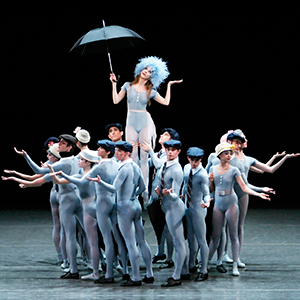
There is nothing like a good ballet spoof. At New York City Ballet’s January 21 matinee performance at Lincoln Center, the company danced Jerome Robbins’ “The Concert” (1956). Whether you get the inside jokes about famous ballets, Robbins’s jabs at ballet traditions—the good, bad and the ugly—directly communicate. Many of the high jinks in “The Concert” involve the corps de ballet. They aren’t a sisterhood of synchronous arms and legs, but a bunch of competitive ladies with faulty memories in respect to their steps. The prima ballerina, danced to perfection by principal Maria Kowroski, isn’t satisfied until she is tearing through space, emoting like a diva, and wearing ridiculous headgear (a blue pom-pom hat). Meanwhile the on-stage pianist, Cameron Grant, plays on a dust-covered piano. Dance studios boast some of the most broken down pianos around. These ancient instruments, which have tortured generations of musicians, are too often treated as good places for dancers to put their gear.

Photo by Paul Kolnik

As for the male dancers in “The Concert,” they are reduced to porteurs, carrying ballerinas to and fro as if they are store window mannequins. The motivation of the lead danseur, Andrew Veyette, is to kill his wife, Amanda Hankes, and to win the long-legged Kowroski.

“The Concert,” to Frederic Chopin’s piano sonatas, was made more than a half century ago, but its traditions (and relevance) hold fast. Competition between dancers, the primacy of the ballerina, men hauling female dancers above their shoulders: it’s all very 2012. An all-out audience pleaser, “The Concert” is a gem for any mixed bill program that needs a little leavening.

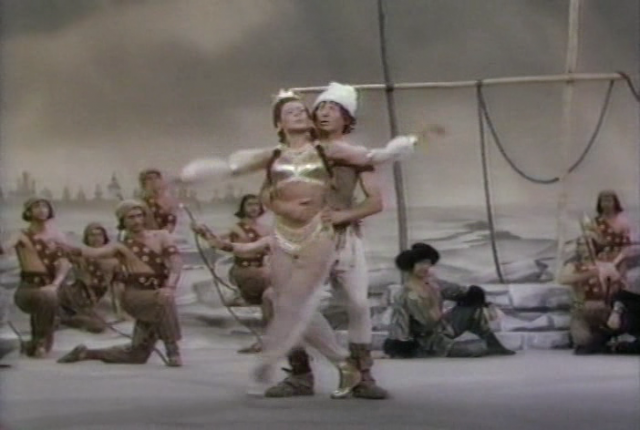
Two years before Robbins made “The Concert,” his younger colleague Michael Kidd choreographed a ballet spoof for Paramount Pictures called “Knock on Wood.” Kidd and Robbins cut their teeth as performers on Russian ballet. Both felt like imposters, being Jewish, not apprenticing to classical dance in their wee years, and failing to cotton to the big fairy tale ballet aesthetic. When Kidd left the ballet world in 1947 and became a sought after dance arranger for musicals, he used his Russian ballet experience to side splitting effect. In “Knock on Wood,” Kidd directed Danny Kaye to duck into a theatre, don a costume of a Slavic hero and ad-lib through a Russian ballet performance to escape from bad guns with guns. Kaye dances the flat-footed fool in some very saggy tights. He’s no aristocrat. Neither was Kidd. “I was never cut out,” he said, “for being the Swan Prince.” You Tube currently carries the Knock on Wood ballet scene. It’s a little over eight minutes long, but it feels like a flash.

Danny Kaye in "Knock on Wood"

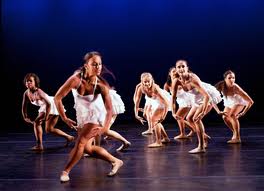
Some ballets are meant to be serious, but are best enjoyed as comedy. Such was the case with an excerpt of Jeremy McQueen’s “Concerto Nuovo” (2009). Performed on January 24 for the Dancers Responding to Aids benefit concert at the Cedar Lake Contemporary Ballet Theater, McQueen set his all-female work to J.S. Bach’s “Concerto in D minor for Two Violins.” If ever there was a loaded piece of music in dance, it’s this concerto. Balanchine and Paul Taylor created their masterpieces, “Concerto Barocco,” and “Esplanade,” respectively, to this music.

Photo by Yi-Chun Wu

Young McQueen not only turns Bach’s concerto into background music for his grab bag of steps culled from ballet, modern, runaway modeling and the competition dance circuit, he states in the program notes that “Nuovo” is inspired by Balanchine’s “Concerto Barocco.” McQueen’s homage and convoluted dance phrases are so tasteless they’re funny. The white ruffled mini dress costumes transform the nine hard-working dancers into identical-looking prom queens. With a good editor, “Concerto Nuovo” could amuse more than offend. Dancing funny to J.S. Bach’s concerto holds promise. Some pieces of music bear too much history to be danced straight.

For more dance writing by Rachel Straus go to rachelstraus.com.

A Confident Handshake

Thursday, January 26th, 2012

by Sedgwick Clark

A confident handshake? It happened in the 1980s in David Dubal’s office at the late, lamented New York classical-radio station WNCN, where I edited the station’s music magazine, Keynote. David, who was music director of the station, always had a string of notable pianists visiting. On this day it was Alexis Weissenberg who smiled and extended his hand. It was a large hand and enveloped mine completely with muscular but warm and welcoming pressure. Absolute confidence. He could have crushed my hand to smithereens if he had wished. In contrast, the grasp of another pianist, who shall remain nameless, left my hand aching for days. Guess who had the bigger career.

Weissenberg died on January 8 at age 82 of Parkinson’s disease in Lugano, Switzerland. The Times obit characterized him as “known for his thundering aggressiveness and rational detachment at the keyboard.” I suppose. He certainly wasn’t known for his singing tone and pliant phrasing. But he was one of two pianists in my experience—Martha Argerich is the other—able to make a Hamburg Steinway “speak.” I recall a Carnegie Hall performance on March 2, 1980, of Rachmaninoff’s First Sonata that did indeed “thunder” with a massive tone and power that pinned me to the back of my seat. Most pianists I’ve heard seem wimpy when seated at a Hamburg. I’ll take the color, detail, and impact of an American Steinway any day.  Dubal could probably tell you why.

Russian Visit

A friend is in town for the next couple of weeks before giving a paper at a Princeton University conference oddly entitled “After the End of Music History” to honor Richard Taruskin, the prolific American author of Russian musical subjects. She is Olga Manulkina, author of From Ives to Adams: American Music in the XXth Century, the first book in Russian to cover the entire century of the subject. While I can’t claim to have read it, I can say that it’s chock full of wonderful photos from the Musical America Archives! Also that its first printing is all but sold out, so readers of Cyrillic should order it ASAP.

Anyway, one of Olga’s projects is to instill a love of baroque music in me, so friends and readers of this column should brace themselves if they see me at unaccustomed concerts. Thank goodness there’s a lot of 20th-century and contemporary American music being performed too!

Looking Forward

My week’s scheduled concerts:

1/26 Alice Tully Hall. Juilliard415/William Christie. Purcell: The Fairy Queen (excerpts). Rameau: Les Fêtes d’Hébé (excerpts).

1/27 Zankel Hall at 6:00. Making Music: David Lang. the little match girl passion (N.Y. premiere). Theatre of Voices/Paul Hillier; vocalists; Nico Muhly, keyboards.

1/28 Metropolitan Opera. The Enchanted Island. William Christie; de Niese, Oropesa, DiDonato, Daniels, Constanzo, Domingo, Pisaroni.

1/29 Le Poisson Rouge at 7:00. Philip Glass’s 75th Birthday Celebration. Kronos Quartet, Dennis Russell Davies, Maki Namekawa, Ira Glass, Michael Riesman, et al.

1/30 Peter Jay Sharp Theater. FOCUS! Festival. Juilliard Percussion Ensemble/Daniel Druckman; Benjamin Sheen, organ. Cowell: Ostinato Pianissimo. Cage: Three²; Third Construction; Credo in Us. Harrison: Concerto for Organ with Percussion Orchestra.

1/31 Metropolitan Opera. Wagner: Götterdämmerung. Fabio Luisi. Voigt, Harmer, Meier, Gould, Paterson, Owens, König.

2/1 Paul Hall. FOCUS! Festival. Cage: Five Songs (1938); Six Melodies for Violin and Keyboard (1950); Imaginary Landscape No. 1 (1939); Etudes Boreales, Nos. 1 & 3 (1978); Sonnekus² (1985); Satie Cabaret Songs; Child of Tree (1975); The Perilous Night (1944).

The Secret Ingredient for Success

Thursday, January 26th, 2012

By: Edna Landau

To ask a question, please write Ask Edna.

I was recently honored to be asked to participate on a panel at the annual Astral Artists auditions, during which I listened to a substantial number of pianists and wind players. While all were on a rather high level, I was struck by the relatively small number who grabbed my attention right from the start of the audition and sustained it all the way through. It got me thinking about a three letter word, not often mentioned, that for me constitutes an essential ingredient of successful performance, whether on stage or in the workplace:  JOY.  While it is indisputable that beloved artists such as Itzhak Perlman and Yo-Yo Ma have earned their place as musical legends first and foremost by virtue of their extraordinary artistry, I am convinced that their joy in music making has been an essential ingredient in making them household names. It is palpable from the very first notes that they play. I believe that this element of performance is rarely addressed in the practice room, where the majority of attention may be focused on the mechanics of playing. Can joy be taught? Probably not, but I do think that all teachers can encourage their students to identify and perform repertoire that brings out the best in them and in which they feel they have something special to say. For works that are relatively unfamiliar, the artist should be encouraged to share with their audience some spoken comments regarding why they chose to program the work, thereby increasing the potential receptivity to it from their listeners. Joy in performance may result from confidence that a program has been well prepared, and from the artist’s belief that it offers works or interpretations that might be new to an audience or juxtaposed in an interesting way. The artist might pause, almost imperceptibly, before a phrase that they find particularly special, just as a storyteller would do, thereby sharing that moment more meaningfully with the audience. It seems to me that our most treasured artists are those who give us the impression that there is nothing they would rather be doing than performing for us. While a healthy schedule of performances is essential to a successful career, a concert should never be a means to advance to the next rung on the career ladder. It is a special moment in time, and the opportunity to communicate with a live audience should be savored.

And what about the workplace? In my twenty-three years as Managing Director of IMG Artists, I interviewed many job applicants and often made a positive decision after the first few minutes. A good number of people that I hired still work at IMG after ten years or more, and they have all advanced through the ranks to higher levels of responsibility and more distinguished titles. Their excitement about working at a dynamic and distinguished international agency was visible to me from the start, and it quickly became apparent that the pleasure they took in their work overshadowed any eagerness they may have felt to advance in their career. The promotions came naturally because they were great team players, galvanizing everyone around them with their enthusiasm and joy in having a job that allowed them to be surrounded by great performers and inspiring colleagues. This created a family atmosphere throughout the years, despite substantial growth in the size of the artist roster and number of employees, which I think was a key element in the company’s success.

Beethoven’s Ninth Symphony may be the most beloved work in the classical music literature, uplifting all who hear it with the final movement’s magnificent setting of Friedrich Schiller’s Ode to Joy. Our lives will undoubtedly be richer and more meaningful if we can compose, and actually live, our own personal ode to joy.

To ask a question, please write Ask Edna.

© Edna Landau 2012
You Don’t Know Me, But…

Thursday, January 19th, 2012

By: Edna Landau

To ask a question, please write Ask Edna.

Dear Edna:

I’m an artist sending out letters of inquiry to a handful of presenters. Can you give me an example of an inquiry letter you might send, as an artist, to a concert series or presenter when proposing a concert? —Kimball Gallagher

Dear Kimball:

In a time when the DIY approach is increasingly the way to go, especially for young artists, I commend you for plunging in and seeking engagements on your own. While nobody really knows how many presenters actually read unsolicited letters from artists, some I have talked to indicate that they might at least read the first paragraph, and if the letter is well-written and compelling, they will finish it. They might even listen to a little bit of an accompanying demo cd. It is therefore critical that your letter is concise and to the point. Your letter can demonstrate your awareness of the presenter’s typical series offerings and how you think you might fit into their artistic planning. If you have a particular repertoire strength that is somewhat unusual or can offer a new work that you commissioned, that should certainly be highlighted. You might also want to mention your interest in doing outreach activities, if applicable. While each situation might call for a specifically tailored approach, here is an example of what might prove effective:

Dear Ms. Caldwell:

In a time when recital series seem to be dwindling in number, it is a pleasure to see the commitment you continue to make to solo artists and to introducing your audiences to musicians whom they might not yet know. I am a pianist and graduate of Juilliard who seeks to offer somewhat unusual programs and enjoys engaging with audiences before or after a concert.

In the 2013-14 season, which marks the 100th anniversary of the birth of Benjamin Britten, I will be offering a program which will include his Five Waltzes, Opus 3, as well as other works related to dance, from a Bach suite to tangos by Astor Piazzolla. I have enclosed a sample of a recent cd and hope that despite your very busy schedule, you might have time to listen to at least a little of it. Also enclosed are sample programs from some recent concerts, my bio, review quotes, and a brief description of some educational and community activities I have offered to presenters.

I will call you in a few weeks to see if it might be possible for us to work together. With much appreciation for your consideration,

Sincerely,

My informal survey of presenters has not revealed a clear preference for receiving this sort of letter by traditional mail or by e-mail, with a downloadable music sample. However, several I spoke to did admit that e-mails have a way of getting overlooked in the hubbub of a given day and that they sometimes like to listen to demo cd’s en route to or from work. At the bottom of the letter, be sure to include links to your website or to YouTube, but take care to ensure that any video clips are recent and good quality. Good luck!

To ask a question, please write Ask Edna.

© Edna Landau 2012