Archive for 2013

Multiple-Entry Visas: A Safe Bet

Wednesday, February 27th, 2013

By Brian Taylor Goldstein, Esq.

Dear Law and Disorder:


I am working on an orchestra tour for the 13-14 Season. We would like to include Canadian dates in the route, but they are neither possible at the beginning or end of the tour. Is it possible on a work visa, for a group to depart the USA for Canada for a couple of engagements and then re-enter the US as part of a single visa application? This was not possible for the Cubans, I was told. However, I know a Russian ballet company that was able to do this. My associate is confident this is not possible.

I hope you made a bet with your associate, because you’d win. Your associate is incorrect. Except for a specific list of countries, ALL visas are multiple-entry during the validity period. So, for example, if a UK citizen receives an O-1 for 1 year, he can enter, leave, and re-enter as often as he wants during that year. If a Russian orchestra receives a P-1 for 6 months, they can enter, leave, and re-enter as often as they want during that 6 months. Exceptions include such countries as China, Brazil, Cuba, and certain middle-eastern countries. You can find the complete list of countries that have restricted entries on the state department website at http://travel.state.gov/visa/fees/fees_3272.html

So long as a member of your orchestra is not from a country on the restricted entry list, then, provided you are able to obtain a P-1 visa for the orchestra for the 13-14 season, each member will be able to enter the US, leave and go to Canada, and re-enter the US whenever and as often as they wish. However, as they may need separate visas to enter Canada, you will need to check Canadian law immigration to confirm that.

___________________________________________________________________

For additional information and resources on this and other legal and business issues for the performing arts, visit ggartslaw.com

To ask your own question, write to lawanddisorder@musicalamerica.org.

All questions on any topic related to legal and business issues will be welcome. However, please post only general questions or hypotheticals. GG Arts Law reserves the right to alter, edit or, amend questions to focus on specific issues or to avoid names, circumstances, or any information that could be used to identify or embarrass a specific individual or organization. All questions will be posted anonymously.

__________________________________________________________________

THE OFFICIAL DISCLAIMER:

THIS IS NOT LEGAL ADVICE!

The purpose of this blog is to provide general advice and guidance, not legal advice. Please consult with an attorney familiar with your specific circumstances, facts, challenges, medications, psychiatric disorders, past-lives, karmic debt, and anything else that may impact your situation before drawing any conclusions, deciding upon a course of action, sending a nasty email, filing a lawsuit, or doing anything rash!

Bridging the Gap

Saturday, February 23rd, 2013

By James Jorden

One of the things I’m gradually learning as I’m coming up my the 20th anniversary of writing about opera for publication is that you have to be wary about making Pronouncements, because no matter how obvious or intuitive a hard-and-fast rule seems to be, if you write it down where people can find it, one of these days it’s going to embarrass you.

Who would have thought that when, ages ago, I penned something called Dr. Repertoire’s 10 Rules for Stage Directors, I would one day change my mind about not just any rule but Rule #1 (“DON’T STAGE THE OVERTURE, in all caps and bold font yet.)

Though, to be sure, I still feel like most attempts to stage the overture are pointless, as, for example, the silly dumbshow at the top of Le Comte Ory at the Met, by which Bartlett Sher accomplishes nothing but spoiling Comtesse Adèle’s actual entrance half an hour later, and banging up poor Pretty Yende’s knee when she stumbled over those rickety escape steps.

But it is possible, I admit it now, to stage the overture in meaningful and moving way, and the spectacle François Girard came up with for the beginning of the new Parsifal ended up being one of my favorite things among many in this really excellent productions.

The front curtain is a dark mirror, reflecting dimly the horseshoes of houselights of the Met auditorium. The music starts with the lights not quite completely out, and they continue to fade slowly as stage lights come up behind the transparent mirror drop. We see ranks of men in dark suits (close enough to formal wear as makes no difference) and women in little black dresses: an idealized “opera audience,” uniformly chic.

Now, this “mirror” trope—connoting “as you, the audience see yourselves reflected, so is our play meant to be about your own lives”—is quite a familiar one: Hal Prince’s Broadway production of Cabaret began with it way back in 1966, and more recently Robert Carsen adopted this coup de théâtre for his Don Giovanni to open La Scala in 2011.

But Girard took the idea a little further. First we noticed the distinctive curly head of Jonas Kaufmann’s Parsifal among all the swells: he seemed not quite sure where he was or why he was there. As the “pure fool” tried to make sense of the motionless ranks around him, they slowly began to move, as if the “performance” they were watching had finished perhaps (this is adeptly set to the c minor repetition of the opening theme.) The crowd slowly segregates into men in the front row and women toward the back, and then the men start removing costume pieces: shoes and socks, ties, jewelry, and finally jackets, until the chorus are in identical white shirts and black slacks.

Meanwhile the women cover their heads with veils and retreat slowly upstage right. The men also disperse, but they seem to have some purpose: they are arranging chairs into a tight circle, then sitting shoulder to shoulder in some sort of meditative state. Finally the lights come up and the mirror flies out to reveal a parched hillside bisected by a sliver of dried riverbed, as Gurnemanz appear over the hill on the “men’s” side of the cleft.
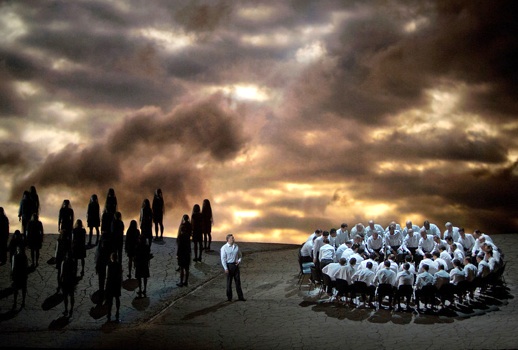
Now, this all I found subtle but impressive, or possibly even more impressive for its subtlety. The “cross fade” between the Met auditorium and the world onstage suggested that the action unfolding onstage was not strictly fiction but rather an alternative reality: a story about what might have happened or what might yet happen. Somehow the civilization we know so well, going to the opera and wearing ties and all of that, just might disappear over time, and what might be left would be this curious community founded on a form of religion that seems familiar enough in outline but not in detail.

Now, after this point, the production veers in a slightly different direction. Girard takes the wound of Amfortas as his central metaphor: something once whole that is now torn apart. The dramatic progress, then, is toward restoration, reconciliation, repair.

We’ve seen the cleft separating the stage and the division between the sexes. But at the end of the first act comes a huge surprise that really rocked me back on my heels. Per the stage directions, Gurnemanz realizes (or anyway assumed) that Parsifal found the Grail ceremony meaningless, so he angrily expels him from the hall. In this production, of course, there is no hall per se, just an area on the hillside where the faithful gather. But even so, I was expecting Gurnemanz to send Parsifal on his way, over the hill or whatever. That’s not what happens, though.

Instead, Gurnemanz walks away, leaving Parsifal alone. The Stimme (aus der Höhe) intones

“Durch Mitleid wissend,
der reine Tor!”

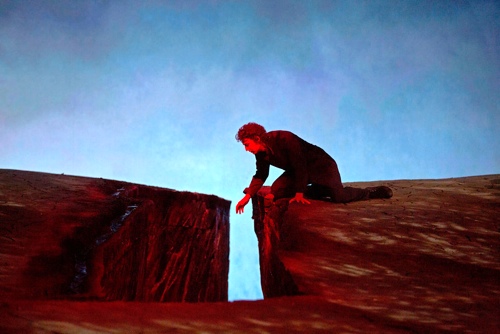
… but maybe the voice isn’t coming from the heights after all. The cleft in the ground gradually opens further into a chasm, and Parsifal crawls over and peers into the depths. Is that, perhaps, where the voice is coming from: inside the wounded earth, and, instead of a prophecy, perhaps these words are a call to further adventures?
That does seem to be the case as the second act starts. It takes a few minutes to get one’s bearings, but eventually the image becomes clear. That vertical slit at the back of the stage is not, as it first appeared in early press photographs, an obvious vaginal symbol, but rather the other side of the “wound” in the earth, rotated through 90 degrees. Inside the wound, naturally, is freely-flowing blood, though, perhaps not quite so naturally, there are a legion of white-gowned brunette maidens grasping silver spears, all surrounding Klingsor in his blood-soaked business suit.
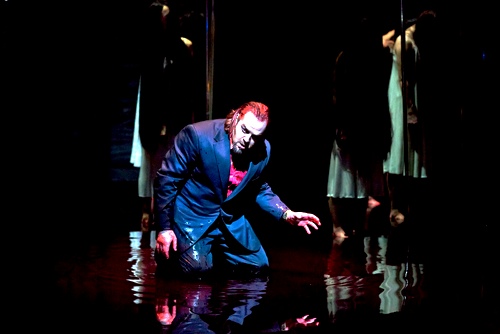
This is an intriguing idea: Parsifal is eventually going to heal this wound, but first he must explore the inside of it, brave all the evils and temptations that have so gravely injured poor Amfortas. I was reminded idly of the sci-fi film Fantastic Voyage.  (In fact, some of the projections for this act by Peter Flaherty resemble the special effects for that 1966 movie: giant corpuscles throbbing in slow motion and so forth.)

So the tone of the second act is not that of a standard Parsifal.  There’s less of a sense of personal connection between Parsifal and Kundry, and more of a sort of trial or test, perhaps a reenactment of Amfortas’s experience. If that is so, it is a successful examination: Parsifal comes to the point at which Amfortas made his mistake, forgetting himself in the ecstasy of sexual attraction, but he suddenly returns to himself. Significantly, this “return” is not accomplished by any intellectual application of rules of morality or behavior, or even by any questioning process, but rather through a sudden intuitive empathy for Amfortas’s experience.

But that intuitive breakthrough is not a cure, only a sign pointing to the cure. There are numerous wounds, both literal and metaphorical, to be closed in order to make the system whole again, and so Parsifal must experience a lifetime of empathy in all its forms in order to be able to understand how to bring the divorced parts together again.

Here again, as Parsifal returned in the third act, I was confused: what I expected from previous exposures to the work was a kind of exalted hero, someone imbued with the holy energy of enlightenment. Even in the strange and violent production by Calixto Bieito, that’s how Andrew Richards played it.
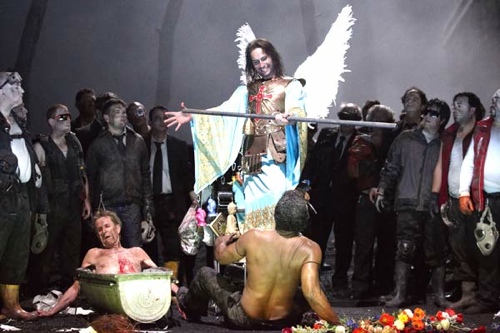
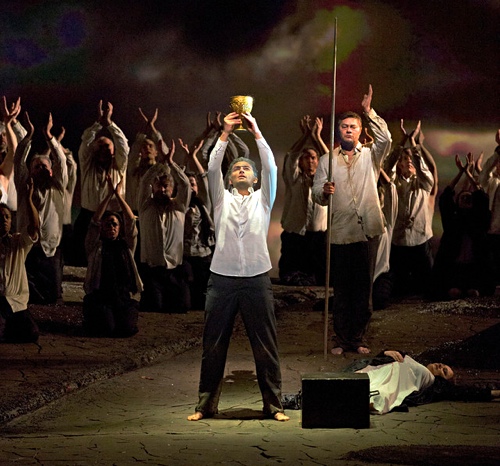
In Girard’s interpretation, Jonas Kaufmann took almost precisely the opposite approach. He was broken down by fatigue on his entrance (as all Parsifals are) but he never got that burst of divine oomph, that “now I am a savior!” moment. At most he achieved a kind of basic peace, enervated in body but maybe a little clearer in mind. There was nothing you could call joy or exaltation in his taking on the office of king of the grail; rather, it was a simply quiet duty, something one does without any particular pleasure, but something that absolutely must be done. Nothing glamorous or glorious, but rather a responsibility: the work of an adult.
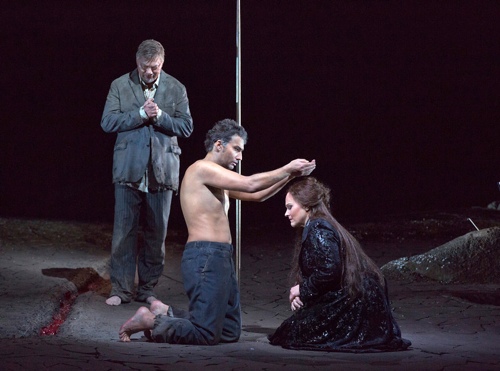
And the work is accomplished, or at least well begun: the wound of Amfortas is healed, the sexes mix naturally, and the Grail is available to anyone who seeks it, unhidden, uncovered and open. Even the complicated question of Kundry’s unnatural existence is resolved, quietly and with dignity. (I thought I would never see a staging of this piece in which Kundry actually dies as prescribed in the stage directions, but without the unwanted sense that she is somehow being punished. Girard directs this moment with great elegance, assigning Gurnemanz and Parsifal to attend to her last peaceful moments. Her death feels natural and organic, an end to suffering, which is exactly as it should be.)

But, again, there’s nothing triumphant here, no sense of “winning.” The task of healing the world’s wound is accomplished not through any magic or feel-good religion, but through the dirty, grueling grind of endurance, living day by day as best one can. The earth is still parched, the sky still dark. This Parsifal, chosen one or not, has to earn his crown again with every new day.
Photos by Ken Howard, except for Andrew Richards as Parsifal (Martin Sigmund)
Where does the Concertgebouw Stand?

Thursday, February 21st, 2013

by Sedgwick Clark


NOTE: BEGINNING THIS WEEK, I’LL BE POSTING MY BLOG ON THURSDAYS AT NOON RATHER THAN WEDNESDAYS.


Amsterdam’s Royal Concertgebouw Orchestra and its current music director, Mariss Jansons, stopped by Carnegie Hall last week (2/13 and 14) for a pair of concerts to celebrate the ensemble’s 125th anniversary. They were a great success, as always, with everyone on my aisle burbling over its glorious sound and virtuosity.

No doubt whatsoever, it is a great orchestra, and for many of my over-40 years of hearing it in concert it was my favorite European orchestra. But the dark, burnished sonority of yore, cultivated to such full-toned splendor during Bernard Haitink’s tenure (1963-1988), was eviscerated by Riccardo Chailly’s superficial musicianship (1988-2004). And the turnover of orchestral musicians that occurred internationally in the last two decades of the 20th century brought forth a new generation of players who pride clarity over rich, bass-oriented textures. The only orchestra I know that has managed to retain its early-1970s persona resides in Philadelphia, and it remains to be seen what effect its new music director, Yannick Nézet-Séguin, will have.

So what effect has Jansons had on the RCO? While one can’t deny his expertise on the podium, I don’t find much personality in his conducting—of the Austro-German repertoire anyway. He was at his best in the first concert, in his accompaniment to Leonidas Kavakos’s kaleidoscopic brilliance in Bartók’s Violin Concerto No. 2. Still, it was little more than an expert rendering of the score. Listen to soloist Zoltán Székely and the Concertgebouw in the live world premiere recording under Willem Mengelberg in 1939 for those little nudges of temperament I missed with Jansons or the 1958 Stern/Bernstein/New York Philharmonic studio recording (in its judiciously remixed Prince Charles Edition reissue) for no-holds-barred emotional drama.

Recalling Jansons’ devastating Mahler Sixth Symphony a few years ago on LSO LIVE, I looked forward to the Mahler First, which followed intermission. But despite the orchestra’s powerful, pinpoint playing, the Wayfarer themes didn’t sing, the third movement’s Parodie sections were poker-faced, and in general the slow music was impatient and tempo changes were exaggerated. A disappointment.

Little need be said about the next evening’s Strauss Death and Transfiguration and Bruckner Seventh. Over the weekend I pulled out my recordings of Strauss’s own 1926 Staatskapelle Berlin recording, the 1942 Philadelphia and 1952 NBC Toscaninis, 1960 Monteux/San Francisco, and 1983 Haitink/Concertgebouw of the former, and the 1951 Furtwängler and 1974 Karajan, both with Berlin, of the latter. All were different, all sublime in their individual ways. Jansons sped up where Strauss marks Sehr breit (“Very broad”) for the transfiguration theme and sailed through the Wagner tuba threnody after the Bruckner’s second-movement climax. Inexplicable.

David Hamilton (1935-2013)

Another of my heroes is gone. David Hamilton, 78, died at home on February 20 after a long illness. He reviewed records and wrote occasional features for High Fidelity when I began building my record collection in college, and I relied on his insights into 20th-century music, especially that of Stravinsky. His initials at the end of a review meant “must read,” even if I had never heard of the composer.

David was a Princeton grad (A.B., 1956; M.F.A., music history, 1960), where he was the music and recording librarian, 1961-65. He was assistant music editor and then music editor at W.W. Norton, 1965-74, then became music critic of the Nation in 1968 and wrote for many publications during his lifetime. I had the pleasure of editing (if that’s the word, for his copy was immaculate) articles of his at Keynote and Musical America. His Metropolitan Opera Encyclopedia (1987) is one of my most frequently used reference books. For many years, he was producer of historical Met Opera broadcasts and wrote notes for the company’s program booklet.

One of the benefits of working in the classical division of Philips and Mercury Records in the early 1970s was that I got to know many writers who were formative in my musical taste. It’s easy to remember my first lunch with David: We were each going to hear Boulez conduct the Philharmonic that evening in what turned out to be one of the great Mahler Sixths I ever heard, and with a grin he pulled out the Mahler Critical Edition score from his briefcase.

We often saw each other at Boulez concerts. The conductor’s Rug Concerts were nearly always sold out, and long lines of the converted would form to get the best seats on the floor. I always arrived early and when the doors opened would storm up the escalator as the ushers shouted, “No running allowed.” (Shades of elementary school!) When David was there, I would save him room. But one night, an all-Schoenberg Rug Concert was only about half full. I remarked after a striking performance of Pierrot Lunaire that it was too bad it hadn’t sold out. “Well, look at it this way,” he replied. “Have you ever seen so many people at a Schoenberg concert?”

David succumbed to Alzheimer’s disease, one of those ironies that we who remain find so baffling in those of such extraordinary intellects. His long-time friend Sheila Porter was with him the afternoon before he died and told me that she and his nurse chose James Levine’s Met recording of Mozart’s Marriage of Figaro for him to hear.

Looking Forward

My week’s scheduled concerts (8:00 p.m. unless otherwise noted):

2/21 at 6:00. Metropolitan Opera. Wagner: Parsifal. Daniele Gatti (cond.). Jonas Kaufmann (Parsifal), Katarina Dalayman (Kundry), Peter Mattei (Amfortas), René Pape (Gurnemanz), Evgeny Nikitin (Kingsor), Rúni Brattaberg (Titurel).

2/22 at 11:00 a.m. Avery Fisher Hall. New York Philharmonic/Alan Gilbert; Jan Vogler, cello. Rouse: Phantasmata. Bloch: Schelomo. Brahms: Symphony No. 1.

2/22 Carnegie Hall. Philadelphia Orchestra/Yannick Nézet-Séguin; Jean-Yves Thibaudet, piano. Gabriela Lena Frank: Concertino Cusqueño. Ravel: Concerto in G. Stravinsky: The Rite of Spring.

2/23 Weill Hall at 1:00. Discovery Day: The Rite of Spring. Richard Taruskin, keynote speaker. Lynn Garafola, David Lang, Osvaldo Golijov, Jeremy Geffen (moderator).

2/24 Juilliard School. Peter J. Sharp Theater at 2-4:00. Leon Fleisher master class: Brahms’s Piano Concerto No. 1. Performance at 5:00.

Bieito Hijacks Boris

Thursday, February 21st, 2013

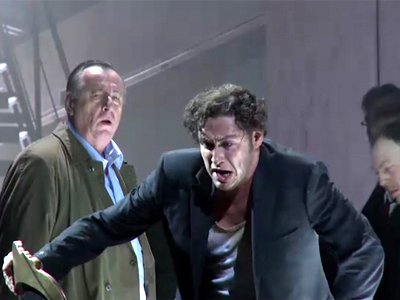
Anatoli Kotcherga and Alexander Tsymbalyuk

By ANDREW POWELL
Published: February 21, 2013

MUNICH — As dramaturgy, Calixto Bieito’s new staging here of Mussorgsky’s seven‑scene 1869 Boris Godunov (heard and seen yesterday, Feb. 20) runs into trouble almost immediately.

Set in present‑day Russia — identifiable by the up‑to‑date, thug‑police gear and the wall map in Boris’s Terem (Scene V) — it seems to want to cast Vladimir Putin as the boyar turned czar (actual reign: 1598–1605). Indeed, Putin’s face is first, front, and center among placards displayed in Scene I, as the crowd is bullied into endorsement of a leadership change.

But that would entail the Russian president dropping dead on the stage of Munich’s nice theater, an outcome for which not even Bieito — born in Old Castile, Spain — would have the cojones, to say nothing of Bavarian State Opera management’s likely concerns.

So the thing gets diluted. Putin’s face is promptly surrounded by placards for sundry other politicians, to wit: Cameron, Hollande, Monti, and Rajoy, supplemented by the peacefully removed from office Bush, Blair, Berlusconi, and Sarkozy; the current German chancellor and U.S. president apparently do not merit inclusion, though someone resembling Leon Panetta does. And Boris emerges as a fill‑in‑the‑blank oligarch, schemer and poison victim. His death (Scene VII) occurs at an oligarch get‑together attended — in a feeble try at framing the concept — by present‑day, multinational finance ministers. Boyar, you see, equals oligarch, equals business leader; finance ministers are there to cater.

Still, Bieito shoots his interpretive load along the way with slices of supposed present‑day Russian life. People are shoved, choked and skull‑crushed by the police. Boris’s young daughter Xenia is a drunk. The Innkeeper (Scene IV) ruthlessly whips her own toddler while puffing a cigarette. The robbed Holy Fool is repeatedly stabbed by a little girl, and then shot in the head by her at close range under police cover.

Pimen the chronicler undoes history by ripping pages from a file. His student Grigory (a.k.a. False Dmitry I, czar in 1605–06) stabs a policeman, breaks the necks of the Nanny and Xenia, and suffocates Boris’s son Fyodor (historically czar in 1605). Boris’s own slow death, in context, doesn’t exactly ache in its poignancy.

For visual sustenance during the unbroken 135‑minute proceedings, we survey a cumbersome dark metallic unit shifting around the stage against an equally dark, smoky background. Technical staff here are proud of their mostly quiet hydraulics.

Last night’s performance (transmitted live on Mezzo TV) riveted attention through extraordinary singing. Alexander Tsymbalyuk’s stentorian bass voice in the title role brought eager expression to all lines of the anguished ruler. Secure from bottom to top, Tsymbalyuk sang with refined legato here, pointed declamation there. Now 36, this Ukrainian artist last year concluded a nine‑year affiliation with Staatsoper Hamburg; remember the not‑so‑easy name.

Veteran of the title role, and fellow Ukrainian, Anatoli Kotcherga (65) invested Bieito’s un‑chronicler with power, eloquence and welcome stature. Another sometime Boris, Vladimir Matorin (64) from Moscow, boomed with full‑voiced, undaunted lyricism as Varlaam, effective well beyond So It Was In the City of Kazan.

St Petersburg tenor Sergei Skorokhodov introduced a clarion, unstrained Grigory. Gerhard Siegel floated attractive tones in the oily duties of Basil Shuisky (future czar Basil IV, 1606–10), presenting the character as a credible advisor more than as a scorned stereotype. Company member Okka von der Damerau lent her vivid and plush mezzo to the hard‑put‑upon, abusive Innkeeper, and 23‑year company member Kevin Conners of East Rochester, NY, bellyached musically as the Holy Fool.

Advance hopes that Kent Nagano might bring some sweep, flair or insight to Mussorgsky’s graphic score — his last premiere as Bavarian State Opera Generalmusikdirektor — soon receded. His approach was plain, without feel for the Russian phrase. If he grasped the problems of balance caused by Mussorgsky’s intermittent misjudgment of orchestral weight, in this third performance of the run, he made no audible compensation for them. As usual he paced the music fittingly and coordinated well. Wind ensemble fell below par for the Bavarian State Orchestra; the chorus sang in unclear Russian, with greater musical discipline than usual. Disenchanted by Bieito’s whopping liberties with the colorful, pageant‑endowed story, but enthralled by the singing, the crowd applauded lightly.

Still image from video © Bayerische Staatsoper

Related posts:
Petrenko’s Sharper Boris
Manon, Let’s Go
Verdi’s Lady Netrebko
Thielemann’s Rosenkavalier
Petrenko’s Rosenkavalier

Where does the Concertgebouw Stand?

Thursday, February 21st, 2013

by Sedgwick Clark

NOTE: BEGINNING THIS WEEK, I’LL BE POSTING MY BLOG ON THURSDAYS AT NOON RATHER THAN WEDNESDAYS.

Amsterdam’s Royal Concertgebouw Orchestra and its current music director, Mariss Jansons, stopped by Carnegie Hall last week (2/13 and 14) for a pair of concerts to celebrate the ensemble’s 125th anniversary. They were a great success, as always, with everyone on my aisle burbling over its glorious sound and virtuosity.

No doubt whatsoever, it is a great orchestra, and for many of my over-40 years of hearing it in concert it was my favorite European orchestra. But the dark, burnished sonority of yore, cultivated to such full-toned splendor during Bernard Haitink’s tenure (1963-1988), was eviscerated by Riccardo Chailly’s superficial musicianship (1988-2004). And the turnover of orchestral musicians that occurred internationally in the last two decades of the 20th century brought forth a new generation of players who pride clarity over rich, bass-oriented textures. The only orchestra I know that has managed to retain its early-1970s persona resides in Philadelphia, and it remains to be seen what effect its new music director, Yannick Nézet-Séguin, will have.

So what effect has Jansons had on the RCO? While one can’t deny his expertise on the podium, I don’t find much personality in his conducting—of the Austro-German repertoire anyway. He was at his best in the first concert, in his accompaniment to Leonidas Kavakos’s kaleidoscopic brilliance in Bartók’s Violin Concerto No. 2. Still, it was little more than an expert rendering of the score. Listen to soloist Zoltán Székely and the Concertgebouw in the live world premiere recording under Willem Mengelberg in 1939 for those little nudges of temperament I missed with Jansons or the 1958 Stern/Bernstein/New York Philharmonic studio recording (in its judiciously remixed Prince Charles Edition reissue) for no-holds-barred emotional drama.

Recalling Jansons’ devastating Mahler Sixth Symphony a few years ago on LSO LIVE, I looked forward to the Mahler First, which followed intermission. But despite the orchestra’s powerful, pinpoint playing, the Wayfarer themes didn’t sing, the third movement’s Parodie sections were poker-faced, and in general the slow music was impatient and tempo changes were exaggerated. A disappointment.

Little need be said about the next evening’s Strauss Death and Transfiguration and Bruckner Seventh. Over the weekend I pulled out my recordings of Strauss’s own 1926 Staatskapelle Berlin recording, the 1942 Philadelphia and 1952 NBC Toscaninis, 1960 Monteux/San Francisco, and 1983 Haitink/Concertgebouw of the former, and the 1951Furtwängler and 1974 Karajan, both with Berlin, of the latter. All were different, all sublime in their individual ways. Jansons sped up where Strauss marks Sehr breit (“Very broad”) for the transfiguration theme and sailed through the Wagner tuba threnody after the Bruckner’s second-movement climax. Inexplicable.

David Hamilton (1935-2013)

Another of my heroes is gone. David Hamilton, 78, died at home on February 19 after a long illness. He reviewed records and wrote occasional features for High Fidelity when I began building my record collection in college, and I relied on his insights into 20th-century music, especially that of Stravinsky. His initials at the end of a review meant “must read,” even if I had never heard of the composer.

David was a Princeton grad (A.B., 1956; M.F.A., music history, 1960), where he was the music and recording librarian, 1961-65. He was assistant music editor and then music editor at W.W. Norton, 1965-74, then became music critic of the Nation in 1968 and wrote for many publications during his lifetime. I had the pleasure of editing (if that’s the word, for his copy was immaculate) articles of his at Keynote and Musical America. His Metropolitan Opera Encyclopedia (1987) is one of my most frequently used reference books. For many years, he was producer of historical Met Opera broadcasts and wrote notes for the company’s program booklet.

One of the benefits of working in the classical division of Philips and Mercury Records in the early 1970s was that I got to know many writers who were formative in my musical taste. It’s easy to remember my first lunch with David: We were each going to hear Boulez conduct the Philharmonic that evening in what turned out to be one of the great Mahler Sixths I ever heard, and with a grin he pulled out the Mahler Critical Edition score from his briefcase.

We often saw each other at Boulez concerts. The conductor’s Rug Concerts were nearly always sold out, and long lines of the converted would form to get the best seats on the floor. I always arrived early and when the doors opened would storm up the escalator as the ushers shouted, “No running allowed.” (Shades of elementary school!) When David was there, I would save him room. But one night, an all-Schoenberg Rug Concert was only about half full. I remarked after a striking performance of Pierrot Lunaire that it was too bad it hadn’t sold out. “Well, look at it this way,” he replied. “Have you ever seen so many people at a Schoenberg concert?”

David succumbed to Alzheimer’s disease, one of those ironies that we who remain find so baffling in those of such extraordinary intellects. His long-time friend Sheila Porter was with him the afternoon before he died and told me that she and his nurse chose James Levine’s Met recording of Mozart’s Marriage of Figaro for him to hear.

An Enlightened Concert Experience

Thursday, February 21st, 2013

By: Edna Landau

To ask a question, please write Ask Edna.

About a month ago, I attended a panel discussion at Chamber Music America’s 35th annual conference in New York during which one of the panelists, pianist Simone Dinnerstein, spoke of her quest to make her concerts as personal, intimate and warm as possible. Reinforced by the atmosphere at a Leonard Cohen performance at the Barclays Center in Brooklyn (seating capacity of approximately 18,000), which made her feel as though she were in his living room, she has set out to experiment with special lighting to warm up the feel of her concerts. Where possible, presenters may be asked to use special gels that may complement a motif in her concert attire. Alternatively, she may ask for a lamp with a lamp shade near the piano, as well as a piece of carpeting under the piano. In some instances, Ms. Dinnerstein has prepared a mixed tape to be played in the hall from the time the doors open, that is related to the program she will perform and that is designed to help the audience put their cares behind them and to welcome them into the concert experience even before she plays a note. Such a compilation might include selections as diverse as songs sung by Joni Mitchell and the late countertenor, Alfred Deller. In a program called “Night”, based on her soon to be released album by that name with singer-songwriter Tift Merritt, the two came out and started performing on a dark stage. As the lights gradually came up, the audience was already engrossed in what they were hearing, spared the applause that traditionally accompanies the artists’ coming out on stage and that can be a rather harsh entry point into a captivating musical experience.

A darkened stage is not a unique or new phenomenon in the concert hall. CMA panelist Eric Edberg, artistic director of the Greencastle Sumer Music Festival, related how he presented Messiaen’s Quartet for the End of Time on a dark stage with only stand lights. Conductor Paul Haas, founder and visionary Artistic Director of Sympho (which was launched with a revelatory and highly acclaimed multi-media concert in 2006 called “Rewind”) will present a concert at the Church of the Ascension in New York this May with the title “Ascending Darkness”. The following description appears on Sympho’s website: “In this concert, Sympho will explore what happens to the orchestral concert experience when the lights go out, when the audience is invited to listen to the music without visual distractions, allowing the sense of hearing to be heightened. World premieres and pre-composed classics collide in varying degrees of light and darkness in the resonant space of Manhattan’s famed Church of the Ascension. Musicians are placed in unexpected configurations and locations, enveloping the audience in various musical textures. No programs to fumble with or tall concertgoers to peek around. Instead, this concert invites you to sit and focus on what you came to hear in the first place: glorious music.” Like Simone Dinnerstein, Mr. Haas is not exploring new forms of concert presentation because he thinks the music doesn’t stand convincingly on its own. Rather, he feels the concert experience for audience members can be significantly enhanced if they can immerse themselves in the music in as complete a way as possible.

A presenter who has come to many of the same conclusions is Laura Kaminsky, Artistic Director of New York’s Symphony Space. She spoke to me of the acoustical challenge of presenting chamber music and jazz in their smaller theatre, the Thalia, which was built as a screening house and has a low ceiling. The acoustics in the hall are much brighter when the screen is lowered and she thought to create visual backdrops for the music on stage by using lighting, gobos and gels to match the mood of the music being performed. Colors and images are chosen to illuminate and enhance the audience’s musical experience. During a recent contemporary music marathon, the lighting changed throughout the eight hour period, which they felt helped to give each piece its own special world and kept the audience alert and engaged.  In the annual Wall to Wall marathons which take place in the larger 800-seat theatre and which run for twelve continuous hours, she and her staff have created special tableaux that are projected to coordinate with what is happening on stage and that illustrate the changing theme of the Wall to Wall each year. They also feel strongly about setting the tone of a performance from the moment the audience enters the hall, both through lighting and music that create a suitable atmosphere and relate to the program that the audience is about to hear. Ms. Kaminsky elaborated on this to me, as follows: “When you go to a restaurant, you’re going for the culinary experience , but part of what makes it special is the lighting, the ambience, and perhaps the beautifully set table. You don’t go to simply fortify your body with calories. Similarly, a concert is a sensory, aesthetic and cultural experience which should be enjoyed to the fullest.”

While I still regularly attend concerts and feel uplifted by a stimulating program beautifully performed, without the benefit of special lighting or any other unusual sensory stimulation, I am excited at the thought that colleagues whom I hold in high regard are exploring new ways to make audience members feel more comfortable, engaged and connected to what they are hearing and seeing on stage. This can only be a positive development as we continue our efforts to introduce new, younger audiences to centuries of great musical masterpieces.

To ask a question, please write Ask Edna.

© Edna Landau 2013

A Rosina Is Born

Wednesday, February 20th, 2013

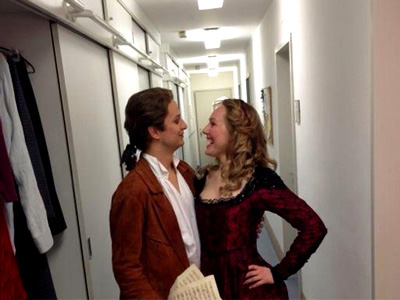
Angela Brower backstage with Nikolay Borchev at the Bavarian State Opera

By ANDREW POWELL
Published: February 20, 2013

MUNICH — Bavarian State Opera this month dusted off (sort of) Ferruccio Soleri’s drab staging of Il barbiere di Siviglia. The Italian actor’s action scheme has devolved in his absence into an unfocused free-for-all, permissive, at its saddest, of impromptu bopping and weaving to Rossini’s tunes by principal members of the cast. Mesa, AZ, mezzo-soprano Angela Brower saved the Feb. 9 performance (sort of) with articulate roulades, cheerful trills and neat messa di voce, embellishing a poised but resolute Rosina. Her star turn here as Nicklausse in 2011 (under the deft leadership of Constantinos Carydis) raced agreeably back to mind. A Glimmerglass Young Artist, Brower joined the Munich company’s Opera Studio in 2008 and the company itself in 2010. (She is pictured with Nikolay Borchev.) Fellow company member Levente Molnár, as Figaro, found chemistry with the mezzo, leading to a comedic highpoint in Dunque io son, tu non m’inganni? Elsewhere he tried too hard theatrically and, though firm of voice, slid through vital Italian consonants. Javier Camarena coped gracefully as Almaviva, a few ungainly fortissimos notwithstanding, but his interpolation of Bésame mucho paid Rossini no compliment. Tiziano Bracci made an entirely-at-home Bartolo, irked on point for A un dottor della mia sorte. More volume to his patter would have been welcome. Ildar Abdrazakov seemed looser than his usual lumbering self, the voice projecting well, but he reduced Basilio to caricature in La calunnia è un venticello and danced obtrusively while the tenor negotiated Cessa di più resistere. Lombard conductor Riccardo Frizza provided unwitty, poorly balanced accompaniment.

Photo © Bayerische Staatsoper

Related posts:
Verdi’s Lady Netrebko
Mélisande as Hotel Clerk
Festive Sides
Don Giovanni Shipped
Widmann’s Opera Babylon

You’re Not the Boss of Me!

Wednesday, February 20th, 2013

By Brian Taylor Goldstein, Esq.

Dear Law & Disorder,


Our ensemble has recently had friction with its management over weather-related travel concerns. We had concerts scheduled during both Hurricane Sandy and this most recent blizzard in the Northeast, and as both approached, discussed postponing them with our management company. In both instances, they stated that since plane, train, and public transportation travel had been halted, we would need to rent a van and drive to the engagements. They said that due to the nature of our contracts, we would have to make every effort to get there no matter what. We had serious safety concerns about doing this, due to the predicted severity of the storms. In the end, it turned out in both instances that the presenters chose to reschedule the concerts for hopefully sunnier springtime dates, so we did not need to travel after all.


I know that our contracts with presenters include an “Act of God” clause, and my question is, who is empowered to make the decision about whether invoking this clause is the right thing to do? The presenter, our management company, or us? What if all three parties do not agree? Can we refuse to travel if we feel conditions are unsafe? Also, our ensemble is a non-profit organization, with the musicians hired as independent contractors. I am concerned that should we ever go ahead and travel to an engagement during bad weather conditions against our better judgment, and should an accident occur, that the individual musicians would have grounds to sue our non-profit for essentially telling them they must go. Would our management company be held responsible at all since they would not allow us to postpone? Help!


An “Act of God” clause is purely a creature of contract. It’s the terms of the contract (not God!) that defines what constitutes an “Act of God” and who gets to make the decision as to whether or not to invoke the clause. If the contract merely says something like: “This engagement may be canceled in the event of an Act of God”, it’s fairly meaningless. While I am familiar with lots of artists, managers, and presenters who prefer short and simple contracts, the problem with “short and simple” is that, in cases such as yours, it can also mean “vague and useless.” A good Act of God clause will define what constitutes an Act of God and who can make the determination, as well as address such issues as whether or not deposits need to get returned or engagements re-booked.

In your situation, to determine whether the nature of your contract, in fact, required you to make every effort to get there “no matter what,” I’d need to review your specific contract. However, I can’t image an engagement contract that actually required you to risk personal safely to get to the engagement—especially if planes, trains, and public transportation had all been halted. Even if you had, indeed, signed such a contract, there are always alternatives to risking personal safety merely to comply with a contract—including a legal defense called “impossibility of performance.”

Regardless of what a contract says or doesn’t say, the ultimate decision to cancel or postpone an engagement, whatever the reason, is always yours. Whether you’re canceling or postponing because you feel you cannot travel safely or canceling because you want to pursue a more enticing offer, those decisions are yours to make, not your manager’s.

Similar to Act of God clauses, manager/artist relationships are also defined and determined by contracts. However, unlike Act of God clauses, most state laws impose two legal obligations on all agents and managers which can never be waived or altered by contracts: (1) All managers owe a fiduciary duty to their artists (ie: they must put the artist’s interest above their own) and (2) All managers must follow the instructions and directives of their artists. (There are other obligations, too, but these are the most important.)

Like an attorney, a manager is there to provide advice, counsel, and direction, but not to give orders or commands. Unless a manager is also a producer, the manager works for the artist, not the other way around. Final decisions are always yours to make. Of course, the consequences—including being sued by presenter for breach of contract—are solely yours to bear, as well.

Granted, the manager/artist relationship should always be one of mutual respect, otherwise it doesn’t work for either of you. If a manager feels you are not taking their advice and counsel, and, as a result, you are adversely affecting your career, then the manager may rightly choose to no longer work with you. Likewise, if there comes a point when you believe your manager is putting his or her interest above your own, its time to move on.

As for your liability question, let’s save that for another post. For now, suffice it to say, under our less-than-intuitive legal system, anyone can sue anyone else for just about anything—especially if an artist is injured because you required them to drive in poor weather conditions. Get insurance! Stay tuned.

_________________________________________________________________

For additional information and resources on this and other legal and business issues for the performing arts, visit ggartslaw.com
To ask your own question, write to lawanddisorder@musicalamerica.org.

All questions on any topic related to legal and business issues will be welcome. However, please post only general questions or hypotheticals. GG Arts Law reserves the right to alter, edit or, amend questions to focus on specific issues or to avoid names, circumstances, or any information that could be used to identify or embarrass a specific individual or organization. All questions will be posted anonymously.

__________________________________________________________________

THE OFFICIAL DISCLAIMER:

THIS IS NOT LEGAL ADVICE!

The purpose of this blog is to provide general advice and guidance, not legal advice. Please consult with an attorney familiar with your specific circumstances, facts, challenges, medications, psychiatric disorders, past-lives, karmic debt, and anything else that may impact your situation before drawing any conclusions, deciding upon a course of action, sending a nasty email, filing a lawsuit, or doing anything rash!

THE REGENERATION GAP

Tuesday, February 19th, 2013

By James Conlon

A few months ago I wrote about two extraordinary projects in Rome that introduce children, from five to eighteen years of age, to opera. Performances of The Magic Flute and Don Giovanni were presented to thousands of young people by two completely separate entities:  the Rome Opera and the Tito Gobbi Foundation. The method I witnessed seemed to me an ideal model for introducing opera through participatory–“interactive” if you like–performances.

In the course of a recent series of concerts in Berlin and tour in Spain with the Deutsches Symphonie Orchester Berlin, I conducted an introductory program for children (ages six to twelve) of Dvořák’s New World Symphony, excellently presented by moderator Christian Schruff. It consisted, naturally, of musical excerpts, and the participation of special guest, Jocelyn B. Smith, a New York born jazz singer who has lived in Berlin for many years, who coached the audience in singing “Swing Low, Sweet Chariot,” while explaining its coded meaning. The cost was four euros for children and ten for the adults who accompanied them.

Not long ago I participated in a similar program in Leipzig with the Gewandhaus Orchester: Alexander Zemlinsky’s Die Seejungfrau (The Mermaid) interlaced with Hans Christian Andersen and the composer’s life as a young man in love with Alma Schindler (later Mahler).

We do all this in the United States, and, in many places, we do it well. But what struck me about the success of these European ventures was the depth of commitment on the part of all the participants; musicians, moderator and parents.

Concerts take place on weekends, so families can attend together. Whereas events organized through schools are often excellent, I believe that arts attendance with older members of the family adds a valuable additional context to the experience.  My septuagenarian friend from Berlin brought his granddaughter with him for her eighth birthday. Two musician friends, who had travelled from Cologne, were joined by their twenty-five year-old (!) daughter who studies in Berlin. On the way out, they told me, they had overheard a little boy, who they had guessed to be about five or six, turn to his mother and say (roughly translated): “That was not at all as terrible as I expected!”

This is a tiny example of how things can be turned around in rebuilding a future audience and in maintaining a great tradition. This is one more young person for whom the beautiful world of classical music has possibly been opened, despite the negative preconceptions that surround him and many others.  The point is that Germans have recognized that the process of whetting an appetite for classical music must begin early and may be best accomplished with family participation. Their systematic and broad commitment to reaching children is exemplary and merits our attention.

And what happens when those children are in their twenties and actually want to go to concerts but can’t afford to? Two striking examples I have encountered in as many months have suggested to me that we can also do better on that count.

At La Scala in Milan, I conducted ten performances of Berlioz’ Roméo et Juliette (turned into an opera/ballet), the first of which was part of a series called “Preview.”  The theater was sold out (sold out!), exclusively to an audience under thirty years old. Top age, thirty years; top price, thirty euros.  La Scala has tacitly recognized and addressed the financial challenge to our young people. It is no use only educating the young and then abandoning them when they cannot (yet) afford to buy tickets. The “Preview” model at La Scala is helping them (and us) foster a love for classical music (in this case, opera). These previews are not rarities, but a regular part of La Scala’s season. The low ticket prices are obviously highly successful in drawing an audience. In the U.S. we face the same challenges, but there is no consensus as to how to resolve them.

Once a year at LA Opera we offer two performances in Los Angeles’ Cathedral of Our Lady of the Angels. Six thousand free tickets are requested each year within hours of the announcement of their availability over the Internet.  This would seem to indicate that “ordinary” people do want to come, and will come, when they can afford to so. It is interesting to note that, though one hears so much talk about how classical music needs a way to “get the message out,” thousands of people do respond within hours when financial obstacles are removed.  This suggests that the message is out—that classical music and opera are things people believe they will enjoy, and when they can afford it, they will come to performances.

The tradition of attending Classical music concerts will have difficulty prevailing, given the many factors mitigating against it, if we don’t abandon, at least temporarily, economic models that may have satisfactorily functioned for the last half century but cannot be expected to do so any longer.

In November I returned to Madrid to conduct the Orquesta Nacional de España. Three subscription concerts were relatively well attended, given the severe economic difficulties at the moment. Given those difficulties, I was struck by the large and very enthusiastic presence of young people in the audience. The Spanish have clearly been effective in developing a young audience that, despite today’s challenges, has integrated concert-going into their lives.

It can be done, and there is hope for all of us in the future.

Blomstedt Blessings

Sunday, February 17th, 2013

Herbert Blomstedt photographed by Lengemann

By ANDREW POWELL
Published: February 17, 2013

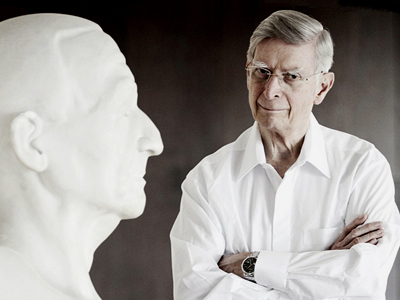
MUNICH — There is a genteel inscrutability about Herbert Blomstedt. Authoritative, tall and silver-haired, he has never cut the profile of a star. But the gaze is probing. Musicians play well for him perhaps out of a sense of being acutely monitored. Two years ago Bayerischer Rundfunk hired the Massachusetts-born, Juilliard-educated Swede, now 85, for a Dvořák Seventh with its flagship Symphonie-Orchester. That was a revelation: the minor-key work played as an engrossing set of assertions and retorts, Victorian shadings and Czech emphases. Much cheered, it soon showed up as a pirate CD. These last two weeks Blomstedt has been back with the BRSO, conducting music associated with him. The Feb. 7 Gasteig program paired Nielsen’s Flute Concerto (1926) with Bruckner’s D-Minor Third Symphony.

Henrik Wiese, one of the orchestra’s two principal flutists, nimbly traced the solo line of the stubbornly jaunty two-movement concerto. Its brief sections of banter with other wind instruments injected droll humor. Blomstedt and the modest orchestra, in unobtrusive support, flexed their way through the Danish composer’s background shades of light and dark. The concluding tempo di marcia section, written last and calibrated to sum up the 18-minute piece, made its witty impact without seeming to try.

By using the symphony’s Urfassung of 1873, Blomstedt cast the work in optimal light, as a snapshot of a composer in transition. (Christian Thielemann and his Munich Philharmonic did the same in 2009; Lorin Maazel in concerts since then has not.) For Bruckner was just settling on what would become his trademark compositional palette and his way of leading the ear with brass motifs. The piece suffers from odd logic and thematic paucity, especially when compared with the less “Brucknerian” yet fully mature and richly argued C-Minor Second Symphony of the previous year (1872). Numerous revisions to the Third never overcame these problems.

The opening trumpet melody over rippling string figures signaled a balanced, restrained performance. Conducting from memory and without visible toil, Blomstedt had apparently set fine dynamic and interpretive details in rehearsal. Wind intonation was exemplary. The Gemäßigt, misterioso first movement, as marked in this version, and the brief Scherzo brought suave playing from the BRSO strings. Blomstedt did not always nudge the pulse in the second-movement Adagio as might his peers in this repertory — fellow octogenarians Stanislaw Skrowaczewski (still busy at 89) and Bernard Haitink (83), along with Thielemann (53) and the versatile Daniel Barenboim (70) — and so Bruckner’s longueurs took their toll, but the conductor’s discipline and his rapport with the musicians compensated. Call it an honest snapshot.

Photo © Martin Lengemann

Related posts:
Blomstedt’s Lucid Bruckner
MPhil Asserts Bruckner Legacy
Bruckner’s First, Twice
Nitrates In the Canapés
Blacher Channels Maupassant