Dear Friends of Muncie,
If all goes well, the editorial section of Musical America Directory will close today, and I’ll be able to turn to yet another episode of “Why I Left Muncie.” Keep the faith!
SAC
Dear Friends of Muncie,
If all goes well, the editorial section of Musical America Directory will close today, and I’ll be able to turn to yet another episode of “Why I Left Muncie.” Keep the faith!
SAC
By Robyn Guilliams
Dear Law & Order: Performing Arts Division –
Many nonprofit arts organizations have board members or other affiliated parties who offer their services free of charge or at a reduced rate to support the organization. Is it possible for the nonprofit organization to give a tax letter for the value of the donated services? If so, under what circumstances and how should it be handled to comply with tax rules? Examples would be a photographer who gives her services at a reduced rate or an advertising agency that offers graphic design services free of charge.
Thanks for a great question – one which causes a good deal of confusion in our industry. The value of services donated to a nonprofit organization is NOT deductible.
However, one who donates such services may be able to deduct certain amounts that she pays for expenses incurred while donating services to the charity. To be deductible, those amounts must be:
Here are a few examples of what types of expenses are – and are not – deductible:
Note that to claim any of these expense deductions, the services provided must be to a registered 501(c)(3) organization. Also, while a written statement from the organization isn’t necessary for these expenses, it is a good idea to keep written records (and receipts, if they exist) for these expenses, and any other tax deductions you intend to take!
________________________________________________________________
For additional information and resources on this and other legal and business issues for the performing arts, visit ggartslaw.com
To ask your own question, write to lawanddisorder@musicalamerica.org.
All questions on any topic related to legal and business issues will be welcome. However, please post only general questions or hypotheticals. GG Arts Law reserves the right to alter, edit or, amend questions to focus on specific issues or to avoid names, circumstances, or any information that could be used to identify or embarrass a specific individual or organization. All questions will be posted anonymously.
__________________________________________________________________
THE OFFICIAL DISCLAIMER:
THIS IS NOT LEGAL ADVICE!
The purpose of this blog is to provide general advice and guidance, not legal advice. Please consult with an attorney familiar with your specific circumstances, facts, challenges, medications, psychiatric disorders, past-lives, karmic debt, and anything else that may impact your situation before drawing any conclusions, deciding upon a course of action, sending a nasty email, filing a lawsuit, or doing anything rash!
By Rachel Straus
Hofesh Schechter is a slippery soul. In Political Mother, seen October 11 as part of Brooklyn Academy of Music Next Wave Festival, the Israeli-born choreographer cloaks his earnestness in irony. The 80-minute, 2010 work is structured through a series of blackouts in which 12 dancers and seven musicians evoke the demagoguery in politics, and entertainment.
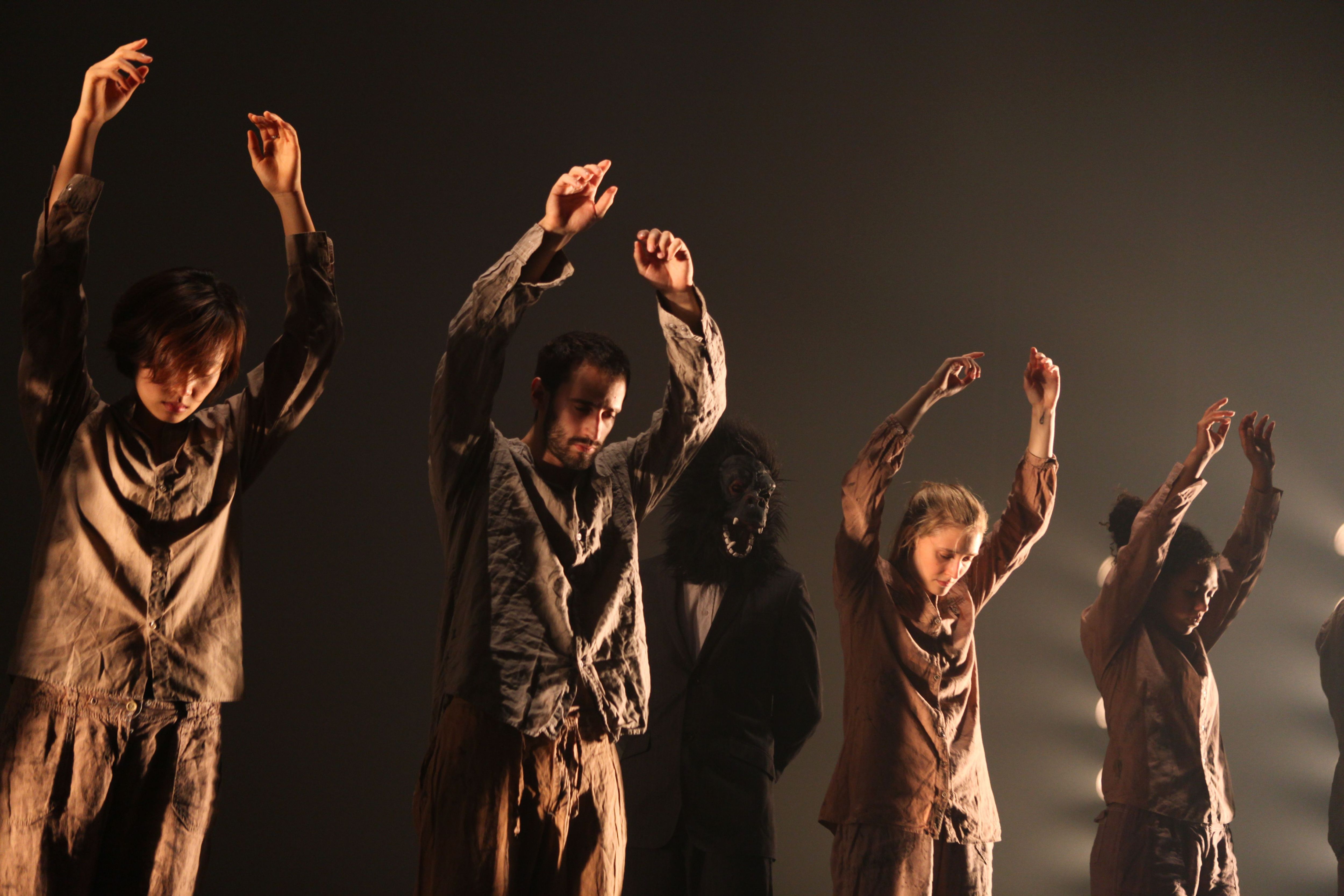
Photo by Juileta Cervantes
The work pivots on three visions: the rock concert, with the rapper raging into his microphone above supplicants of fans. The military-style drummers, who appear in portals like a set of Kodak negatives, and who drive the dancers into waves of hyperkinetic motion. The tribe, who perform Hasidic-like folk dances, but with an intensity that beckons questions about their sanity. Dressed like prisoners, with arms raised in their air as though they are shackled from above, they not so subtly evoke those who lived in concentration camps.
Despite these visions, what stays in the mind about Politcal Mother are the slick production values and the deafening sound of Schechter’s pounding music.
Repetition is used to drive home Schechter’s theme: whether you are in Nazi Germany, present-day Williamsburg, Brooklyn or watching a James Bond movie (Daniel Craig was in the audience), it’s all the same. Humans behave like drones, they suffer like beasts, and one man will always rise to the top in attempts to control others.
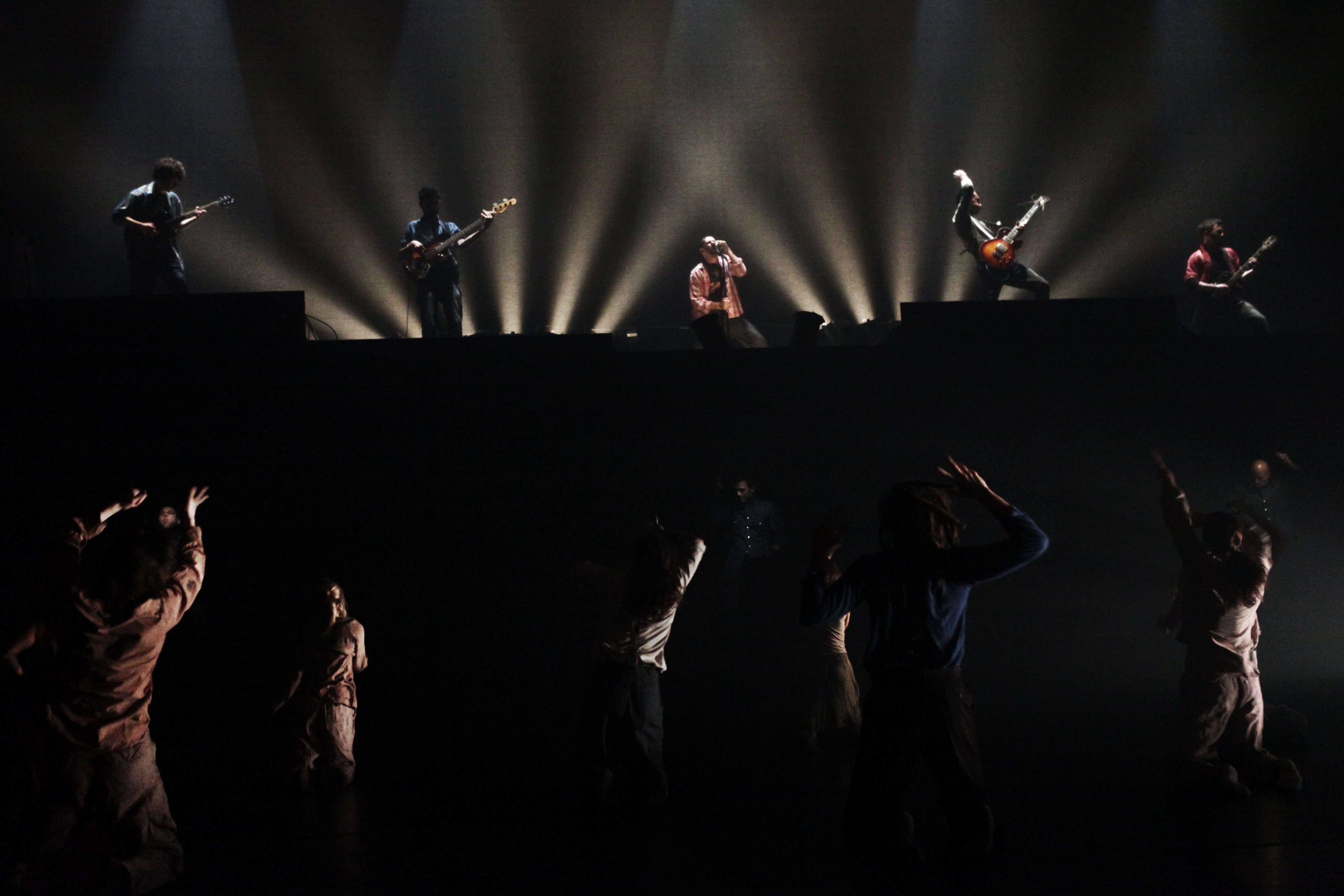
Photo by Julieta Cervantes
So where is Mother in all this antic behavior? She is folk dance. In electric-yellow lights, at the dance’s end, we read the following words, “Where there is pressure, there is folk dance.” For Schechter, folk dance appears to be the universal form of protest against oppression. It’s where Schechter’s creativity and carefully cloaked earnestness lies.
In folk dance, Schechter rejects the current state of high art, opera house dance, the codified vocabulary of ballet, which historically in Western Europe was the sanctified form of dance expression. With folk dance, Schechter taps into populism. He can skirt between visions of the rock concert, the neo-nationalist volk of Leni Riefenstahl’s films (that helped consolidate Hitler’s power), and the zealousness of far-right religious fundamentalists. What’s notable is that these adopted visions are cynical ones. But, nonetheless, with folk vocabulary—the stamping rhythms, the democracy of the circle dance, and the erasure of gender (in Schechter’s use of it)—beats the heart of this Israeli’s artistry. Like a true postmodernist, Schechter isn’t able to openly love the folk dance he loves. He’s a choreographer in a cat’s cradle.
Throughout the work, I wondered how Political Mother could possibly end. With the cast going mad, the appearance of a masked gorilla, and two murder attempts by pistol, how could Schechter up the ante? The answer: Cinema technique. Schechter hits the rewind button. In less than five minutes, he gives us snapshots of the dance from end to beginning. Consequently the work opens, and concludes, with a Samurai-like warrior committing hari-kari with a sword that pierces his belly from front to back. Too bad this beginning didn’t get more laughs. Watching one male dancer with dreadlocks grunting and groaning from his self-inflicted wound was not a catharsis. It was a cartoon. Few got it. American audiences are indeed earnest.
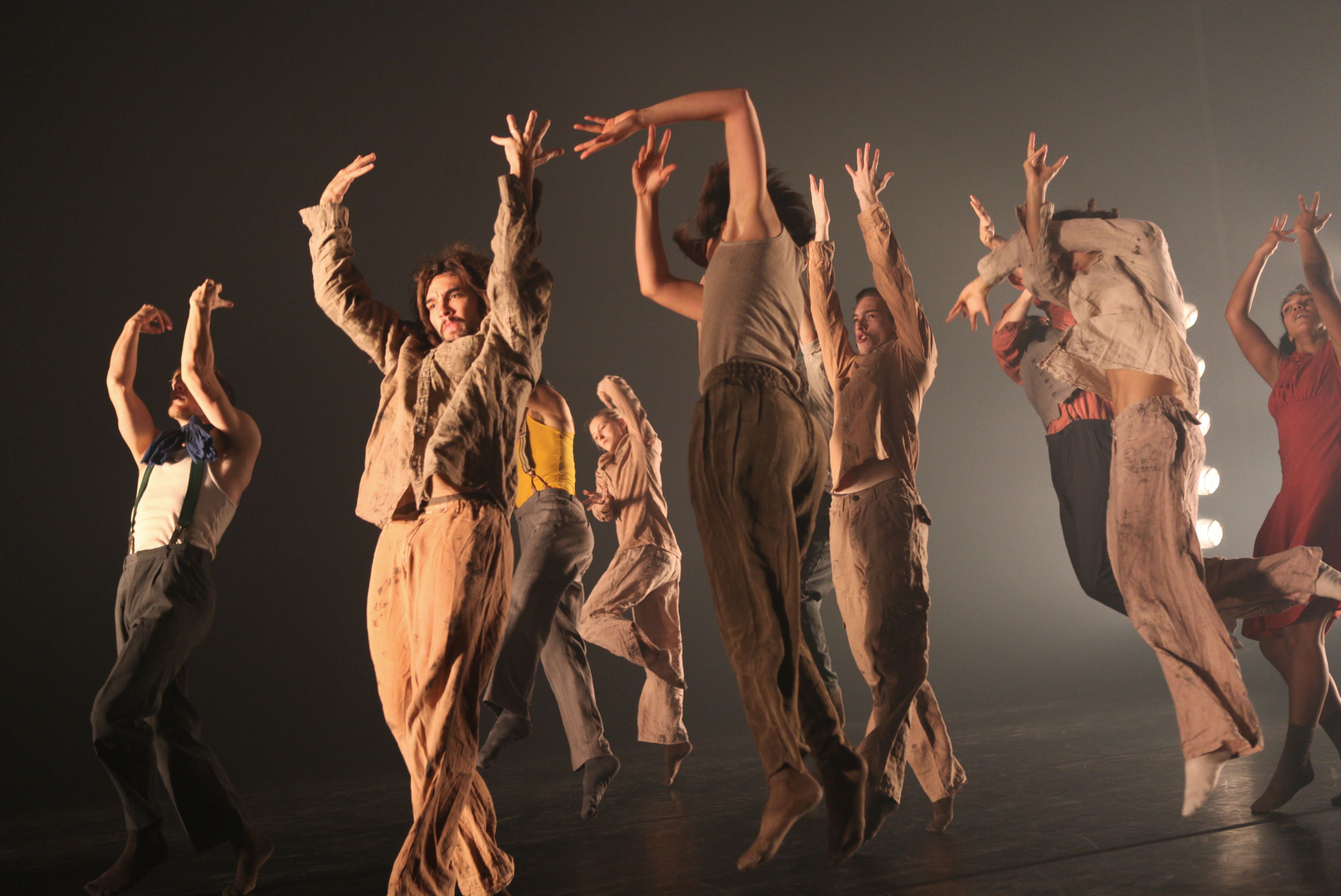
Photo by Julieta Cervantes
Nonetheless, neo-folk dance is the wellspring from which many great choreographers (from Leonide Massine to Pina Bausch to Alexi Ratmansky) return for material. It’s a way of bringing concert dance back to the people, back to a human body that isn’t always upright and gloriously assured. In Political Mother, Schechter is on to something. Too bad he isn’t willing to tender his dancing credo with less ironic hyperbole.
In one notable section Schechter interpolates the music of Verdi—and—he leaves the stage empty. Solemnity, he seems to be saying, doesn’t include dance movement. Solemnity is reserved for sound, and in that respect Schechter may end up devoting more of his time to musical composition than to choreography.
By Rachel Straus
The Slovak National Theatre Ballet in Bratislava is not a destination point for international balletomanes, but it should be if one wants to see August Bournonville’s La Sylphide up close and personal. In the city’s neo-Renaissance theatre, the 92-year old ballet troupe performs regularly. Being there on October 6 felt like visiting the interior of a Faberge egg.
When La Sylphide‘s supernatural and realistic aspects collide, when the mime sections are as affecting as the dancing, the ballet ceases to be a historical document: i.e. the longest continuously performed Romantic ballet. It becomes a dark morality tale. In it a Scottish bloke abandons his bride at the altar for a hyper-feminine creature. He wishes to possess her; he ends up killing her. Too often the production gets mired in ballerina doll sweetness, but not in this case.
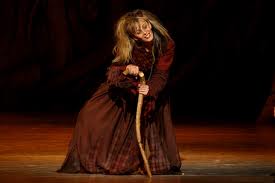
Kvetoslava Štefeková. Photo by Ctibor Bachratý
In Bratislava, the real star of the ballet was not the title character, danced by beautiful Viola Marina. It was Kvetoslava Štefeková, who performed Madge the witch. Unlike the Royal Danish Ballet’s production seen last year in New York, this version gives greater attention to the crucial role of Madge, who sets nearly every turn of the story in motion. (For a plot refresher, click here.)
Štefeková’s Madge is no arthritic hag. She’s an athletic feminist who dislikes wishy-washy men. Before she grabs the poison scarf and gives it to James (Oliver Jehelka) to give to the Sylphide, she twirls across the stage like a tornado. In the ballet’s final moments, she grabs Jehelka by his hair and violently lifts his head so that he witnesses the Sylphide’s funeral cortege. This Madge abhors James’s choice: to leave his bride Effie (Veronika Hollá) for an unearthly woman. This Madge ensures that Effie is not left alone. She literally pushes Gurn (Andrej Kremz) into proposing to the humiliated girl. The fact that Effie accepts Gurn without fuss underscores the condition of early 19thcentury women—and the no-nonsense approach of the Slovak National Ballet Theatre to accurately depict women’s lack of historical power.
While Hollá (Effie) plays the good girl and Mariner performs a Marilyn Monroe-like Sylphide, Štefeková’s Madge comes across as a modern female personality. She projects joy and rage, curiosity and condemnation. As the curtain lowers on a crumpled James (Jehelka), Stefekova raises her fists above her head. Here is a woman in bitter triumph, something rarely seen in the denouement of Romantic ballets or, for that matter, in contemporary works where the classical technique is featured.
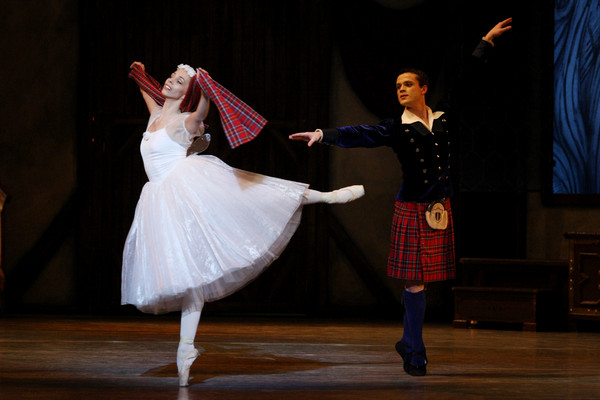
The other notable aspect of this La Sylphide, staged by former Bournonville principal dancer Niehls Kehlet, was it’s mis-en-scène—and I don’t mean the set design. I mean the dancers’ relationship to the smallness of the stage. Compared to North American stages, this one is tiny. In this environment, every detail of the dancers’ performance is brought into relief. When Mariner (the Sylphide) bats her eyes at Jahelka (James) for the first time, I could actually see her eyelids and the gently lilt of her fingers underneath her opalescent face. What was made clear was that this woman is as beautiful as she is practiced at tendering her feminine wiles.
Viola Mariner. Photo by Ctibor Bachratý
The Austrian-born Mariner possesses Taglioni-like arms and the neck of Anna Pavlova. Her arabesque is the best part of her dancing. As she effortlessly lifts one leg behind her, she simultaneously balances and grows beyond the shape. The effect is that of flying. And that’s the point: Sylphs can fly. But apart from Mariner’s soaring arabesque and lovely arms, she dances without enriching H.S. von Lövenskjold’s plaintive music as competently conducted by Martin Leginus. Her body doesn’t sing it as much as keep time with the tempi.
As for the Slovak National Theatre Ballet’s female corps, they were a model of synchronization—a vision of sisterly sylphdom.
By Rebecca Schmid
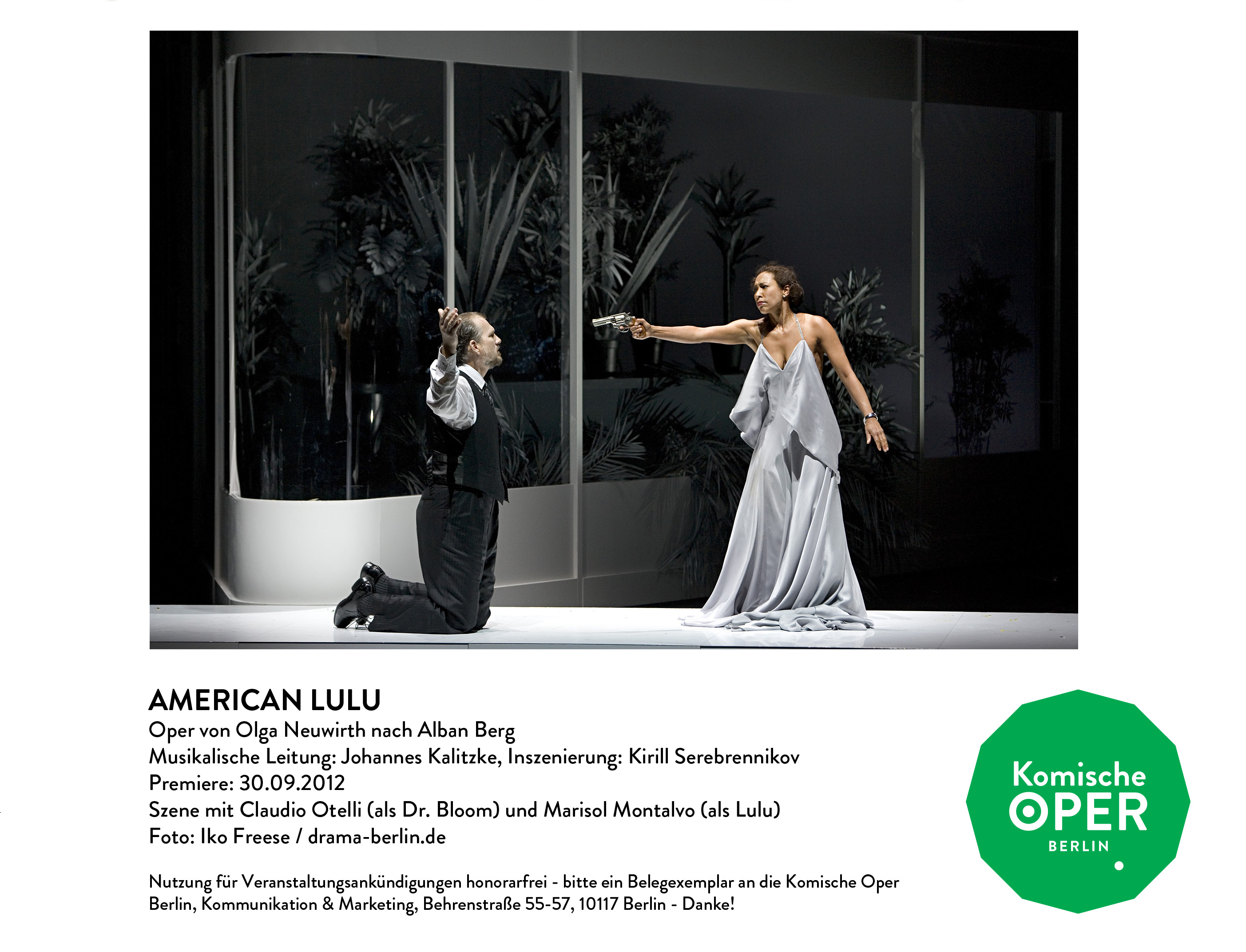
The socially aware agenda of the Komische Oper’s new Intendant Barrie Kosky has been ruffling the feathers of Berliners months before he officially took over this season, not least with the decision to end the house tradition of performing operas exclusively in the German language. His emphasis on cultural pluralism aside, the program so far should assuage any fears that the native Australian will create a rupture with the opera’s hallowed emphasis on reinventing opera for contemporary audiences. Following a 12-hour Monteverdi trilogy as rescored by Elena Kats-Chernin and staged by Kosky, the intendant has unveiled the world premiere of Olga Neuwirth’s American Lulu, a shortened, updated version of Berg’s incompleted last opera.
It is either ironic or a sign of historic progress that Berlin, where Nazi politics once thwarted a full staging of the work, has mounted the second new Lulu in less than a year. The Staatsoper presented the work with a recomposed third act by David Robert Coleman last spring when a new production by Andrea Breth made it legally impossible to use the standard reconstruction by Friedrich Cerha. Almost foreshadowing Neuwirth, Coleman drew upon the jazz band of the First Act for his orchestration, thinning out textures to a chamber ensemble including marimba, steel drums cowbells, and banjo.
American Lulu (seen Oct.6) takes the thematicization of jazz a step further, setting out to reference Afro-American culture in everything from a steam blown organ ballad to a trumpet which emerges as a symbol for the blues singer, Eleanor (a curly haired, less feudal characterisation of Countess Geschwitz). Neuwirth resets passages of Berg’s original music to the first two acts for brass, woodwinds, a small set of strings, and percussion as well as electronic guitar and piano, in some places adding contours to Berg’s expressionist lines with the deeper timbres and expanding the sonic space with recorded sound. By contrast, her entirely original third act emerges as an unsure blend of quasi-minimalist textures, jazz-band brass, spectralist fades and raw, avant-garde string textures.
The English-language libretto is redevised in a similarly awkward fashion. The story begins and ends in an upscale New York apartment, traveling through New Orleans, where Lulu is living with the painter—here a photographer. Dr. Schön is instead Dr. Bloom, who kills Lulu’s lover by throwing ice at him. She flees with Bloom’s son, Jimmy (a stand-in for Alwa), becoming a high-class whore to a white banker and rebuffing the advances of Eleanor without remorse until she is killed by a stranger. Neuwirth also inserts an unidentifiable, pimp-like character named Clarence, who upbraids Lulu for being so “damn insatiable.” Recitations about black rights and other poetic musings emerge perplexingly through the speakers between acts.
The racially conscious goals of the production mostly came across as clichéd, but it had to its credit Marisol Montalvo in the role of Lulu, able to nail her high notes and move seamlessly into Sprechgesang as she cavorted in everything from lingerie to Brazilian tassels. Despite the high dose of eroticism, her dramatic portrayal did little to convey the danger of a femme fatale, which can also be attributed to the limited scope of her character in Neuwirth’s libretto and stilted direction by Kirill Serebrennikov. In the role of Eleanor, Della Miles performed with saucy poise, coaxing the orchestra of the Komische Oper into her R&B inflected grooves. The male roles were well-cast but not outstanding. Jacques-Greg Belobo gave a smooth-voiced delivery of Clarence, and Austrian baritone Claudio Otelli was an imposing Dr. Bloom. The bass Philipp Meierhöfer was in fine form as the Athlete, and Rolf Romei made for an earnest Jimmy, including when he cracked into the higher range.
German conductor Johannes Kalitzke balanced the score’s wide-ranging demands with a steady hand. Sets and costumes by Serebrennikov provided a stark backdrop for Neuwirth’s modern fantasy but ended tastelessly with a bloodied picture of a murdered Lulu. Conventional black-and-white video projections by Gonduras Jitomirksky similarly did little for a production whose progressive aspirations fail to match up with its artistic standards. Perhaps Lulu was never meant to be a vehicle for racial mobility after all.
by Sedgwick Clark
At night after watching Jon Stewart and Colbert and checking out TCM’s midnight film, I’m often up proofreading or writing captions during deadline. I was up until 5 a.m. yesterday morning finishing details for the last article of the 2013 Directory to go to the designer. Last night I had looked forward to a good night’s sleep for the first time in months, and the light was out by 2.
My wife can sleep through any alarm on the market. The other day I noticed a cream-colored conical protuberance about three-quarters of a foot high on her bedside table, and she explained brightly that it was her new alarm clock. It gradually lights up the room like the sun rising and birds begin to chirp – definitely something new in a second-floor rear apartment in Manhattan. If that doesn’t do the trick, it also has a radio. “What’s WQXR?” she asked. “96.3,” I answered, knowing full well that it has a new frequency since the Times sold the station a few months ago; I just can’t remember it.
This morning I experienced her alarm for the first time. Sometime after 8:30 I became aware that the bedroom had become flooded with light and birds were chirping as if a tiger had entered the room. It was about the same time that the workers arrived to continue pointing the building and their drilling and pounding began. (I’m not making this up.)
As I stumbled out of bed, I asked if at least the bird noises could be slowed down and reduced in volume. “No,” mumbled the woman who won’t watch my DVD of Hitchcock’s The Birds because it scares her, and she fell back asleep.
Stoki in Philly at 100
My fellow ARSC member Don Drewecki reminded me of a momentous occasion in the history of American orchestras: “It was 100 years ago today that Leopold Stokowski conducted his first concert with the Philadelphia Orchestra. And on that day, a new era in American Orchestral Supremacy was ushered in.”
Howard H. Scott, Noted Record Producer
It’s no exaggeration to say that Howard Scott produced some of the most important recordings in history. Glenn Gould’s 1955 Bach Goldberg Variations, the Fleisher/Szell Beethoven piano concerto cycle — which belong in any serious collection — come immediately to mind, but my own personal favorite was a Stokowski pairing made during his return to the Philadelphia in 1959, nearly 20 years after he had last conducted the orchestra: Falla’s El amor brujo and the conductor’s “symphonic synthesis” of music from Wagner’s Tristan und Isolde, surely two of the most erotically charged performances ever commited to records — and in stereo too, which allowed the full panoply of Stokowski’s extraordinary music-making with this amazing orchestra to be captured in modern sonics for the first time.
I had the pleasure of many lunches with Howard as he regaled me with stories of Szell, Fleisher, Stoki, Gould, Stern, and many of the great Columbia artists he recorded. We have Howard’s ballsiness to thank for the complete Beethoven cycle. They were scheduled to record just the Fourth and Fifth but finished the sessions so quickly that Howard decided on his own to suggest to the artists that they record one of the others (I forget which one) in the time left. Now that three were “in the can,” and with such superb results, Columbia decided to finish the cycle. It’s still the set that I’ll take to my desert island.
Howard died on September 22 at age 92.

By ANDREW POWELL
Published: October 11, 2012
MUNICH — Arts groups here present a restrained 2012–13 season facing pros and cons not always aligned with those in America. Funding, for instance, holds steady: city and state (Bavaria) play their part, as do local corporations Siemens, BMW, Audi, Allianz and Linde. Excellent pools of musicians, instrumental and vocal, fill the rosters of the choir, chamber orchestra, two opera companies, and five symphony orchestras discussed below. Audiences are large and regular; not incidentally, tickets for most events are affordably priced and come with free access to the train and bus network, covering residents in a 25-mile radius. The cons are few, but they matter. Creative torpor impedes the main orchestras, a reflection in part of more than one sadly filled music directorship. The Regietheater problem rages in Germany, defiling the worthiest efforts in opera. Atrocious acoustics plague Munich’s main concert hall, and one vintage venue is shut for now for a retrofit. All that said, the groups enter the new season with active agendas.
The 201-year-old Bavarian State Orchestra ventures six programs at its home, the National Theater. Mostly led by outgoing Generalmusikdirektor Kent Nagano, these Akademie concerts extend a tradition begun when the ensemble was new; their past features names like Strauss, Walter, Knappertsbusch, Krauss, Fricsay, Sawallisch and Kleiber. Under-rehearsal can hamper results, however, a consequence of the musicians’ hectic theater schedule; that the GMD does not always supply the last ounce of insight or much rhythmic thrust only accentuates the negative. Despite and still, one upcoming program has allure (April 8 and 9): the eloquent young Czech conductor Tomáš Hanus tackles Mahler’s kaleidoscopic Seventh Symphony.
Clarinetist Jörg Widmann’s seven-scene opera Babylon is a fall commission of Bavarian State Opera, Germany’s largest and busiest opera company. Nagano conducts as part of his last season, and Carlus Padrissa, who last year introduced a circus-tent Turandot, has been entrusted with the stage action (premiere Oct. 27). Several of the season’s productions will be streamed at no charge, starting with the Widmann on Nov. 3. Hanus follows his persuasive (and filmed) Rusalka of two years ago with a revival of Jenůfa (from March 6) as well as a Richard Jones production of Hänsel und Gretel (March 24). Constantinos Carydis, among the company’s other worthy conductors — and indeed winner of its first Carlos Kleiber Prize — is absent from the 2012–13 slate, effecting a sabbatical.
The smaller but versatile Staatstheater am Gärtnerplatz company enters a second season as refugee while its genial home undergoes construction work. Not all the substitute venues are ideal, but at the Cuvilliés Theater a Don Pasquale (premiere Oct. 25) should bring smiles: Franz Hawlata sings the title role, retired mezzo-soprano Brigitte Fassbaender (pictured with Intendant Josef Köpplinger and conductor Marco Comin) serves as régisseuse. This company labors under a mixed mandate, complementing Bavarian State Opera with Baroque and rare operas but also catering to a broad audience with operettas and musicals, at times amplified. Its orchestra copes gamely with the assortment, its singers less well.
Alexander Liebreich’s ongoing leadership of the MKO, a.k.a. Münchener Kammerorchester, has been yielding tidy ensemble and a crisp image for the group. Subscription concerts at MKO’s base, the Bayreuth-Festspielhaus-like Prinz-Regenten-Theater, habitually pair old and brand new, as on Oct. 18: Salvatore Sciarrino’s L’ideale lucente e le pagine rubate (2012) and Beethoven’s music for Egmont. Or Dec. 13: Ligeti’s Violin Concerto (old) and a Helena Winkelman piece jointly commissioned with Musica femina München.
Guest conductors, in contrast, are what enliven the Bavarian Radio Symphony Orchestra. Ranked highly for its expertise, and drilled weekly for clean-as-a-whistle broadcasts, the BRSO perseveres under monochrome directorship. Antonini, Rattle, Haitink, Muti, Harding, Gilbert, Robertson, Salonen, Chailly and Metzmacher are names implying color in upcoming programs. The season splits as usual between the modest shoebox Herkulessaal, part of Munich’s Residenz arts complex, and the city-operated, fan-cum-vineyard Gasteig hall, where only the intra-ensemble sound travels properly.
The adventurous Münchner Rundfunk-Orchester, a second BR (Bavarian Broadcasting) ensemble, devotes much of 2012–13 to oddball concert opera — Franz Lachner’s Catharina Cornaro? — when its exploratory funds would go further in orchestral music and better balance the BRSO. Welcome projects include a German-language take (May 3) on Hindemith’s FDR oratorio When Lilacs Last In the Dooryard Bloom’d, which may find its way to disc alongside this orchestra’s award-winning 2005 recording of Des Simplicius Simplicissimus Jugend by Hartmann (who wove the Whitman elegy into his own First Symphony). Playing standards have been high under Künstlerischer Leiter Ulf Schirmer. He stepped into the shoes of the late Marcello Viotti in 2006 and has more recently also assumed musical and managerial duties at Oper Leipzig.
Still under broadcasting auspices, the BR Chor supports both of the above orchestras. Alert, flexible singing places this group among Germany’s best large choirs, with perhaps only Leipzig’s MDR Chor ahead in precision. Certainly it draws the better Munich choristers, those disinclined to strip down to their underwear and strike mindless poses, as repeatedly required of their colleagues in local opera companies. Dutchman Peter Dijkstra is the affable artistic leader. BR Chor concerts this season, in the group’s own series, include Mozart’s C-Minor Mass (Nov. 24) and a well-cast Matthäus-Passion (Feb. 16), at the Prinz-Regenten-Theater and Herkulessaal respectively.
The Munich Philharmonic seemed to want to dive off a cliff three years ago when its management publicly bickered with its greatly-in-demand Generalmusikdirektor Christian Thielemann, effectively losing him, and just eight months later chose Lorin Maazel as his successor. (One tabloid reported Thielemann’s salary to be €800,000.) Those twin decisions are now home to roost, as the 82-year-old American unfurls his inaugural season. Maazel’s work ethic can only be admired, but he appeared artistically drained in interregnum Gasteig programs ten months ago — in music in which he long ago excelled, such as Debussy’s La Mer. This orchestra will gain the most if Munich ever does build a proper concert hall, as recently championed by Bavarian Minister for Science, Research and Art, Wolfgang Heubisch. As a city-run ensemble, it is today confined almost entirely to the problematic Gasteig.
Less glamorous, though certainly busy, the Münchner Symphoniker offers concert series at the acoustically preferable Prinz-Regenten-Theater and Herkulessaal. Georg Schmöhe is Chefdirigent and pianist Philippe Entremont serves as Ehrendirigent. In 2011 this orchestra undertook a long U.S. tour devoted to movie music. This season at home it offers an all-Beethoven program (Jan. 27 and 28) and a mostly Haydn evening (March 20) as part of a generally conservative lineup.
Photo © Christian Zach
Related posts:
Pintscher Conducts New Music
Mastersingers’ Depression
Gärtnerplatztheater Reopens
Gergiev, Munich’s Mistake
BR Chor’s St Matthew Passion
By: Laura Hartmann
I am delighted to have as guest blogger this week the widely respected and admired founder of LVanHart Artist Productions, Laura Hartmann. This is the first Ask Edna post that addresses jazz, and it couldn’t be in better hands. — EL
This summer, while having lunch together, my friend and colleague Edna Landau and I entered into a discussion about the differences between management practices in the classical and jazz worlds. Afterwards, she asked if I would write a piece on this topic for “Ask Edna.” What an honor! So, here you go:
In thinking about how to approach this subject, I remembered a panel that I put together for Arts Presenters in the late ‘90’s called “Demystifying the Business of Jazz.” In the audience that day were artists who wanted to know how to approach the whole concept of finding help with their careers. They were stumped as to how to navigate among the different people who are involved in a jazz artists’ life. It can be daunting, but the key to demystifying the process is to understand what roles we each play.
In the classical world, companies like Alliance Artists, CAMI, IMG, or Barrett/Vantage Artists are ‘one-stop shopping.’ They provide management services as well as booking services, and they even have publicity and travel or operations departments. Artists may not need to hire anyone else to help them with their careers and get them work. However, in the jazz world, a given artist may have a manager, a booking agent, a publicist, or any number of people who may work out of separate offices. The size of the team, of course, depends on the level of the artist. So, let’s examine the different roles and define each one.
The manager is the person who is responsible for guiding the artist’s career (the captain of the ship, as I like to think of it). They would include Karen Kennedy at 24/7 Artist Management, Gail Boyd Artist Management, Louise Holland of Vision Arts Management, and myself, LVanHart Artist Productions. The manager may also advance concerts and tours (including planning flights, booking hotels, ground transportation, hiring sidemen, budgeting, making sure the artist’s technical needs are met by each venue), assist with business, help in developing promotional materials, and guide the artist in finding a booking agent, a publicist, an accountant, or a record label. For providing these services, a manager would typically ask for a commission of 10-20%, depending on what the artist requires. Some managers are also asking for a small monthly fee to cover administrative duties that do not generate income, yet are necessary to care for the artist.
The booking agent books engagements for the artist, without necessarily providing guidance for career advancement. (In many states a booking agency must have a license because it is viewed as an employment agency.) Examples of jazz agents would be Myles Weinstein at Unlimited Myles, Ted Kurland & Associates, IMN, Michael Kline Artists, and Ed Keane & Associates. A booking agent generally charges 10-15%.
A publicist’s job is to generate and manage publicity for their artist, gaining attention in the press for their concerts, recordings, and any noteworthy developments, such as prizes and special projects. Some of the publicists in jazz are Seth Cohen PR, Don Lucoff at DL Media, Jim Eigo at Jazz Promo Services, and Michael Bloom Media Relations. Publicists are usually hired on a project basis, for example to promote a CD release or a specific tour. The fee is likely to be based on the duration of the campaign or the number of cities in a given tour. The publicist might also be hired on a monthly basis to help the manager paint the ‘big picture,’ beyond a single event. Fees for publicists vary widely and really depend upon what the artist wants him/her to do. Monthly fees can range from $400 to over $3000.
As you search for someone to help you with your career, it is very important that you understand the difference between the artist manager and the booking agent. The classic mistake an artist makes is to go to a manager and think that they will book them a whole bunch of gigs. Booking concerts is NOT their primary function. If you have all of your business together, have a clear idea of how you want to grow your career and how to make it happen, you would just want to seek out a booking agent. There are artists that do that very successfully. Bill Charlap is one. He is booked by Ted Kurland’s office, but doesn’t have a manager. He has done an impressive job of furthering his career and he really knows how to take care of business!
But if you are like most artists, you want help with your career. You want help in making it grow, or you want to have someone to take care of business so you have more time to practice or write music. A manager is really what you are seeking. When my client Steve Wilson came to me almost 16 years ago, he was working in the bands of Dave Holland, Chick Corea and many others. Yet Steve was anxious to lead his own ensembles. That was a priority for him in taking his career to the next level. Over the years I have helped him bring his quartet to Europe and have made introductions that led to dates in larger and more prestigious venues. We have also worked together to develop his creative ideas. A project with string quartet, featuring music from Charlie Parker’s ‘Bird with Strings’, began as a residency in colleges and has expanded into a program including a chamber orchestra and newly commissioned works, at venues such as The Kennedy Center and the Detroit Jazz Festival.
Now, as with all things, there are gray areas. Myles Weinstein is a booking agent for some artists who have managers, and others who don’t. He finds that with the clients who don’t have management, he does have to step in from time to time to help with travel and advancing their dates, or even give general guidance. His primary focus, however, is on booking concerts, not guiding his clients’ careers. Karen Kennedy is a manager, all of whose clients are currently with booking agencies; but if she signs an artist who doesn’t have an agent — an up-and-coming artist perhaps — she will book gigs to get them going. Clearly, nothing is black and white, but if you keep the above guidelines in mind as you search for partners in your career, you will maximize your chances for finding the right team.
To ask a question, please write Ask Edna.
By Brian Taylor Goldstein
I just got a notice that a venue where I booked one of my artists is closing. I have a written engagement contract that was signed by the venue over a year ago. The notice I received says that they have run out of money and are cancelling their season. Can they do that? Do I have a valid claim? Should I file a lawsuit? Can I alert the media? How do I send a message to other venues not to do this?
Assuming you have a valid, enforceable contract with no cancellation clause or other termination provision, then the venue had no legal right to cancel regardless of their financial situation and the venue is in breach of the engagement contract. The question is whether or not your claim is worth pursuing…or, assuming that you were acting as an agent on behalf of your artists, whether or not your artists have a claim worth pursuing.
The first course of action would be to send the venue a letter notifying it that it is in breach and will be liable for damages if you are unable to re-book the date. Then, you must make every effort to re-book the date and minimize (aka “mitigate”) damages. As a matter of contract law, your artists are not automatically entitled to the full engagement fee. Rather, if you were to re-book the date for a smaller engagement fee, your artists would be entitled to the difference. If you were to re-book the date and obtain a higher fee, your artists would not be entitled to any damages at all. Even if you are unable to re-book the date, you must be able to show that you made every effort to do so and made every effort to minimize any other losses or out-of-pocket expenses. (ie: Can you cancel or get a refund for any travel expenses? Are they any production or crew costs you can avoid if the engagement is cancelled?)
To enforce your claim, you would need to file a lawsuit. Depending upon the terms of your contract, you may be able to file the suit where you are located or where the venue is located. However, any judgment outside of the state where the venue is located would be unenforceable unless you took the judgment into a court in the venue’s state and had it recognized by that state. Regardless, getting a judgment does not mean that you will get any money. It just means you are legally entitled to money. With the judgment in hand, you would still need to “collect.” Collection would involve more court proceedings in order to levy bank accounts and attach assets. All of this would need to be done in the state where the assets are located. Also, unless your contract provides for court costs and attorneys fees, those would not be recoverable. Ultimately, whether or not you want to file a lawsuit depends on the amount of your damages and whether the time and costs of pursing the claim outweigh the likelihood of collection. Unless the venue actually owned its own performance space or has other assets to draw from, it can be near impossible to see any actual money. If the venue has no assets or files for bankruptcy, then you would get nothing…or next to nothing.
Your more immediate and practical course of action, aside from making every effort to re-book the date and mitigate damages, may be to notify the venue of your claim and then wait. The statue of limitations for a written contract varies from state-to-state, but, in most instances, you will have from 3 to 6 years to file a lawsuit. If the venue is able to re-organize and re-open before the statute-of-limitations runs out, you could revisit the matter and, if they refuse to pay or otherwise agree to a reasonable settlement, still file your lawsuit. On the other hand, if the non-profit ultimately closes, and it turns out that there are assets to distribute, they will need to seek a court approval of the distribution. You can file a creditor claim and stand in line with their other creditors at that time.
This is may also be a good opportunity to review your engagement contract. As you can see, a lot of your options in these situations depend on the enforcement tools you give yourself in your contract. Do you require non-refundable or forfeitable deposits? Are there specific liability provisions? Interest? Attorneys fees?
As for alerting the media, I realize the venue’s actions appear outrageous, unprofessional, and unethical. Nonetheless, without knowing more about the specific circumstances of this particular venue and what has led to their decision to cancel, “going public” could easily backfire on you as well as your artists. Resist the urge to go on a crusade. They are rarely successful and everyone dies. As for sending a warning to other venues, I seriously doubt most non-profits need to be reminded that contractual breaches, lawsuits, and dissolution of assets are not effective strategic plans.
__________________________________________________________________
For additional information and resources on this and other legal and business issues for the performing arts, visit ggartslaw.com
To ask your own question, write to lawanddisorder@musicalamerica.org.
All questions on any topic related to legal and business issues will be welcome. However, please post only general questions or hypotheticals. GG Arts Law reserves the right to alter, edit or, amend questions to focus on specific issues or to avoid names, circumstances, or any information that could be used to identify or embarrass a specific individual or organization. All questions will be posted anonymously.
__________________________________________________________________
THE OFFICIAL DISCLAIMER:
THIS IS NOT LEGAL ADVICE!
The purpose of this blog is to provide general advice and guidance, not legal advice. Please consult with an attorney familiar with your specific circumstances, facts, challenges, medications, psychiatric disorders, past-lives, karmic debt, and anything else that may impact your situation before drawing any conclusions, deciding upon a course of action, sending a nasty email, filing a lawsuit, or doing anything rash!
Fall for Dance Festival: Recapping Program 1, 2 and 5
Wednesday, October 17th, 2012By Rachel Straus
The seventh annual Fall For Dance Festival came to a meaty close on October 13. Program five at New York’s City Center trafficked in high testosterone, thanks to China’s LPD-Laboratory Dance Project’s No Comment (2002) and Yaron Lifschitz’s Circa (2009), which is also the name of the Australian acrobatic troupe. In both works the body was treated like a battering ram.
Circa by Justin Nicholas Atmosphere Photography
In Circa, the performers used not only their fellow artists’ thighs and shoulders, but also their faces, as launching pads for balancing in midair and jettisoning across the space like Evel Knievel. In No Comment, the men continually fell to the floor, as though blown down by an invisible hammer. As a finale, they stripped to their waists to reveal their glistening muscular torsos. Like fight club winners, they took their bows. But their message—sex objects who pulverize themselves are cool—confounded me.
Visions of aggression and angst trumped visions of cooperation and kindliness in the three FFD programs of 12 dances from 12 international and national-based companies seen on September 28 and 30, and October 13. Perhaps the programming, spearheaded by artistic advisor Stanford Makishi, not only represented his personal preferences, but also reflected the times. The majority of the works were made in the past four years, and only two dated before 2002. This decade hasn’t been an easy ride; the dances reflects that.
The festival’s first program ended with Martha Graham’s Chronicle, which was made in response to rising European fascism before World War II. The first section of Graham’s 1936 work surprisingly echoed the last work in the festival: Deseo Y Conciencia (2011). In Deseo, flamenco choreographer-performer Maria Pagés donned a red costume that transformed into a shroud. Likewise, the gargantuan red underskirt worn by Blakeley White-Mcguire in Chronicle possessed the same import. Both women became symbols of mourning, evoking through their blood-red cloaks a fraught world.
Maria Pages. Photo by David Ruano
Blakeley White-McGuire. Photo by Michele Ballantini
The two most ambitious works, of the 12 viewed, were Pam Tamowitz’s Fortune (2011) and Christopher Wheeldon’s Five Movements, Three Repeats (2012). Both tendered subtlety, nuance and mystery. (Full disclosure: Fortune was choreographed on the Juilliard School dancers and I work at Juilliard.) In Fortune, Tamowitz set 21 dancers, costumed in hot pink and red unitards, against a field of greenish yellow. Here was a happy Mark Rothko painting. Though Tamowitz’s movement vocabulary is clearly inspired by Merce Cunningham’s, she doesn’t ignore the music as was Cunningham’s way. Tamowitz’s sharply sculptural patterning, full of pregnant pauses, reflected Charles Wuorinen’s stop and go Fortune (performed by a quartet Juilliard School musicians). In response to Wuorinen’s abrupt shifts in sounds, which instantly dissolve as though they never happened, Tamowitz evokes mini narratives, some absurd, others resonant of a city life, where pedestrians walk with laser-eye certainty.
Juilliard Dancers in "Fortune." Photo by Rosalie O'Connor
Also of note was Christopher Wheeldon’s Five Movements, Three Repeats, which was made for Fangi-Yi Sheu & Artists. Sheu, a former Graham dancer born and trained in Taiwan, is now based in New York. She is one of the great performers of our time. Her guests were none other than Wheeldon’s former colleagues at New York City Ballet: Tyler Angle, Craig Hall and Wendy Whelan. To a recording of Max Richter’sMEMORYHOUSE and Otis Clyde’s The Bitter Earth/On the Nature of Daylight, Wheeldon didn’t treat Sheu as some modern dance oddity among the City Ballet dancers.
At the beginning of every other section of Five Movements, Three Repeats, Sheu undulated her spine like a fern seeking light. Her pliable torso work was best picked up in Hall’s simultanesously-occurring solo that spiraled into the floor. Later on, Sheu and Hall folded their limbs into each other. Their duet featured a melding of their bodies, and organically blended central aspects of their different technical training (Sheu’s focuses on weight, Hall’s on ethereality).
Ms. Sheu and Mr. Hall. Photo by Erin Baiano
Though Sheu’s legwork is akin to the arrow-like esthetic favored by ballet choreographers, Wheeldon didn’t devolve to his usual histrionics: over-choreographing women’s leg extensions in the pas de deux. Consequently, Sheu did not become a human gumby. Instead, she partnered Hall’s weight as much as Hall partnered her’s. Wheeldon’s venture into making work for a modern-trained dancer is heartily welcome. The task seems to stretch him instead of over-stretching his female collaborators.
Tags:Blakeley White-Mcguire, Charles Wuorinen, Christopher Wheeldon, Chronicle, Circa, Craig Hall, Deseo Y Conciencia, Evel Knievel, Fall for Dance Festival, Fang Yi-Sheu, Five Movements Three Repeats, Fortune, LPD-Laboratory Dance Project, Maria Pages, Martha Graham, Max Richter, Memoryhouse, Merce Cunningham, No Comment, Otis Clyde, Pam Tamowitz, Stanford Makishi, The Bitter Earth/On the Nature of Daylight, The Juilliard School, Tyler Angle, Wendy Whelan, Yaron Lifschitz
Posted in The Torn Tutu | Comments Closed