Archive for 2012

Dudamel’s Mahler 8th for All Time

Thursday, October 4th, 2012

by Sedgwick Clark

Gustavo Dudamel’s recording of Mahler’s Eighth Symphony will restore your faith in life. Quite simply, it is the most thrilling newly recorded release I’ve heard in decades.

This Mahler Eighth must be seen to be believed. With a mind-boggling choral phalanx of 1,200 on risers, the combined orchestras of the Los Angeles Philharmonic and Simón Bolívar Symphony Orchestra of Venezuela, eight soloists, and lord knows how many more choristers tucked into the nooks and crannies of Caracas’s Teatro Teresa Carreño, the work handily earns a new nickname as the “Symphony of Over 1,400.” Deutsche Grammophon has released it on Blu-ray, conventional DVD, and CD, but forget about the latter format unless you want to listen in the car or on a walk in Maiernigg.

I sat transfixed last Saturday night watching a Blu-ray on a 60-inch Panasonic plasma TV with a Bose sound system in a large room, wishing I had had the presence of mind to catch its HD theater engagement earlier this year. But even a home viewing was overwhelming, with every last chorister clearly etched and instrumental timbre true. The camera work, attributed to Michael Beyer (video director), was remarkably musical: none of that frenzied American brand of a new angle every second, which made last week’s New York Philharmonic Live from Lincoln Center broadcast unwatchable.

The Eighth was the climax of Dudamel’s complete (numbered) Mahler symphony cycle shared between the two orchestras in L.A. and Caracas last January and February, except that in the Eighth the orchestras performed together. He was leading the Eighth for the first time. It’s a great performance—as masterly as his LAPhil Mahler First video is callow. Perhaps most astonishing, even allowing for the magic of digital editing from two performances, the playing and choral singing are amazingly clear and precise.

If it doesn’t sweep the Grammys in every eligible category, I’ll eat all the Mahler recordings in my collection.

Looking Forward

My week’s scheduled concerts:

10/5 Carnegie Hall. Chicago Symphony Orchestra/Riccardo Muti. Dvořák: Symphony No. 5. Martucci: Notturno. Respighi: Feste romane.

5/10 at 7:30. Avery Fisher Hall. New York Philharmonic/Alan Gilbert; Robert Langevin, flute; Nikolaj Znaider, violin. Nielsen: Flute Concerto; Violin Concerto. Tchaikovsky: Symphony No. 2 (“Little Russian”).

Who Should Write Program Notes?

Thursday, October 4th, 2012

By: Edna Landau

To ask a question, please write Ask Edna.

Congratulations to Mollie Alred of Sciolino Artist Management who won a $25 gift card for submitting the following question

Dear Edna:

As a manager of classical musicians, I have the opportunity to work with many different presenters. No matter the type of presenter, size of the hall, the budget or the number of staff members, one question frequently pops up: Who is writing the program notes? Some organizations hire a professional writer, others handle the task on site, and still others have generous (and well informed, very skilled) volunteers. Yet, there are others who expectantly ask me for this material. This has led to the very last thing I want to have: an uncomfortable exchange with a presenter. As a concert goer, I love program notes and read them carefully. I think they go a long way in engaging our audiences. I also see the presenter’s point of view that the notes should be included as part of the “whole package”. Nevertheless, as an artist manager, writing program notes on Beethoven string quartets falls outside of the duties I can realistically handle. Please help me solve this. What is the industry norm? — Mollie Alred, Associate, Sciolino Artist Management

Dear Mollie:

Thanks for sending in your excellent question. I understand that this was a hot topic at a recent Major University Presenters meeting so it is clearly on many people’s minds. As I usually do in a situation like this, I surveyed a number of manager and presenter colleagues from various parts of the country. What emerged is that there is no industry norm but that most presenters view it as their responsibility to produce program notes. They usually hire someone to do this or resort to one of the solutions you mentioned in your question. The one exception mentioned by everyone I spoke to is new music. It is common for composers to write notes for their works and I would go so far as to say that it is even expected. There are some instances where artists who write well like to submit their own notes. This lends a special personal touch to the program and is gratefully received by the presenter, especially when the works on the program are rather unusual. In the case of vocal recitals, presenters will not necessarily expect to receive program notes but they will expect to receive song texts and translations from foreign languages into English. Most managements keep a data base of such texts and will also refer to the REC Music Foundation’s website, www.recmusic.org.

You might be interested to know that some managements put in their contracts that they don’t provide program notes. I haven’t seen the exact language but I’m sure there is a way to state this which acknowledges that you wish it could be otherwise. In cases where this doesn’t go down well, it should be possible to explain over the phone that it is becoming harder and harder to provide top level service in every aspect of artist booking and servicing in these difficult economic times and that you must concentrate on the essentials. You might also want to add that it is not in your management’s budget to commission program notes for presenters and that you are keenly aware that it is illegal to reproduce and provide notes that have been written and copyrighted by others. One manager told me that since she knows where each artist is playing each program, she sometimes puts one presenter in touch with another to see if they might be able to share the cost of commissioning the notes. Another knew of situations where exceptional students received credit for writing program notes. Bert Harclerode, Executive Director of Chamber Music Sedona, told me that they are fortunate to have Northern Arizona University nearby, where often the Chair of the School of Music has provided informative and witty notes. There may be other presenters who haven’t thought of these possible solutions and who would be grateful to learn of them from you.

I hope that the above suggestions and feedback from both presenters and managers will reduce, or even eliminate, the possibility of you having any further uncomfortable exchanges on this subject in the future.

To ask a question, please write Ask Edna.

© Edna Landau 2012


A Sure Grammy Bet

Wednesday, October 3rd, 2012

Tune in tomorrow to read about the recording destined to sweep the classical Grammys!

Can A Visitor Record An Album?

Wednesday, October 3rd, 2012

By Brian Taylor Goldstein

So glad I found your page on the internet, so far it’s been the most helpful out of all my Google searches! I have just a couple of questions. We are from Australia and I have a 14 year old son who has signed a recording contract in the US. Currently we are traveling back and forward on the Visa Waiver Program. I understand he is not aloud to perform until he has an “O” visa. However, is he aloud to record music in his producer’s studio for the album and take label meetings in the hope of placing a major recording contract? When I say meeting, its meeting with music labels for an interview/audition and you normally have to sing a song so that they can hear you and see if they like you in their office.

First of all, congratulations on the recording contract. Those are NOT easy to come by these days.

The visa waiver program allows citizens of certain countries (with Australia being among them) to enter the U.S. for up to 90 days as a “visitor” without first having to obtain an actual B1/B2 (visitor) visa from a U.S. Consulate. Citizens of visa waiver countries only need to have a valid passport to enter the U.S. as a visitor. When an individual enters on the visa waiver program, he or she is subject to all of the same rules and restrictions as if they had an actual visitor visa.

A “visitor” to the U.S. is allowed to do all of the normal visitor activities (sightseeing, shopping, visiting friends, etc.) as well as have business meetings. Visitors cannot work or look for work. Artists who enter as visitors are allowed to attend competitions and auditions (which, as we all know, is a heck of an amount of hard work!), as well as have meetings with producers, agents, and other arts professionals. However, with limited exceptions, they are not permitted to perform in front of an audience–even if they perform for free and/or no tickets are sold! An artist must have an appropriate artist visa (either an O or a P) in order to perform. When it comes to recordings, there’s a limited exception: A recording artist is permitted to come to the U.S. as a visitor to use recording facilities in the U.S., for recording purposes only, provided the recording will be distributed and sold only outside the U.S., and no public performances will be given. Otherwise, when recording artists enter the U.S. to record albums, they are required to obtain an appropriate artist visa.

In your situation, it is perfectly fine for you son to enter the U.S. on the visa waiver program to meet with his agents, producers, and representatives of his label. He can even have interviews and auditions. However, he cannot record music in his producer’s studio for purposes of a publicly released and distributed album unless it’s for an album that will be sold and released outside of the U.S.

You’re fortunate in that Musical America just released a fantastic downloadable report on the complex issue of obtaining U.S. visas for artists, full of helpful tips and explanations. You’ll also want to check out artistsfromabroad.org which has become the definitive resource tool on the issue and which contains an exhaustive array of information and materials.

_______________________________________________________________

For additional information and resources on this and other legal and business issues for the performing arts, visit ggartslaw.com

To ask your own question, write to lawanddisorder@musicalamerica.org.

All questions on any topic related to legal and business issues will be welcome. However, please post only general questions or hypotheticals. GG Arts Law reserves the right to alter, edit or, amend questions to focus on specific issues or to avoid names, circumstances, or any information that could be used to identify or embarrass a specific individual or organization. All questions will be posted anonymously.

__________________________________________________________________

THE OFFICIAL DISCLAIMER:

THIS IS NOT LEGAL ADVICE!

The purpose of this blog is to provide general advice and guidance, not legal advice. Please consult with an attorney familiar with your specific circumstances, facts, challenges, medications, psychiatric disorders, past-lives, karmic debt, and anything else that may impact your situation before drawing any conclusions, deciding upon a course of action, sending a nasty email, filing a lawsuit, or doing anything rash!

The Elixir fails to work its Magic at Lincoln Center; Efterklang with the Wordless Music Orchestra

Sunday, September 30th, 2012

By Rebecca Schmid
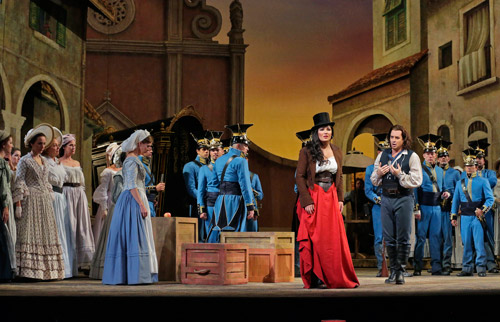
Many American opera-goers, including New Yorkers, look across the ocean and wish that their home institutions would afford themselves the same liberties of programming. Back in Berlin, the Deutsche Oper kicked off its season with a Lachenmann opera, Das Mädchen mit den Schwefelhölzern, while the Komische Oper launched a Monteverdi trilogy including themed culinary experiences during intermission, devised by the new Intendant Barrie Kosky. Anyone steeped in bel canto might be secretly happy to spend his or her time otherwise, melody being as foreign to Lachenmann as plot is to the tradition of Regietheater. But the opening production of the Metropolitan Opera this season, L’Elisir d’Amore (seen September 27), sadly reaffirms the stereotype that even this country’s leading companies are often content to rehash well-known repertory in not so inspired packages.

The director Bartlett Sher, who recently presided over Nico Muhly’s Dark Sisters at English National Opera, attempts to go against the grain by positing Donizetti’s opera as an allegory for the Risorgimento. Sergeant Belcore and his soldiers represent the Austrians, while the peasant Nemorino and the beautiful landowner Adina must hold to their Italian territory. This is at least what the program notes tell us, all the more convincing given that the love potion which Nemorino falsely believes has allowed him to win over the heart of Adina is nothing more than a bottle of red wine. Yet the production concept fails to materialize with depth and stalls an inherently humorous, light hearted opera.

The star of the production is of course not Sher but Anna Netrebko, the Met’s official poster child who opened last season in another Donizetti opera, Anna Bolena. Her reappearance this year in a top hat failed to distract from the fact that bel canto operas are not an ideal vehicle for her vocal skills. The Russian soprano’s timbre has only become rounder and richer in recent years, and her personality naturally lends itself to the role of the flirty Adina, yet her Italian diction is largely incomprehensible and her mastery of coloratura still subpar. It was refreshing to see the American tenor Matthew Polenzani in the spotlight as Nemorino, albeit in a more earnest than buffo portrayal. He briefly stopped the show in a soulful account his romanza “Una furtiva lagrima,” demonstrating fine use of messa di voce.

Mariusz Kwiecien possesses a tough, gallant baritone that suited Sher’s vision of Belcore, yet it was Ambrogio Maestri who brought the heaviest of dose of authenticity—and humor—in the role of Doctor Dulcamara, distributor of the love potion. One of the most memorable moments in the opera occurs in his barcarolle with Adina at the start of the second act, in which Dulcamara portrays a rich senator. The contrast of Maestri’s old school inflections with Netrebko’s hammed up acting was especially prominent here, although they both appeared to be having a good time onstage. Rounding out the cast in the role of the peasant girl Gianetta was the lyric soprano Anne-Carolyn Bird, whose nasal timbre and studied acting did little to enhance what was largely an under inspired evening.

The orchestra of the Metropolitan Opera performed with natural verve and flexible phrasing under Maurizio Benini, although the Italian conductor was a bit too eager to keep the energy high with fleet tempi. The Met’s chorus did not deviate from its high standards as the peasants surrounding Adina and Belcore’s platoon. Naturalist sets by Michael Yeargan aimed for a larger-than-life, rustic charm that gained aesthetic appeal in the pastel buildings of the village square scene in the first act, while the painted haystacks lining Adina’s farmhouse in the second act indicated a bland attempt to reinvent this familiar opera in bold, accessible strokes. Costumes by Catherine Zuber, ranging from frilly peasant dresses to Austrian soldiers’ uniforms, were well-crafted but not particularly memorable. Top hats for Adina and Dulcamara added perplexing, out of place flash. While there is no doubt that Lincoln Center remains a center of world-class opera, even with the remains of New York City Opera roaming the streets, it may not be enough to ride on big names and crowd pleasers if the Met is to live up to its name as an unrivalled bastion of quality.

Wordless Music

A visit to New York would of course not be complete without a venture into the thriving homegrown culture of indie classical. The Wordless Music Orchestra, founded in 2006 by Ronen Givony, has won attention for bringing together musicians who specialize in contemporary repertoire with rock artists such as Johnny Greenwood of Radiohead and the Japanese band MONO. On September 22, the Met Museum presented the orchestra in arrangements of songs by the Danish trio Efterklang, whose new album Piramida was released three days later. The concert boasted a strong representation of what a friend was quick to identify as hipsters, i.e. younger listeners who would most likely not venture outside their borough for a formal event at Lincoln Center. Orchestration by Karsten Fundal and Missy Mazzoli added ethereal textures to the cool vocals and ambient electronica of Efterklang, described by NPR as lying “somewhere between the cooing gloom of Bon Iver…and the soaring grandiosity of Coldplay.” A trio of female vocalists, led by Katinka Fogh Vindelev, added another layer of atmospherics, while lead singer Casper Clausen brought a friendly, casual presence to the stage.

The atmosphere took a decidedly more pop-rock direction when Clausen asked the audience to stand up for the last two numbers. Among the encores was a reprisal of “The Ghost,” a rhythmically catchy number to which Mazzoli added inventive, rubbery textures in the strings. Fundal had arranged the bulk of the songs, with a range of success. Tremoli in the slow medley “Sedna” met powerfully with vocal wailing and live electronica, while the scurrying violins were drowned out by the drums and electronica toward the end of “Between the Walls.” Despite such moments, Efterklang’s meditative, rock-inflected vibes were only enhanced in the collaboration with classical musicians. The flutes in “Told to be fine,” also entrusted to Fundal, added a heavenly sheen. The result may lack the mental rigor classical listeners associate with everyone from Bach to Lachenmann, but if blending popular and classical idioms can be such good listening, why spend one’s time otherwise?

Plonk

Sunday, September 30th, 2012

By James Jorden

Of hundreds of juicy anecdotes in Ken Mandelbaum’s indispensable volume Not Since Carrie: 40 Years of Broadway Flops, one stands out perhaps a little more than the others. It’s about a show called Reuben Reuben which closed out of town in 1955. This was a through-composed absurdist piece by Mark Blitzstein, and Mandelbaum reports that on the opening night of the show over 300 audience members walked out of the Shubert Theater in Boston. (more…)

Tips for Successful Grant Writing

Thursday, September 27th, 2012

By: Edna Landau

To ask a question, please write Ask Edna.

One of the questions I was asked this past summer when I did a live Ask Edna session at the Imani Winds Chamber Music Festival was about tips for successful grant writing.  Unfortunately, the allotted time that day didn’t suffice for me to address that topic but I felt I should dedicate a column to it as the question frequently comes up. The points itemized below have been gathered from various Internet websites and from a workshop that was presented to my class at the Colburn School a few years ago by Melissa Snoza and Adam Marks of Fifth House Ensemble. They have always been DIY types and they have developed considerable skill in this area over the years. Here are some general pointers that should apply to any type of grant application:

  1. Leave yourself a lot of time from when you request an application until it is due. If you do your job thoroughly and take the time to learn from others with experience in this area, you will maximize your chances for success. Seek out people who have written successful grant proposals. They might be happy to show you some samples. There are many sources of information on the Internet regarding successful grant writing. Chief among them is the Foundation Center. Just google “grant writing” and you will discover many hours’ worth of constructive reading.
  2. Read all instructions very carefully. A grant proposal can be rejected simply because the writer didn’t precisely adhere to them or because it was incomplete.
  3. Your proposal should be neat and easy to read. Be sure to submit the exact number of copies the funder requests. If you are allowed to submit supporting materials, try to ascertain which items would be most helpful, rather than assume that you should include every nice letter that was ever written about you.
  4. Make sure your project falls within the funding guidelines of the granting organization and matches their priorities. Also, take the time to check that you qualify for a grant even if you don’t have 501(c)3 status. You might be eligible if you have fiscal sponsorship but some funders won’t give grants through fiscal sponsors.
  5. It is essential to comply with all deadlines stipulated by the funder. Keep a “tickler file” or online timeline of when all materials are due or when you need to complete certain tasks, and update it regularly as you make progress with your proposal.
  6. Inquire about the maximum possible amount of the grant you are seeking and be sure not to submit a proposal for more. It is important to ensure that your budget corresponds realistically to what you hope to achieve. Don’t underestimate your expenses in hopes that a more modest grant request will have a greater chance for success.
  7. Make sure your need and purpose in applying for a grant is well thought out, concise and crystal clear. In this regard, I liked the following sentence which I found on the lone-eagles.com website:“You should know exactly what you’re planning to do with their money and express it in elegant simplicity.” Be very specific as to what you will be delivering if you receive the grant and make sure that the outcomes are objective and measurable.
  8. At any point along the way, you should feel comfortable calling the funder to ask any questions you may have. In fact, you might want to call even before you start the application process to make sure that your project falls within their guidelines. You might want to ask how applications are reviewed and how decisions are made. It is a good idea to invite them to events you are presenting during the application period. If you do not receive the grant in the end, you can also call them to get feedback that might prove helpful in the future.
  9. In advance of the big moment when you finally submit your proposal, proofread it carefully and have at least one other person read it. Ask them if what you have written is totally clear to them and if they think you have made a compelling case for your project. Double and triple check the numbers in your budget.

If you are feeling squeamish about the prospect of going it on your own, you can always enlist the services of a grant writer. However, it would be prudent to use someone who comes with recommendations from people you know. You might even ask them to show you one or two sample proposals they submitted that met with success. In the end, you might decide to resort to buying Grant Writing for Dummies. Someone I know who has had repeated success with grant applications swears that they learned everything they know from this book. If you go this route, please be sure to let me know if you found it helpful!

To ask a question, please write Ask Edna.

© Edna Landau 2012

Polisi for President

Wednesday, September 26th, 2012

by Sedgwick Clark

Of Lincoln Center, that is.

The announcement on Tuesday (9/25) that Reynold Levy, 67, president of Lincoln Center since 2002, considers his work done and will move on at the end of next year, was a surprise. I figured there would be more total remakes like Alice Tully Hall. Under Levy, all the $1.2 billion renovations of the past seven years were accomplished on time and on budget. (Lincoln Center’s detailed press release offers the full official information.) Not in the release is my own observation that the populist move begun by his predecessor Nat Leventhal has bloomed full flower, with summer events never envisioned by John D. Rockefeller and LC’s founding fathers.

I never quite believed my friend Betsy Vorce, v.p. of public relations at LC, who has been saying for some time that the renovations are nearly finished. I’ll certainly be happy to see the scaffolding removed. But what about Avery Fisher Hall, which I attend more than any other venue at LC? Won’t LC be in charge of the inevitable work there, or will the NYPhil be responsible? We all know that renovation – mainly acoustical – is desirable. I speak, of course, as an audience member, not as one aware of day-to-day operating necessities such as dilapidating plumbing, etc. (This is not the time to revisit this difficult subject. I’ll just say that I’ve heard the NYPhil sound magnificent in Fisher under Masur, Maazel, Gilbert, and Davis, and unlistenable under Mehta.)

Tomorrow (9/27), in honor of Levy’s achievements, an 83-foot pedestrian bridge on the Walter Reade Theater level connecting the Rose Building to the main Lincoln Center “campus” will be opened and dedicated The President’s Bridge by Mayor Michael R. Bloomberg and other dignitaries.

Back, however, to the subject of my title: Joseph Polisi. He has been president of The Juilliard School for 28 years and was honored by Musical America as Educator of the Year in 2005. His reputation as a master diplomat — a necessary quality when dealing with LC’s 11 turf-sensitive constituents – is impeccable and widespread. He had responsibility for the many alterations in the Juilliard building, most notably changing the school’s entrance from the original “back-door” location of 66th Street onto the more significant 65th Street where the action is. As author of American Muse: The Life and Times of William Schuman (Amadeus, 2008), he undoubtedly knows the ins and outs of everyone and everything to do with Lincoln Center, for Schuman was LC’s first president. Seems to me that Polisi would be ideal.

Looking Forward

My week’s scheduled concerts:

9/26 at 7:30 David H. Koch Theater. New York City Ballet. Stravinsky-Blanchine: Violin Concerto; Monumentum pro Gesualdo/Movements for Piano and Orchestra; Duo Concertant; Symphony in Three Movements.

9/27 Paul Hall (Juilliard School). Joel Sachs, piano; Cheryl Seltzer, piano; vocalists. Music of Henry Cowell.

10/3 at 7:00 Carnegie Hall. Chicago Symphony Orchestra and Chorus/Riccardo Muti. Orff: Carmina burana. OPENING NIGHT.

Music and Dance Partnerships

Wednesday, September 26th, 2012

By Rachel Straus

At the most recent Guggenheim Museum Works & Process (September 23), I couldn’t help but think of Monte Carlo in 1928. In that city and year, the 24-year-old George Balanchine created his bedrock neo-classical ballet to Stravinsky’s Apollon musagète. For the next four decades, the partnership between the young Russian choreographer and older Russian composer flourished.

At Sunday’s moderated talk and dance exhibition, the subject was a new ballet-music partnership—that of the 25-year-old American choreographer Justin Peck and American indie rocker Sufjan Stevens. Peck is a current New York City Ballet corps member who has been making work since 2009. Stevens has several award winning albums under his belt. Moderator Ellen Bar mentioned that Stevens has a “cult following.” The hope is that his music will bring in a new, young audience to New York City Ballet. On October 3 the Peck-Stevens work, Year of the Rabbit, will premiere at the former New York State Theater.

What’s odd about this new collaboration is that Stevens’s 2001 electronica album Enjoy Your Rabbit is getting a complete classical music makeover. In fact, Rabbit has been through not one but two iterations since its inception. Classical music arranger Michael Atkinson turned it into a string quartet in 2007. For the City Ballet commission, Atkinson and Stevens expanded the quartet into a full orchestral score. Instead of electronic acoustics and club beats, Atkinson inserted clacking sounds for the violin and a fare amount of percussion. Stevens’s original work, heard in excerpted form over the PA system, captures the cosmic sensibility of The Chinese Zodiac, which served as Stevens’s original inspiration. The orchestral version, also heard in excerpted form, sounds less celestial.

When Peck began reading up on Chinese astrology, he confessed to feeling overwhelmed by the enormity of the subject. When asked about the challenges of making Year of the Rabbit, Peck said that it has been easy sailing, partially because NYCB Ballet Master in Chief Peter Martins gave his work priority and the pick of the company’s dancers. Only Alexei Ratmansky might have gotten this treatment at City Ballet. But that is the very point. Ratmansky is gone; he took an Artist in Residence position at American Ballet Theatre in 2007. Choreographer Christopher Wheeldon left City Ballet in 2008 to start his own company. Martins is looking for a new wunderkind. Peck has fluency formulating movement based on academic ballet steps. He is the great new hope.

Four excerpts showcased Peck’s choreographic talent, energy, and ambition. His work is fast, virtuosic and not as angular as Balanchine’s style. But the softer arm work often rides on top of Peck’s hyper-kinetic foot work (and sometimes lyricism gets lost). When City Ballet principal Tiler Peck (no relation) danced an excerpt from “Year of the Ox,” it was the most exciting moment of the evening. Having learned the part 48 hours prior, Peck was filling in for an injured Ashley Bouder. Becoming the Ox, she pawed the ground. Her legs and arms yoked in one direction, and then another. She pushed back with flying limbs that syncopated against the music and responded to the violins’ high notes.

**

Another event that featured music as much as dance was the September 17 Alice Tully Hall performance of the Simón Bolivar National Youth Choir and the José Limón Dance Company. The highlight of the one-night only occasion in celebration of Venezuala’s El Sistema was Missa Brevis. With a score by Zoltan Kodaly, a choir of more than 65 young singers, and a cast of 18 dancers, the 1958 Limón work has never looked better.

In the age of irony, it’s not easy to dance Missa Brevis. The work was inspired by Limón’s trip to Poland, where he witnessed the people’s poverty and dignity under Soviet Union rule. Despite this big subject, Missa Brevis came across Monday night not as an ideological sermon, but as a prayer. In their Lincoln Center debut, the Limón dancers performed Limón’s landmark work without an ounce of sanctimony.

Like a religious icon above the heads of the worshippers, Missa began with Kathyrn Alter raised out and aloft of a mass of men and women. Hovering above the organist, played by Vincent Heitzer, Alter’s face shone like a Madonna. Francisco Ruvalcaba danced Missa‘s Christ figure. Ruvalcaba is the outsider who dances alone and prostates himself on the floor in the sign of the cross. Angels also appear: three men men lift three women; they float through the air; their arms reach upwards; their limbs sing to the heavens.

The groupings of dancers in response to Kodaly’s choric mass created sonic-visual achitecture. Its architectural correlative is the great cathedral, one that possesses a high golden altar and low simple benches. Limón learned from his mentor Doris Humphrey that contrast is key to choreography. Consequently, Missa doesn’t focus solely on darkness and sorrow. Of the 12 sections, almost half of them speak of hope.

Under the artistic direction of Carla Maxwell, the Limón Company is now in its 65th year. The company’s executive director is the Venezuelan-born Gabriela Poler-Buzali. Since her appointment in 2009, Poler-Buzali has been forging alliances with Latin American arts organizations, presenters and choreographers. The company is increasingly touring Latin America. Today Limón is being rediscovered as a Latino artist. The majority of the audience at Alice Tully were there to listen to the Simón Bolivar National Youth Choir. Hopefully, they will seek out the José Limón Dance Company after this first, magnificent introduction.

What Are You Trying To Hide?

Wednesday, September 26th, 2012

By Brian Taylor Goldstein

I run a small management company. In addition to our commissions, we bill our artists monthly for their share of expenses (conference fees, publicity materials, etc.) One of our artists is now refusing to pay unless we provide her with an itemization of expenses. Do I have to give her one? In the past, she has always paid and never asked for an itemization before?

Do you have a written agreement with your artists that requires an itemization? I once had a manager contact me with a similar question and she was unaware that the contract she had been using for years required all reimbursable expenses to be itemized. She never did, but a savvy artist eventually called her on it.

If you have a contract that requires you to provide an itemized invoice, then you are required to do so even if the artist has never asked for one before. However, lets assume your contract doesn’t have such a requirement or…perish the thought…you don’t even have a written agreement in the first place. Why not provide an itemization anyway?

Unless you’re trying to hide something, it’s not an unreasonable request. I don’t pay my credit card bill or even a restaurant check without checking the itemized charges first. (Ok, in the interest of disclosure, I don’t do math, so I rely on my wife to check these things, but the point remains the same!) It doesn’t mean someone doesn’t trust you when they ask for an itemization. People make inadvertent mistakes and, in today’s economy, every penny counts.

I realize that preparing itemized invoices requires an additional level of record keeping and bookkeeping, but, presumably, you are already keeping track of your expenses in some fashion. Besides, when representing an artist, whether as an agent or a manager, the artist is your client. They are the ones paying for your services. If you provide an itemization and the artist still refuses to pay for reasonable expenses that were knowingly incurred on their behalf, that’s a different matter. However, in any service oriented business, a happy client is a paying client.

___________________________________________________________________

For additional information and resources on this and other legal and business issues for the performing arts, visit ggartslaw.com

To ask your own question, write to lawanddisorder@musicalamerica.org.

All questions on any topic related to legal and business issues will be welcome. However, please post only general questions or hypotheticals. GG Arts Law reserves the right to alter, edit or, amend questions to focus on specific issues or to avoid names, circumstances, or any information that could be used to identify or embarrass a specific individual or organization. All questions will be posted anonymously.

__________________________________________________________________

THE OFFICIAL DISCLAIMER:

THIS IS NOT LEGAL ADVICE!

The purpose of this blog is to provide general advice and guidance, not legal advice. Please consult with an attorney familiar with your specific circumstances, facts, challenges, medications, psychiatric disorders, past-lives, karmic debt, and anything else that may impact your situation before drawing any conclusions, deciding upon a course of action, sending a nasty email, filing a lawsuit, or doing anything rash!