Archive for 2012

A Master Multitasker

Thursday, November 29th, 2012

By: Edna Landau

To ask a question, please write Ask Edna.

I am frequently asked how musicians can be expected to handle the various artistic, administrative, financial, and performance related responsibilities they must regularly juggle and still not have their performances suffer in quality. I actually wrote about this in an earlier column entitled Time out for Time Management (June 30, 2011). The question resurfaced when I was sitting in the audience at a recent Musica Sacra concert of some of my favorite choral music and spent part of the intermission reading the program, specifically music director Kent Tritle’s bio. I was so astonished by the number of positions he holds concurrently that I went backstage after the very wonderful concert to ask if he would be willing to meet for coffee and shed some light on how this is humanly possible. Fortunately, he agreed, and I am happy to share what I learned.

In addition to being Music Director of Musica Sacra, Kent Tritle is Director of Cathedral Music and organist at the Cathedral of St. John the Divine, Music Director of the Oratorio Society of New York, Director of Choral Activities at the Manhattan School of Music, a member of the graduate faculty of the Juilliard School, organist of the New York Philharmonic and the American Symphony Orchestra, and host of a weekly radio show The Choral Mix on WQXR. My first question to Mr. Tritle was whether he had assistants in all of these places (except his organ jobs) and the answer was yes. However, some deeper probing revealed that the assistance he has had over the years didn’t materialize overnight. He worked hard to earn it. When he began his 22-year tenure at the Church of St. Ignatius Loyola in New York City in 1989, part-time help was organized on an hourly basis as needed. When he conceived of the idea of a concert series that would open the doors to a larger community and received enthusiastic endorsement from the pastor, he personally sent out letters to potential supporters and met with considerable success. Subsequently,the staff grew to five full-time employees. At the Manhattan School of Music, his only initial assistance was from a graduate student, but he now works closely with the esteemed Associate Director of choral activities, Ronald Oliver. He still gets additional assistance from graduate students who, in turn, get “podium time” conducting sectional rehearsals. Mr. Tritle’s weekly radio show would not be possible without the excellent help of Production Associate, Daniel Scarozza, whose passion for choral music mirrors his own. The selections are drawn from Mr. Tritle’s massive collection of recordings,which number in the thousands.

To keep all of the above in balance, Kent Tritle employs a personal assistant for 12-20 hours a week. However, he credits his Franklin Planner with helping him maintain his equilibrium. It has led him to spend fifteen minutes at the beginning of every day looking at the monthly, weekly and daily picture. He calls this time P & S (planning and solitude). It helps him get a sense of the overall flow of his responsibilities – what can wait, and what really must happen right away. He also orders his daily priorities by A, B and C, with A generally consisting of score study, practice, and exercise. These may not happen at the same time each day but they do happen. In recognition of the fact that there are so many elements of a performer’s life that are unpredictable, he stressed to me the importance of taking responsibility on a daily basis for the things one can manage so as to remain flexible for everything else that might come up.

In looking at Mr. Tritle’s performance schedule, what is impressive, and even touching, is how he brings together individuals from the various institutions for whom he works, affording them enriching opportunities that they might not otherwise have. In the fall of 2011, the Manhattan School of Music Symphonic Chorus performed Walton’s Henry V with the New York Philharmonic, and the chamber choir joined the Philharmonic for a Young People’s concert. The New York Philharmonic’s final concert of the 2011-12 season, Philharmonic 360—Spatial Music from Mozart’s Don Giovanni to Stockhausen’s Gruppen at the Park Avenue Armory, featured the Oratorio Society of New York and the MSM Chamber Choir, performing in the finale of Act I of Don Giovanni. In April 2013, Mr. Tritle will lead the MSM Symphonic Chorus in organist David Brigg’s transcription of Mahler’s Symphony No. 2 for organ, chorus, and soloists at the Cathedral of St. John the Divine. How exciting for all of the participants in these programs! This cross-pollination seems to be a very natural reflection of Kent Tritle’s humility, dedication, and excitement over every project he undertakes. If he has access to multiple venues and organizations, why not involve as many of the people he regularly works with as much as possible? It must be nice to see familiar faces on stage, and it undoubtedly facilitates communication when rehearsal times are at a premium.

There is one final fact that should perhaps not be overlooked in discussing Mr. Tritle’s ease with multitasking. He has not had a television in his home since 1994.

To ask a question, please write Ask Edna.

© Edna Landau 2012

Can We Loan Sheet Music?

Wednesday, November 28th, 2012

By Brian Taylor Goldstein, Esq.

Dear Law and Disorder:

May we loan music that we own for orchestral performances by other non-profit organizations (schools, community orchestras, etc? Would the other group still need to obtain performing/recording permissions? Could we be liable if they don’t?

It depends how define “own.” If by “own”, you mean that you purchased the sheet music, then, yes, you can loan it or give it to whomever you want. It’s like purchasing a book or CD: when you’re done reading it or listening to it, you can loan it to a friend, donate it to a library, or even re-sell it. You just can’t copy it, perform it, or record it—and neither can the organization you loan it to.

Ownership of a physical copy of books, sheet music, CDs, or other copyrightable material is not the same thing as owning the copyright. Owning a physical copy merely gives you the right to physically possess it—or give it away—not do anything else or convey any other rights. So, if you’ve purchased the sheet music and you loan or give it to another organization, regardless of whether or not the other organization is a non-profit or for-profit, they will still have to obtain the necessary rights if they want to perform or record it. Should they fail to do so, they will be liable for copyright infringement, not you.

If, on the other hand, you have merely “licensed” or “rented” the sheet music, then you cannot loan or give it to anyone else. That would be like sub-letting an apartment without permission. When you license or rent, its just for you.

__________________________________________________________________

For additional information and resources on this and other legal and business issues for the performing arts, visit ggartslaw.com

To ask your own question, write to lawanddisorder@musicalamerica.org.

All questions on any topic related to legal and business issues will be welcome. However, please post only general questions or hypotheticals. GG Arts Law reserves the right to alter, edit or, amend questions to focus on specific issues or to avoid names, circumstances, or any information that could be used to identify or embarrass a specific individual or organization. All questions will be posted anonymously.

__________________________________________________________________

THE OFFICIAL DISCLAIMER:

THIS IS NOT LEGAL ADVICE!

The purpose of this blog is to provide general advice and guidance, not legal advice. Please consult with an attorney familiar with your specific circumstances, facts, challenges, medications, psychiatric disorders, past-lives, karmic debt, and anything else that may impact your situation before drawing any conclusions, deciding upon a course of action, sending a nasty email, filing a lawsuit, or doing anything rash!

LEIPZIG JOURNAL

Tuesday, November 27th, 2012

By: James Conlon

The Gewandhaus Orchester was the first to play the Prelude to Die Meistersinger, conducted by the composer, on November 1, 1862. The orchestra traditionally observes important anniversaries of works that were premiered there. The honor (and pleasure) fell to me last week to open the program with the Prelude before moving on to works less familiar to the orchestra and to the public in Leipzig. But even the ten minutes spent in front of one of the oldest and most distinguished “Traditionsorchestern” (as the Germans, with well-deserved pride, refer to them) is enough to drive home the immense value of tradition in the best sense of the word. (More on this subject to come.)

The city’s metamorphosis since the re-unification of Germany is astounding (I had not seen Leipzig since 1985). My afternoons were all free, as German orchestras, who often have two services in a day, usually respect the afternoon as private time. I took advantage of that, and had a week of tourism, which will remain unforgettable.

Leipzig is designated a “Musikstadt,” and it is richly deserving of the name. Of the many famous composers who lived, worked or passed through Leipzig, only Richard Wagner was born there. As was (and still is) characteristic, his relationship to the city, and its relationship to him, was testy and contentious. But standing on the street where he was born, walking upstairs to the second floor of the Nicolaischule, where he was a rebellious student, or to see the “Königshaus,” where his uncle, who had inspired Wagner’s lifelong love of literature, lived and worked, is impressive.

The old center of Leipzig is quite small but boasts an extraordinary wealth of musical history; almost all of it is within walking distance. Within its borders flourished one of the world’s greatest concentrations of compositional genius from the time of the arrival of the young Johann Sebastian Bach up until the 1930s. It is to German Classical Music what Florence is to the Italian Renaissance, a tiny square mile or two that has enriched the Western World as a zenith in cultural history. Between museums, monuments, residences and plaques, you can retrace a trail of composers and musicians equaled perhaps in a few European large capitals, but unsurpassed in a city of these compact dimensions.

Most moving for me was seeing the Thomas and Nicolai Churches, where Johann Sebastian Bach created the bulk of his life’s work. In addition, one can visit the beautiful new Bach Museum (in the house where Bach lived across the street from Thomas Church) with its interactive exhibits. Bach’s presumed remains are marked by a simple bronze plaque in the church. An organist was practicing an impressive piece of Messiaen while I was visiting, a reminder that Leipzig’s rich past was always based on being at the forefront of the “contemporary” music of the time.

Bach (and sons), Edvard Grieg, Felix Mendelssohn, Gustav Mahler, Clara and Robert Schumann, Georg Philipp Telemann and Richard Wagner, for starters, all lived and worked there for some period of their lives. Composers less familiar to us in America but significant in the history of German music left their mark as well: Hanns Eisler, Albert Lortzing, Heinrich Marschner, and Max Reger. Franz Liszt and Hector Berlioz, as well as Wagner and Mendelssohn, visited the Schumanns in a house that is open to the public and is home to a beautiful collection of memorabilia.

There are many bookshops, and in one of them I found something of very special interest. It was a standard tourist guidebook, one devoted exclusively to Leipzig’s musical landmarks. There was one very surprising entry and there will be more to come on that subject next time.

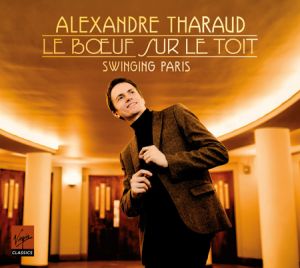
‘Le Boeuf sur le Toit’ recreates 1920s Parisian Club

Friday, November 23rd, 2012

By Rebecca Schmid

The eclectic musical life of the brief but thriving ‘Roaring twenties’ continues to inspire a nostalgia that is all the more understandable given contemporary classical music’s reorientation toward popular idioms from techno to rock. The latest album of French pianist Alexandre Tharaud, Le Boeuf sur le Toit, sets out to recreate the acts of a cabaret bar that provided a hub for the cross-fertilization of jazz and classical, spawning the French expression “faire le boeuf” (to jam). Stravinsky, the members of Les Six, Picasso and Chanel count among the personalities to have hung out in the Parisian bar, named after a Cocteau-Milhaud ballet. Yet it was a little-known figure that, according to liner notes, provided the “soul of the club.” The pianist and film composer Jean Wiéner, one of the first French advocates for jazz in the aftermath of World War One, devised programs such as “concerts salades” featuring performances of Gershwin and Porter alongside the compositions of friends. The Belgian pianist Clément Doucet, who mostly made a living accompanying silent films, was a permanent fixture, joining Wiéner for four-hand routines.

Tharaud, having discovered these recordings as a young child, spent years transcribing their arrangements, for which no scores existed. He also met Wiéner at age eight. Much in the spirit of the original club, the pianist summoned several musician friends for his project, from the chanteuse Juliette to Nathalie Dessay. Frank Braley is Tharaud’s partner for the Wiéner-Doucet duos, which provide some of the album’s highlights. Gershwin’s Why do I Love You? has an infectious energy through the joie de vivre of its textures, seamlessly coordinated by the performers. Doucet’s solo riffs on works by Chopin, Liszt and Wagner also deserve to be better known. His dance-like spin on the Liebestod in Isoldina is especially refreshing in the midst of the deluge for Wagner’s bicentenary. Tharaud moves suavely from each contrasting piece of repertoire to the next, whether in the leisurely stroll of Wiéner’s Harlem, or in spritely musical theater accompaniment for Bénabar in Maurice Chevalier’s Gonna Get a Girl. The chansonnier’s French accent brings a touch of authenticity and charm to the mix. There are also homegrown musical numbers, such as an excerpt from the operetta Louis XIV featuring Guillaume Gallienne.

The ‘shimmy movement’ Caramel mou, a Cocteau-Milhaud collaboration, provides another rare gem with its fragile polytonality and lightly absurdist lyrics about taking advantage of a younger girl: “Prenez une jeunne fille/remplissez la de la glace et de gin…et rendez la à sa famille” (take a young girl/fill her up with ice cream and gin…and bring her back to her family). Jean Delescluse gives a performance conjuring the best French cabarets, with Florent Jodelet on percussion ranging from march-like snares to wood blocks evoking horse hooves. Just as priceless is Dessay’s cameo appearance in the soft, trompet-esque vocalising of Blues chanté, one of three such pieces Wiener wrote with instructions for the performer to treat the voice like a brass instrument. Madeleine Peyroux makes for a modern Ella Fitzgerald in Cole Porter’s Let’s Do It, while David Chevallier’s banjo adds spirited twang to Tharaud’s rendition of the fox trot Collegiate. It is impossible to grow tired of this album as it unfolds, with its eclectic arrangement of repertoire unified by such a tight dramaturgical arc. Wiéner’s harpsichord transcription of Saint Louis Blues by William Christopher Handy, performed on a 1959 Pleyel instrument, provides yet another surprise with its refined contours of the blues classic. Tharaud has conceived a truly original project that entertains as it illuminates this small but rich piece of musical history.

Le Boeuf sur le Toit is available for purchase on Virgin Classics.

rebeccaschmid.info

Widmann’s Opera Babylon

Friday, November 23rd, 2012

Jörg Widmann’s opera Babylon

By ANDREW POWELL
Published: November 23, 2012

MUNICH — Scorpion-Man prowls the rubble of an unnamed flattened city at the start of Babylon, Jörg Widmann’s new opera, wailing as he moves. We should care.

Seven scenes, a Hanging Garden interlude, and three costly theater hours later, he is back, doing his thing over the same debris, also multiplying himself, and alas we have not cared or even learned what he represents. Perhaps he is us sad cityites, predatory and detached from our souls.

Widmann’s librettist for this Bavarian State Opera commission (heard and seen Oct. 31) is the post-humanist philosopher Peter Sloterdijk, whose worries, intra-urban and intra-galactic, drive Babylon in one big circle against the backdrop of the 6th-century-BC Jewish exile.

Sloterdijk’s narrative feebly pivots on a love-interest, in the persons of exile Tammu and local priestess Inanna. The character Soul is catalyst in a progression of these two that ends, before the circle has closed, in a concordance of Heaven and Earth (cue sweet music).

Along the way, Tammu gets drugged, laid, sacrificed, resurrected, and flown away with his gal in a spaceship. After administering the drug and enjoying her man, Inanna’s one job is to descend post-sacrifice into the Underworld and retrieve him, being sure not to lose sight of him as they make their way out together.

If this suggests a too-rich stew of Isolde or Norma and Euridice with Tamino, it is. But we are in Babylon, and your bowl arrives as the Euphrates overflows, the New Year rings in at the Tower of Babel, and Ezekiel dictates the Word of God, not to list the antics of seven Sloterdijk planets and fourteen Poulenc-ish sex organs.

Born here in 1973 and locally esteemed, Widmann as composer is much identified with Wolfgang Rihm, one among several teachers and influences. He is, besides, a bold and expressive clarinetist: a 2012 Salzburg Festival performance of Bartók’s Contrasts with Alexander Janiczek and András Schiff all but vaulted off the Mozarteum’s platform, and a 2011 Munich partnership with the Arcanto Quartet found rare vigor as well as cozy plushness in Brahms’s Clarinet Quintet.

The Nabucco-era subject had taken the composer’s fancy long ago. Ideas sprouted. A raucous Bavarian-Babylonian March emerged as orchestral fruit last year, bridging the millennia if not exactly the cultures. At some point came the link with Sloterdijk and the decision to plough forth with an opera, Widmann’s sixth piece for music-theater.

Undaunted by the librettist’s loony layers, Widmann supplies for Babylon music of chips and shards and sporadic mini-blocks. 160 minutes of it.

He savors direct quotes, splintered just past the point of identifiability. These he takes from jazz, operetta, lute song, Baroque dance, cabaret, Hollywood, symphonies, band repertory. He crafts brief, pleasingly original blocks of sound in various forms — brass swells, percussive glitter, choral refrains, woodwind banter — deploying them to varying effect. He is a gifted colorist, writing with virtuosity for all sections of the orchestra, in this case a large one, heavy on low winds and percussion.

Vocally the writing is less fluent, less confident. Abrupt ascents are a peculiarity. The tessitura of all three principal roles — Inanna, the Soul and Tammu — lies coincidentally high for each of the voice types (two sopranos and a tenor). Vocal lines are often aborted, mid-flight, again producing small blocks.

Widmann’s chipboard elements are arrayed in rapid indigestible sequences some of the time (Scene III’s orgy). Elsewhere, thin writing overstays its welcome or fails to develop in sync with the cosmic-Biblical scheme (Scene V) — the “prolix musical treatment” George Loomis noted in his review.

Enter Carlus Padrissa, the busy Spaniard known for constant stage movement. Hired to define and motivate the opera’s characters and unite the threads in text and score, Padrissa delivers, well, movement.

The gloomy arthropod’s rubble swiftly morphs into moveable letterpress type: Cuneiform, Katakana, Cyrillic, Hebrew — ah, Babel, the universal translator — to be piled up by mummers, piled down, carried off, brought on. Nearly incessantly. Flown and raised platforms support and transport sundry participants, some of them needed. Projected screen-saver lines depict the restless Waters of Babylon. Moving photographic images reveal holy verse, hell fire, a meteor (or ICBM) crashing to Earth. There is always plenty to watch.

Still, two problems dog Padrissa’s circus-like approach to opera, evident in his 2007–9 Valencia Ring and 2011 Munich Turandot: movement everywhere deprives the action of focus; and physical space required for upstage activities (open wings, as in ballet) deprives the singers of sound boards (in the form of sets) to reflect and project their voices. So it is with Babylon.

In the Turandot — due by chance for Internet streaming in its revival on Sunday (Nov. 25), here, and significant for the textual decision to end where Puccini ended — the voice-projection problem is addressed by having much of the principal singing occur drably near the stage apron.

In Babylon it is addressed with amplification*, subtly on the whole, though on Oct. 31 individual vocal lines resounded unnaturally at several moments.

Generalmusikdirektor Kent Nagano brought to the new opera his dual virtues of judicious tempos and attention to balances. The orchestra played compliantly, David Schultheiß working as poised and able concertmaster. Anna Prohaska and Claron McFadden coped deftly with the vocal stratosphere as Inanna and the Soul. Gabriele Schnaut brought rolling majesty to the Euphrates personified. Countertenor Kai Wessel exuded glum fortitude as Scorpion-Man. Jussi Myllys, the Tammu, relished having more to do than in his numerous recent Jaquinos, serving Widmann’s music earnestly. Willard White, as Priest-King and as Death, growled and boomed with his customary expertise.

When final blackness came, the polite Bavarian audience registered its ennui not with boos but with the barest, most ephemeral applause. Reconciling Heaven and Earth had proven easier than reaching across the proscenium.

[*Bavarian State Opera in a Nov. 26 message noted that “amplification was used for some parts” of the opera and that Widmann “actually marked the use of amplification for the scenes with heavy orchestral instrumentation in the score.”]

Photo © Wilfried Hösl

Related posts:
Levit Plays Elmau
Petrenko Hosts Petrenko
Manon, Let’s Go
Tonhalle Lights Up the Beyond
Mélisande as Hotel Clerk

A Time for Thanksgiving

Thursday, November 22nd, 2012

By: Edna Landau

On the occasion of the Thanksgiving holiday, I would like to offer my thanks to Musical America, all our devoted readers, our sponsors, and those who have sent in their interesting and thought-provoking questions. I look forward to continuing to receive your questions, and even suggested topics for this column. Happy Thanksgiving to all!

“Ask Edna” will return to a regular weekly schedule next Thursday, November 29.

To ask a question, please write Ask Edna.

In New York’s Concert Halls

Wednesday, November 21st, 2012

by Sedgwick Clark

Atlanta Symphony/Spano

My broadest exit smiles so far this season occurred the same week at Carnegie Hall featuring programs with a chorus: the Philadelphia Orchestra and Westminster Symphonic Choir (Joe Miller, director) under Yannick Nézet-Seguin in Verdi’s Requiem on 10/23 and the Atlanta Symphony Orchestra and Chorus (Norman Mackenzie, director) under Robert Spano on 10/27.

The first, about which I enthused in this space on 10/25, is one of those pieces one simply cannot miss at Carnegie. The Atlanta program was equally enticing in its own way, a satisfying amalgam of works laced in jazz rhythms and irresistible melody: Copland’s Appalachian Spring Suite, Bernstein’s Chichester Psalms, and Walton’s Belshazzar’s Feast. Ensemble was occasionally wayward in the Copland, but the two choral works were knockouts. If the Psalms lacked the composer’s manic energy, Spano’s spacious warmth offered numerous beauties in this most affecting of Bernstein’s concert works; the use of a countertenor (John Holiday) in the second-movement solo provided more vocal assurance than the prescribed boy sopranos I’ve heard, although one might argue that a certain innocence was lost. Best of all was the Belshazzar, in which Walton’s episodic structure was given welcome continuity without ever shortchanging the work’s pagan exhilaration. It completely surpassed a hectic affair in 1976 at Carnegie by the Chicago Symphony Orchestra and Chorus under Georg Solti, the only other live performance I recall hearing. That this fine orchestra is confronting a $20 million deficit and that musician ranks will be reduced along with a 20 percent cut in salaries is shameful.

Cleveland Orchestra/ Welser-Möst

My word, the Cleveland Orchestra makes a beautiful sound under Franz Welser-Möst these days (11/13)! The downside is that I don’t recall ever hearing so many dropped programs and undefined thumps at a concert. W-M’s overly refined Beethoven Fourth was ho-hum. The Grosse fuge later in the program was much more involved. But it’s not really a “nice” piece, Franz, and I’m afraid the sumptuous Cleveland strings will pale in memory next to the electrifyingly precise Minnesota/ Vänskä earthshaker in March 2010. The gentlemanly rendering of Scriabin’s Poem of Ecstasy at the close seemed positively perverse with such an interpretive engine available to him. I remember a Comissiona/Baltimore performance in the ’70s that blew the roof off of Carnegie; afterwards, as I raved about it to friends, my date interjected, “Gee, I wish you’d get that excited about me!”

Aimard’s Debussy and Schumann

I was surprised at how much this esteemed pianist went in for washes of color rather than clarity in Debussy’s Preludes, Book II (11/15). A pianist friend didn’t like it at all, and Zachary Woolfe in the Times leaned toward Jean-Yves Thibaudet’s Debussy program the week before. The latter not being one of my faves, I didn’t subject myself to his “freedom” of expression, but I did enjoy Aimard’s performances, even if a certain sameness crept in after awhile. (Admission: I think the Book I Preludes are more inspired and individual.) But Aimard’s reticent Schumann, while perhaps hewing to the letter of the score, doesn’t move me, and I think that inserting the five posthumous etudes in the middle of the piece makes it interminable. Play the five independently if you must (but they are still not top-drawer Schumann).

Adès’s Grey Tempest

With all the encomia over this Brit darling of the critics, Thomas Adès, I expected a new operatic masterpiece at its final performance this season (11/17). True to form, local reviewers raved en masse. But, great heavens, what a disappointment: colorless (Shakespeare?), dynamically squashed, melodically tepid. Would that Hurricane Sandy, which struck six days after this operatic tempest’s debut, had packed such a paltry punch! Give me an operatic treatment of MGM’s 1956 sci-fi classic Forbidden Planet, based loosely on The Tempest, with Louis and Bebe Barron’s “electronic tonalities” for the music.

Perhaps my esteemed colleagues were taken with the Brittenisms scattered throughout (Midsummer Night’s Dream?). I spoke with one who, when challenged, said he might have gone overboard in his praise because he doesn’t want to discourage new opera at the Met. I’ll try again in the eventual revival and hope to be embarrassed by my comments herein. In the interim, Peter G. Davis’s informative and positive review on this Web site (10/25) may provide more than my visceral reaction.

Does Original Music Exist Anymore?

Wednesday, November 21st, 2012

By Brian Taylor Goldstein, Esq.

Dear Law and Disorder:

I have a small venue. All 3 licensing companies are claiming I need to pay them for my karaoke and music that occurs weekly, but the bands that I have sign contracts making sure they only play their original music, nothing copyrighted. These companies have been strong-arming me with threats that there’s no such thing as original music anymore and that I must pay or I will be heavily fined. Is this true and, if so, is there blanket licensing that I may acquire for all 3?

Well, if there’s “no such thing as original music anymore”, that’s news to me and, I suspect, the thousands of composers out there!

If you require your bands to perform only original music that they composed themselves, then you do not need to obtain performance licenses from ASCAP, BMI or SESAC. The bands can give you all the permissions you need. However, if the bands breach their contract by “sneaking in” a few covers and performing music written by other bands or artists, then you would be liable for not having the proper performance licenses in place. (The band would be liable, too—for both breach of contract AND copyright infringement—but the performing rights organizations are more likely to go after you than the band.)

The karaoke is another matter. Karaoke machines, like jukeboxes, require licenses to be used in public venues such as yours. If you are featuring weekly karaoke nights, then you definitely must obtain karaoke licenses. The good news, such as it is, is that you can, indeed, obtain blanket karaoke licenses from each of the three performing rights organizations. The licenses will be based on the size and income of your venue.

Thanks for writing…and thanks to all of you who have written in, supported our blog, and asked great questions! Keem ‘em coming! Happy Thanksgiving!

________________________________________________________________

For additional information and resources on this and other legal and business issues for the performing arts, visit ggartslaw.com

To ask your own question, write to lawanddisorder@musicalamerica.org.

All questions on any topic related to legal and business issues will be welcome. However, please post only general questions or hypotheticals. GG Arts Law reserves the right to alter, edit or, amend questions to focus on specific issues or to avoid names, circumstances, or any information that could be used to identify or embarrass a specific individual or organization. All questions will be posted anonymously.

__________________________________________________________________

THE OFFICIAL DISCLAIMER:

THIS IS NOT LEGAL ADVICE!

The purpose of this blog is to provide general advice and guidance, not legal advice. Please consult with an attorney familiar with your specific circumstances, facts, challenges, medications, psychiatric disorders, past-lives, karmic debt, and anything else that may impact your situation before drawing any conclusions, deciding upon a course of action, sending a nasty email, filing a lawsuit, or doing anything rash!

Thielemann’s Rosenkavalier

Monday, November 19th, 2012

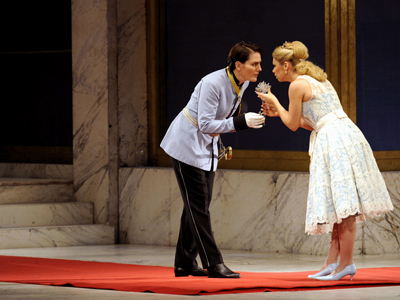
Daniela Sindram and Daniela Fally in Der Rosenkavalier in Dresden

By ANDREW POWELL
Published: November 19, 2012

DRESDEN — Christian Thielemann made his opera debut here yesterday (Nov. 18), thirty-seven long months after agreeing to replace Fabio Luisi as Chefdirigent of the Sächsische Staatskapelle Dresden, effectively music director of the Semperoper company. The vehicle, Uwe Eric Laufenberg’s 12-year-old, quasi-faithful staging of Der Rosenkavalier — notable for its Act II, set in a Trump high-rise complete with high-wire paparazzo window cleaner — looked a little clunky for the grand occasion, but the Munich Philharmonic’s ex-boss unfurled his Strauss credentials effectively.

Early on, an out-of-balance woodwind musician sparred with Thielemann until a nifty ascending phrase triggered smiles. Eventually a refined steadiness was achieved across all sections of the orchestra and did not let up. In contrast to recent performances in Munich and Vienna — where handsome werktreuen Otto Schenk stagings dating to 1972 and 1968 hold sway, and where casts are gathered on longer purse strings — this traversal of Der Rosenkavalier cohered musically: rhythms chugged or raced where needed, elsewhere pulsing their way with nonchalance; vocal lines prevailed through instrumental storms; climaxes rose without advance detection; waltzing came naturally.

Daniela Sindram sang with warm impetuosity as the Knight, mooring the cast. Soile Isokoski shaped and shaded the Feldmarschallin’s music with poignant know-how. Veteran baritone Hans-Joachim Ketelsen, jumping in for a sick Martin Gantner, found the high-lying duties of Faninal a bit strenuous. Also straining at the top, at least in Act I, was Wolfgang Bankl as the pivotal Ochs. Sadly, his was the role most impaired by Laufenberg’s comedy-defeating tendency to enrich the action, already finely calibrated by librettist Hofmannsthal. Daniela Fally introduced a too-cute, small-voiced Sophie who blew easy chances to relate to her fellow protagonists.

The saintly-quiet Dresden audience, bewildered and agog at curtain at the effect of Strauss’s Act III dénouement properly executed, just stayed put and applauded one call after another until the conductor effectively ordered an end with a low sweep of his arm. The production returns next June with a different cast. Thielemann’s other 2012–13 Dresden stage engagements are Lohengrin in January and, against type, Manon Lescaut in March, for a grand total of twelve dates.

Photo © Matthias Creutziger

Related posts:
See-Through Lulu
Petrenko’s Rosenkavalier
Verdi’s Lady Macbeth
Safety First at Bayreuth
Time for Schwetzingen

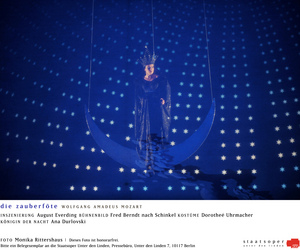
‘The Magic Flute’ regains its Classical Garb

Friday, November 16th, 2012

By Rebecca Schmid

As Regietheater becomes the norm on opera stages in Germany, it is a pleasant, if not shocking, surprise to see a production of Die Zauberflöte that looks like a throwback to the time of its world premiere. The Staatsoper Berlin has revived a 1994 staging modelled after designs by the nineteenth-century Prussian architect and landscape painter Karl Friedrich Schinkel, primarily remembered for his Royal Theater (now rebuilt as the Konzerthaus) on Berlin’s Gendarmenmarkt. Schinkel’s sets were commissioned to commemorate the crowning of Friedrich Wilhelm I on January 18, 1816, 115 years after the inauguration of Friedrich Wilhelm I. In contrast to the production’s huge success with the audience, the prince was reportedly not pleased with the results of this investment of royal funds. “In the future I won’t mix my opinion into administration affairs,” he wrote to the General Intendant of the Royal Theater.

While stage director August Everding and his team emphasize in program notes that it would be impossible to recreate Schinkel’s vision, as we cannot travel back in time to witness certain conventions in mimic and gesture, they hope to have shed new light on Mozart’s opera in the very city that is home to Schinkel’s neo-Classical creations. The Staatsoper’s current home in the Schiller does not benefit from the 18th-century splendour of the company’s headquarters on the Boulevard unter den Linden, which are currently under renovation, but painted sets by Fred Berndt and costumes by Dorothée Uhrmacher (seen November 9) immerse the audience in an aesthetic that faithfully evoke the mythic realms of the Queen of the Night and Sarastro.

The Queen descends for her first aria on a crescent moon against a starry sky while sets representing the rocky terrain on which Prince Tamino arrives part seamlessly to the side. Sarastro’s priestdom emerges with trompe l’oeil paintings of the Egyptian-inspired architecture indicated by Mozart’s librettist, Emmanuel Schikaneder, with expert lighting by Franz Peter David to give the sets depth. In what could easily offend modern viewers, Monostatos and his gang are represented with blackface as a group of violent thugs, while the three boys first emerge with a unicorn. Surreal animals ushered in by the magic flute bring a further touch of childish charm. The feathered Papageno and the family he joins at the end of the opera also made for humorous moments, even when the libretto was doctored with contemporary gags, such as the bird catcher’s response to Tamino that they are in the Schiller Theater.

In a strange twist to the usual constellation, the evening was not as even musically as it was theatrically. The conductor Julien Salemkour, an assistant to Music Director Daniel Barenboim, gave a somewhat perfunctory performance with the Staatskapelle, often hammering out notes without enough dynamic nuance and rushing the ends of phrases. On a few occasions he also did not coordinate smoothly with the singers. The performance gained intensity and authenticity starting with the more subdued, neo-Bachian passages that usher in Tamino and Pamina’s trials through fire and water toward the end of the second act, but could have used more elasticity in the final chorus “Heil sie euch Geweihten.” Having heard the orchestra in Don Giovanni and Le Nozze di Figaro under Barenboim last season, I know the musicians are capable of better.

The visceral, legato singing of René Pape in the role of Sarastro only emphasized how much more attention to line this deceptively simple score deserves, particularly in his aria “In diesen heiligen Hallen.” Pape is surely one of the best Sarastros of his generation, if not the past century, grounding the role with solemn spirituality. The Slovakian tenor Pavol Breslik also gave a beautifully sung performance in the role of Tamino. The streetwise mannerisms of Adriane Queiroz may not have always evoked the innocence of Princess Pamina, but her lush soprano colored ensemble numbers with reliable warmth. She was also affecting in the scene in which Sarastro forbids her from taking the vengeful orders of her mother. As the Queen, Anna Siminska reliably hit the stratospheric staccato notes of her arias but struggled with intonation as she prepared for the climax of “Der Hölle Rache” and did not capture the character’s menacing seduction.

Roman Trekel animated the show with well-sculpted tones as Papageno and a keen sense of comic timing. He found a fine match in his Papagena, Narine Yeghiyan. In the role of Monostatos, Michael Smallwood was equally convincing with a clear, high lying tenor and humorous presence. The Three Women (Carola Höhn, Rowan Hellier and Anna Lapkovskaja) formed a compelling ensemble, as did the Three Boys (of the Aurelius Sängerknaben) despite difficulty following the conductor in their last scene. The guards of the pyramid (Kyungho Kim and Alina Anca) stood out among the male comprimario roles of the priestdom, and the chorus provided well-balanced singing, particularly in the second act. As mythical animals waved at the audience during the final bars, one had the feeling that Mozart and Schikaneder might approve of a production so respectful of the artistic principles that have proved their popularity with audiences time and again.

rebeccaschmid.info