Archive for 2013

Remembering Ralph

Thursday, February 14th, 2013

By: Edna Landau

To ask a question, please write Ask Edna.

In my first column of this year, I listed among my New Year’s resolutions “try to go to at least one concert a month that offers music unfamiliar to me, preferably new music.” Little did I know then how rewarding that would prove to be. On January 10, I received a press release announcing “A Contemporary Evening for Ralph”at Merkin Concert Hall in New York on February 4. I learned that some of the finest new music groups to be heard anywhere were joining together to pay tribute to Ralph Kaminsky, who died at the age of 85 one year ago and who was perhaps one of the greatest advocates of new music that the contemporary music world has ever known. Those groups included the JACK Quartet, Either/Or, Talea Ensemble, International Contemporary Ensemble (ICE), and members of Alarm Will Sound. It promised to be an extraordinary evening and indeed it was. The groups, all of whom donated their services, seemed to be as delighted to all be performing in the same concert as the audience was to hear them. The hall was full and many people were seen embracing one another. Who was this man, I wondered, who brought all of these new music performers and aficionados together?

Ralph Kaminsky was a native of western Canada whose studies were in economics and who subsequently taught at the University of Manitoba and at Yale. After a time, he ventured into urban planning, which took him to various countries around the world. He returned to academia as professor of economics and public administration, and later associate dean, at New York University’s Graduate School of Public Administration, a tenure which lasted 23 years. After his retirement, he devoted the last 20 years of his life to his great passion for contemporary music. Together with his wife Hester Diamond, an authority in visual art and design, he hosted monthly listening sessions in a large music room in their beautiful home, where the guests (many of whom were from outside the music world) were introduced to Ralph’s latest discoveries – young composers and contemporary works that particularly excited him. The sound system was state of the art and all who attended received meticulously prepared programs, complete with notes about the (often cutting-edge) pieces. A lively discussion always followed the concerts. With the exception of some special marathons that were devoted to Wagner’s “Ring”, it was a rare occurrence if any of the music heard at the sessions was written before 1980. As Bruce Hodges, a writer and close friend of Ralph’s, wrote in a beautiful tribute on his blog, Ralph was often heard saying, “I listen to music by composers who are composing, not decomposing.” Sometimes the programs involved live performance, featuring familiar faces from the new music scene. But Ralph didn’t just enjoy new music at home. He regularly went to concerts and supported both the performers and the institutions who presented them. He had no hesitation in writing to major concert presenters in New York City to question why new music didn’t constitute a larger percentage of their concert offerings. At various times he sat on the boards of the American Composers Orchestra, Talea Ensemble, Sospeso Ensemble and eighth blackbird. The Merkin Hall concert program included the following tribute from eighth blackbird: “He was part of our organization before we even had a career, when he graciously opened up his home to us to rehearse for the Young Concert Artists competition. He of course showed us his amazingly ridiculous sound system and his exhaustive music library, but what we remember most is that he sat down and talked with us at length, discussed the New York music scene and new music in great detail, and showed a genuine interest in what we were doing. In short, he cared, at a time when we were unsure of ourselves and what we were doing. It meant a lot.”

It is unlikely that the contemporary music world will ever encounter another individual as single-mindedly dedicated to introducing laymen and music lovers alike to the great composers and new music ensembles of our time, and giving them the tools to personally relate to their music. Alex Lipowski, a close friend of Ralph’s and percussionist with the Talea Ensemble, called him a “trendsetter”. Rather than just lament this great loss, he and other close friends of Ralph’s conceived of the idea of organizing a concert to celebrate his life and jointly planned the event. The production costs were covered by members of the Contemporary Listening Group, many of whom saw one another at the concert for the first time since the last listening session, one and a half years ago. The brilliantly performed program consisted of works that were particularly meaningful to Ralph, including Marc-André Dalbavie’s Fantaisies, which his wife had commissioned for his 80th birthday. Happily, the concert coincided with the announcement of the Ralph Kaminsky Fund for New Music, “which aims to carry on his legacy by encouraging curiosity, exploration and passion for cutting-edge contemporary music through commissioning new works and ensuring their performance.” Ralph Kaminsky never sought the spotlight, but there is no question that he would have heartily endorsed this project and been touched by the superb and loving tribute concert in which so many of his close friends participated. I came to Merkin Hall just to hear a concert, but I left feeling deeply inspired by how much one person’s passion and intense dedication can lastingly affect an entire music community.

To ask a question, please write Ask Edna.

© Edna Landau 2013
The Philharmonic Spans the World

Wednesday, February 13th, 2013

by Sedgwick Clark

The Warm European Touch

Andris Nelsons is one of the hottest young conductors around. Hailing from Riga, Latvia, he has been music director of the Birmingham Symphony since 2008 and made a splash in March 2011 at Carnegie Hall, substituting on a day’s notice for James Levine in a Boston Symphony performance of Mahler’s Ninth Symphony. He has conducted Turandot and Queen of Spades at the Met in recent years, but he only made his New York Philharmonic debut last season. The orchestra wasted no time in re-engaging him, and last week he led a comfortable program of works by Dvorák, Brahms, and Bartók. There wasn’t a harsh sound to be heard from an orchestra renowned for its assertive style in the not always felicitous acoustic of Avery Fisher Hall. The results, to my ears, were soothing but understated.

Dvorák’s symphonic poem The Noon Witch tells of a mother’s backfiring attempts to calm her child’s noontime tantrums by invoking the reprisal of an evil spirit. The work’s tedious structure is a drawback, but unleashing the New Yorkers’ inherent sense of drama might have driven the narrative ahead to greater effect.

Brahms’s Violin Concerto seemed a mismatch, with Nelsons leading a warm, idiomatic accompaniment to Christian Tetzlaff’s astringent solo. This superb violinist’s sound has troubled me in recent years. Never exactly a cuddly player, his beauty of tone seemed to recede at the same time he traded in his horn rims for contacts. His unappealing, tight-lipped publicity photo in the program all but shouts, “I’d rather be playing Lutoslawski.” Certainly not Brahms.

Bartók’s Concerto for Orchestra is meat and potatoes for a virtuoso band like the Philharmonic, and they played magnificently. Still, while savoring the score’s pungent beauty, I wished for more emphasis of Bartók’s pointed Hungarian rhythms and accents – especially the sharp punctuation of timpani throughout.

The Year of the Snake

The Philharmonic’s “new tradition of celebrating the Chinese New Year,” inaugurated on Tuesday (2/12), was a pleasure from first note to last. Conducted by Long Yu, China’s apparent general music director, the orchestra was in flawless fettle, with the strings displaying some of the loveliest legato I’ve heard from them in some time and ideally blended brass.

I’ll leave in-depth comments to those more informed, except to say that Li Huanzhi’s Spring Festival Overture (1955-56) was played to the hilt, with the New Yorkers making the most of the work’s indebtedness to Glinka’s Russlan and Ludmilla Overture. Chen Qigang’s quietly expressive Er Huang for Piano and Orchestra (2009) was played with self-effacing affection by Herbie Hancock. Selections from the Beijing opera The Drunken Concubine, sung by the spectacularly costumed Yan Wang, received perhaps the most warmly committed playing from the Philharmonic. The effervescent Snow Lotus Trio sang three songs to conclude a delightful concert.

Dad, May I Borrow the Car?

Wednesday, February 13th, 2013

By Brian Taylor Goldstein, Esq.

Dear Law and Disorder: May we borrow music for an orchestral performance from another organization that purchased this music, but is currently not using it?

When you write that the other organization “purchased this music”, do you mean that they actually purchased all performance rights to the music or merely purchased the score and parts? Did they actually purchase the score and parts or merely rent them?

When it comes to copyrights and performance rights, “physical” possession of an artistic work does not inherently include any rights to the work other than the right to own it and possess it. For example, when you purchase a copy of Harry Potter, you get the right to read it, enjoy it, and place it on your bookshelf. If you like, you can even lend it to a friend or sell your used copy at a flea market. However, purchasing a copy of the book does not give you the right to perform it, interpret it dramatically, make a movie out it, copy and re-print excerpts, or do anything other than enjoy it. Similarly, when you purchase a painting from a gallery, you are purchasing the right to hang it on your wall and enjoy it. Like a book, you can also lend it to a friend or museum, or even re-sell it—but you do not have the right to make copies of it, alter it, post images on your website, use it as your logo, or do anything other than look at it. Those rights must be obtained separately.

Purchasing music works much the same way. The physical ownership of sheet music does not also give you the rights to perform it. Those rights must be obtained separately from the composer or publisher—or, if the composer is a member of a performing rights society (ASCAP, BMI, or SESAC) then you can obtain licenses through the society. So, in your scenario, assuming the other organization purchased the score and parts, then they have the right to loan you the music, but if you want to perform it, then you will need to obtain your own performance rights and licenses. Assuming they only rented the score and parts, then they don’t have the right to loan it to you in the first place. That would be like an illegal sub-let.

Borrowing music is like borrowing a car. First, you have to make sure that the person loaning you the car actually has the right to loan it to you in the first place. (Just because they have the keys, doesn’t mean they own the car.) Second, even if you are allowed to borrow the car, if you want to drive it, you’ll still have to pay for your own gas.

_________________________________________________________________

For additional information and resources on this and other legal and business issues for the performing arts, visit ggartslaw.com

To ask your own question, write to lawanddisorder@musicalamerica.org.

All questions on any topic related to legal and business issues will be welcome. However, please post only general questions or hypotheticals. GG Arts Law reserves the right to alter, edit or, amend questions to focus on specific issues or to avoid names, circumstances, or any information that could be used to identify or embarrass a specific individual or organization. All questions will be posted anonymously.

__________________________________________________________________

THE OFFICIAL DISCLAIMER:

THIS IS NOT LEGAL ADVICE!

The purpose of this blog is to provide general advice and guidance, not legal advice. Please consult with an attorney familiar with your specific circumstances, facts, challenges, medications, psychiatric disorders, past-lives, karmic debt, and anything else that may impact your situation before drawing any conclusions, deciding upon a course of action, sending a nasty email, filing a lawsuit, or doing anything rash!

Berlin’s Lutosławski Tribute kicks off with Dvořák

Friday, February 8th, 2013

By Rebecca Schmid

The Berlin Philharmonic is celebrating the centenary of Lutosławski with several concerts this month. The first of the series on February 7—featuring his Concert for Orchestra—opened appropriately with Anne-Sophie Mutter, who premiered one of his most important works, Chain Two, in 1988. In an interview I conducted two years ago, the violinist recalled how seeing the score triggered a passion for contemporary music which she continues to nurture. Her appearance at the Philharmonie alongside guest conductor Manfred Honeck took an unrelated historic twist with a performance of Dvořák’s Romance in F-minor, although the Czech composer’s innovative integration of folk music can be seen to have foreshadowed composers such as Bartok and Lutosławski. The last violinist to perform this work with the Philharmonic is Carl Flesch, in 1909. As Mutter also explained to me, she considers herself a kind of ‘great-grandchild’ of the legendary violinist given that Flesch taught her mentor Aida Stücki.

The Romance is derived from the slow movement of Dvořák’s String Quartet in F-minor, with a main melody so melting one understands why the composer was tempted to repurpose it. He gives it a short fugal exposition in the orchestra before the violin enters, wrought well by the transparent timbre of the Philharmonic’s strings, although the sound was tense during later fortissimo passages. Mutter brings a crying quality to her high notes which pushed the Romantic emotion to the edge, and struck a mix of strength and fragility in the cantabile lines, yet the tempo was slightly pressed. The pacing was more solid for Dvořák’s Violin Concerto, and the orchestra warmed up to a more communal sound in tutti episodes. Honeck’s conducting remained deferential, if not slightly meek, but clear. Mutter and the orchestra gave the fast opening movement a glowing but icy sheen, while the inner Adagio swooned with more sentimentality. The final Allegro giocoso was the most exciting. Mutter carved out melodies with the sweet but slick tone that has inspired composers from Rihm to Penderecki, and Honeck brought out the folksy rhythms with natural flair.

Folklore plays an equally important role in Lutosławski’s Concert for Orchestra, which effectively established him as a generation’s leading composer in 1950s Poland. Its rigorous yet experimental development of tonality and rich orchestration certainly qualify it as a modernist masterpiece that deserves to be heard more often in concert halls. The instrumentation of his Concert is full of delicious subtlety, such as a piccolo solo that moves through a dissolving circle of fifths above swirling winds and strings in the inner Capriccio. But it is the final Passacaglia, Toccata e Corale that, for this listener, captures Lutosławski’s genius, with a bass line that is passed through monumental brass to the middle of the orchestra before the outer voices come crashing against it. The violins are left with the melody, a remnant of a culture that once was, against a jarring piano chord as the rest of the orchestra dies. Once the music comes back to life, the counterpoint locks into clockwork before dismantling like a cubist painting (I thought of the Czech artist Bohumil Kubista, a member of the New Secession movement), with dark, atmospheric colors that overcome angst with their own sense of order. Honeck led the work with spirit and spontaneity, and the Philharmonic responded with smooth precision.

rebeccaschmid.info

Broadening Your Repertoire Horizons

Thursday, February 7th, 2013

By: Edna Landau

To ask a question, please write Ask Edna.

I am extremely grateful to the following individuals whose input was of great assistance in preparing this week’s column: Nadine Asin, Emanuel Ax, Bärli Nugent, Jay Campbell, David Finckel, Ani Kavafian, Jennifer Koh and Lucy Shelton.

Dear Edna:

I have read a number of your blog posts in which you encourage young musicians to incorporate into their programs commissioned works by their contemporaries and unusual repertoire that is deserving of more frequent exposure. With everything I have to do to meet the requirements of my Master’s degree in piano, it is hard to set aside time for researching this. I actually don’t even know where to start. Can you help? —Robin S.

Dear Robin:

Thanks for writing with a question that I expect will be of interest to many of our readers. Since you are still in school, you have considerable resources at your disposal. First and foremost are your teachers. Be sure to share your curiosity about repertoire with them as they will undoubtedly have ideas about works that will suit your musical temperament. If your school has a composition department, that should be your next port of call. Composers are eager to have their music performed and if they haven’t written anything for piano, consider commissioning them. While still at school, they may charge a nominal fee or nothing at all in exchange for getting their music heard. They might also tell you about their friends who may have written for your instrument.  You have also probably seen me write about the importance of going to concerts of music with which you are not familiar. You might hear a ravishing song cycle and discover that the composer also wrote solo piano works or chamber works with piano that you’d love to explore.

Here are some additional suggestions and resources which you might find helpful, both with regard to new and older music:

WEB RESOURCES

  • All music publishers list their catalogues online. Some give you the opportunity to listen to sound clips of particular works (for example, http://www.boosey.com and http://www.schirmer.com).  The Schott Music Corporation’s Project Schott New York features more than seventy new works by over thirty composers, with listening samples and videos embedded in the blog section of the website.
  • School libraries are a great resource. If you can’t physically get to them, many offer a wealth of information online. One example is Yale University’s Irving S. Gilmore Music Library (http://www.library.yale.edu/musiclib) whose website offers a broad variety of useful information.
  • Cellist Jay Campbell finds http://brahms.ircam.fr useful when seeking the comprehensive works of a particular composer, especially for 20th century music and music of today.
  • The website http://www.arkivmusic.com is primarily a source for purchasing recordings but it contains a great deal of information about a large variety of composers and their works, as well as listening samples.
  • Emanuel Ax told me about the Petrucci Music Library, a source for a huge amount of work that is in the public domain and can be accessed on computer for free. (I am told it can even be downloaded to your iPad.) He also told me about Music for the Piano: a Handbook of Concert and Teaching Material from 1580 to 1952 by James Friskin and Irwin Freundlich (Courier Dover Publications, 1973).
  • David Finckel called my attention to Classical Archives which offers a broad scope of works that can be listened to in full. A subscription costs $7.99 a month.

OTHER IDEAS

  • Look at catalogues of great composers to whose music you are drawn to see what they wrote for your instrument.
  • Explore the recordings of great artists of the past on your instrument. They often reveal neglected gems that were frequently played in times gone by.
  • If you have heard of a composer who you think might be of interest to you, they are in all likelihood represented by performances of their works on YouTube.
  • The ASCAP Foundation and BMI both give awards to young composers and have an impressive track record of having recognized gifted young composers before they became famous. The names can be found on their websites.
  • Look at programs from broad ranging and innovative concert series and festivals to be introduced to new works and composers. Don’t limit yourself to solo works. A chamber piece can be very refreshing on an otherwise solo recital program. Take a look, also, at works being performed by artists and ensembles who you admire.
  • Acquainting yourself with composer anniversaries (births and deaths) may draw you to works that you may not know and that may prove interesting to both presenters and audiences alike. A good source for such information is Classical Composers Database.

All of the artists I spoke to in preparing this column weighed in strongly about the responsibility of today’s musician to explore the great heritage of repertoire for their instrument and to become part of the exciting community of new composers writing for it. They emphasized how much easier it is today than it was thirty or more years ago when research could only be done by physically going to a library. Ultimately, an artist should only play repertoire that truly appeals to them and that demonstrates their strengths to the fullest advantage. However, a musician who expends energy in meeting composers and is generally curious about repertoire  is someone who is likely to connect most successfully with fellow musicians, presenters and even record companies, and enjoy the richest and most meaningful experiences throughout their career.

To ask a question, please write Ask Edna.

© Edna Landau 2013
A Gentle Tchaikovsky Gold Medalist

Wednesday, February 6th, 2013

by Sedgwick Clark

Daniil Trifonov is a diplomat at the keyboard, not a pounder. We’re so used to powerhouse Russian pianists that the slight young man who bounded onstage Tuesday evening for his Carnegie Hall recital debut and proceeded to caress the keys took at least one listener by surprise. Winner of the prestigious Tchaikovsky and Rubinstein competitions, he has the all-powerful Valery Gergiev in his corner and encomiums from several distinguished fellow pianists. He has recorded a Chopin CD for Decca and Tchaikovsky’s First Piano Concerto with Gergiev for the Mariinsky label. A recording contract with Deutsche Grammophon was announced today, beginning with the release of this concert (2/6).

This one-man jury was out in the recital’s first half. As in the case of another of his generation’s pianistic talents of slight build, Yuja Wang, who made her Carnegie Hall recital debut last season, I wondered how wise it is to rush accomplished yet unformed artists into such prominent venues. Scriabin’s Second Sonata didn’t seem ideally arresting for Trifonov’s recital opener, although the heavily Russian audience probably disagreed. And Liszt’s half-hour Sonata in B minor, with which Wang concluded her recital last season, is difficult to make cohere under any circumstances, at any age. Its fireworks are irresistible to young artists, but its dangers are manifold. In my concert experience, Arrau and Brendel conquered it masterfully; under Horowitz it fell apart. Trifonov simply lacked the requisite weight.

The recital’s second half, the Chopin Preludes, was something else. Again and again, one warmed to his light tone and simple, unsentimental, poetic – and eminently satisfying — approach. The little A major Andantino, which many cannot resist personalizing (Arrau is laughable on his Philips recording), was played in a single lambent breath – perfection! The varying moods of the “Raindrop” were superbly rendered. And in the final Prelude in D minor, Trifonov threw caution to the winds with impassioned turbulence.

Undoubtedly an artist to watch.

Deception

Hollywood has never been lacking for howlers, and one of my favorites is in the film Deception (1946), starring Bette Davis, Paul Henried as a cellist she loves, and Claude Rains as a jealous composer named Alexander Hollenius. After a rehearsal for the composer’s new concerto (by Korngold, actually), a reporter asks the cellist to name his favorite contemporary composers, and he replies thoughtfully, “Well, let me see. Stravinsky, when I think of the present. Richard Strauss, when I think of the past. And, of course, Hollenius, who combines the rhythm of today with the melody of the past.”

I was reminded of this line the other day by a press release for an upcoming Decca CD by Nicola Benedetti called “The Silver Violin,” featuring Korngold’s Violin Concerto and numerous short pieces focusing “on the timeless music of the silver screen.” A Gramophone reviewer stated that “Benedetti need not fear comparison with the likes of Shaham, Mutter and Laurent Koscia . . . .” Laurent who? I wonder if the reviewer ever heard of Jascha Heifetz, who gave the work’s premiere in 1947 and whose 1953 RCA recording is still considered peerless by most critics?

Looking Forward

My week’s scheduled concerts (8:00 p.m. unless otherwise noted):

2/7 at 7:30. Avery Fisher Hall. New York Philharmonic/Andris Nelsons; Christian Tetzlaff, violin. Dvorák: The Noon Witch. Brahms: Violin Concerto. Bartók: Concerto for Orchestra.

2/12 at 7:30. Avery Fisher Hall. New York Philharmonic/Long Yu. Chinese New Year Celebration.

“Year of the Rabbit”: Justin Peck Makes Ballet Run

Tuesday, February 5th, 2013

By Rachel Straus

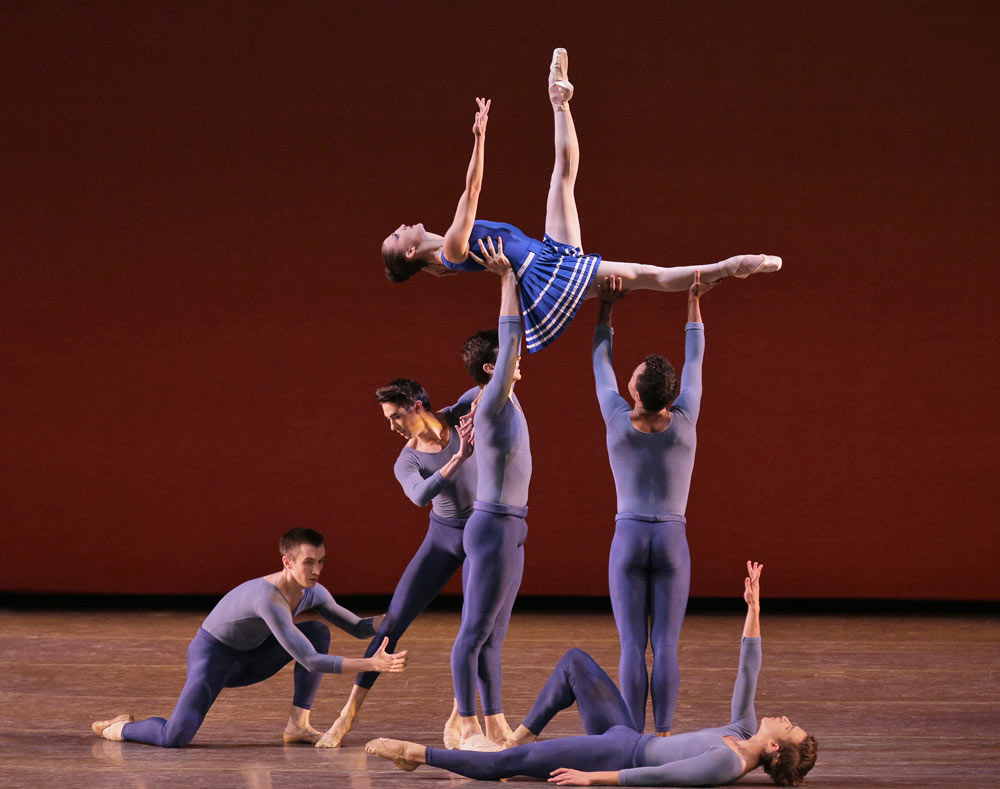
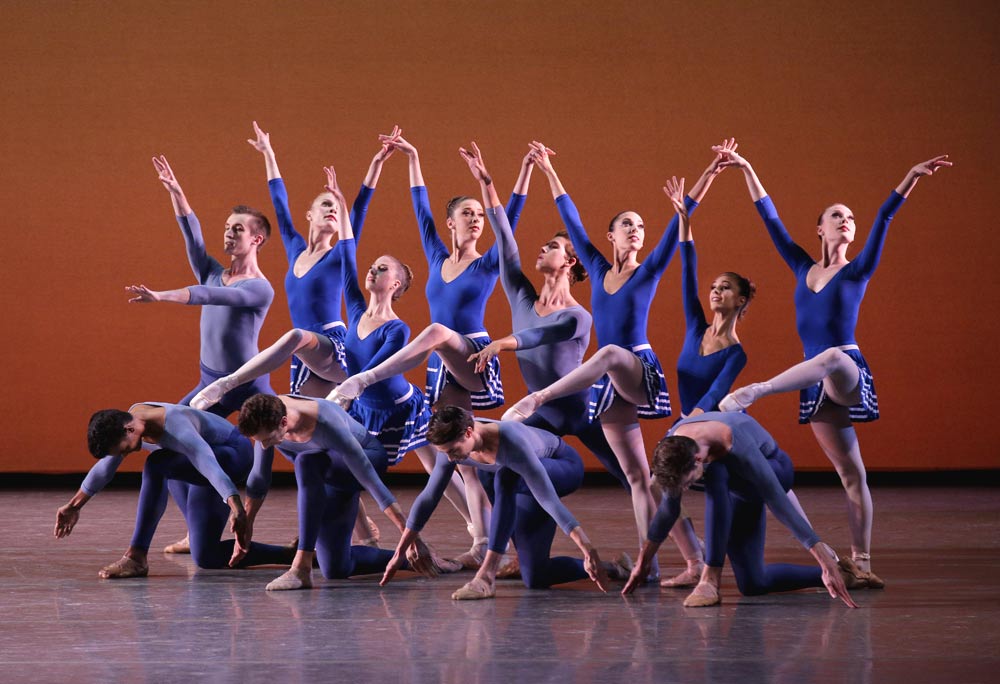
Justin Peck’s “Year of the Rabbit” begins with a whirligig virtuoso solo by Ashley Bouder. The principal New York City Ballet dancer performs her multiple turns into off-kilter leaps with playful abandon. The total effect is that of “Road Runner” cartoon: Here comes Bouder. Beep Beep! The company that George Balanchine developed is known for moving speedily. But Justin Peck, a 25-year-old corps dancer who has now made three works for NYCB (this is his second), gets his dancers to move even faster than the company’s founding choreographer. About half way through Peck’s 2012 piece—to Michael P. Atkinson’s orchestration of Sufjan Stevens’ electronica album “Enjoy Your Rabbit” (2001)—one had to wonder what all the hurry was about.

Ashley Bouder and New York City Ballet in Year of the Rabbit. © Paul Kolnik

Peck is the first choreographer who Ballet Master in Chief Peter Martins has supported that grew up firmly in the Internet age. While Christopher Wheeldon (age 39) and Alexei Ratmansky (age 44) surely have the latest gadgets, and Martins’ support, it is Peck’s fastidiously fast choreography that evokes the furrowed brow of our new century.

New York City Ballet in Year of the Rabbit. © Paul Kolnik

Back in the 1980s, it was Twyla Tharp who upped the ante on choreographic tempi. She taught aerobics as part of her company’s training. With “In the Upper Room” (1986), she featured dancers in tennis shoes and tracksuits, jogging up and down as though they were on a Stairmaster to heaven. But while Tharp’s “Upper Room” evokes the timelessness of Zen, via repetition of speedily performed choreographic leitmotifs, Peck’s interest in speed feels like young man’s game–with a smidgeon of ADD.

Robert Fairchild in Year of the Rabbit. © Paul Kolnik

Though speed feels like the subject of “Year of the Rabbit,” it also concerns contemporary ballet and its values. In the center of the work, there is a romantic pas deux for the wonderfully expressive dancers Teresa Reichlen and Robert Fairchild. The pair appears to be questing for each other’s love: they dance in separate fiefdoms of the stage, created by boundaries formed out of dancers from the opposite sex. Yet as soon as Fairchild and Reichlen touch, they go their separate ways. The pas de deux’s erotic potency lies with the pair’s physical separation. Actual intimacy isn’t the point, just as Facebook concerns looking and commenting at friends and loved ones from the safety of one’s digital screen.

Peck’s musicality, in which he corresponds, sidles, and departs from Atkinson’s melodic lines, demonstrates that he is astute. His choreography for the corps is also notable.  He continuously weaves the corps through six soloists’ dancing, thus blurring (and democratizing) the typical separation between leading and supporting dancers. All of this movement takes place place swiftly and efficiently, making “Rabbit” an indicator of our times.

Maazel: ’Twas Always Thus

Friday, February 1st, 2013

Lorin Maazel

By ANDREW POWELL
Published: February 1, 2013

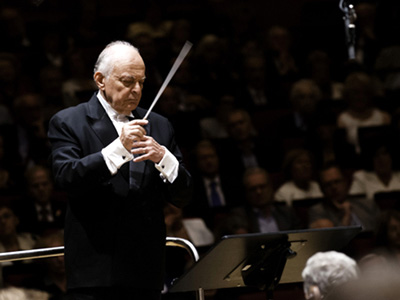
MUNICH — In a statement issued today here, Lorin Maazel shed light on the brevity of his tenure as Chefdirigent of the Munich Philharmonic:

“I congratulate Valery Gergiev on his appointment as principal conductor … starting the 2015–16 season. I am honored to have been serving as the artistic bridge between the terms of two much respected colleagues, Mr. Thielemann and Mr. Gergiev. When I took on this responsibility, I made it quite clear that it could only be for three years, because I always wanted to continue to serve as guest conductor with the orchestras with which I have been involved for half a century. I moreover postponed my composition projects for three years … . Starting September 2015, I will be able to return to them again, as well.”

Photo © Wild und Leise

Related posts:
MPhil Vacuum: Maazel Out
Jansons! Petrenko! Gergiev!
Gergiev, Munich’s Mistake
Modern Treats, and Andsnes
Gergiev Undissuaded

Après lui, le déluge…reflections on Wagner at the Akademie der Künste

Friday, February 1st, 2013

By Rebecca Schmid

Richard Wagner has managed to slowly dominate the scene internationally in recent seasons, but with the official arrival of his bicentenary, the saturation in Germany has only begun. Nürnberg, Leipzig, Munich and Dresden have unveiled new exhibits; in the latter’s case, an entire new building. A stream of publications has hit the market, leading Nike Wagner—rebellious daughter of Wieland, one-time bidder for the Bayreuth Festival upon Wolfgang’s resignation—to point her finger at the ‘tsunami-like influx’ (NB: her book Über Wagner comes out February 20). And then there’s the 15-hour opera. Klaus Zehelein, president of the Deutscher Bühnenverein (German Stage Association), called for a moratorium on Ring cycles last June. ‘We should leave the work alone, ideally worldwide,’ he said, denouncing centenary programming as a series of ‘encyclopedic events without artistic relevance.’

In what may be an attempt to provide an antidote, the exhibit, lecture and stage production series Wagner 2013 Künstlerpositionen at Berlin’s Akademie der Künste has set out to grapple with the German master’s polarizing effect and his place in artists’ lives, from painters to contemporary composers. A spokesperson explained that the concept arose from the international enthusiasm for Wagner and was intended to take place prior to this year. Why that didn’t happen is anyone’s guess. On January 27 the academy invited four composers and academy initiates of different generations—Dieter Schnebel, Erhard Grosskopf, Manos Tsangaris, and Enno Poppe—to discuss their relationships to Wagner in the same hall that is exhibiting the legendary rat costumes from Hans Neuenfels’ 2010 production of Lohengrin in Bayreuth.

Musicologist and moderator Jürg Stenzl opened the dialogue with a quote from Pierre Boulez, who declared Wagner ‘forgotten music’ for his generation and invited the composers to express their views on the issue. Schnebel, born in 1930, admitted that he had been corrupted as a child of Nazi times and, upon re-listening to Tristan post-war, couldn’t resist. His Wagner-Idyll (1980), for soprano and chamber orchestra, reworks the lines of Gurnemanz, the veteran knight in Parsifal, into Sprechgesang for a mezzo-soprano—naturally a subversive use of the material. At the other end of the spectrum, Poppe considers Wagner a ‘historical phenomenon,’ much as he considers Nazi Germany part of the past.

None of the composers stated they could ‘believe’ in Wagner. He is too ambiguous, a man who works with symbols, said Schnebel, as opposed to Verdi, whose operas he considers ‘clear cut’ and ‘music of reality.’ This is a fair assessment, although morality is far from clear cut in an opera such as La Traviata (based on the life of the singer Giuseppina Strepponi, whom the composer married). Nor is it true that Verdi didn’t work with symbols—he used entire allegories. The Jewish people in Nabucco represent Italians fighting for liberation from the Hapsburg Empire; the title character of Rigoletto is a disguised king.

Stenzl ended the discussion with a quote from Mauricio Kagel who, upon Beethoven’s centenary, suggested that there be a hiatus from his music for an entire year so that ‘we could then look forward to January 1’ (for a hilarious commentary of the mania around Beethoven, see Kagel’s film Ludwig Van). Tsangaris suggested that, contrary to Cage—who was feted for an entire year at the Akademie der Künste last year—there is already enough interest in Wagner from the public at large (perhaps the academy should have taken up the centenaries of Britten and Lutoslawski instead?). Poppe joked that we will need a ten year break from the Ring because the singers will have to recover their voices.

By many accounts, the music world is already weary. In New York, Robert Lepage’s colossal, machine-generated cycle has provoked a scandal of seemingly irreparable proportions. In Berlin resentment has long been brewing over a tetralogy that the Staatsoper mounted in co-production with La Scala, yielding a light, futuristic aesthetic that one critic likened to a Star Wars film. Meanwhile, in Milan, the decision to open the season with a new Lohengrin by Claus Guth was more than enough to leave national pride wounded in a country where people sing along to the ‘Brindisi’ on New Year’s Day. Still, few can ward off an endless fascination for Wagner, even if it necessitates psychiatric support (as Simon Rattle recently joked in an interview with Die Zeit). For better or for worse, we will be wandering the dark forests of myth for the next year.

rebeccaschmid.info

A Long Blog on Lawrence in HD

Friday, February 1st, 2013

by Sedgwick Clark

A Blu-ray video of Lawrence of Arabia was finally released in November. Collectors have been screaming for it for years, but Columbia Pictures was working on yet another upgrade of this foremost of epic films for its “50th Anniversary Edition.” I ran to Barnes & Noble the first day of its availability (somebody’s got to rearrange those deck chairs before the ship sinks), rushed home, and sat starry-eyed and golden-eared for nearly three and a half hours as director David Lean’s breathtaking desert vistas, Maurice Jarre’s magnificent symphonic score, and Peter O’Toole’s astonishing performance (not to speak of the superb supporting actors) set my pulse racing once again.

The range of color on the Blu-ray disc is eye-poppingly rich. I showed it to two film-loving friends the other day, and they were stunned. Still, a lot of work went into making Lawrence what it is today. After its premiere the film was subjected to insensitive cuts over the years. The original parts were badly stored. The soundtracks were destroyed in 1975, so even though Jarre’s music sounds superior to the tinny reproduction on previous video releases, it is reproduced from a fifth-generation dub. The credit sequence of Lawrence filling the gas tank for his fatal motorcycle accident is crisp and clear, but the opening scene of his ride through the countryside and the crash is from an inferior source, with oversaturated color. Fortunately, the excellent quality returns in the following scene of Lawrence’s funeral and remains so throughout.

Those who like to read about films should seek out a 20-year-old book entitled Lawrence of Arabia: The 30th Anniversary Pictorial History (Anchor, 1992) by L. Robert Morris and Lawrence Raskin. The story of the enigmatic T. E. Lawrence and his famous account of the c. World War I Arab revolt, The Seven Pillars of Wisdom, is briefly recounted before moving on to the making of Lean’s epic film itself, its profit-driven abridgement, and its heroic restoration in 1987-88. I bought the book soon after its publication, probably looked at the fabulous array of photos, and returned to my first Musical America Directory deadline. Now, encouraged by screening the Blu-ray, I figured it was time to actually read it and found it riveting.

I was 14 when I first saw the film — three times at Muncie’s Rivoli Theater — and it undoubtedly reinforced my career aspiration of being a film critic in New York. But it was not to be: A college roommate introduced me to Stravinsky’s stereo recording of The Rite of Spring, and my life goal shifted to a different branch of the arts. That certainly hasn’t stopped me from seeing Lawrence every chance I could on a big screen, however, including the 1971 reissue at New York’s legendary Rivoli Theatre on Broadway across from Jack Dempsey’s bar between 49th and 50th, both long gone now. This showing of Lawrence was drastically altered, having had 35 minutes sliced from the 222-minute 1962 premiere to allow more showings per day in theaters. Moreover, when the film was shown on television, further bits and pieces of various lengths were cut by Columbia studio technicians to allow for commercials, and crucial original parts became lost or misplaced – or, in the case of the soundtracks, simply junked.

Enter film archivist and restoration expert Robert A. Harris, who knew the stature of Lawrence and that it would essentially be a “lost” film if someone didn’t act fast. Columbia execs were enthusiastic, and in January 1987 Harris began the arduous job of locating the original parts and assembling the premiere version of the film. Fortunately, he had the invaluable assistance of the original editor, Anne Coates, and director Lean. It is this restored “Director’s Cut,” with small trims in the film that Lean had wanted to make soon after the film’s release, that we see on the Criterion Collection laserdisc, the 2002 DVD, the subsequent “Superbit” DVD, and the new HD Blu-ray at hand. The feature length is now approximately 217 minutes, with a grand total of 227 minutes including the Overture, Entr’acte, and Exit Music.

Lawrence of Arabia is inconceivable without Maurice Jarre’s score. The grand romantic sweep of his Lawrence theme, the brutal rhythms of the entrance into Auda abu Tayi’s camp, and the stodgy British march music are subtly varied throughout to match the emotional tenor of the scene at hand. At the end of the Overture, Jarre even has the three themes played in counterpoint – not a compositional trick often encountered in “movie music.” My guess is that Dutch composer Gerard Schurmann’s orchestrations are a strong contributing factor to the success of this score. Jarre’s personal use of percussion and exotic instrumentation are always prominent, but there is also a transparency of texture that doesn’t exist in Jarre’s thickly scored music for Lean’s Doctor Zhivago.

The Lawrence score could have been a disaster. Producer Sam Spiegel’s first choice was for Sir William Walton (who scored Olivier’s Henry V, Hamlet, and Richard III) to write the patriotic British music; Sir Malcolm Arnold (Oscar winner for Spiegel-Lean’s previous film, The Bridge on the River Kwai) would score the dramatic scenes and conduct. But the British composers hated the film and pulled out. Spiegel next called on Benjamin Britten to write the British music, Aram Khachaturian the Arab scenes, and the young French composer Maurice Jarre, who had just finished scoring Sundays and Cybele, to score the dramatic scenes. But Britten was too busy, and the Armenian composer couldn’t leave the Soviet Union. At some point, Bernard Herrmann was approached, but he demanded too much money. So it looked as if Jarre alone would compose the music.

But Spiegel had another brainstorm: He signed up Richard Rodgers to read the script and, without seeing the film, compose themes that Jarre could orchestrate. When Lean heard the American theater composer’s themes played on piano, he erupted (“Sam, what is this rubbish? This is ridiculous!”). Spiegel then asked Jarre if he had composed anything that Lean could hear; he had, and he played his Lawrence theme for Lean, who enthused, “Great! That’s exactly what I want! Sam, that’s what we should have — this kind of feeling.” At this point, Jarre had just five weeks to score a 222-minute film, which he did superbly, winning one of the film’s seven Oscars.

There’s more to this improbable tale. The London Philharmonic had been hired to perform the score, with the orchestra’s music director, Sir Adrian Boult, conducting. Jarre rehearsed the musicians for three hours prior to the recording sessions and then turned the podium over to Boult. But when Sir Adrian realized he would have to synchronize the music to the film, which he had never done before, he declined to conduct and the composer led the sessions. And yet, although he didn’t lead a note of the score, it is Boult’s name credited on the titles because Spiegel wanted more British names associated with the film! At least Jarre received proper credit (and royalties) for the soundtrack album.

The New York Philharmonic announced its 2013-14 season last week. It’s beginning its new season with two programs of films accompanied live by the orchestra. The first program (September 17 and 18), conducted by Constantine Kitsopoulos, consists of excerpts from Hitchcock films. The second (20th and 21st), conducted by Alan Gilbert, will be the complete Stanley Kubrick 2001: A Space Odyssey. (In Cinerama?) Let’s hope the film quality is superior to that on a Philharmonic program conducted some years ago by John Williams. And then we can hope for a big-screen presentation of Lawrence of Arabia.

Looking Forward

My week’s scheduled concerts (8:00 p.m. unless otherwise noted):

2/4 at 6:00. Zankel Hall. Making Music: Osvaldo Golijov. Jeremy Geffen (moderator). Lawrence String Quartet; Jessica Revira, Biella da Costa, sopranos; The Zankel Band. Golijov: Qohelet (string quartet). Ayre (song cycle).

2/5 Carnegie Hall. Daniil Trifonov, piano. Scriabin: Sonata No. 2, Op. 19. Liszt: Sonata in B minor. Chopin: 24 Preludes, Op. 28.