Archive for 2012

Carter’s Night to Remember

Friday, December 21st, 2012

by Sedgwick Clark

April 22, 1972, was American composer Elliott Carter’s night to remember, when 2,800 listeners at Carnegie Hall cheered a stupendous performance of his Variations for Orchestra (1955) by Georg Solti and the Chicago Symphony. Solti brought him to the stage and the audience went wild. They were called out by the audience five times, with their faces more aglow with each appearance.

By an amazing coincidence, Lorin Maazel was leading the New York Philharmonic in the Variations at exactly the same time over at Lincoln Center. I caught Monday’s subscription concert, and while it’s iffy to accurately describe the performance qualities of such a complex piece after 40 years, I recall it as being flat as a pancake — as deserving of its tepid audience response as the CSO’s acclamation was two days before. Maazel motioned for Carter to stand in one of the boxes on the left. The audience paid barely any heed, so I shouted “bravo.” The composer turned in my direction, smiled, and bowed, Maazel walked off the stage, and the applause stopped as if sucked into a black hole.

To complete my anecdote, the Chicagoans had originally programmed the Variations in the Boston concert of their East Coast tour, but a standard repertoire work was substituted at the last minute. The Globe’s esteemed music critic and Carter aficionado, Michael Steinberg, was so miffed that he refused to review the concert, sending a stringer instead.

(Postscript, Solti wanted to record Carter’s Variations and couple it with Schoenberg’s Variations for Orchestra, but Decca/London would have none of that, pairing the latter with Elgar’s Enigma Variations.)

Carter’s post-war music was undeniably thorny, but I rarely missed a New York premiere. His early Boulanger-inspired, Coplandesque folk nationalism was not distinguished, and he himself knew that he needed to find his own voice. That happened in his 1950 First String Quartet, as Allan Kozinn noted in his perceptive Times obituary (November 6, 2012). Difficult as his music may have been to grasp at first, it rarely failed to pay dividends on rehearing, especially when Pierre Boulez was conducting.

Carter’s death of natural causes at age 103 on November 5 was not exactly a surprise, but it was unexpected nevertheless. His astonishing Indian summer output and good cheer whenever I saw him and his personal assistant, the clarinetist Virgil Blackwell, at yet another premiere seemed boundless. His last local appearance was at two performances of his Two Controversies and a Conversation last June at Symphony Space for a New York Philharmonic Contact concert. He was in a wheelchair, and his voice quavered a bit when interviewed, but my word what genes he must have had!

According to Zizi Mueller, president of the New York branch of Boosey & Hawkes, Carter’s publisher in his last years, we may look forward to the premieres of American Sublime, for baritone and mixed ensemble, written for James Levine and awaiting the maestro’s first performance, and Epigrams for piano trio, written for another of his champions, pianist Pierre-Laurent Aimard. Also, the American premiere of Dialogues II, written for Daniel Barenboim’s 70th birthday and first performed at La Scala in November by the pianist, with Gustavo Dudamel conducting.

And to think that we named Carter Musical America’s 1993 Composer of the Year soon after he turned 85 because we didn’t want to be too late!

Rigoletto Lands in Stadium

Friday, December 21st, 2012

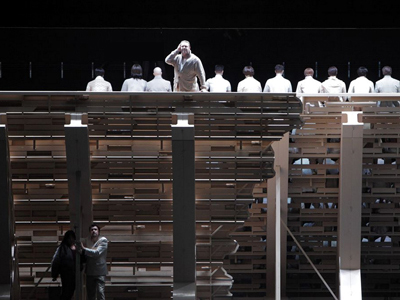
Árpád Schilling’s stadium-bound Rigoletto for Bavarian State Opera

By ANDREW POWELL
Published: December 21, 2012

MUNICH — They all laughed eight years ago when Bavarian State Opera set Verdi’s Rigoletto on the Planet of the Apes, and the production fast vanished. Naturally, then, the return of the deformed ducal jester in a new régie last Saturday (Dec. 15) promised relative normalcy, perhaps even a faithful night at the theater.

So much for expectations. Young Hungarian director Árpád Schilling gets the planet right but strips the bitter tale of period, place, and — crucially — social order. Stadium bleachers substitute for Renaissance Mantova. The action unfolds, when courtiers aren’t sitting, near and on top of the prompter’s box. Costumes suggest nouveau siècle clones on vacation.

Sure, this opera has traveled before without falling apart, to 1940s New York and to Hollywood studio offices, for example, but always with Victor Hugo’s power structure intact. Schilling’s Duca operates with no apparent authority, and his Gilda plays a tough game: remote, not much of a daughter, and never the guarded innocent.

Under the circumstances, the cast on opening night toiled uphill. Patricia Petibon keenly projected Gilda’s music, even when required to deliver the gushy Caro nome from the bleachers (and among the vile razza dannata). But her Italian eluded comprehension and her trills were feeble. Joseph Calleja, singing at the epicenter of his repertory, made an ideal Duca. The closing diminuendo revealed powers in reserve and superlative control.

Franco Vassallo had a good night too, robust of tone and expressive against the odds. In a singular blemish, the long last Pietà of Miei signori, perdono, pietate went amusingly haywire, as if he (correctly) sensed his jester character was emoting without pull in the house.

Tackling Monterone and Sparafucile, the Russian bass Dimitry Ivashchenko got to toy with Schilling’s one inspired prop, a penny-farthing wheelchair that serves as apparatus of the assassin. His is a majestic voice, and every consonant and vowel of the text came across. Nadia Krasteva, from Sofia, who this year concluded a ten-year stint as ensemble member at the Vienna State Opera, deployed her warm chest voice to striking effect in the roles of Giovanna and Maddalena. Sadly the director gives her little to do but vamp, which she does well, even if it is not necessarily what she does best.

Marco Armiliato drew immaculate playing from the orchestra. He also held the attention of the Bavarian State Opera Chorus, normally a weak link. Tempos were moderate, occasionally expansive.

Only time will tell whether Schilling’s non-conception lasts longer than the Apes show, but it should be around until Dec. 30, when Planet Earth gets to see it via streaming. Fabio Luisi is slated to lead performances next summer. For context, Bavarian State Opera mounts three new Verdi productions in 2012–13, scheduling nine Verdi operas in all, to balance the nine Wagner operas due.

Photo © Wilfried Hösl

Related posts:
Netrebko, Barcellona in Aida
Kušej Saps Verdi’s Forza
Kaufmann Sings Manrico
With Viotti, MRO Looks Back
Verdi’s Lady Netrebko

What’s Wrong With Canada?

Wednesday, December 19th, 2012

By Robyn Guilliams, Esq.

Dear Law and Disorder

Why is it necessary for Canadian performers to obtain work permits in order to perform in the United States? Although Visas are not necessary, the work permit is necessary. Why are the artists not able to enter the way other business people under the North American Free Trade Agreement? Cultural industries exempt are books, films and recordings. Why is performance by artists in the USA not covered by the Agreement?

We get this question a lot from our “northern” artists and the answer, though simple, is frustrating: the North American Free Trade Agreement (NAFTA) doesn’t cover performing artists.

Just like performers from all other non-U.S countries, Canadian performers are required to obtain O or P work authorization to perform in the United States. It is true that certain types of Canadian and Mexican workers may enter the United States and work legally pursuant to NAFTA. Unfortunately, this NAFTA exception to the usual visa requirement does not extend to performers.

It’s also true that NAFTA includes provisions pertaining to “Cultural Industries,” which include the production, distribution and sale of items such as books and magazines, CDs, DVDs, and sheet music. However, these provisions of NAFTA do not apply to performances. For these reasons, the usual laws pertaining to the arts and entertainment industry – including those pertaining to immigration and taxes! – apply equally to Canadians as well as all other non-resident artists performing in the U.S.

As for “why” NAFTA does not cover performing artists and performers, you would have to ask the unholy alliance of lobbyists, legislators, diplomats, and bureaucrats who negotiate these things.

________________________________________________________________

LAW AND DISORDER WILL BE TAKING A BREAK FOR THE HOLIDAYS!

WE WILL RESUME ON JANUARY 8, 2013….JUST IN TIME FOR APAP!!!

________________________________________________________________

For additional information and resources on this and other legal and business issues for the performing arts, visit ggartslaw.com

To ask your own question, write to lawanddisorder@musicalamerica.org.

All questions on any topic related to legal and business issues will be welcome. However, please post only general questions or hypotheticals. GG Arts Law reserves the right to alter, edit or, amend questions to focus on specific issues or to avoid names, circumstances, or any information that could be used to identify or embarrass a specific individual or organization. All questions will be posted anonymously.

__________________________________________________________________

THE OFFICIAL DISCLAIMER:

THIS IS NOT LEGAL ADVICE!

The purpose of this blog is to provide general advice and guidance, not legal advice. Please consult with an attorney familiar with your specific circumstances, facts, challenges, medications, psychiatric disorders, past-lives, karmic debt, and anything else that may impact your situation before drawing any conclusions, deciding upon a course of action, sending a nasty email, filing a lawsuit, or doing anything rash!

Tips for Giving a Successful Media Interview

Thursday, December 13th, 2012

By: Edna Landau

To ask a question, please write Ask Edna.

I am very grateful to my longtime friend and colleague, Albert Imperato, for sharing his time and expertise with me in connection with today’s blog post. Albert is a veteran of the public relations industry and Founding Partner of 21C Media Group, Inc. Most of the answer to the question below was formulated on the basis of a recent conversation with him.

Dear Edna:

I have enjoyed reading your blog and have noticed that there is a topic that you don’t seem to have addressed yet. It concerns interviews. I am a violinist in my early 30’s and am fortunate to have management; however, my manager hasn’t given me much guidance as to how to handle the interviews that sometimes precede my concerts. On some occasions, I have felt that I was too outspoken in an interview, or that I should have just talked less. Do you have some useful tips for me? —R.L.

Dear R.L.,

Thanks very much for your excellent question. Here are some guidelines that I hope you will find helpful in improving both the experience and the outcome of your interviews:

1) Know the exact nature of your interview. Will it be for radio, television, Internet or print? Will it be live or taped? Will it be for a profile of you or will your interview be one of several? If it is for a print publication, is the reader likely to be musically sophisticated or would they be considered more mainstream? This will help you in your preparation.

2) Make sure you know up front how much time the interviewer wants or you are prepared to give them. It will help you prioritize what you want to say. Review the allotted time with the interviewer at the start of the interview and try to keep track of it so that you don’t begin to ramble. In general, it is advisable to be as concise as possible, without sacrificing enthusiasm and warmth that might make the interview more meaningful.

3) Practice for the interview in advance with your manager, publicist (if you have one) or a trusted colleague. Prepare answers to any delicate questions you might anticipate. If you are doing a telephone interview, it might be wise to have bullet points in front of you to remind yourself of important things you want to say. Do not allow the interviewer to goad you into saying something you don’t want to say. Stick to your prepared answer and always remain respectful.

4) Bear in mind that you can introduce information even if you weren’t asked about it. For example, at a logical moment, you can say: By the way, I’m not sure if you were told that I have a new album out. When it comes to talking about future engagements, be careful not to divulge information that has not yet been released to the public by the presenter.

5) If you are asked a question that you don’t understand, ask for clarification. If you don’t know an answer, it’s better to say that you don’t know, than to speculate. If it’s not a live interview, you can offer to get back to the interviewer with an answer. It’s useful to take notes of key things you say during an interview (for future reference) if it doesn’t distract you too much.

6) If you are doing an in person live interview, try to arrive early so as to get comfortable with your surroundings. Arriving early also allows you to relax your body, clear your mind of any distractions, and summon up all of your positive energy.

7) Remember that there is no such thing as “off the record”, even if the interviewer agrees to it. Everything you say could be printed.

8) Try to avoid making negative comments because you can never know in what context they will appear. A joke may look different in print from what you intended. Keep a respectful tone and only say things you would feel comfortable having people read. Avoid controversial topics, such as politics.

9) Be wary of moments of silence. Many of us are tempted to speak in order to reduce the awkwardness at such times, but we are more likely to be off guard and say something we didn’t adequately think through.

10) Remember that you wouldn’t be doing the interview if your remarks weren’t expected to be newsworthy and enlightening. This should always be a source of confidence to you.

I asked Albert Imperato whether it’s possible to ask to see the questions in advance. He said that most writers prefer not to do this. They don’t want to compromise the spontaneity of the interview. It might be possible for a publicist to get a general sense of the thrust of an interview, especially if it will be live and on camera. In some instances, with print interviews, artists have been known to ask for the questions in advance and have given responses by e-mail, but this is more generally accepted in the case of performers who are universally acknowledged as having very busy schedules.

I hope these points prove helpful to you. Becoming adept at interviews is an art. You will undoubtedly learn from each one and before long, you will be able to teach others how to excel in them!

To ask a question, please write Ask Edna.

© Edna Landau 2012

Note: This is the final “Ask Edna” column of 2012. I wish all our readers a very happy holiday season and look forward to reconnecting with you on January 3, 2013!


Can I Re-Use an Old Union Consult Letter for a Visa Petition?

Wednesday, December 12th, 2012

By Brian Taylor Goldstein, Esq.

Dear Law and Disorder:

Last year I filed a P-1 petition for a group. I obtained a consult letter from AFM. When I filed a petition for their 2013 tour, the USCIS said I needed to get a new consult letter. I thought that union opinion letters are good for 3 years? Did that rule change?

No, nothing’s changed. There’s just a bit of confusion, that’s all. Union consultations for O-1B petitions are good for 2 years provided the artist is performing within 2 years of the date of the original union consultation letter. If that’s the case, then you don’t need to get a new one. However, this has never been the rule with P-1 petitions or any other category: O-2, P-1S, etc.

So, if you obtained an O-1B for an opera singer and you have an AGMA consult letter dated October 1, 2012, then that same consult letter can be used for subsequent O-1B petitions for the singer’s subsequent engagements through October 1, 2014. You just need to be able to provide a copy of the prior consultation letter. Even if the original consult letter was written for a different petitioner, you can still use it. It’s the identity of the artist that counts. However, if you obtained a P-1 for a group and you have an AFM consult letter dated October 1, 2012, then any and all new petitions will require new consult letters.

In your case, I assume you received a Request for Evidence (RFE) from USCIS. You just need to get a new consultation letter from AFM and attach it to your RFE response. That should do the trick.

________________________________________________________________

For additional information and resources on this and other legal and business issues for the performing arts, visit ggartslaw.com

To ask your own question, write to lawanddisorder@musicalamerica.org.

All questions on any topic related to legal and business issues will be welcome. However, please post only general questions or hypotheticals. GG Arts Law reserves the right to alter, edit or, amend questions to focus on specific issues or to avoid names, circumstances, or any information that could be used to identify or embarrass a specific individual or organization. All questions will be posted anonymously.

__________________________________________________________________

THE OFFICIAL DISCLAIMER:

THIS IS NOT LEGAL ADVICE!

The purpose of this blog is to provide general advice and guidance, not legal advice. Please consult with an attorney familiar with your specific circumstances, facts, challenges, medications, psychiatric disorders, past-lives, karmic debt, and anything else that may impact your situation before drawing any conclusions, deciding upon a course of action, sending a nasty email, filing a lawsuit, or doing anything rash!

MA’s Annual Joy

Friday, December 7th, 2012

by Sedgwick Clark

December is a special time for us at Musical America because we have the great pleasure of honoring a group of the finest musicians in the world and introducing the latest issue of our annual Directory. At our Awards party Joy to the World reigns, we forget about our typos, gnashing of teeth over cancelled bookings, dried up press outlets, and orchestra deficits.

Last night (Thursday, December 6) was no exception. Our five 2013 awardees were eloquent and humble in their expression of the art to which they have committed their lives. They are:

Musician of the Year: Gustavo Dudamel

Composer of the Year: David Lang

Instrumentalist of the Year: Wu Man

Vocalist of the Year: Joyce DiDonato

Educator of the Year: José Antonio Abreu

As always on this favorite annual night of my professional life, I felt honored in being able to present the awards to such incredibly musical artists who have made my distinctly unmusical but appreciative life such an immense pleasure night after night in New York’s concert halls for the past 44 years. I don’t mean to slight the first four of the artists above when I say that I had an extraordinary reaction when Maestro Abreu arrived with his large family and associates. We shook hands and he smiled and spoke warmly of how pleased he was to be here, and I just lost it. To be in the same room as the conductor and teacher hailed as creator of the most imaginative approach to music education in our time was simply overwhelming. I sputtered a few ridiculous words of our pleasure to have him here and had to turn away. Thinking about my reaction, the only word I have been able to come up with to describe him is “saintly,” a word that astonishes me I could utter.

Oh, well . . . .

The very first issue of the Musical America International Directory of the Performing Arts in 1961 hailed a single Musician of the Year on our cover, Leonard Bernstein. In 1992, the number of artists was increased to include a Composer of the Year, a Conductor, an Instrumentalist, and a Vocalist. The thinking was—rightly so—that there are so many extraordinary musicians deserving of recognition that we should widen the field. Since then, awards have gone to Ensembles, Educators, Collaborative Pianists, and an Impresario as well.

Years ago, the late Audrey Michaels called to tell me that bookings of one of her clients, the violinist Cho-Liang Lin, had increased noticeably after being named Instrumentalist of the Year (2000). Nothing has made my time at Musical America more satisfying.

Looking Forward

My week’s scheduled concerts (8:00 p.m. unless otherwise noted):

12/7 Carnegie Hall. Venezuelan Brass Ensemble/Thomas Clamor.

12/8 Zankel Hall at 1:00. El Sistema lecture and panel. Leon Botstein (keynote lecture), José Antonio Abreu, Gustavo Dudamel (panelists), Jeremy Geffen (moderator).

12/8 BAM Harvey Theater at 7:30. Anonymous 4. David Lang: love fail.

12/9 Juilliard School. Willson Theater at 2 p.m. Juilliard Opera/Mark Shapiro. Britten: Curlew River. Vaughan Williams: Riders to the Sea.

12/10 Carnegie Hall. Simón Bolívar Symphony Orchestra of Venezuela/Gustavo Dudamel. Revueltas: La noche de las Mayas. Chávez: Sinfonía india. Orbón: Tres versiones sinfónicas.

12/11 Carnegie Hall. Simón Bolívar Symphony Orchestra of Venezuela/Gustavo Dudamel; Aquiles Machado, tenor; Gaspar Colón. Baritone; Westminster Symphonic Choir. Esteban Benzecry: “Chaac (Maya Water God)” from Rituales Amerindios. Villa-Lobos: Chôros No. 10. Antonio Estévez: Cantata criolla.

12/12 Symphony Space. Ensemble for the Romantic Century. Jekyll and Hyde. The drama of Dr. Jekyll and his demonic double unfold in a psychoanalytic tale of horror in turn-of-the-century Vienna. Featuring music by Mahler, Schubert, Schumann, Webern, Berg, Zemlinsky, Brahms, Pfitzner, and Schoenberg. Written by Eve Wolf.

A Studio of Entrepreneurs

Thursday, December 6th, 2012

By: Edna Landau

To ask a question, please write Ask Edna.

I have often wondered whether violists are more entrepreneurial than other groups of musicians. I have written about Nadia Sirota and have had Jessica Meyer as a guest on this blog, to name just two whom I admire greatly. This idea was reinforced when I had occasion to meet Fitz Gary, a violist in Juilliard’s Master’s program, who together with a very entrepreneurial cellist (!), Avery Waite, mounted a concert last June called Music Feeds Us in their home town of Charlottesville, Virginia. Inspired by Music for Food Boston, founded by the esteemed violist Kim Kashkashian, they raised $6,483 and 482 pounds of food for the Blue Ridge Area Food Bank, which is equivalent to 26,333 meals. A Google search for further information about Fitz Gary led me to the website of The American Viola Society, and a most fascinating blog emanating from the Juilliard studio of Heidi Castleman, Misha Amory, Hsin-Yun Huang, and Steven Tenenbom, a.k.a the “ACHT” Viola Studio. (Robert Vernon, Principal Viola of the Cleveland Orchestra, also works with many of the students.) Hosted by the American Viola Society, it is called the AVS Pedagogy Blog, or From the Studio. Each day of the week, the studio’s students, teachers, teaching assistants, as well as alumni, post columns on the blog which break down into five categories: Outreach and Resources, Pedagogy, Repertoire and Interpretation, Technique, and The Cast. The Cast typically introduces students in the studio in an interview format, hence a column entitled Introducing Fitz Gary!, in which he reveals that when he was in fifth grade and had to choose an instrument, he chose the viola because the line to try it was the shortest.

Over coffee with Heidi Castleman, I learned that it was Edward Klorman, a violist and teaching assistant in the “ACHT” Studio and chair of the Music Theory and Analysis Department at Juilliard (who also sits on the board of the American Viola Society) who first told her of the Society’s desire to start a pedagogy blog. He conceived of it being a project of the “ACHT” Studio and the American Viola Society enthusiastically endorsed the idea. The studio signed on for the blog’s inaugural season. Prof. Castleman plays a central role in the project, along with the blog’s co-directors, Molly Carr and Gabriel Taubman. The beauty of this blog is that it gets students thinking and learning from one another and contains a wealth of information that should prove valuable to more than just violists. Jessica Chang’s wonderful article Starting Chamber Music by the Bay contains useful tips and inspirational ideas about music education that will undoubtedly help pave the way for like-minded musical entrepreneurs. I encourage everyone who can spare 5-10 minutes to read The Healing Power of Music: The Performer’s Gift, by Daniel Adams, and Hannah Ross’s Outreach in Tanzania, both of which touched me greatly. Clearly, this blog reflects the nature of the “ACHT” studio, which fosters the idea that students can be truly successful if they impact and relate to the world around them. Prof. Castleman surmises that violists, who play on an instrument that so often represents an “inner voice”, may particularly thrive on efforts to link to everything around them and share responsibility for the whole. Her holistic outlook for the students infuses the studio with optimism, the courage to pursue new initiatives, and a feeling of excitement about the endless possibilities for sharing their love of music with others.

Although there are other blogs with similar content, I believe that the “ACHT” studio blog is unique, in that all of the contributors are directly affiliated with the studio. It has an impressive number of readers from as far away as Singapore, Malaysia and New Zealand. I think it serves as an excellent model for other music studios and there is no doubt that all of the contributors have benefited greatly from sharing both music and life’s lessons and joys.

To ask a question, please write Ask Edna.

© Edna Landau 2012

Silence Is Not Golden!

Wednesday, December 5th, 2012

By Brian Taylor Goldstein, Esq.

Dear Law and Disorder:

Help! We are a small agency. We booked an engagement for one of our artists at a venue that has now cancelled the date. We had a series of emails with the venue confirming the date and fee and then sent them a formal contract that was never returned. We followed up with more emails confirming the date and asking for the contract to be signed and returned, but they never did. The venue is now claiming that because they never signed and returned the contract, they were never obligated to do the show. Are they correct? Don’t the emails count for anything? How to we keep this from happening in the future?

When it comes to contracts, silence is never golden. If you sent a contract and it was never signed and returned, that should have been a huge red flag or at least an implicit sign that read: “Stop! Go no further! Abandon all hope ye who enter here!”

If you have a series of emails confirming the engagement, and you can show that you relied on those emails by reserving the date and by turning away other bookings for that date and you can show that the venue knew you were relying and never stopped you, then, legally, you may be able to establish that there was an implicit contractual relationship. But that’s only going to get you so far! If the venue still refuses to honor the engagement or re-book or pay a reasonable cancellation fee, then you’re going to have to decide whether or not its worth pursuing a claim by filing a lawsuit.

And, of course, it all depends on what your emails actually say. Often, I’ve seen a chain of emails between a venue and agent that confirms the engagement date and fee, but ends with the agent writing something like: “Great. So we’re all set. I’ll get a contract out to you right away.” Such language can be legally construed as making the entire deal contingent on the contract. And if the contract contains additional terms and requirements that were never previously discussed, then, the contract will be legally construed as a “counter-offer”, which the venue can then refuse.

If you’re taking the time to send out contracts, then you need to make sure they are signed and returned—and, if they are not, assume the engagement is cancelled, re-book the date and move on. I realize that the realities of time and other logistics can make babysitting contracts difficult. There are many times when situations will demand that you proceed without a signed contract. However, when you choose to do so, know that you are assuming the risk. If there is a breach or cancellation, you can’t then go back and seek the protection of a contract you never followed up on or enforce terms that were never agreed upon.

Even when you have a signed contract, there’s no guarantee that the other party won’t breach it. Contracts are not self-enforcing. They merely give you the right to go into court and present a strong argument that you are entitled to damages. More importantly, they give both parties the opportunity to share concerns and expectations and access risks and challenges to the relationship. If things do go badly, the contract is a tool through which you can make an argument. For certain, it’s not the only tool, but I’d much rather pound a nail with a hammer than my head.

_________________________________________________________________

For additional information and resources on this and other legal and business issues for the performing arts, visit ggartslaw.com

To ask your own question, write to lawanddisorder@musicalamerica.org.

All questions on any topic related to legal and business issues will be welcome. However, please post only general questions or hypotheticals. GG Arts Law reserves the right to alter, edit or, amend questions to focus on specific issues or to avoid names, circumstances, or any information that could be used to identify or embarrass a specific individual or organization. All questions will be posted anonymously.

__________________________________________________________________

THE OFFICIAL DISCLAIMER:

THIS IS NOT LEGAL ADVICE!

The purpose of this blog is to provide general advice and guidance, not legal advice. Please consult with an attorney familiar with your specific circumstances, facts, challenges, medications, psychiatric disorders, past-lives, karmic debt, and anything else that may impact your situation before drawing any conclusions, deciding upon a course of action, sending a nasty email, filing a lawsuit, or doing anything rash!

‘Mahlermania’ at the Deutsche Oper’s new Tischlerei

Friday, November 30th, 2012

By Rebecca Schmid

In the final scenes of Mahlermania, a ‘dramatic fantasy with music by Gustav Mahler’ conceived by the troupe Nico and the Navigators in cooperation with the Deutsche Oper to inaugurate the West Berlin opera house’s new alternative stage Tischlerei on November 27, manuscript paper and fur coats scatter across the stage in front of a dismembered composing hut. An actress representing Alma Mahler, donning a fur hat and trench coat, douses herself with champagne. In the midst of a chamber performance of Abschied from Das Lied von der Erde, a figure representing the alter-ego of the composer lets out a blood-curdling howl. “Es gab Mozart, Schubert,” blurts out Alma. “Damit muss man sich abfinden” (‚There was Mozart, Schubert. One was to resign oneself to it.’). The Viennese seductress is reduced to a superficial socialite when a dancer, also Alma, waves at the audience Miss America-style.

Few historical relationships lend themselves better to a theatrical realization than the tumultuous marriage of the Mahlers, ridden by the composer’s illness, his impotence alongside the ambitious Alma, and her affair with the architect Walter Gropius, not to mention the death of their first child. Mahlermania assembles a program of chamber arrangements by Anne Champert, Rainer Riehn, and Arnold Schönberg ranging from the celestial third movement of the Fourth Symphony to songs from the Knaben Wunderhorn and Rückert Lieder cycles, which are narrated with an experimental mix of dance and theater. At the center of the action is a speed-talking Alma (Annedore Kleist) whose insatiable materialism cannot be harnessed.

Gustav’s infamous sense of being “three times homeless” as a Bohemian among Austrians, an Austrian among Germans, and a Jew throughout the world is represented with suitcases, pacing, close-ups of actors in awe-struck expressions, and the lowly shack—alongside a nearly obsessive amount of furs. At one point, Kleist reveals the history of each directly to the audience, in English—“I posed in this one for Kokoschka, totally nude…1910, New York.” More effective than such indulgent sarcasm are gestures that allow the music to breathe, such as a video projection of rolling waves onto the gauze sphere surrounding the members of the Deutsche Oper orchestra during the third movement of the First Symphony.

Mezzo soprano Katarina Bradic and baritone Simon Pauly bring sensitive musicianship to Mahler’s songs and blend well dramatically, but their performances are often intercepted by failed attempts to add psychological depth, such as the dancer Anna-Luise Recke’s ravenous munching of an apple during Bradic’s earthy tones in the devastating “Ich bin der Welt abhanden gekommen” (‘I am lost to the world’) of the Rückert Lieder. A few dance episodes gain more traction, such as when the athletic Frank Willens psychoanalyzes the lithe, Sasha Waltz-inspired moves of Recke as ego-driven before scaling the bare walls of the hut, but the Freudian twist become hackneyed as Willens takes on a purely theatrical role, diagnosing Alma as he puffs on a cigarette.

Nico and the Navigators cannot be criticized for allowing tastelessness to overrun their concept, sparing the audience the nudity and fake blood that have become signatures in German theater, but the high point lies in the musical gems brought together for the occasion. Moritz Gnann and his 16-head ensemble capably evoked the composer’s brushes with death and sighs at the world’s beauty with gleaming tone in the woodwinds, even if the string section led by Detlev Grevesmühl could have benefitted from more flexible lyricism. The new Tischlerei, a generous concrete space with raked seating designed by German architect Stefan Braunfels, provided intimate acoustics.

The new stage for experimental Musiktheater, having secured support from the Berlin Senate, the pharmaceutical company Aventis, and other private sponsors, has the potential to incubate exciting collaborations in a city where the alternative scene is just starting to win the attention and funding for which it has long been fighting. In a post-performance celebration over pro secco and pretzels, young creatives mingled with the bourgeois core audience of the Deutsche Oper as well as the new Intendant Dietmar Schwarz and the city’s Culture Secretary André Schmitz. The German capital is fortunate to be booming while recession beleaguers many parts of Europe. Yet if Mahlermania stands an example of what is to come at the Tischlerei, it is the dramaturgy that will provide the biggest challenge.

rebeccaschmid.info

More Delights in New York Concert Halls

Thursday, November 29th, 2012

by Sedgwick Clark

Gardiner’s “Authentic” Missa solemnis

I was driving with a friend over Thanksgiving weekend, and we tuned in during the middle movement of a Sibelius Violin Concerto on Sirius FM. I was quickly enthralled by the soloist’s rubato and technical command and declared him to be “an old Russian violinist.” When I heard the double basses’ pianississimo in the last five bars, barely audible yet with firm tone, I had no doubt: “This is the 1959 Heifetz with Hendl and the Chicago Symphony.” Indeed, it was. But what pleased me more than my good guess was that for years I have considered it inferior to the violinist’s 1937 recording with Beecham. The later recording’s freedom, especially in the finale’s wild accelerating into climaxes and subsequent backing off as the temperature cools, bothered me in my youth, but last week I reveled in it. The recording hadn’t changed, but I had!

I keep hoping I’ll change in my appreciation of “period” performances. Alas, except for a couple of pages at the beginning and end of the Adagio section of the Credo, where he managed to elicit momentary meaning and emotion, John Eliot Gardiner’s performance of Beethoven’s Missa solemnis with the Orchestre Révolutionnaire et Romantique and the Monteverdi Choir at Carnegie (11/17) was his typically punctilious reading of notes on the wretched-sounding, so-called stylistically correct instruments that many find to be illuminating. With Colin Davis’s awe-inspiring interpretation with the London Symphony Orchestra’s modern instruments last season indelibly imprinted in my memory (10/27/11), Gardiner’s puny conception couldn’t hope to compete. The Times’s new lady on the aisle, Corinna da Fonseca-Wollheim, filed a more welcoming point of view on 11/19.

Frühbeck’s “Charmingly Unstylish” Mozart

Far more to my liking, on 10/26 with the New York Philharmonic, was Rafael Frühbeck de Burgos’s charmingly old-fashioned account of Mozart’s Serenata notturna. In the Menuetto’s Trio, for the four principal strings, he didn’t even conduct but sat back and smiled while they played. (George Szell conducted solos.) Frühbeck was Musical America’s Conductor of the Year in 2011, and I went backstage to say hello. “I loved your Mozart!” I said in greeting him, and he laughed broadly. “Well, you know, that’s the way we all played Mozart when I was young. I know it’s not the way young conductors do it today, but I like it that way. The Philharmonic is such a great orchestra, and I love to conduct them. I’m going to do Heldenleben next season,” he confided with great relish.

Frühbeck had looked fine back in June, when he conducted Carmina burana, but not now. He had lost weight and walked to the podium with great effort and sat while conducting. I spoke with a friend in the orchestra, who told me that he had had stomach cancer; but his doctor assured him that his recent surgery was completely successful, and she said that he had conducted as if he had a new lease on life. The Philharmonic musicians played their hearts out for him in Mahler’s First. Next summer he will conduct the Boston Symphony in Mahler’s Third in the opening weekend at Tanglewood.

DiDonato’s Drama Queens

Kansas mezzo-soprano Joyce DiDonato is irresistible, a self-evident statement to the some 2,800 music lovers who delighted at her catchily dubbed “Drama Queens” recital a couple of Sunday afternoons ago (11/18). The program encompassed a selection of arias from Baroque operas that depict queens and royalty, including works from Orlandini’s Berenice, Cesti’s Oronotea, Monteverdi’s L’incoronazione di Poppea, Radamisto, and Alesandro, Giacomelli’s Merope, Hasse’s Antonio e Cleopatra, Porta’s Ifigenia in Aulide, and Handel’s Giulio Cesare, plus orchestral works by Vivaldi and Scarlatti. She’s presenting this recital internationally for the next year, and Virgin Classics just released her recording of it. Her backup band, Il Complesso Barocco, with Dmitry Sinkovsky as director and violinist, was ideal.

Philharmonia on My Mind

Everyone at Avery Fisher Hall was talking about the ravishing sound of the Philharmonia Orchestra. It wasn’t that Esa-Pekka Salonen conducting Mahler’s Ninth (11/18) and a semi-staged version of Berg’s Wozzeck (11/19) was small potatoes. The Philharmonia has a noble tradition for its beauty of sound. Created just after World War II by Walter Legge primarily as a recording orchestra, its timbre was honed by Furtwängler and Karajan in many recordings that have never left the catalogue. Klemperer was its most visible leader from the mid 1950s through the end of the next decade, with memorable concerts and recordings during that time by Giulini and Frühbeck de Burgos. But its direction and reputation had begun to falter during Klemperer’s decline in the late 1960s, which led to a freelance image buoyed by occasional appearances by such notables as Boult and Barbirolli.

But no one could remember when the orchestra last played in New York. The most recent I could recall was in November 1971, when the orchestra was named the New Philharmonia and Avery Fisher was still called Philharmonic Hall: Lorin Maazel led crack renditions of Sibelius’s Seventh, Delius’s Paris, and Bartók’s Miraculous Mandarin Suite, conducting the latter’s hectic final dance with his rear end.

Calls to Lincoln Center and Carnegie Hall’s Archives revealed that the Philharmonia graced Fisher Hall most recently in January 2002 with Vladimir Ashkenazy conducting. Prior to that were concerts in March 1988 and January 1990 conducted by the orchestra’s then-principal conductor Giuseppe Sinopoli, an interesting but variable maestro. The ensemble’s most recent New York appearance was in a pair of Carnegie concerts in October 2003 with Christoph von Dohnányi (in works by Bruckner, Wagner, Haydn, Brahms—no wonder I didn’t go), a maestro whose sole distinction, to my ears, lies in performances of the New Vienna School and complex 20th-century works.

So perhaps the way to get the orchestra noticed is to play compelling programs, eh? I have no doubt that E-P wanted the audience to make the connection of Mahler’s final completed symphony (1909) with Berg’s first opera (sketches begun in spring 1914, orchestral score finished eight years later, premiere performance by the Berlin Opera under Erich Kleiber on December 14, 1925). In other words, had Mahler lived, the late-Romantic language of his valedictory Ninth Symphony would have developed into the ripely atonal world of Berg’s Wozzeck.

In the Mahler, Salonen’s tightly knit opening movement was most impressive, avoiding the incoherent sprawl of many current performances. Still, the triple-forte climax, which Mahler marks “with utmost violence,” could have been more cataclysmic (where was the tam-tam?). The middle movements lacked character, and the finale was shapeless. The brass did not always avoid the Fisher Hall glare but otherwise played with distinction. Woodwinds were infallible throughout, with honors going to the bassoons and contrabassoon. And the strings! Their consistent beauty of tone, from whispered pianissimi to massed fortissimi, and attention to Mahler’s frequent portamento indications were the highlight of the afternoon.

In Wozzeck the next evening, the Philharmonia was simply astonishing, conjuring up orchestral wonderment that even surpassed the Metropolitan Opera Orchestra under James Levine. However—and it’s a big however—Salonen allowed the orchestra to cover the singers so often that their only recourse was to bellow (the Berg Bark?). Of the major roles, heard from audience right in Row V, only Angela Denoke’s touching Marie and Tijl Faveyts’s cheerfully demented Doctor went unscathed. In the end, frustrating though the vocal balance may have been, the tradeoff of hearing Berg’s orchestral writing played so magnificently won the day for me. And if a recording was made in London before setting off on tour, the engineers can fix it in the mix!

Salonen is the Philharmonia’s current beau, and judging from the clamorous audience response he may turn out to be what the orchestra-lovers’ doctor ordered. Lincoln Center already has two major Brit bands as regular tenants—the London Symphony and London Philharmonic—and it would behoove Jane Moss and company to add the Philharmonia to its stable ASAP.

Looking Forward

12/1 Avery Fisher Hall. New York Philharmonic/Alan Gilbert; Gil Shaham, violin. Steven Stucky: Symphony. Barber: Violin Concerto. Rachmaninoff: Symphonic Dances.