Archive for 2013

Minnesota Chicken

Thursday, September 12th, 2013

by Sedgwick Clark

Will the Minnesota Orchestra board of directors and musicians union commit corporate hari-kari? The deadline imposed on the players by the board is this Sunday, September 15. Minneapolis Mayor R.T. Rybak is quoted in the local StarTribune, “Lock yourself in a room and shut up about it until you come back with a solution. The community is disgusted and desperate.” Among my vivid memories of these artists is a program of Beethoven’s Grosse Fuge and Sibelius’s Kullervo at Carnegie Hall on February 28, 2010. One does not need to live in Minneapolis to be “disgusted and desperate.” See my blog of August 31 for details.

Are Recordings “Honest”?

For over three decades now, digital editing has rendered studio recordings unreliable as documents of a performance, just as photoshop has destroyed the verity of photographs. It’s only in a live concert that we can truly judge a performer’s technical acumen or artistic ability—and still one may legitimately wonder if the hall might be assisted by discreet miking.

So my interest was piqued a few days ago by this paragraph in a Decca press release of a Liszt recital by a young pianist who has reportedly achieved renown via U Tube:

“A fiery performer who likes to take risks, Valentina Lisitsa recorded one version of the recital direct to analogue tape, transferred without edits for a special edition LP product. Due to size limits, the LP edition contains slightly less repertoire than the full album.  Lisitsa simultaneously recorded in high-resolution 24-bit digital audio to make the most of modern music formats.”

I don’t know how the two separate performances could be recorded “simultaneously”—“in the same sessions” would be more accurate—but I’m being picky. Actually, truth in recordings became a thing of the past about 30 years before digital editing. Prior to the advent of tape, in 1948, records were made in approximately four-minute “takes,” and the artist(s) would make as many takes as necessary (or affordable) to achieve a releasable result. Some were barely that: Listen to the shocking hash that Artur Schnabel makes of the mighty solo-piano fusillade that opens the development section of the Brahms D-minor Piano Concerto’s first movement. I played that passage for David Dubal and Ruth Laredo one afternoon at WNCN, and they nearly fell out of their chairs.

No pianist today would dare play like that in public. Note-perfect performances are simply expected. We’ll see how Lisitsa’s honest LP measures up to the digital “product” when the recordings are released on October 8.

Looking Forward

My week’s scheduled concerts (8:00 p.m. unless otherwise noted):

9/17. Avery Fisher Hall. New York Philharmonic/Constantine Kitsopoulos; Alec Baldwin, narrator. Hitchcock! Excerpts from Vertigo, North by Northwest, To Catch a Thief, Dial M for Murder, and Strangers on a Train with soundtracks performed live.

Inspiration and Mentoring in the Workplace

Thursday, September 12th, 2013

by Edna Landau

To ask a question, please write Ask Edna.

Over the summer months, I had the opportunity to speak with a number of young people who are currently working in artist management, as well as others who have moved on to different areas of the classical music business. Having felt for a long time that we are not doing enough to nurture the next generation of artist managers, I asked for their opinions and suggestions. Overall, they tended to concur with my supposition; however, they all felt that the situation could be improved despite changes in the industry and the minimal profit margins that many artist managements face. The most immediate problem for those entering the field is the limited opportunities for upward mobility. They often have a music background and are willing to start at a low salary with entry-level responsibilities, with the hope that their situation will improve before too long. They soon learn that there is no built-in system for advancement, and that promotions are often dependent on someone leaving the company since the budget rarely allows for adding new positions unless there are significant new artist signings or touring attractions. What can make a real difference during this indefinite “apprenticeship” period is if those senior to them take advantage of opportunities to inspire and mentor them in ways that will nurture their talents and groom them for future higher positions within the company as they open up. Often this doesn’t happen and when word gets out to other agencies about their promising potential, they are snatched away at a higher salary (which might only be $2500 to $5000 more). Might there not have been a way to trim the expense budget enough to hold on to them? The process of training a new person can be lengthy and time-consuming, and there is always the danger of a dip in morale with staff departures. How can we do a better job of nurturing and mentoring gifted younger talent to avoid the disruptions that regular turnover causes in our businesses? Here are some ideas that we came up with together:

Senior staff should check in on junior employees at least once a week to see how they are doing. They should make sure to offer praise for work well done. They should inform them when visitors might be coming into the office and make every effort to introduce them to one another. Just about everything in the artist management business revolves around personal relationships. People at every level will work harder if they get to meet people with whom they interact on a regular basis. It should go without saying that every individual who works on behalf of an artist at any level should have the opportunity to meet that artist when they visit the office.

If possible, managers should give their associates/assistants opportunities to listen to conversations that might be particularly enlightening (at least to one side of the conversation, if using a speaker phone is awkward). There is no better way to learn how to negotiate fees than to eavesdrop on a manager adroitly navigating their way through a demanding negotiation. Managers should also share with their assistants details of some of the challenges they have been encountering, asking how they might have dealt with such challenges and leaving ample time for questions. Once managers and their assistants have worked together for a while, it becomes especially meaningful if they invite them to artist meetings. It demonstrates to the artist that they have a team to turn to at all times and it is very gratifying to the assistants to feel trusted in this way. An additional way to convey a sense of trust is to give the assistant a small project to handle on their own, with the prior understanding of what is to be undertaken and the desired goal. Constructive feedback (and hopefully praise) at the end of the project helps enormously to build confidence and a sense of achievement.

An incalculable amount can be learned by being cc’d (or blind copied) on e-mails.  When Charles Hamlen and I headed up Hamlen/Landau Management and later IMG Artists, we circulated our daily correspondence to anyone who felt inclined to read it. Managers tend to travel a great deal and sometimes it can be difficult to keep up with everything while on the road. An informed junior colleague will be up to date on their activities and will be familiar with their style of dealing with artists and presenters—a great advantage during the manager’s absence.

No matter what challenges crop up on any day, it is important for the senior artist manager to present a positive and upbeat demeanor to junior employees. If they often come across as exhausted and frustrated, they could seriously cause a young colleague to wonder if this is a direction they should personally be contemplating. All of us who have spent a great deal of time in the artist management business and the classical music industry in general undoubtedly feel that the joys of our work far outweigh any possible drawbacks. Our only hope in attracting new gifted talent to the field is to demonstrate that joy and communicate it regularly to those around us.

In thinking about colleagues of mine with the greatest longevity in our business, I was drawn to contact R. Douglas Sheldon, the greatly respected Sr. Vice President and Director of Columbia Artists Management Inc. (CAMI). He kindly agreed to meet with me and share some personal insights gained over 47 years with the company. He came to CAMI in 1966 from the Rochester Philharmonic and started out as the Midwest booking representative. There was no formal training but he learned from watching Ed Kneedler, who ran the booking department, and later from Sheldon Gold and Ronald Wilford. He also cites as mentors such legendary presenters as John Edwards (Chicago Symphony), Bill Dawson and Fan Taylor (both managers of the University of Wisconsin cultural presentations), Al Edgar (with whom he founded the Ames International Festival in 1969) and Chicago impresario, Harry Zelzer. After four years, Mr. Sheldon became Director of Booking, a position he held until 1979. His subsequent work has focused on management of leading artists and orchestras, as well as developing younger talent. Anyone who comes in contact with Doug Sheldon surely has no doubt of his total dedication and passion for the business, which must have played a big role in keeping an associate such as Mary Jo Connealy working alongside him for 25 years (until her untimely death in 2005). She began as his second secretary, handling itineraries, logistics and tour budgets, but brought with her a strong musical training and an acute ear for talent. In her seventh year at CAMI, he asked her to travel with violinist Anne-Sophie Mutter for three Canadian dates during a recital tour. The respect that had begun to develop between the two solidified during that time and led to close work together over many years, yet at no point did Ms. Mutter question Mr. Sheldon’s ongoing dedication to her and the development of her career. Ms. Connealy went on to become a Vice President and beloved artist manager at CAMI.

Doug Sheldon spoke to me about young people applying for jobs at CAMI today. Their first question is often about the path for promotion at the company. He tells them that there is no “path,” but offers to introduce them to a good number of people who started at the most basic entry level and now occupy significant positions. He explains that they succeeded in earning the company’s and its artists’ confidence and created their own path. I asked how he personally helped some of them along the way. He spoke of the importance of sharing information, philosophy and context. He further explained that there is no point in asking someone to handle their first fee negotiation if they don’t possess background on the artist and presenter and understand the significance of the date and the depth of the relationship that led to the negotiation. He was also quick to add that one should always remain open to hearing from younger colleagues as “their ideas can be better than your own.”

Doug Sheldon spoke of his team of six as “helping him accomplish what he could never do on his own.” For that reason, he feels they should know as much as possible about his work. He has daily interaction with them and they have total access to his e-mail correspondence. One imagines that with this style of working, everyone wins. I recall attending Doug Sheldon’s 60th birthday party during which Zarin Mehta, among others, made a toast. He said that he could sum him up in just one word: integrity. I am sure that all of us who have been privileged to work in the artist management field for a long while strive to bring integrity, first and foremost, to everything that we do. We must dedicate ourselves to sharing that goal with our younger colleagues and give them the tools with which to achieve it.

To ask a question, please write Ask Edna.

© Edna Landau 2013

Please note that this column will henceforth be posted biweekly.

Salon Style Dance: Miro Magliore’s Chamber Ballet

Tuesday, September 10th, 2013

By Rachel Straus

Small is beautiful. That has been Miro Magliore’s approach to dance making since he created the New Chamber Ballet in 2004. On September 6 and 7, at New York City Center’s Studio Five, Magliore presented five short ballets. His selection of a salon-size cast—five female dancers and two musicians—and his decision to annually present his two-night seasons in a bare bones studio are not just practical responses to the dire state of U.S. arts funding. They express his aesthetic vision. Magliore’s ballets cleave to modesty. His City Center evenings, which offer neither sets nor lighting, bear a similarity to the experience of sitting in one of the spare Lutheran churches of his German homeland. In contrast to the baroque spectacle of Roman Catholic churches (and Broadway theaters a few blocks west of City Center), Magliore’s presentations, which always feature live music, are the opposite of the razzle and dazzle. A large number of his sixty plus dances explore classical ballet as modernist minimalism (think Mondrian’s grid paintings or Balanchine’s Agon). His works demonstrate how ballet can occupy a space, and develop a small, loyal audience, beyond its visible position as an elite opera house entertainment for the rich and powerful.

Magliore’s newest work Oracle, seen on the 7, is for three dancers and it’s a departure for this trained composer, who has a penchant for dissonant classical music. The only sound in Oracle comes from the rhythmic rattles and propulsive stabs produced by the dancers’ African-style anklets and by the wooden blocks of their pointe shoes. The Oracle of the ballet’s title is Traci Finch. She rushes onto the stage and throws herself onto the floor. When she enters the dance space, marked by a square of white tape, she places the rattles, made of dried seeds, around her ankle. She disturbs a pastoral tableau created by the supine Sarah Atkins and Holly Curran, who, like she, are wearing Greek-style tunic dresses and golden bands in their hair (created by Sarah Thea Swafford). Finch spurs the sleeping pair into dance, and when she does, the trio performs triplet rhythms reminiscent of galloping horses. But instead of running, the lithe women execute échappés (open and closing of the legs) and passes (balances on one leg), which in pointe shoes develop pliable and steely pointe dancing. When the three women circle the space in sets of three unison lunges, which pause long enough for their rattles to cease their echoing of the movement, they resemble three Greek muses, floating.

The subject of Oracle certainly references ancient mythology. Finch, who is as an outsider and is abandoned at the ballet’s end, is the soothsayer. She sees a dire future, becomes frenzied (her ankle rattle becomes possessed by a shuddering invisible demon), and then she drops dead. She’s seen the worst, but what it is is anyone’s guess. Magliore’s approach to these events isn’t particularly interesting. It’s difficult to create epic drama without music, a sizable cast, and danceable music. But this new work should be perceived as a failure. It’s a highly imaginative use of two traditions: pointe work from Europe and instruments from Africa (or the Middle East). When the dancers break into Dionysian solos, each undulating their torso to the accompaniment of their fellows dancers’ rhythmic stamping, Magliore is in new territory. I hope he continues this cross-continental pollination.

The other works on the program were Klaverstück (2008) to Karlheinz Stockhausen’s Klavierstück IX (as played by pianist Melody Fader and danced by Elizabeth Brown and Holly Curran). In A Simple Black Dress (2010) to Pierre Boulez’s Anthèmes (as played by violinist Doori Na and danced by the remarkable Amber Neff), Anna’s Last Day (2013) to Rebecca Saunders’ Duo for violin and piano (with a cast of Na, Fader, Sarah Atkins and Neff) and The Letter to Joseph Haydn’s Piano Sonata No. 50 in D Major (with Fader, Brown and Curran). In each ballet, the musicans performed with or next to the dancers.

In Magliore’s world, music and dance are given equal weight, both visually and aurally. In Magliore’s world, small isn’t just beautiful, it expresses something of the divine.

* The New Chamber Ballet’s 2013 season isn’t finished. For more information, go to Magliore’s company website or click upcoming performances.

Popularizing the Classics

Thursday, September 5th, 2013

by Sedgwick Clark

In a thought-provoking article in the August 25th issue of The New Republic, Philip Kennicott addresses the crisis of American orchestras. “How an effort to popularize classical music undermines what makes orchestras great,” reads the deck. What exactly does “popularize” mean, and what will it undermine?

Is it “popularization” for the New York Philharmonic to play two pre-subscription season film-music programs in tandem with the films — the first being excerpts from five Hitchcock films (8/17 & 18) and the second a complete showing of Stanley Kubrick’s 2001: A Space Odyssey with Alan Gilbert conducting the classical foreground score (8/20 & 21)? Or is popularization driving Carnegie Hall’s opening-night mix (10/2) with the Philadelphia Orchestra under Yannick Nézet-Seguin: classical bon-bons by Tchaikovsky, Saint-Saëns, and Ravel, with Josh Bell as soloist, followed by Esperanza Spalding in new arrangements for double bass from her latest CD? Or would orchestral arrangements of pop music be attempts at popularization? Well, of course they are, and what of it? Did members of the Philharmonic sully their artistry when they moonlighted in Bernstein’s Deutsche Grammophon recording of West Side Story? No comment necessary.

All I know is that I plan to go to the pre-season NYPhil concerts because I love those films and their music, and that won’t stop me from going to several of the orchestra’s subscription concerts if I like the programs. I especially look forward to hearing the Hitchcock cuts in full orchestral dress. My major concern is whether the Philharmonic gets good copies of the films. Several years ago, John Williams led a concert of his film music at the Phil, and the film sources were washed out and grainy. (I was told when I complained to management that he brought his own films, tailored for the concert.) I’ll go to the Carnegie opening too, enjoy the “classical” selections of the program, and (if deadline permits) maybe even stick around for the Esperanza Spalding part. But I don’t think I’ll be attending a complete Spalding concert or the Philly playing arrangements of Bruce Springsteen hits. New Jersey Governor Christie can have my seat if that ever happens.

We’ve Been Hacked!

Wednesday, September 4th, 2013

By Robyn Guilliams

Dear Law & Disorder: Performing Arts Division,

We are a small presenting organization, and we use an outside company to handle our ticket sales.  The company provides us with cloud-based software, which we use to process both online and box office ticket sales. We were recently informed by the software company that they’d been hacked!  The company told us that all of our patrons’ relevant information may have been compromised, including their credit card information. A lawyer on our board said that we are responsible for notifying all of our patrons of the security breach.  Is this true?  There are over 8,000 patrons in the system, going back quite a few years!  We don’t have the personnel to devote to this type of project.  One of the reasons we out-sourced our ticketing was to avoid handling and storing this type of sensitive information.  If we don’t handle the credit card information, why are we responsible if that information is stolen?

Oy, what a headache!

Unfortunately, I would guess that the terms of your organization’s contract with the ticketing software company require your organization to notify its patrons in the event of this type of security breach.  In fact, the contracts I’ve seen for this type of service require that the presenting organization indemnify the software company in the event of a breach.  This means that you are not only responsible for your own legal expenses and damages should one of your patrons suffer a loss as a result of the breach, but you’ll have to pay the software company’s legal expenses and damages as well!  And usually, these types of provisions are not negotiable.

In addition, you may want to take a look at the website of the PCI (Payment Card Industry) Security Standards Council, which sets the standards for companies who process credit card transactions (like your ticketing software company.)

See: https://www.pcisecuritystandards.org/faq/

Because your organization doesn’t actually handle or store credit card data, it’s not required to be “PCI Compliant.” However, as stated on this site, “it is the responsibility of the merchant to ensure that the data they share with third parties is properly handled and protected – just because a merchant outsources all payment processing does not mean that the merchant won’t be held responsible by their acquirer or payment brand in the event of an account data compromise.”

The good news here (such as it is) is that most states provide a mechanism for an organization like yours to protect itself in the event a third party credit card processor is hacked.  Generally, if you provide timely notice to your patrons of the breach, you can’t be held liable for your patrons’ damages (the theory being that if your patrons know about the breach, they can take steps to protect themselves.)  For instance, in New York (and many other states), your organization is protected from liability if you notify your patrons of the security breach “in the most expedient time possible and without unreasonable delay.”  The notice can be made in writing, electronically, or by phone.

Also, there are insurance policies that cover this type of cyber liability.  These policies usually cover the cost of notifying your patrons, as well as any legal expenses or damages you may have due to the breach.

In short, the volunteer lawyer on your board is correct. (As we don’t often agree with most lawyers, this is a rare occurrence, indeed!) Given the vulnerability of identification fraud and the potential exposure of your organization, you’d be wise to find a way to notify your patrons.

_________________________________________________________________

Brian Goldstein and Robyn Guilliams will be attending the 2013 Midwest Arts Conference in Austin, Texas next week.

Our next blog will be on September 17, 2013.

_________________________________________________________________

For additional information and resources on this and other legal and business issues for the performing arts, visit ggartslaw.com

To ask your own question, write to lawanddisorder@musicalamerica.org.

All questions on any topic related to legal and business issues will be welcome. However, please post only general questions or hypotheticals. GG Arts Law reserves the right to alter, edit or, amend questions to focus on specific issues or to avoid names, circumstances, or any information that could be used to identify or embarrass a specific individual or organization. All questions will be posted anonymously.

__________________________________________________________________

THE OFFICIAL DISCLAIMER:

THIS IS NOT LEGAL ADVICE!

The purpose of this blog is to provide general advice and guidance, not legal advice. Please consult with an attorney familiar with your specific circumstances, facts, challenges, medications, psychiatric disorders, past-lives, karmic debt, and anything else that may impact your situation before drawing any conclusions, deciding upon a course of action, sending a nasty email, filing a lawsuit, or doing anything rash!

The Minnesota Orchestra’s Dance of Death

Thursday, August 29th, 2013

by Sedgwick Clark 

EXTRA! EXTRA!

Moments after posting this blog I received a press release announcing that “The Minnesota Orchestra Board Negotiating Committee has issued a revised contract proposal in the ongoing labor dispute with the Musicians’ Union that would lift the musician lockout and significantly modify both the proposed wage reduction and the number of work rule changes sought.” While the news is encouraging, we await a response from the Musicians’ Union. My general comments still apply.

SEE THE MUSICAL AMERICA WEBSITE FOR A COMPLETE REPORT!  http://www.musicalamerica.com/news/newsstory.cfm?storyid=30280&categoryid=1&archived=0 

It has the makings of Shakespearean tragedy. If orchestra musicians believe they can make a comparable living as freelance chamber-music players in today’s economy, they should hold their course and believe that managements will eventually cave in. If Boards of Directors cease believing in the reason for their existence, they should stick to their union-busting guns and allow the orchestra to die. If a prideful music director believes more in the music than in the music-making, he should resign his position.

We watch aghast as one of the most distinguished American orchestras, a tea party Board of Directors, and one of the foremost conductors of our time march toward Armageddon. A press release arrived yesterday, and my heart skipped a beat in hope of a sanity sunrise. But, no, Minneapolis music lovers had not lynched the president of the board, the orchestra union remained in untenable lockstep, and Music Director Osmo Vänskä clung to “the week of” September 30 as the deadline for rehearsals to begin after a year-long strike and still perform adequately in his career dream—four concerts devoted to his countryman Sibelius’s seven symphonies at Carnegie Hall, beginning on November 2. Trumping that date, management stated that “the Minnesota Orchestra management and musicians will need to reach a contract agreement by Sunday, September 15,  . . . in order to give musicians appropriate notice to return to work by the end of the month.”

No one comes out of this disaster with a good odor. It took bankruptcy to convince the Philadelphia Orchestra musicians that times had changed. Fact: The Minnesota Orchestra has a brilliant history of accomplishment over its 110 years, and in recent seasons at Carnegie Hall has challenged the best in the land. Fact: Many American orchestras’ audiences today will no longer support a 52-week season. Fact: The organization may not be able to continue with the budget and season of pre-recession times. Fact: If all factions of the Minnesota Orchestra cannot drop their rancor and point-making to get back to work and salvage the performance level instilled by Maestro Vänskä, its orchestra will be artistically irrelevant.

Ominously, or perhaps realistically, Carnegie Hall’s latest subscription brochure does not mention the Minnesota concerts.

Showcasing: A Rare Visa Exception

Wednesday, August 28th, 2013

By Brian Taylor Goldstein, Esq.

Dear Law and Disorder

Do non-US artists need artist visas when they come in to perform a showcase at a booking conference? They don’t get paid. Its just to get bookings. In fact, the artists lose money doing this. Can they enter on a tourist visa or do they have to spend even more money and go through the process of getting an artist visa?

Its rare that someone asks us an immigration question where they actually might like the answer…this may be one of those instances.

However, its first always worth remembering that, under current U.S. immigration law, whether or not a foreign artist is required to have an artist visa (almost always either an O or a P) is not related to payment. What triggers the need for an artist visa is performance. Whether or not an artist is paid, whether or not tickets are sold, whether or not the performance is public or private, whether or not the performance is for a non-profit educational or a cultural organization, if an artist performs, and there is someone watching the performance, he or she is required to have an appropriate artist visa.

Except for rare and limited exceptions, an artist can never perform on a visitor visa or, if applicable, under the visa waiver program. One exception is a competition. An artist is not required to have an artist visa if the artist is coming to the U.S. for the sole purpose of participating in a competition where there is no payment other than expenses and a prize, monetary or otherwise. Another exception is an audition. An artist is not required to have an artist visa if the artist is coming to the U.S. for the sole purpose of auditioning or meeting with producers or presenters in the hopes of being hired to perform in the future.

While there is no official codification of a showcase being regarded as an audition, the U.S. State Department in conjunction with U.S. Citizenship and Immigration Services have long taken the position that a showcase is regarded as an audition if it meets the following criteria: The showcase is not open to the public, no tickets are sold or available, attendance is open only to registered members of the booking conference, and the artists are not paid and are responsible for their own expenses. Also, the artist cannot perform any other engagements in the U.S. while on the same trip. In other words, they need to get in, perform the showcase, and get out. If these criteria are met, then an artist may enter the U.S. and perform at the showcase on a visitor visa or, if applicable, a passport issued by a “visa-waiver” country.

Be forewarned: simply calling a performance a “showcase” is not sufficient. Nice try, but that won’t work. If an artist books a venue, sells tickets or otherwise makes tickets available to the public, but allows booking conference attendees to attend free, that is NOT a showcase for purposes of the artist visa exception and the artist will be required to have an appropriate artist visa. Similarly, booking an engagement with a low fee simply because the artist or the artist’s agent/manager believes such engagement will be an opportunity to showcase or introduce the artist’s talents to the U.S. market in the hopes of getting future bookings is also NOT a showcase.

If you believe that you or an artist you represent may qualify for the showcase exception, then, if the artist is traveling on a passport from a “visa waiver” country, he or she needs to travel with a letter from the artist’s agent/manager or, even better, from the booking conference itself, confirming that all the elements of the exception are met. If the artist is traveling on a passport from a “non-visa waiver” country, then he or she will need to apply for a visitor visa at a U.S. consulate, but should bring the appropriate letter with them explaining that the showcase exception applies.

__________________________________________________________________

For additional information and resources on this and other legal and business issues for the performing arts, visit ggartslaw.com

To ask your own question, write to lawanddisorder@musicalamerica.org.

All questions on any topic related to legal and business issues will be welcome. However, please post only general questions or hypotheticals. GG Arts Law reserves the right to alter, edit or, amend questions to focus on specific issues or to avoid names, circumstances, or any information that could be used to identify or embarrass a specific individual or organization. All questions will be posted anonymously.

__________________________________________________________________

THE OFFICIAL DISCLAIMER:

THIS IS NOT LEGAL ADVICE!

The purpose of this blog is to provide general advice and guidance, not legal advice. Please consult with an attorney familiar with your specific circumstances, facts, challenges, medications, psychiatric disorders, past-lives, karmic debt, and anything else that may impact your situation before drawing any conclusions, deciding upon a course of action, sending a nasty email, filing a lawsuit, or doing anything rash!

Written On Skin, at Length

Saturday, August 24th, 2013

Barbara Hannigan and Iestyn Davies in Munich

By ANDREW POWELL
Published: August 24, 2013

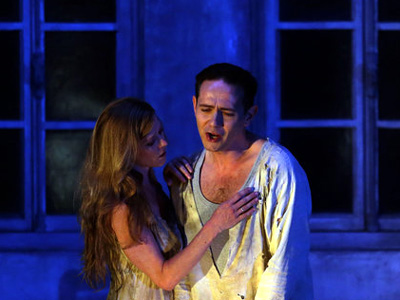
MUNICH — What is written on skin? Craftsmanship “as immaculate as anything … composed since the heyday of Ravel” and “glimpses of a 21st-century tonality,” if you read Alex Ross in The New Yorker. And “a psychologically gripping, emotionally heart-pounding and viscerally satisfying drama,” according to Corinna da Fonseca-Wollheim for The New York Times. The skin in question is parchment for an illuminated family history, the requisition of which propels a retelling of a short medieval horror story: husband serves faithless wife her (troubadour) lover’s heart. Boccaccio used it in 1351. Verdi five hundred years later did not. The cited critics are praising an “opera” of the bloody tale by George Benjamin to a libretto by Martin Crimp, premiered in Aix-en-Provence last year and given its first German outing here at the Prinz-Regenten-Theater on July 23 as part of the Munich Opera Festival.

To these ears, Written On Skin with its two momentary breaks amounts to a 95-minute triptych of orchestral pieces and an applied, alien vocal overlay: concert sheep in wolf’s clothing. Each piece employs constructs familiar from Benjamin’s Ringed By the Flat Horizon (1980, heard at its London premiere that year) and Palimpsests (2002, played intently here 15 months ago by the Bavarian Radio Symphony Orchestra). Those 20-minute works adumbrate with their own kind of anything-but-operatic drama: discreet coloring; cautious pacing; finely splintered textures and balances; spare, crashing climaxes; and retreats of knowing modesty. They hold the attention and lodge themselves in the mind for, well, years. Craftsmanship indeed.

Laced with motifs and fuller phrases for verrophone and bass viola da gamba, the opera’s scoring coyly addresses its ghoulish subject. Sandpaper blocks and a whip contribute against a brooding 8-6-6-6-4 string complement. Stretched atop and across is the Brittenish writing for voice. This is at its most expressive and stirring in several duets, especially those involving the husband, cast by Crimp as the “Protector.” Often, though, the meeting of the earlier composer’s techniques and Benjamin’s deliberative way with structure produces drawn-out phrases — the natural counterpart to his instrumental writing and a reflection of the style and methods he settled into at Cambridge, England, more than thirty years ago. Characters then emote in similar Saran Wrap lines at various pitches. The music cannot under the circumstances shift organically, let alone spontaneously. Instead of driving the action, it merely colors it, albeit with distinction and force: drama as ornament for inescapable, purely musical shapes.

Benjamin cultivates tension right from the start, and sustains it, as he does in concert hall music, until those inevitable but seemingly casual breaks. Tension, not suspense. If some of the same could be said of Bartók’s opera, it could never be said of the average Monteverdi madrigal.

Determined, apparently, to create a music-theater work of feature length after collaborating on the chamber-scale Into the Little Hill (2006), composer and librettist chose a tale with one linear thread: a hiring, a seduction, marital confrontation, murder, a juicy meal and a suicide. This Crimp spins out to the breaking point, even if his words are always fresh and concise; his dead-end subplot offers no substitute for missing theatrical counterpoint. And so the characterizations are limited: the Protector a landed, obsessive-possessive bully; the wife, called Agnès, his hapless vassal; the third principal singing role, called the Boy (and Angel 1), passive and largely inert — yet it is he who, hired at the outset, is tasked with preparing that family history and who stirs rebellion in Agnès, becoming her lover without wishing it or evolving as a result.

Katie Mitchell’s clearly purposed, split-level staging (from Aix) operates supportively enough. She perhaps sensed the need for more action, but she responds with supplemental and ineffectual zombie exploits stage right, and the viewer soon tunes these out. Her principal direction, however, remains assiduously in focus.

Kent Nagano led a committed performance on opening night, taking over from the composer, who had conducted in Aix. That was Munich’s loss: Benjamin, on hand for bows, is a gifted leader. But Nagano’s coordination endured and the Austrian orchestra Klangforum Wien played with obvious dedication. Philipp Alexander Marguerre and Eva Reiter ably traced the vital verrophone and viola da gamba parts. Countertenor Iestyn Davies, taking over from Bejun Mehta who had sung the Boy in France, contrasted ideally with Christopher Purves’s fearsome and all-too-realistic (bass-baritone) Protector. Both were persuasive musically. As the distressed Agnès, soprano Barbara Hannigan acted and sang as if her own life were under “protection.” Marie Victoria Simmonds (mezzo-soprano) and John Allan Clayton (tenor) made vivid contributions as Angels 2 and 3.

Photo © Matthias Schrader for Associated Press

Related posts:
Verdi’s Lady Netrebko
Kaufmann Sings Manrico
Mélisande as Hotel Clerk
Nitrates In the Canapés
Liederabend with Breslik

Opera on the Gendarmenmarkt: Iván Fischer’s ‘Marriage of Figaro’

Friday, August 23rd, 2013

By Rebecca Schmid

The season is already underway in flying colors at the Konzerthaus Berlin. Iván Fischer, following an enthusiastically received appearance at the Mostly Mozart Festival, unveiled his concert staging of Le Nozze di Figaro yesterday featuring much of the same cast alongside the Konzerthausorchester. It was a pleasure to see the concert house’s neo-classical interior—an opulent post-war refurbishment—brought into my relief by Fischer’s concept. Rococo-dressed mannequins and wire-framed costumes (designs by György Kertész) were suspended from the gilded ceiling on metal grids, descending as the disguises which drive the opera’s class- and gender-bending comedy of errors. Figaro seizes the head of a model representing the count in his aria “Se vuol ballar,” only to dress him down to boxers; and the page Cherubino slips full of desire into the arms of a costume representing Susanna—externalizing the double-illusion of a woman playing a boy.

Fischer—who has sought to widen the house’s reach through new formats such as Espresso Concerts, public rehearsals and online video since becoming music director last season–stood casually upstage before the performance began, chatting with passers-by before raising his baton toward the back of the hall and launching into the overture. He conducted most of the performance seated to the edge of the second violins, with the orchestra arranged in a semi-circle around two platforms that served as focal points for the action. The singers, however, wove freely in and out of the orchestra from doors placed on either side of the stage. Eighteenth-century wigs were tossed around playfully, integrating Fischer and the musicians into the drama. The aesthetic risked on camp, however, and the exposed transition into the fourth act was more irritating than charming as stagehands fastened karabiners onto mannequins that would allow the Countess and Susanna to switch places and trick the Count. “It will only last another two or three minutes,” Fischer told the audience.

One forgave the setback once the music resumed. The orchestra has made tremendous strides under Fischer, now playing with renewed warmth and energy in the strings. His intuitive connection to Mozart’s emotional world emerged in graceful but playful phrasing, although there was an unfortunate tendency to rush into attacks. The cast displayed delightful emerging singers in roles which, as it happens, are best depicted by youthful performers. As the cunning servant Susanna, Laura Tatulescu anchored the evening with lush, expressive tone. She also conveyed the character’s feminine wiles with admirable comic timing. Hanno Müller-Brachmann, with a precocious, unforced bass-baritone and boyish charm, proved a fine partner as Figaro, although he is even stronger in German repertoire. The detailed characterization and well-sculpted tone of Rachel Frenkel in the role of Cherubino made for another stand-out. The seasoned mezzo Ann Murray and bass Andrew Shore were a memorable pair as Marcellina and Bartolo, Figaro’s long-lost parents, although Murray’s thespian approach seemed more tailored to a full staging. Roman Trekel brought subtle comedy to his portrayal of the Count, and Miah Persson—returning to an opera she has sung many times—inhabited the role of the Countess with natural aristocratic restraint. Norma Nahoun was a charming as Barbarina, the daughter of the gardener Antonio, here in a strong performance by Matteo Peirone.

The acoustics of the stage formation required some getting used to—inner voices at times jumped out unexpectedly, and the singers had to cut through an orchestra that surrounded them on all sides—but Fischer guided the musicians with unimposed authority. His fluid integration of scenic elements and flair for comedy remain a triumph. He managed to flesh out the characters of Mozart and Da Ponte in great detail, unencumbered by the gags that often drown out the action on opera stages. With three full-time houses, Berlin is of course not in need of more opera—and just across town, the Berlin Philharmonic can boast a far more entrenched tradition, a house with far superior acoustics, not to mention a level of international fame with which only one or two other orchestras on the planet can compete. But Fischer has succeeded in revitalizing the Konzerthaus with a fresh, organic—albeit quirky—creative impulse that remains blissfully impervious to outside influence.

Bard’s Stravinsky Festival

Thursday, August 22nd, 2013

by Sedgwick Clark

A long weekend of festival gluttony left me exhausted but happily so: the first weekend of Bard’s Stravinsky deluge (8/9-11), Tanglewood Contemporary Music Festival’s U.S. premiere of George Benjamin’s ecstatically received opera Written on Skin (8/12), and back home for David Lang’s the whisper opera at Lincoln Center’s Mostly Mozart Festival (8/13).

We drive up the Taconic Parkway along the Hudson River through some of the most beautiful country in the Northeast, in passionate anticipation of what Bard’s omni-proselytizer Leon Botstein has to share with us. He and his artistic co-directors, Christopher H. Gibbs and Robert Martin, invariably concoct illuminating musical menus by the primary composer and complementary works by various colleagues. Preconcert talks and panels of experts dot the schedule, reminding us that Bard is a school. Superbly produced, unfailingly literate, and perfectly proofread programs are available to all attendees. One never fails to learn and even be surprised. (Ever hear any music by Mikhail Gnesin, Maximilian Steinberg, or André Souris? I hadn’t even heard of the latter.) Two programs this year featured ten composers, and they sometimes run close to three hours counting setups between works. Bard audiences are notable for their sitzfleisch.

Tempo is the principal problem in the performance of his music, Stravinsky tells Robert Craft in Conversations with Igor Stravinsky: “A piece of mine can survive almost anything but wrong or uncertain tempo.” Botstein’s presentational approach to conducting is more in tune with Stravinsky, who claimed to loathe interpreters, than, say, Mahler, whose music is open to a variety of approaches. I’m hopeful. In his introductory preconcert talk on opening night, Botstein says that, with few exceptions, Stravinsky’s music is no longer difficult for contemporary audiences. But, he warns ominously about one of the works on the program, “I assure you that Abraham and Isaac does sound ‘modern.’ ” (Actually, it doesn’t, being a 60-year-old serialist relic whose time has long passed in our current, neo-tonal era.) Interestingly, Botstein’s easygoing performance of this ungrateful piece with members of the American Symphony Orchestra was quite the most digestible I’ve ever heard, abetted by baritone John Hancock’s mellow rendering of the Hebrew text. The most popular work on the program, Symphony of Psalms, was unerringly paced but compromised by mushy choral articulation. Anna Polonsky and Orion Weiss, two young pianists who would shine in other performances throughout the weekend, brought the unaccountably neglected Concerto for Two Pianos to life. And Botstein led a taut Les Noces that featured an engaging vocal quartet—soprano Kiera Duffy, mezzo-soprano Melis Jaatinen, tenor Mikhail Vekua, and bass-baritone Andrey Borisenko—to end the concert.

The second program, called “The Russian Context,” was one of those point-making Bard concerts performed largely by workmanlike festival regulars. Three Tchaikovsky works, for instance, Feuillet d’album, Op. 19, No. 3, and Humoreske, Op. 10, No. 2, both for piano, and the song None but the Lonely Heart, Op. 6, No. 6, were all adapted by Stravinsky for his 1928 ballet Le Baiser de la fée. The pianist in these, and several other works throughout the first weekend, Gustav Djupsjöbacka, was discouragingly half-hearted, whether as soloist or accompanist. Fortunately, contributions by pianists Orion Weiss in works by Glinka and Stravinsky and Piers Lane in works by Rachmaninoff, Scriabin, and Stravinsky compensated. Most impressive, however, was the young, Curtis-trained Dover Quartet in Glazunov’s Five Novelettes, Op. 15, which had everyone marveling over the foursome’s warm, full-bodied sonority and gracious Romantic style.

A teacher (Rimsky-Korsakov), and two students (Steinberg and Stravinsky) in works from 1913, dominated the third program, with the full American Symphony under Botstein reveling in the shimmering sensuousness of a suite from Rimsky-Korsakov’s The Legend of the Invisible City of Kitezh (1907) and Maximilian Steinberg’s ballet suite from Les métamorphoses. The music might have been from the same pen. What a contrast with the savage Le Sacre du printemps, however, conducted pretty much in one well-chosen tempo throughout, as the work’s first conductor, Pierre Monteux, said was possible. There were no serious mishaps, and the Danse sacrale—the burial ground for innumerable past performances—went perfectly. Unfortunately, the brass were nearly always too loud, overwhelming the strings, and rasping and ugly besides.

Many performances of Schoenberg’s Pierrot Lunaire (1912) strike people as “modern” because they are so unattractively sung. What a revelation in the fourth program, then, to hear Kiera Duffy tackle the composer’s Sprechstimme with utmost security and beauty, matched by the character and musicality of the excellent instrumentalists. Her accuracy in honoring the composer’s frequent p and pp indications imparted a surprisingly delicate character to a work that 101 years later can still be daunting, although I wondered if listeners farther back than my row F could distinguish the text without difficulty. Four fine performances of vocal works with instrumentation inspired by Pierrot followed: Ravel’s Trois poèmes de Stéphane Mallarmé (1913), Melis Jaatinen, mezzo-soprano; Delage’s Quatre poèmes hindous (1912-13), Lei Xu, soprano; Stravinsky’s Trois poésies de la lyrique Japonaise (1913) and Pribaoutki (1914), Lei Xu, soprano, and John Hancock, baritone, respectively. Short pieces by Falla, Ravel, Bartók, and Satie composed in homage to Debussy soon after his death followed, and the concert ended with a performance of Debussy’s always welcome two-piano En blanc et noir (1915) by Alessio Bax and Lucille Chung.

Les Six, a group of post-World War I Parisian composers who adopted avant-garde artistic trends as a backlash against Debussy and impressionism, dominated the sixth program. Looking to the eccentric composer Erik Satie as a mentor, The Six—Francis Poulenc, Georges Auric, Darius Milhaud, Germaine Tailleferre, Louis Durey, and Arthur Honegger—injected café music, ragtime, and jazz into the concert hall. Typically for Bard, the most famous of these pieces, Milhaud’s Le boeuf sur le toit (The Bull on the Roof; 1920) was not performed, and Satie’s signature piece, the ballet Parade (1916-17), was played in the composer’s four-hand piano arrangement. Missing, therefore, were such surrealistic aspects of Jean Cocteau’s scenario as sirens, whistles, gunshots, and a typewriter, but pianists Orion Weiss and Anna Polonsky made the best case possible for the black-and-white version. Polonsky accompanied John Hancock in a first-rate performance of Poulenc’s last song cycle Le travail du peintre (1956). Conductor Geoffrey McDonald conjured a delectable blend of sass and refinement from the Bard Festival Chamber Players in Stravinsky’s Ragtime for 11 Instruments (1918) and Les Mariés de la tour Eiffel (1921)— a collaboration between all The Six except Durey. The final work on the concert, Stravinsky’s 25-minute opéra bouffe Mavra (1921-22), was one of Botstein’s most successful performances, undoubtedly helped by the work’s chamber forces, which prevented him from inflating dynamic values, and absence of the ASO’s brass. The impressive vocalists were soprano Anne-Carolyn Bird (Parasha), mezzo-sopranos MelisJaatinen (The Neighbor) and Ann McMahon Quintero (The Mother), and tenor Nicholas Phan (The Hussar).

A fine conclusion to Bard’s first weekend of Stravinsky and His World.

I had intended upon hearing Bard’s second weekend as well, but attending to an ailing pet took precedence. So my upstate festival hopping ended the next day with Tanglewood’s Contemporary Music Festival for the U.S. premiere of George Benjamin’s acclaimed opera Written on Skin, about which I blogged last week. Perhaps it’s unfair to compare the Bard Festival with Tanglewood’s Festival. Their missions are different. If nothing else, the Bard performers are all professionals and Tanglewood’s are all students. I have no idea what the respective budgets are, but professionals must be paid, and students do not. My recollection is that Bard used to have more “name” soloists (Peter Serkin was the only one this year, although some Bard musicians may reach that status eventually). I noted many American Symphony players in chamber performances this year, which cannot help but lead to exhaustion in the rehearsal and performance of concerts. Perhaps shorter programs, Maestro Botstein, would level the playing field. One wants to be encouraging about Bard because there are so many positive aspects about it—and I did enjoy many performances this year—but the inescapable conclusion, as I sat enthralled in Ozawa Hall, was that Tanglewood’s student orchestra and vocalists were so vastly superior that the Bard performers were thrown totally in the shade.