Archive for 2012

Soloist, Collaborator or Both?

Thursday, May 3rd, 2012

By: Edna Landau

To ask a question, please write Ask Edna.

Dear Edna:

I am a pianist finishing my first of two years in a graduate program at an American conservatory. I received my undergraduate degree at the same conservatory. Over the years, I was fortunate to have been frequently sought out as a collaborative artist for recitals with singers and instrumentalists. While I have always greatly enjoyed filling this role, I still dream of the possibility of having a solo career. It is very helpful for me to have the income from this work but if I continue along this path, will I rule out that possibility altogether? –Brian W.

Dear Brian:

Since you have told me that you are often approached by your peers to collaborate with them, I assume that you excel in this area. Happily, these are times when most artists feel comfortable wearing a variety of musical hats and moving back and forth between solo appearances and collaborations, especially when opportunities present themselves to work with inspiring colleagues. Two days ago, I had the pleasure of listening to a wonderful young pianist, Michael Brown, perform a recital program with the captivating violinist, Elena Urioste. Within the previous three weeks, he had played two solo recitals in New York (with largely different programs). From what I heard and read, all three were beautifully prepared and imbued with equal enthusiasm. The truth is that you don’t need to categorize yourself and make an either/or choice, at least for now. Every career has elements of the unexpected. You may decide to play a recital with a singer and it could turn out that a manager attending the recital is so drawn to your playing that they make a point of finding out more about you. A variation of this happened early in my IMG Artists days when Charles Hamlen and I attended a recital given by one of our clients, soprano Lucy Shelton. The program featured this wonderfully versatile artist in a variety of repertoire, including Schubert’s “The Shepherd on the Rock”, with guest artist David Shifrin on clarinet. After just a few measures of his playing, we glanced at one another with total rapture and knew that we would soon be adding a clarinetist to our management roster, challenging as it was to take on a solo wind player. The important message here is that any time you set foot on stage in any capacity, it is an opportunity to be noticed.

I think it would be advisable for you to take advantage of your upcoming year at school to seek candid advice from your teacher, as well as others who know your playing, with regard to their assessment of your potential for a solo career. Keep in mind that it is difficult and time-consuming to secure solo engagements on your own or to attract the attention of a manager. As long as the collaborations are bringing in a steady income, I see no reason to give them up. If you like, you can keep your feet in both camps by entering a few competitions, if you feel prepared and motivated to do so (but I would advise against appearing as both collaborator and soloist in the same competition, even if you think it’s cool!). To get a balanced view, you might also want to consider enrolling in a collaborative piano program, such as the one offered by The Music Academy of the West. It might afford you a broader framework in which to establish your priorities, as well as opportunities to interact with a new group of performers and teachers who could lend additional perspective. Once you leave school, you might truly need to decide what your primary focus should be. Opportunities to collaborate with other musicians may be less frequent, unless you cultivate your connections and get the word out that this is a priority for you. If you are fortunate to perform with partners whose careers are on the rise, you may find great fulfillment in concerts in major cities where you might even attract positive critical attention. We are fortunate to have many superb collaborations captured on recordings, among them pianist Samuel Sanders with Itzhak Perlman and Martin Katz with Marilyn Horne. Both of these pianists gained great recognition through these partnerships and, undoubtedly, so much more.  In a wonderful YouTube video, Martin Katz relates how he grew as an artist through his association with Ms. Horne and how her standards became his standards. If he ever harbored aspirations of becoming a soloist, I doubt that he felt let down by his ultimate decision.

To ask a question, please write Ask Edna.

© Edna Landau 2012

Resounding Crumbs; Ruggles on CD

Wednesday, May 2nd, 2012

by Sedgwick Clark

We hear entirely too little of George Crumb’s music in New York. On 4/19 Leon Botstein and the American Symphony Orchestra stepped into the breach with crackerjack performances of the American composer’s early Variazioni (1959, but not premiered until 1965) and Star-Child (1977), played with power and sonority, especially by Crumb’s beloved array of exotic percussion. In between came Echoes of Time and the River (Echoes II), Crumb’s 1968 Pulitzer Prize winner and a Botstein favorite.

The first piece—a partly 12-tone work that reveals his student infatuation with Berg’s Lyric Suite and Violin Concerto and Bartók’s MUSPAC, among others, along with clear evidence of the Crumb to come—deserves frequent hearing, as does the more fancifully astronomical Star-Child. The sheer size and virtuosity of the latter’s forces obviously mitigates against performance, but Botstein and the expanded ASO—“including soprano, solo trombone, children’s choir, a male speaking choir that also plays hand-bells, organ, and enlarged sections that include six horns, seven trumpets, and eight percussionists,” writes annotator Robert Carl—were up to Crumb’s demands in the resounding acoustic of Carnegie.

Echoes of Time and the River was more problematic. Crumb requires members of the orchestra to march across the stage and down into the parquet aisles in a precisely executed processional, all the while chanting and, at the end, whistling. In the program booklet, Botstein recalls his undergrad days as assistant conductor and concertmaster of the University of Chicago orchestra in 1967 and observing a rehearsal of the Chicago Symphony premiere of the piece in which the players refused to do the processionals. When Seiji Ozawa led the Boston Symphony in Echoes at Carnegie in February 1976, the players looked mortified. I don’t recall how the BSO audience reacted, but the ASO’s audience laughed. Perhaps some preparatory words from the podium before the downbeat might have helped, but the players lacked any semblance of ritualistic evocativeness in either pace or expression (the women stomped resoundingly across the stage in hard heels). Perhaps a screening of the Shangri-la scenes of Lost Horizon might have provided behavioral insight. But at least the “Procession Coordinator” should have insisted on rubber-soled shoes. As for the musical performance, Echoes required a more sensitive hand than Botstein’s presentational manner.

Shaham in New Jersey

Gil Shaham playing the Berg Violin Concerto and a thoughtful program capped off by one of my favorite Prokofiev symphonies, the Third, enticed me to Newark’s NJPAC on 4/27. New Jersey Symphony’s music director, Jacques Lacombe, puts together interesting repertoire, and the orchestra is a fine one. They will be playing works by Varèse, Weill, and Busoni next week, 5/9, at Carnegie’s Spring for Music. Don’t miss it.

Shaham’s performance of the Berg concerto, unlike those of most virtuoso violinists, actually honored the composer’s muted dynamic scheme. This is a very quiet piece—almost chamber music—and Lacombe was with him all the way. At times one wished for a larger body of strings (playing quietly, of course) to support the pianissimos, but the orchestra’s level of artistry was evident throughout. Shaham also played the world premiere of Richard Danielpour’s Kaddish for Violin and Orchestra, a lovely, affecting expansion for strings and harp of a sextet he composed after his father’s death in 1977. It deserves wide performance.

Prokofiev’s Third Symphony (1929) uses themes from his opera The Fiery Angel. It’s loud, dissonant, aggressive, and the New Jersey performance was too well behaved and underpowered for the optimum effect I’ve heard in concert from Philadelphia/Muti and Chailly with the New York Philharmonic and Concertgebouw. Still, there were many beauties to enjoy in the quiet second movement and serpentine third.

All of Ruggles on CD at Last!

Hard on the heels of Michael Tilson Thomas’s American Mavericks tour with the San Francisco Symphony, MTT’s long unavailable recording of the complete works of Carl Ruggles is on CD at last. American music devotees have the new-music organization Other Minds (www.otherminds.org) to thank for stepping in gloriously where Sony Classical had feared to tread.

I remember Columbia’s mid-seventies press conference to announce its new recording contract with Tilson Thomas. With irrepressible enthusiasm, he announced that his initial projects would be complete cycles of Ruggles and the French composer Pérotin (12th c.-13th c.), whose music has influenced minimalism. Nothing came of the latter, but the Ruggles project was recorded between 1975 and 1978 and released in 1980 to rave reviews. The orchestral works were played by the Buffalo Philharmonic, of which MTT was music director (1971-79) and getting impressive results in concert and on record. Such artists as soprano Judith Blegen, trumpeter Gerard Schwarz, Speculum Musicae, the Gregg Smith Singers, and pianist John Kirkpatrick, a friend and champion of both Ruggles and Ives, were enlisted for the chamber works. It was a class act and is unlikely to be duplicated.

Other Minds has prepared a model reissue. Most importantly, the master source material of original producer Steven Epstein’s recordings frees us at last from listening to the abominably pressed CBS LPs. The handsomely designed CD booklet, adorned with Thomas Hart Benton’s portrait of Ruggles composing at the piano, reprints the LP notes by Tilson Thomas and Kirkpatrick and adds a 1946 essay about Ruggles by Lou Harrison.

No one interested in American music should hesitate to buy this CD set.

Looking forward

My week’s scheduled concerts:

5/3 Metropolitan Opera, 6 p.m. Wagner: Götterdämmerung. Fabio Luisi (cond.). Katarina Dalayman, soprano; Wendy Bryn Harmer, soprano; Karen Cargill, mezzo; Jay Hunter Morris, tenor; Iain Paterson, bass-baritone; Eric Owens, bass-baritone; Hans-Peter König, bass.

5/7 Carnegie Hall, 7:30. “Spring for Music.” Houston Symphony/Hans Graf. Shostakovich: Anti-Formalist Rayok; Symphony No. 11 (“The Year 1905”).

5/9 Carnegie Hall, 7:30. “Spring for Music.” New Jersey Symphony/Jacques Lacombe; Hila Plitmann, soprano; Marc-André Hamelin, piano; Men of the Westminster Symphonic Choir. Varèse: Nocturnal. Weill: Symphony No. 1 (“Berliner Symphony”). Busoni: Piano Concerto.

Generic Forms: A Prescription For Trouble

Tuesday, May 1st, 2012

By Brian Taylor Goldstein

HELLO –

How can an organization that presents music programs, and puts some of them on the Internet, find a good general release form for artists/speakers to sign?

The tricky part about forms is not finding them, but choosing which one is right. There are lots of sources for good general release forms—the Internet, formbooks, colleagues, etc. We provide a list of formbooks that we recommend on our website www.ftmartslaw-pc.com. However, to select the right form, you need to know what you need.

A “release” is just another word for “permission”, and, like all other contracts, it memorializes an agreement between two parties. So, in order to know what form you need, you need to know what permissions you need and what permission the other party is willing to grant. For example, if you are presenting a music program and you want a form through which a musician will give you the right to record their performance and place it on the internet, you will want a form that addresses the following issues: (1) Is the musician expecting to get an extra fee in exchange for granting permission?(2) Do you want to place the entire performance on the Internet, or just excerpts?(3) Will you be posting the performing on your own website or on other websites such as YouTube?(4) Can you leave the recording up indefinitely, or will the musician be able to tell you to take it down? (5) If there is more than one musician performing, such as a band or ensemble, will you require a release from each performer or does one person have the right to grant permission on behalf of everyone else? and, perhaps most importantly, (6) Is the musician performing his or her own music? Remember: unless the musician is also performing music he or she wrote themselves, they cannot give you permission to record it. You will need to get that permission from the composer as well as from the musicians.

There is no “generic” permission form or release that will apply to everyone in every situation. Any form or any contract is only “good” if it addresses all of the elements of your specific circumstances and successfully communicates the understanding between the parties and covers all of the necessary. It may not surprise you to learn how often I have been contacted by someone who found what they believed was a “generic” form, filled in the blanks, and found out too late that it didn’t give them the rights or permissions they needed for their specific circumstances. So, when it comes to forms, don’t go for the generic…go for the prescription you need. Before you go hunting around for the right form, first figure out what you need, then start reading and editing forms and until you get the one that fits just right.

________________________________________________________________

For additional information and resources on this and other legal and business issues for the performing arts, visit ftmartslaw-pc.com.

To ask your own question, write to lawanddisorder@musicalamerica.org.

All questions on any topic related to legal and business issues will be welcome. However, please post only general questions or hypotheticals. FTM Arts Law reserves the right to alter, edit or, amend questions to focus on specific issues or to avoid names, circumstances, or any information that could be used to identify or embarrass a specific individual or organization. All questions will be posted anonymously.

__________________________________________________________________

THE OFFICIAL DISCLAIMER:

THIS IS NOT LEGAL ADVICE!

The purpose of this blog is to provide general advice and guidance, not legal advice. Please consult with an attorney familiar with your specific circumstances, facts, challenges, medications, psychiatric disorders, past-lives, karmic debt, and anything else that may impact your situation before drawing any conclusions, deciding upon a course of action, sending a nasty email, filing a lawsuit, or doing anything rash!

Loss, Lust and Repentance at the DSO

Friday, April 27th, 2012

By Rebecca Schmid

Of Berlin’s seven major orchestras, the Deutsches Symphonie-Orchester (DSO) is beloved among connoisseurs for its innovative programming. For the past five seasons, the orchestra has offered “Casual Concerts” concluding with a DJ act in the foyer of the Philharmonie, as initiated by former Music Director Ingo Metzmacher. In what the Berliner Zeitung is calling one of the most important concerts of the season, the series most recently featured Hans Graf, principal conductor of the Houston Symphony, in a self-devised triptych that traveled through Puccini’s Suor Angelica, Hindemith’s Sancta Susanna, and Skryabin’s Le poème de l’extase. The program was also performed as a straight concert on April 22, which I had the opportunity to attend.

Hindemith’s one-acter about the forbidden desires of a nun is, according to a recent publication issued by the Hindemith Foundation, one of the biggest scandals in twentieth-century music history. The conductor Fritz Busch refused to perform it in 1921 as part of a Puccini-inspired triptych that begins with Mörder, Hoffnung der Frauen and ends with Das Nusch-Nuschi. When Sancta Susanna premiered in Frankfurt the following year, religious and conservative cultural institutions broke out into protest. While the Catholic Women’s League was organizing “atonement devotions” during Holy Week, Theodor Adorno praised Sancta Susanna as not only “the best of the three pieces” but the most mature stage work Hindemith ever wrote: “the thematic pressure of the orchestral flow and widely arching vocal melodies, the sultriness of the spring night and the vehemence of the catastrophe from this single, elemental force.”

The 25-minute work based on poetry by August Stramm has enjoyed something of a renaissance this season, with a full staging at the Opéra Lyon in January and, as seen with the DSO, a well-conceived semi-staging. Graf positioned the singers in front of himself and the orchestra, using screens on which they were able to follow his direction. The concert hall was otherwise darkened, with individual lights for the musicians to follow their scores. Melanie Diener inhabited the title role with fearless dramatic force, ripping of her black cape lustily when she declares in a climactic moment to the cautioning Sister Clementia (Lioba Braun), “ich bin schön” (‘I am beautiful’). Other parts of the plotline were left to the audience’s imagination—such as the moment when Susanna rips the loin cloth of the crucifix and the apparition of a spider (a symbol of repressed female sexuality) that crawls across the altar, only to end up in the protagonist’s hair. This must be a challenging aspect even in full stagings, although Hindemith’s xylophone motive makes it perfectly clear when the creature appears.

Graf led the DSO in a powerful account of Hindemith’s score. The vocal lines are initially set to eerily sparse textures, which were kept taut and hushed. The agonized chords representing the convent’s repression surged with raw force—as Adorno noted, the vivid landscape of anger, lust and frustration reveals Hindemith at his most expressive powers. Hindemith also adopts impressionist touches, such as the sensuous melodies of a flute that hovers over trembling strings, yet in the end the orchestra repents grudgingly. The work thus functioned perfectly as a kind of purgatory scene following Suor Angelica, in which the title character drinks poison after discovering that her illegitimate son has died of a fever. Juxtaposed with Hindemith, the modernist features of Puccini’s score also emerged more clearly, such as when Suor Angelica declares “parlate mi di lui” (‘tell me about him’), setting the orchestra in unison through a jagged, furious descending motive.

Barbara Frittoli was slated to sing the title role, but health reasons forced her to cancel at the last minute. Fortunately, another Italian soprano, Maria Luigia Borsi rose to the occasion admirably with lush bel canto singing that is rare to hear in Berlin. “Senza Mamma” was quietly devastating, with the orchestra already providing glimpses into the white light of heaven. While the DSO’s strings could have been warmer throughout the score, Graf sculpted Puccini’s phrasing with depth and conviction. The semi-staging worked well, with the nuns celibately donning white, roped gowns. Braun made a stand-out performance as the frigid princess, Angelica’s aunt, who convinces her to sign off her inheritance. The American soprano Heidi Stober gave a dynamic performance as Suor Genovieffa despite some less-than-ideal diction; Jana Kurucová (La suora zelatrice) and Ewa Wolak (La maestra della novizie) impressed with their rich timbre.

Le poème de l’extase concluded the program with opulent orchestration and heaving melodies, a refreshing embrace of sensual indulgence afer the harrowing experience of Sancta Susanna. Above the shimmering strings and colorful motivic development, the trumpets herald a new realm beyond the earthly, an explosion of sound which Skryabin declared in 1905 would be “an enormous festival.” Graf led the DSO with tremendous control, steering through the contours of this unpredictably episodic score with the same dramatic sensitivity he brought to the previous one-acters. The audience was left raptured, if not emotionally spent, by this musical journey—concerts like this make it clear how the DSO is able to hold its own even with the Berlin Philharmonic in town, and how spoiled those living here are for variety.

Stay tuned for a review of the Berlin Philharmonic under Dudamel featuring Leonidas Kavakos in Korngold’s Violin Concerto (not the Golijov world premiere that was originally slated, but who’s complaining)

The Most Desirable Photos, From a Presenter’s Perspective

Thursday, April 26th, 2012

By: Edna Landau

To ask a question, please write Ask Edna.

I would like to thank the following individuals who helped me prepare this week’s column: Naomi Grabel, Director, Marketing and Creative Services, Carnegie Hall; DeAnna Sherer, Coordinator, Artistic Programs, Carnegie Hall; Monica Parks, Director of Publications, The New York Philharmonic; Christopher Beach, President & Artistic Director, La Jolla Music Society; Martin Schott, Director, Creative Services, Lincoln Center for the Performing Arts

Dear Edna:

I am a violinist who will be graduating with an Artist Diploma from an American conservatory next month. I am fortunate in having won a few competitions which gave me performing opportunities and I have additional ones scheduled in the coming year. I have been advised to invest time and money in getting high quality photos, as well as creating a website. Can you please tell me what I should keep in mind when I prepare for a photo shoot. Am I aiming for portraits or performance photos? Should I be dressed formally or casually? How many photos should I hope to walk away with at the end of the session? Thank you.—Catherine D.

Dear Catherine:

In doing a little research in order to best answer your question, I realized how much has changed since my early days as an artist manager. At that time, we usually sent two black and white head shots, one formal and one informal, and of course they were not digital. When I spoke recently with Monica Parks, Director of Publications at the New York Philharmonic, she stressed the importance of the format of the photos that are submitted today. They look for photos that are at least 300 dpi (dots per inch) or better, and a fairly large file size. This allows them to use the photos in various ways. They can shnrink photos but not enlarge them. It is helpful to have room around the image to allow for cropping. They are looking for color, rather than black and white, and a variety of posed and performance shots. (She mentioned that even in the case of singers and conductors, they welcome some action shots.) It is ok to submit posed photos both with and without your instrument. She also said that it is helpful to have images facing in different directions so they can have maximum flexibility when placing them in printed materials on the right or left side. Of course, a straight on image works in any layout.

Christopher Beach, President of the La Jolla Music Society, told me that they print photos as full pages in their brochure, with overlaid text. Therefore, the quality of the photos is of utmost importance. They need to receive a variety of photos, formal and informal, vertical and horizontal, in color and possibly black and white. For him, it is essential that the photo include the artist’s instrument so that his audience (who may not be familiar with an artist) immediately makes the association and knows what they will be hearing. A performance photo is best. As to the “mood” of the photos, he said: “The best pictures have emotion, and emotion helps to sell tickets.” While some presenters rule out using photos with the artist’s eyes shut, he feels such pictures can be effective and convey great emotion. Naomi Grabel, Director of Marketing at Carnegie Hall, agrees that performance shots are far more exciting than head shots. In choosing photos for their publicity materials, they look for energy, exuberance, dynamism, action and warmth. They feel that the right photograph helps to create a connection between the artist and the audience before they even arrive at the hall.

It is obviously desirable to walk away from a photo shoot with a variety of photos, action and posed, and to be able to use as many as you like. This allows you to alternate them in different years and among different venues, as long as you still look the same! If you and the photographer want to experiment with some full-length shots or fashion oriented photographs that might someday be useful, especially if you are the subject of a feature story, that might prove worthwhile, but keep them in reserve for the appropriate occasion. For those pianists who might be reading this column,  It would be wise to avoid any temptation to replicate some photos I have seen of female pianists in floor length gowns, sprawled over the top of their instrument. Let good sense and good taste always be your guide.

To ask a question, please write Ask Edna.

© Edna Landau 2012

Dick Clark: Don’t R.I.P.

Wednesday, April 25th, 2012

by Sedgwick Clark

The media were consumed last week by the death at age 82 of Dick Clark (need I say, no relation?). I was never a fan of American Bandstand. I came home from school when I was a tot and twisted to Hollywood on Indianapolis TV’s late-afternoon Frances Farmer Presents instead of Chubby Checker. There, in her world-weary voice, the aging actress introduced the film of the afternoon with anecdotes about the stars. I was too young to appreciate what she had to say, but I recall that her show was interlarded with so many commercials that often I didn’t reach the denouement before my mother called me to dinner. It was many years before I learned who got the girl in Casablanca.

Anyway, while America was mourning, I had less charitable thoughts about Dick Clark. In 1972 the New York Daily News ran a short interview with him saying that classical music would die because no one wanted to listen to it. “What a moron,” I thought, and skewered the piece on the wall of my office at Philips and Mercury Records. For some reason I never forgot that little news piece. It perished in the electrical fire that ignited in the ceiling months later, a little after 6 one evening when I would have been at my desk. Fortunately, I was at dinner with Bernard Haitink that night in Boston, where he was conducting Mahler’s First—else my ashes would have forever commingled with Dick Clark’s thoughtless words.

Van Zweden’s Galvanic Mahler    

And speaking of Mahler’s First, it was the major work led by Musical America’s current Conductor of the Year, Jaap van Zweden, in his New York Philharmonic debut on April 12. Talk about intensity! I don’t recall ever seeing a more tightly wound podium demeanor. He cued every last entrance, and the New Yorkers responded with coiled-spring precision. Interpretively, the Dutch conductor fell somewhere between Bernstein’s emotionalism and Haitink’s objectivity, with dynamism in spades. You can’t lose with Mahler’s Triumphal conclusion—the horns standing suddenly to pour out their golden tone fff—and the audience went predictably wild. What was not predictable was that the orchestra stayed seated, applauding van Zweden as he came out for his first bow—a remarkable gesture of respect from these difficult-to-please musicians. He’ll be back soon, no doubt.

In the first half, he accompanied the volatile 25-year-old Chinese pianist Yuja Wang in Prokofiev’s Third Piano Concerto. She kept pushing ahead, but van Zweden and his players kept up respectably. The concluding allegro, beginning with the pizz. strings at 131, was dispatched with a breathless edge-of-seat unanimity that I’ve heard equaled only by the mercurial Martha Argerich, Charles Dutoit, and the Orchestre National de France at Avery Fisher Hall on March 18, 1994—the best performance I’ve ever heard live. Message to Yuja: A bit more poise can yield a more satisfying performance overall.

Looking forward

My week’s scheduled concerts:

4/26 Metropolitan Opera. Wagner: Das Rheingold. Fabio Luisi (cond.). Wendy Bryn Harmer, soprano; Stephanie Blythe, mezzo; Patricia Bardon, mezzo; Adam Klein, tenor; Gerhard Siegel, tenor; Bryn Terfel, baritone; Eric Owens, bass-baritone; Franz-Josef Selig, bass; Hans-Peter König, bass.

4/27 New Jersey Performing Arts Center (Newark). New Jersey Symphony/Jacques Lacombe; Gil Shaham, violin. Mozart: Masonic Funeral Music. Berg: Violin Concerto. Danielpour: Kaddish for Violin and Orchestra (world premiere). Prokofiev: Symphony No. 3.

4/28 Metropolitan Opera (broadcast). Wagner: Die Walküre. Fabio Luisi (cond.). Katarina Dalayman, soprano; Eva-Maria Westbroek, soprano; Stephanie Blythe, mezzo; Jonas Kaufmann, tenor; Bryn Terfel, baritone; Hans-Peter König, bass.

4/30 Metropolitan Opera. Wagner: Siegfried. Fabio Luisi (cond.). Katarina Dalayman, soprano; Patricia Bardon, mezzo; Jay Hunter Morris, tenor; Gerhard Siegel, tenor, Bryn Terfel, baritone; Eric Owens, bass-baritone.

5/1 Carnegie Hall. Mathias Goerne, baritone; Lief Ove Andsnes, piano. Songs by Shostakovich and Mahler.

5/2 Carnegie Hall. New York Phiharmonic/Alan Gilbert. Mahler: Symphony No. 6 (“Tragic”).

Sneaking Artists Into The US: How Lucky Do You Feel?

Wednesday, April 25th, 2012

By Brian Taylor Goldstein

Dear FTM Arts Law:

I represent a British group that frequently tours the US. In the past, the guys have just entered as visitors under the ESTA/Visa Waiver Scheme. So far, we have never had any problems, but I was recently told this was wrong. Is this true? Couldn’t they just say they are not performing?

This one is easy: Is this true? YES. Couldn’t they just say they are not performing? NO!

The ESTA/Visa Waiver Scheme is a program through which citizens of 36 countries (Andorra, Australia, Austria, Belgium, Brunei, Czech Republic, Denmark, Estonia, Finland, France, Germany, Greece, Hungary, Iceland, Ireland, Italy, Japan, Latvia, Liechtenstein, Lithuania, Luxembourg, Malta, Monaco, Netherlands, New Zealand, Norway, Portugal, San Marino, Singapore, Slovakia, Slovenia, South Korea, Spain, Sweden, Switzerland and United Kingdom) can enter the US as “visitors” with only their passports. Unlike citizens from countries such as Russia, China, or Iran, citizens of one of the 36 “visa waiver” countries do not need to obtain an actual visitor visa from a US Consulate before entering the US. All they need to do is pre-register through the on-line Electronic System for Travel Authorization (“ESTA”) website. However, the ESTA/Visa Waiver Scheme only allows such citizens to enter as “visitors”, subject to all of the limitations and restrictions of a visitor visa.

If an artist from a visa waiver country wishes to perform in the US, he or she needs to obtain an actual artist visa, such as an O or a P visa. Artists from a visa waiver country who enter the US under the ESTA/Visa Waiver Scheme cannot perform, regardless of whether or not they are paid and regardless of whether or not tickets are sold. The need for an artist visa (either an O or a P) is triggered by performance, not payment.

If an artist tells a US border officer that they are not performing, when, in fact, they intend to perform, this constitutes a fraudulent entry. Fraud is always a bad thing. Fraud against the US Government is a very bad thing. While you may have not have had any problems thus far, this has been due to pure luck. I know of a group from Canada that for more than five years regularly entered the US as visitors to perform their concerts. Typically, they told the border officer they were coming to “rehearse” or “jam with friends.” However, last year, their luck ran out. A border officer on a slow day decided to Google the name of one of the musicians and discovered their website listing all of their forthcoming US engagements. The group has now been barred from performing in the US! I know of other instances where, though the artists have not been barred from future US travel, their ESTA/Visa Waiver privileges have been permanently revoked, requiring them to forever obtain visitor visas even where they legitimately wish to enter the US as visitors.  In short, your odds of continued success decrease each time your artists enter the US on the Visa Waiver Scheme with the intent to perform. As for lying to a border officer…I hear the weather in Guantanamo is quite lovely this time of year!

___________________________________________________________________

For additional information and resources on this and other legal and business issues for the performing arts, visit ftmartslaw-pc.com.

To ask your own question, write to lawanddisorder@musicalamerica.org.

All questions on any topic related to legal and business issues will be welcome. However, please post only general questions or hypotheticals. FTM Arts Law reserves the right to alter, edit or, amend questions to focus on specific issues or to avoid names, circumstances, or any information that could be used to identify or embarrass a specific individual or organization. All questions will be posted anonymously.

__________________________________________________________________

THE OFFICIAL DISCLAIMER:

THIS IS NOT LEGAL ADVICE!

The purpose of this blog is to provide general advice and guidance, not legal advice. Please consult with an attorney familiar with your specific circumstances, facts, challenges, medications, psychiatric disorders, past-lives, karmic debt, and anything else that may impact your situation before drawing any conclusions, deciding upon a course of action, sending a nasty email, filing a lawsuit, or doing anything rash!

Artistic Freedom and Political Protest: Israel’s Batsheva Dance Company

Tuesday, April 24th, 2012

Note: This review marks the beginning of a new series dedicated to showcasing the best student writing from the Dance History class I teach at The Juilliard School.

By Eve Jacobs

Batsheva Dance Company’s March 7 performance of Hora started with a bang. Lots of them—on cans, drums, and the pavement outside of BAM’s Howard Gilman Opera House. Created in 2009 by Batsheva’s artistic director Ohad Naharin, Hora included sounds and ideas beyond the choreographer’s control. Adalah-NY protestors paraded signs: “BOYCOTT ISRAEL!” “DON’T DANCE AROUND APARTEID!” The anti-Israel activists distributed mock programs that read, “Batsheva Dance Company: Cultural Ambassadors for Israel.”  The slogan refers to former Minister of Affairs Arye Mekel’s “Brand Israel,” campaign, which, according to Adalah-NY, uses art to “show Israel’s prettier face.” Adalah-NY wants Israel to be thought of in the context of war, not art.

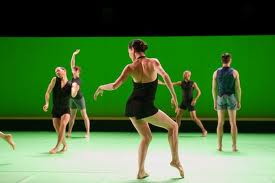
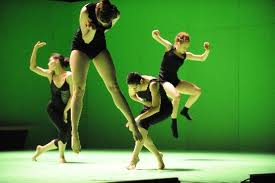
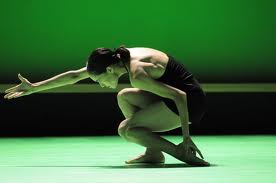
Despite the protests and the politics, Naharin’s Hora reflects neither. Nor does it draw on the same-named Israeli folk dance—a celebratory grapevine danced at weddings. This Hora is secular. The curtain rises on men and women in black outfits that expose their limbs. An extra-terrestrial neon green set encloses them on three sides. Ten dancers sit on a bench while one female’s movement becomes beautiful in its asymmetry. Other dancers join her gradually, yet there is no distinguishable pattern, and no basis for predicting their next actions. With this improvisatory quality, unison moments come as a surprise. The experience is like listening in on a conversation of eleven people who aren’t lying to each other. Hora rambles in a good way. It is at times poignant, silly, sexual, and nebulous—because that’s how life is. Naharin presents no code to unlock and no riddle to deconstruct. He presents irony, oddity, and incongruous events, giving the audience a chance to laugh, think, track patterns, and enjoy.

During the performance of Hora, the protesters outside the theater infiltrated the intended silences of the one-hour work. Poetry was interrupted by politics. Adalah-NY wants artistic containment of Israel, and Batsheva is a perfect target because of its widespread acclaim. The protesters hope to raise human rights concerns, but Naharin and his company aren’t warmongers. They are doing some of the most interesting work in the contemporary dance scene. In addition to Batsheva’s international tours, companies such as Hubbard Street Dance Chicago and Nederlands Dans Theater perform Naharin’s repertoire. Institutions like The Juilliard School and Jacob’s Pillow Dance Festival offer classes in Gaga, Naharin’s sensation-based movement technique. Naharin’s influence on dance is immense. A group of protestors outside BAM cannot reverse that.

When you see Batsheva Dance Company, you’re supporting artistic freedom. Next time the company is in town, bypass the protestors and experience their kinesthetic wonderland.

Eve Jacobs is a second year student in The Juilliard School Dance Division.

St. Matthew leaves the Altar, takes to the Philharmonie

Friday, April 20th, 2012

By Rebecca Schmid

Peter Sellars’ semi-staging of St. Matthew Passion for the Rundfunkchor Berlin and the Berlin Philharmonic, officially called a “ritualization” on the cover of the production’s recently-released DVD, may be one of his most daring enterprises to date. Interestingly though, Bach’s Passion already has a history as a subject of both artistic reverence and unorthodox reinterpretation. When Felix Mendelssohn brought the work back into fashion upon performing it with Berlin’s Singakademie in 1829—approximately a century after St. Matthew’s Leipzig premiere—he made several cuts to the original score, excluding all solo arias but two. “To think that it had to be an actor and a Jew to bring back the greatest Christian music for the people,” he reportedly exclaimed to his actor-friend, Eduard Devrient, who helped arrange the performance.

St. Matthew is officially a sacred cantata on a libretto by Picander, who set two chapters of the Gospel of Matthew in Luther’s translation, yet its episodic nature alternating arias, recitative, chorales, and choruses has been compared to Greek tragedy. If some scholarly articles are any indication, there may also be less compelling reason to confine the work to a Protestant church than one would think. A 1985 article by Rosalie Atlhol Schellhous in Musical Quarterly argues that the Passion is rooted more in a tradition of mysticism than direct Lutheran values, designating the work as a formal meditation or “mental prayer.”

Sellars, in a bonus interview with Rundfunchor Director Simon Halsey, consciously or unconsciously segues right into this discourse by comparing Bach to a “twelve-step process” that is not just about spiritual but physical transformation. It should be “vividly experiential rather than an intellectual proposition,” he says. “We’re opening it and going inside instead of admiring it as a monument from a distance.” Paradoxically, Sellars’ visual representations only emphasize how skillfully the theatrical and spiritual elements of St. Matthew Passion are embedded in the music itself.

The members of the Rundfunkchor admirably learned their parts by heart and were encouraged by Sellars to allow their individual personalities to shine through as they pondered the weight of Bach’s music. Yet their amateurish expressions of Lebensschmerz distract from its introspective qualities. Dressed in all-black, they walk around stage in a forlorn state during the opening chorus “Komm, ihr Töchter.” At the center of the stage is a tombstone-shaped block on which the Evangelist will lie with his wrists tied in invisible rope at the end of the piece, the chorus huddled around him. I struggled not to cringe at such touch-feely gestures.

It is of course hard to judge the effect this Passion had live. The production premiered in 2010 at the Salzburg Easter Festival and subsequently the Philharmonie, where it was filmed on the Berlin Philharmonic’s own label. Sellars, as he explains to Halsey, was inspired by the “360” pentagonal shape of Hans Scharoun’s architecture and sought to absorb the audience into the event by scattering singers throughout the hall. The footage is expertly edited and covers the full range of shots from various angles, but often lingers close to the stage. As is often the case in audiovisual documents, the close-ups prove bothersome.

Sellars grants the soloists a great deal of artistic freedom, which leads to some positively operatic performances. Magdalena Kožená, incarnating Marry Magdalene, let her hands wander all over the body of the Evangelist (Mark Padmore) during the aria “Buß und Reu,” in which she sings of how sin breaks the heart in two and her desire to anoint Jesus with her tears. Her performance in the second part, in which she accosts the chorus and laments Christ’s fate to the audience, is more moving in its directness. The Swedish soprano Camilla Tilling brings a full, pleasant tone but an unusual amount of vibrato to her arias. Sellars was blessed with what must have been an unexpected naturalist touch given that she was eight-months pregnant when they shot the DVD, which makes it quite dramatic to watch Tilling sing of a traitorous child (“es ist zur Schlange worden”) in “Blüte nur, du liebes Herz.”

The male roles are inhabited even more convincingly. The smooth baritone and dramatic restraint of Christian Gerhaher in the role of Jesus convey more spiritual depth than any action onstage. Padmore lives up to his reputation as one of today’s most seasoned Evangelists, exuding modern fervor and a sense of pathos that is at times overstated but generally effective. Thomas Quasthoff is moving in the bass parts, easily expressing personal redemption in the final aria “Mach dich, mein Herze rein.” Finnish tenor Topi Lehtipuu brings a handsome presence and expressive dramaticism without chewing up the scenery. His dynamic as he kneels pleadingly before the viola da gamba soloist (Hille Perl) in the aria “Geduld, wenn mich falsche Zungen stechen” is straightforward and emotionally immediate, as is his performance alongside oboist Albrecht Mayer in “Ich will bei meinem Jesus wachen.”

Sir Simon Rattle, although less known for his forays into early music, gives an elegant, authentic account of Bach’s score with the Berlin Philharmonic. While this recording will not rival that of John Elliot Gardiner or other specialists, the transparent timbre that Rattle has (albeit controversially) cultivated as music director of his orchestra serves the Passion well. It is also impressive that he single-handedly conducts the surround-sound staging and the double-choir (which includes boy singers from the Staats- und Domchors Berlin). Sellars’ concept places the Philharmonic’s world-class soloists such as Mayer and flutist Emmanuel Pahud into the spotlight they deserve, although I enjoy their playing just as much when they are sitting down.

Maverick Wrap-Up

Friday, April 20th, 2012

by Sedgwick Clark

I didn’t react favorably to all the works in Michael Tilson Thomas’s American Mavericks series, which has consumed this blog for three weeks. But that’s not the point: This is the kind of programming that keeps our concert halls vital, and the full houses certainly bespoke wide interest, especially among younger listeners. As I write this (4/19), I look forward to a program tonight at Carnegie Hall of George Crumb’s music, courtesy of Leon Botstein and the American Symphony. Among other works, I’ll hear Crumb’s Star-Child, which I haven’t heard live since its premiere in 1977 with Boulez and the New York Philharmonic. Long may these enterprising conductors wave!

Partch, Bates, Del Tredici, Harrison (3/29)

The music of California composer Harry Partch (1901-1974) is genuinely unique, played only on instruments he himself created. My interest has been known to wander in his longer works, but his 17-minute Daphne of the Dunes (1958; rev. 1967) was an aural delight and never outstayed its welcome. I was struck by the similarity of the work’s opening rhythm to the fandango beat in Bernard Herrmann’s title music for Hitchcock’s North by Northwest (1959).

Mason Bates’s “stylistic signature,” writes Thomas May in the program notes, is “the blend of acoustic instrumentalists and/or singers with electronic sounds.” The quarter-hour Mass Transmission, for organ, electronica (the composer’s own moniker for his “palette of digital samplings and techno beats”), and chorus, was composed for this festival. It sets texts by early 20th-century Dutch parents attempting to reach their children in Java via radio and an online blog describing a woman’s impressions of Java. The 35-year-old Bates’s music sounded like ’60s MOR.

At intermission, composer David Del Tredici (b. 1937) upstaged his own music with his personal performance art involving a youngish man, chains, and a silver-spiked dog collar and leash. In his comments prior to conducting DDT’s piece, MTT with tongue in cheek called him “the most maverick composer in the room.” DDT’s 45-year-old 12-tone Syzygy for soprano and 20 instrumentalists sets poems by James Joyce—a far cry from his latter-day neo-Romantic Alice in Wonderland period. It received a committed performance from the not-always-ideally-audible soprano Kiera Duffy and MTT. A few days later, I listened to Richard Dufallo’s 1970s Columbia recording of Syzygy and found it a much more approachable, less dissonant piece. I have no idea which best represents it.

Those colorful percussion instruments had all the fun in Lou Harrison’s Organ Concerto with Percussion Orchestra (1973). I can’t imagine that Paul Jacobs, the fine soloist, enjoyed playing the 1974 Rodgers electro-acoustic organ. For all I know, its desiccated wheeze was the authentic timbre of an organ baking in Java’s salt air, but it certainly wasn’t a balm to the ears. Most interesting to me was Harrison’s borrowing of Varèse’s ambling Ionisation rhythm for the snare drums early in the concerto.

Reich, Monk, Foss, Subotnick (3/30)

Steve Reich’s Music for Pieces of Wood (1973) is one of his minimalist, all-percussion works that never fails to send an audience into ecstasy. What a great concert opener!

Meredith Monk (b. 1942) is Musical America’s Composer of the Year for 2012, but she is also a singer, keyboardist, dancer, choreographer, director, and film maker. Her Realm Variations, for several San Francisco instrumentalists and her own vocal ensemble, demonstrated that her status as a composer is no less distinguished. It was the most sheerly beautiful piece in the festival, and I look forward to a recording so I can get to know it well.

I heard Lukas Foss (1922-2009) play the piano part of his Echoi (1963) two or three times over the years, and I have his recording on Epic, but it never seemed to run as long as this performance did. He allowed for improvisation in the piece, which I presume accounts for the inflation. The program book lists 24 minutes, but these fine performers took 30:10. Too long.

It pains me to report that I found little to engage me in Jacob’s Room: Monodrama by Morton Subotnick (b. 1930), a composer whose early electronic works for Nonesuch Records I admire greatly. Jacob has undergone many incarnations, including a full-length opera, since 1985. In the new version, music and text for several characters in the opera are now given to a single voice, spoken and sung by the composer’s wife, soprano Joan La Barbara. Electronic manipulation “throws” her voice and what the program bio describes as “her unique vocabulary of experimental and extended vocal techniques—multiphonics, circular breathing, ululation, and glottal clicks” around the auditorium in a manner that I found distracting to such a serious subject, which the composer explains thusly: “The basic notion of Jacob’s Room is that holocausts are not just local catastrophes; they also gradually destroy the thin fabric we have of being human. They deprive us of the artifacts we have created and our empathy as a group. When these things fall apart, we find ourselves alone in the universe.” Simplicity was called for.

Looking forward

My week’s scheduled concerts:

4/23 Leonard Nimoy Thalia at Symphony Space. Cutting Edge Concerts/Victoria Bond, conductor and host. Theodore Wiprud: My Last Duchess (world premiere). Robert Sirota: The Clever Mistress (New York premiere). Fully staged one-act operas.