Archive for 2012

New York Rites

Friday, September 21st, 2012

By Rebecca Schmid

In Berlin, where contemporary music thrives from the Philharmonie to off spaces, it is a widespread perception that New York’s mainstream institutions are afraid to program anything past Stravinsky. A look at Alan Gilbert’s recent undertakings with the New York Philharmonic, notably in a hugely successful “360” concert of Mozart, Stockhausen, Boulez and Ives in June that exploited the full space of Park Avenue Armory and was streamed live on medici.tv, reveals the idea to be a fallacy. Yet it is ironic that the orchestra’s new season has kicked off with a tribute to Le Sacre du Printemps (The Rite of Spring). The concert is only the first of many events that will commemorate the centenary of Stravinsky’s ballet, which falls on May 29 of next year.

As with many works that have shaped the canon, the work was a scandal upon its Paris premiere. Choreography by Vaslav Nijinsky reportedly set off physical fights in the audience, perhaps a response to the primitive energy that Stravinsky’s music launched onstage—a far cry from the cultivated elegance high society expected to encounter on the Champs-Elysées. Le Sacre has since become one of the most widely recorded and well-known 20th-century works. Even if it doesn’t feel monumental, in the right hands, it is still hard to resist the score’s raw power.

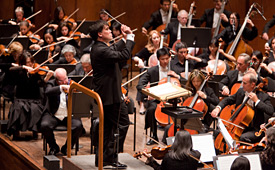
Alan Gilbert and the Philharmonic, seen at Avery Fisher Hall on September 19, made a strong account for venerating Stravinsky, investing ripping strings and grinding rhythms with the animalistic vigor that turns this music into a pagan feast. The painterly dissonances of “The Sacrifice” emerged with ethereal mystery, while the players invested the metallic, stabbing attacks of the final “Sacrificial Dance” with unrepressed drive. The delicate, overlapping wind solos of the opening “Adoration of the Earth” emerged with unpretentious clarity before ceding to the mechanical churning of the “Augurs of the Spring” that effectively wipes the unconscious of its need for soothing classical idioms.

Beethoven’s Third Piano Concerto, performed with Leif Ove Andsnes, received a less unified, persuasive interpretation. Andsnes could not quite match the heat of the Philharmonic in the opening Allegro, although his clean, incisive pianissimi nearly redeemed the performance. He and Gilbert communicated effortlessly, and yet the emotional arc from inner torment to Mozartean bitter-sweetness at times lacked conviction. The inner Largo movement felt a bit studied despite the orchestra’s sensitive phrasing, while the players’ tempered use of bombast was well suited to the final Rondo in its stormy pursuit of light-heartedness. Andsnes brought a natural, although not terribly spontaneous, playfulness to his final solo passages.

Opening the program was Kurtag’s …quasi una fantasia…for Piano and Groups of Instruments, an approximately 10-minute work that calls for the distribution of instrument clusters around the performance space while the pianist (Andnes) remains onstage in pseudo-concerto style. The rustling percussion and sparse descending piano melodies that open the piece would have been even stronger with the lights dimmed, but even more importantly than visual aesthetics, Avery Fisher Hall did not provide ideal acoustics. The snare drums behind me at one point overwhelmed the timpani onstage. Gilbert nevertheless coordinated the work with care, allowing sensuous sighing melodies to linger as strongly as the battery of percussion.

Although the piece is not tailor made for Avery Fisher Hall, Gilbert is making a concerted effort to seduce his audience base into what many listeners would consider unusual repertoire, and one hopes that he will succeed. It takes vision, charisma and daring but sound artistic choices to guide an orchestra through the current age of economic uncertainty and cultural levelling. And if Stravinsky’s Rite of Spring can teach us anything, it is that challenging the status quo is sometimes the only way to make artistic progress. As I descended into the subway after the concert, the flute melody from the opening “Adoration of the Earth” hovered mystically. It was of course just a busking musician. Even if New York does not meet the expectations of more academically-minded new music connoisseurs, one can´t deny its magic.

A Most Unusual Recording

Thursday, September 20th, 2012

By: Edna Landau

To ask a question, please write Ask Edna.

One morning last week, while waking up to radio station WQXR, I heard the announcer introduce a nocturne by Ottorino Respighi, which he said was part of their featured album of the week. I had never heard it before and was spellbound by the beautiful playing. The pianist was Michael Landrum, also totally unknown to me. I decided I needed to know more about the two-cd set entitled Nocturnes and, a few hours later, began to research the recording. I learned that it contained 32 nocturnes by 31 different composers, among them two women – Clara Wieck-Schumann and Fanny Mendelssohn-Hensel. I also learned that the pianist is Professor of Music at Roberts Wesleyan College in Rochester, New York, and that he has long been fascinated by nocturnes and the way different composers have approached them. I decided to call Dr. Landrum in hopes of finding out more about the evolution of this project, what drove him to make the recording, and what effect it has had on his professional career. It was quite easy to get through to him via the school’s music department and after leaving a message, my call was returned later the same day. The conversation proved every bit as rewarding as listening to his wonderful recording (which I bought the same day). Having assumed that he made the recording to get his name out to a broader musical community, I learned that his motivation was not that at all. He made the recording because he loved the music and realized that so much of it is unknown (e.g., nocturnes by Griffes and Tcherepnin). He felt that he would be making a contribution in his own small way by sharing it with a larger audience.

Since I know how difficult it is for performers to find time to research unusual repertoire, I asked Dr. Landrum how he succeeded in assembling such a rich and varied collection of nocturnes. He told me that he hadn’t set out to compile such a collection but “it just snuck up on him”. Having always been inspired by Chopin’s nocturnes, one of which he worked on while a freshman at Oberlin, he later was scavenging around for teaching materials for his undergraduate students and came across some nocturnes by John Field, which were totally new to him. A search through the stacks at Eastman’s Sibley Library yielded the nocturnes by Cyril Scott and Alec Rowley that are on the recording. A music dealer in Atlanta, Hutchins and Rea, have been wonderful about collecting nocturnes for him during their international travels. Actually, each nocturne has its own story. But how did they make their way onto a very distinctive recording?

Dr. Landrum met his record producer, David Frost, at the Taubman Institute, and they became good friends. They set about to record the nocturnes at Roberts Wesleyan College already in the year 2000. Dr. Landrum paid for the engineering and production, program notes and photography. Like many labors of love, nothing happened immediately, but it was David Frost who introduced him to Sono Luminus, the distinguished label who released the recording. He originally gave them enough material for one disc, thinking they would find the repertoire too cumbersome. They insisted on having two. Enjoying my little nocturne adventure so much, I asked Dr. Landrum for contact information for the Managing Director of Sono Luminus. I reached Daniel Shores on the first try. When I asked how he makes decisions about which albums to release, he said that their primary focus is on the highest quality of performance and sound. In the case of the nocturnes, it was the beautiful sound achieved by David Frost and the captivating performances of Michael Landrum. He said he could hear the passion in his music making and felt it needed to be heard. Sono Luminus benefited from receiving a fully prepared recording but they did the final packaging and undertook a substantial promotional campaign which led to WQXR receiving the set and ultimately featuring it on the air.

I have often been asked by young artists: How can I stand out from the pack? What does it take to get noticed? Clearly a recording can be a very valuable tool. But what kind of recording? Something that truly touches the artist and brings out their unique gifts. If the repertoire turns out to be unusual and the recording has a unifying theme, that can prove to be a plus. The chosen works should feel like intimate friends, especially since they will undoubtedly be performed often, in preparation for the recording and later, in promoting it. Michael Landrum did not undertake his recording project to advance his career; however, he has found the nocturnes to be a perfect vehicle for a lecture recital format, which he greatly enjoys presenting both in Rochester and in guest engagements when his schedule allows. In wrapping up our conversation, he told me that “he is stunned that people seem to be interested in his little project”. I told him that I was touched by his humility, dedication and patience in bringing such a special project to light and that I was sure others would be too.

To ask a question, please write Ask Edna.

© Edna Landau 2012

Stravinsky Lovers Unite!

Wednesday, September 19th, 2012

by Sedgwick Clark

Alastair Macaulay’s review in Thursday’s Times reminded me of the two-week Stravinsky-Balanchine mini-festival that opens New York City Ballet’s fall season. No performing organization in the world offers so much Stravinsky in a single season—and so authoritatively. These two weeks commemorate NYCB’s 1972 and 1982 Stravinsky festivals; I saw every program of both those festivals. There are only three programs this time around, and every music and ballet fan should see them. I’ll have more to say when I have.

The Dying Artform on TV

I resist hitting the mute button when I hear classical “beds” for TV commercials. Within five minutes last week, a movement from Vivaldi’s Four Seasons served as background to Donald Sutherland’s Delta commercial, followed by another baroque beauty in the next round of commercials. A couple of hours later on Nightline, the ominous pulsating of waves lapping onto the beach of Rachmaninoff’s Isle of the Dead underscored a commercial for The Master, a new movie starring Philip Seymour Hoffman. I’m definitely interested in hearing how the music is used, and reviews were positive, so if it’s still in the theaters when my MA Directory deadline is over I won’t wait for the video.

Huh?

The Republicans scorn fact checking, but the Mannes School shouldn’t. Descriptions of two Mannes orchestra concerts in a press release sent my mind reeling. In an effort to be kind, I won’t divulge the young author’s name and assume that he likes the music.

On Friday, September 28 at 7:30 p.m., the orchestra will perform Bartok’s Miraculous Mandarin, an act from the early 20th century pantomime ballet Trauer-Symphonie by Haydn, and Bernard Herrmann’s North by Northwest Suite.

On Tuesday, October 30 at 7:30 p.m., the program will include work from The Firebird by Stravinsky and Ravel’s Daphnis et Cholé Suite No. 2.

In the first concert, the students will almost certainly play Bartók’s 20-minute Suite from The Miraculous Mandarin, not the complete version with chorus. Let’s further assume that a comma is missing after “ballet” and that Haydn did not arrange Bartók’s music into separate acts and retitle the work Trauer-Symphonie. Still, what does “an act from the early 20th century pantomime ballet” mean? Bartók’s continuous half-hour ballet has no “acts,” although there are three “decoy games” where three tramps force a girl to seduce men from the street into an apartment to rob them. The suite contains all three of the decoy games.

I haven’t heard of an official North by Northwest Suite. If I were in town, I’d probably go to this concert just to hear how much of this great Herrmann film score would be played. But I’ve got all the recordings and a laserdisc and two DVDs of the film. (I see that a Blu-ray version has just been released too.)

As for the second concert, what in heaven’s name does “work from The Firebird” specify? The complete 45-minute ballet music? One of Stravinsky’s suites (1910, 1919, or 1945)? And the unfortunate typo in Ravel’s ballet suite makes poor Chloé sound like an intestinal bacterium.

Looking Forward

My week’s scheduled concerts:

9/19 Avery Fisher Hall. New York Philharmonic/Alan Gilbert; Leif Ove Andsnes, piano. Kurtág:  …quasi una fantasia … . Beethoven: Piano Concerto No. 3. Stravinsky: The Rite of Spring. OPENING NIGHT.

9/20 Miller Theater. ICE/Steven Schick; Jessica Aszodi, mezzo. Cage: Music for ___; Variations III; Atlas Eclipticalis; Radio Music; 1’5½” for a string player; Amores; The Wonderful Widow of Eighteen Springs. Boulez: Le marteau sans maître.

9/24 Alice Tully Hall. Chamber Music Society of Lincoln Center. Mozart: Serenade in C minor for Winds, K. 388. Kodály: Serenade for Two Violins and Viola, Op. 12. R. Strauss: Serenade in E-flat for Winds, Op. 7. Dvořák: Serenade in D minor for Winds, Cello, and Double Bass, Op. 44. OPENING NIGHT.

When You’re Right, You’re Right!

Wednesday, September 19th, 2012

By Brian Taylor Goldstein

I wonder if you would mind giving me some advice on a visa situation with one of my artists. To summarise, I represent a British artist who was commissioned to write a 7 minute piece for a university in the United States which will be premiered in 2013. The artist will be traveling to the United States around the premiere for various events, including attending concerts and also one or two workshops led by the artist. Primarily, the new piece will also be conducted by the artist himself. In the past, this artist has always held an O-1 visa to work in the United States. However, the university is insisting that, because it is a university, the artist only needs a visitor visa and they are refusing to obtain an O-1 visa for him. The university is not only paying the artist for the commission (which has already been settled through his publishers) but for his visit and performance as a conductor. Therefore, I should think we need a visa and that it’s not really possible for him to travel on the visa waiver scheme – is that correct? If so, am I right in thinking that he really should get an o-1 visa as he always has before?

Because so many legal questions involve the application of broad legal concepts to issues of specificity and nuance, its customary to qualify certain answers by saying “it depends.” That is not the case here. Based on the details you have provided, you have made this extremely easy for me: you are correct. The university is wrong. Plain and simple.

Yes, he needs an O-1 visa. No, he cannot enter and perform on the visa waiver scheme. The visa waiver program allows citizens of certain countries (including the UK) to enter the US as visitors solely using their passports and without the need of obtaining an actual visitor visa. However, they are must abide by the same rules and restrictions applicable to all visitors—namely, no work. For artists, work is not defined by payment. ANY performance of any kind or nature, even if no tickets are sold and the artist receives no fee, is, nonetheless, defined as “work” While there are, indeed, certain exceptions, they are very narrow and limited and, in this case, are inapplicable. I suspect the university is relying on a narrow exception that permits individuals to enter the US as visitors in order to give a lecture or demonstration at an educational institution and receive travel reimbursement and an honorarium. However, that is not the case here. Your artist has clearly been “hired” to conduct. The fact that he is conducting an orchestra at a university does not qualify for a visa exception any more than the fact that music is being performed at a university exempts the need for licensing it (though many erroneously believe this to be the case!). The fact that the university may have convinced other artists to perform for them without the proper visa just means these artists did not get caught. Your artist may not be so lucky.

I would direct the university to www.artistsfromabroad.org. Also, Musical America is about to unveil a special visa issue which will be jammed packed full of insights and tips on bringing foreign artists into the US. Stay tuned!

__________________________________________________________________

For additional information and resources on this and other legal and business issues for the performing arts, visit ggartslaw.com

To ask your own question, write to lawanddisorder@musicalamerica.org.

All questions on any topic related to legal and business issues will be welcome. However, please post only general questions or hypotheticals. GG Arts Law reserves the right to alter, edit or, amend questions to focus on specific issues or to avoid names, circumstances, or any information that could be used to identify or embarrass a specific individual or organization. All questions will be posted anonymously.

__________________________________________________________________

THE OFFICIAL DISCLAIMER:

THIS IS NOT LEGAL ADVICE!

The purpose of this blog is to provide general advice and guidance, not legal advice. Please consult with an attorney familiar with your specific circumstances, facts, challenges, medications, psychiatric disorders, past-lives, karmic debt, and anything else that may impact your situation before drawing any conclusions, deciding upon a course of action, sending a nasty email, filing a lawsuit, or doing anything rash!

Musikfest Berlin salutes the Stars and Stripes

Friday, September 14th, 2012

By Rebecca Schmid

Blame it on Cage. Or the Marshall Plan. It is impossible to escape the American canon as the season opens here with the Musikfest Berlin (August 31-September 18), an annual festival dedicated to 20th-century music. The event falls just as Europe’s major festivals are drawing to a close and often struggles for a coherent dramaturgical arc. This year though, the theme is almost too linear. With Porgy and Bess, Moses and Aron, and a new production of Apartmenthouse 1776 on the program, it is hard to ignore the adage Berlin strives to be the next New York. Program notes by Artistic Directors Thomas Oberender and Winrich Hopp even point out that the presidential elections are coming up this year, although one can assume that John Adams would have come to conduct Nixon in China with the BBC Singers and Symphony Orchestra under any other circumstances. Robert Wilson also made a cameo appearance at the Akademie der Künste reading Cage’s Lecture on Nothing; it’s a shame that the event seems so anticlimactic given that the academy began celebrating Cage’s centennial an entire year in advance, exploring his legacy in every possible interdisciplinary form known to man.

It nevertheless must be said that the festival boasts an impressive line-up, with talks by Gerard Mortier and Nuria Schönberg around her late father’s biblical opera and ensembles ranging from the London Symphony Orchestra and the Mahler Chamber Orchestra to the city’s well-groomed local crop. Charles Ives, arguably the U.S.’s most underappreciated composer both at home and broad, has no less than nine works performed, including new orchestral versions of a selection form his 114 Songs penned by John Adams, Toshio Hosokawa, and Georg-Friedrich Haas. At the Philharmonie, Ingo Metzmacher led the Berlin Philharmonic in an all-American program featuring Pierre Laurent-Aimard in a new edition of Ives’ Fourth Symphony. The score completed by Thomas Broadhead hopes to have made the composer´s intentions more clear not only through more legible notation but also a precise outline of the issues a conductor must consider as he develops an interpretation. Metzmacher opted to conduct the symphony without assistants, as it was conceived, relying on the chamber-like communication skills of the Philharmonic while enlisting star oboist Albrecht Mayer to briefly lead the brass and percussion at the start of the second movement.

The symphony, despite its structural complexity, forges a clear path toward spiritual transcendentalism, interweaving church hymns and patriotic marches with Mahlerian obstinacy into a sprawling, multi-dimensional score. Metzmacher and the orchestra held together the music’s overlapping textures with admirable precision and care for balance in timbres ranging from glassy strings to brooding brass. The distant choir ensemble of five violins and harp performed offstage from an unearthly realm, while Aimard’s introspective but animated playing trapped the piano in memory in the dream-like collage of the second movement. The strings of the Philharmonic, led by Daniel Stabwara as concert master, brought smooth expressivity to the rich, neo-Romantic phrases of the fugal third movement, while the chorus (Ernst Senff Chor Berlin) entered serenely above the profane confusion in the finale.

Latin-inspired music of the mid-twentieth century provided the theme for the rest of the evening with Gershwin’s Cuban Ouverture, Antheil’s Jazz Symphony and, the Symphonic Dances from Bernstein’s West Side Story. The dance rhythms could have used more swing in the Gershwin, but became catchier in the final Animato. Metzmacher brought out opaque dissonances with a strong hand, while wind solos reaffirmed the orchestra’s standards for impeccable elegance. While the “Cool Fugue” of Bernstein´s dances was not quite streetwise enough, the “Somewhere” Adagio was meltingly beautiful. Antheil took a more modernist approach to his repurposing of jazz, particularly in his writing for the piano. The musicians remained on point in a collage-like development reminiscent of Ives, while Metzmacher could have brought more spontaneity to rhythmically playful entrances.

Across town on the Gendarmenmarkt, German violinist Isabelle Faust joined the Konzerthaus Orchestra for Feldman’s Violin and Orchestra conducted by Emilio Pomarico. This final piece of a series of works for soloist and orchestra is also Feldman’s longest orchestral work with a duration of approximately one hour, premiered in 1984 with the Frankfurt Radio Symphony. Faust was well warmed up to the technical subtleties of her part, having recorded the work with the Bavarian Radio Symphony in 2001. She refracted hushed, fragmented melodies and precisely wrought microtonal glissandi against the intricate atmospherics of the orchestra, which responds to the violin’s inquiries with an understated tension that seems to stretch time out into infinity. The Konzerthaus Orchestra retained quiet focus throughout the work, with all the right tuning in place, although the sections are not able to overcome a certain roughness around the edges. A friend who composes in post-Feldman style also called on Pomarico for trying to be expressive with the tempo rather than just beating out time and allowing the music to speak for itself.

Pomarico’s use of rubato proved more amenable to Schubert’s Unfinished Symphony, which he opened the program in dedication to the recently deceased composer Emmanuel Nunes, but the tempo slowed down too much toward the end of the opening Allegro, and the Andante lacked the steady pace that feels like a slow march into heaven. Technical blemishes unfortunately also detracted from the performance’s Gestalt. The strings entered with fiery attacks but were sometimes marred by a husky sound which cannot quite do justice to Schubert’s soulful phrases. Still, as the understated beauty of the Andante floated in time, one felt an unusual sense of historical continuity.

As Feldman admitted at a seminar in Germany in 1972, “there’s an aspect of my attitude about being a composer that is like mourning…something that has to do with, say, Schubert leaving me.” Feldman later disclosed that he didn’t like to discuss the issue publicly, perhaps because of his determination to overcome the overwhelming presence of 19th-century German tradition, which was to some extent inextricably linked for the composer to the horrors of the Holocaust. That his later works managed to preserve a certain amount of sentimentality as they turned their back on western convention only speaks to the lasting power of the New York School which, ironically, is worshipped with an unparalleled fervor in Germany.

Musikfest Berlin, through September 18.

Putting Down New Roots

Thursday, September 13th, 2012

By: Edna Landau

To ask a question, please write Ask Edna.

To Our Readers:

I hope you have all had a very enjoyable summer and I welcome you back to Ask Edna. Since a number of our readers have moved over the summer, I have decided to dedicate this first column of the new season to a question that was posed to me at a session I did at the Imani Winds Chamber Music Festival in July. I was asked how someone who is well-established as a musician in a particular city can make connections when they move to a new city where they don’t know anyone. In thinking about this, I chose to contact pianist Makiko Hirata, a graduate of the Colburn School and now a doctoral candidate at The Shepherd School of Music/Rice University. I have always found her to be very entrepreneurial so I was curious as to how she had personally approached this.

Makiko told me that before moving to Houston, her teacher in Los Angeles called several faculty members at the Shepherd School to introduce her. A prominent composer whose work she had recorded called a number of composers and musicians in the Houston area to introduce her as well. Upon arrival in Houston, Makiko got in touch with some members of the Japanese consulate there, as she had been advised to do by some contacts in the Japanese-American community in Los Angeles. She also auditioned for and was accepted into the Young Artist Program of the Da Camera Society, which provided her with performance opportunities ranging from in-school concerts to a fundraising event where former president George H. W. Bush and Barbara Bush were in the audience. On her own, Makiko organized a fundraiser following the devastating tsunami/earthquake that happened in her native Japan. She got tremendous support from the administration at Rice University, the faculty at the Shepherd School of Music, the media, the local community, and the Japanese community in the greater Houston area. In the end, she raised over $10,000 and (in her words) “found a supportive community of music lovers that was eager to learn about and support her activities and dreams.”

Here are some more things you might want to try, depending on your career objectives:

  1. Check online to see if there is an arts council in your new location. They will often list performance opportunities as well as events taking place in the area.
  2. Learn about any established concert series in your new home city. (Check Musical America’s listings!) Take a look at their website and read their newsletter. Try to attend at least one concert and meet the presenter afterwards.
  3. Much of the musical activity in any town revolves around the school and its music department. Many such concerts are free. Make a point of going to one or two of them and saying hello to the performers afterwards.
  4. Find out who the contractor is for any local orchestra, festival or special occasion gigs, such as weddings.
  5. Acquaint yourself with the venues that are currently being used for concerts and explore new possibilities such as churches, synagogues, banks, galleries, book stores, meeting halls, museums, and even the local zoo. Consider doing a benefit concert for a local charity.
  6. Learn about schools, hospitals, retirement homes and social service organizations who might welcome the opportunity to offer musical programs.
  7. If there is a local classical music station, see if they would be interested in live performances.
  8. If you are seeking chamber music partners and are not a student, place an ad in an appropriate local publication. The same would apply if you are interested in teaching or playing wedding jobs.
  9. Network with people who are already established in the community, such as teachers, to see who they think it might be worth your while to meet. Try to include people who aren’t necessarily musicians.
  10. Investigate whether there are any conductors for whom you might audition.
  11. Check out opportunities in nearby cities within commuting distance, especially if you hope to play in an orchestra.

Any number of these roads should lead you to individuals who can give you valuable advice about how to be most productive and successful in your new home town.

To ask a question, please write Ask Edna.

© Edna Landau 2012

Kudos for a Critic?

Wednesday, September 12th, 2012

by Sedgwick Clark

Frankly it was astonishing: A disingenuous “culture” editor of “all the news that’s fit to print” shunts a classical-music critic from his 35-year beat into a position called “general culture reporter,” and within a day 500 angry readers sign a petition to reinstate him. Two days later the number had grown to 1,100! By noon today (9/12), the number had risen to 1,357. And remember, we’re talking about a critic of the high art that is supposedly dying faster than the printed newspaper.

My phone calls and e-mails haven’t let up since I blogged on the subject last week.

Gil Shaham’s 20th-century Concertos

Just to show that I’m not squeaky clean either, I’m about to quote from a press release! It’s about the upcoming season of Musical America’s 2012 Instrumentalist of the Year, Gil Shaham, who has been engaged in “one of the most imaginative programming concepts in years,” to quote our own words.

Now entering its fourth season, Shaham’s long-term exploration of iconic “Violin Concertos of the 1930s” was conceived when he realized how many outstanding 20th-century violin concertos derived from that fateful decade. The coming year brings the project’s first recording, on which he joins forces once again with David Robertson, his brother-in-law and frequent musical partner. Due for release on the violinist’s own Canary Classics label, the new album features three of the decade’s most evocative concertos, performed with the world-class orchestras of three nations, all with Robertson on the podium: Stravinsky’s (1931) with the BBC Symphony OrchestraBerg’s (1935) with the Dresden Staatskapelle; and Barber’s (1939) with the New York Philharmonic, with whom Shaham previously collaborated to impress the New York Times with their “rich-toned, gracefully shaped performance.”

In the concert hall, Shaham performs no fewer than seven violin concertos of the 1930s over the coming season. Barber’s is the vehicle for his return to the New York Philharmonic, now with music director Alan Gilbert (Nov 29 – Dec 1), and for appearances with Marin Alsop and the Baltimore Symphony (Sep 20–22). He reprises the Stravinsky with both the San Francisco Symphony led by Michael Tilson Thomas (June 18–20) and the Orchestre de Paris under Nicola Luisotti (Jan 9–10), and plays the Berg with Michael Stern directing the Kansas City Symphony (May 31 – June 2). Other 1930s masterpieces showcased over the coming season are William Walton’s concerto (1938-39), which headlines the violinist’s appearances with the Chicago Symphony and Charles Dutoit (Nov 8–11); Benjamin Britten’s (1938-39), which he undertakes with both the Boston Symphony conducted by Juanjo Mena (Nov 1–6) and the Montreal Symphony under James Conlon (Sep 26); Bartók’s Second (1937–38) with the Orchestre de Paris led by Paavo Järvi (March 20–21); and Prokofiev’s Second (1935) on Japanese tour with the NHK Symphony (March 7–11).

I combed with fingers crossed through those two paragraphs for the name “Hindemith,” who wrote what I consider the most underrated Violin Concerto of the 20th century. When Gil received his Musical America award I goaded him into promising that he would add the concerto to his repertoire, and I hope that I’ll see it on a New York Philharmonic schedule soon.

While awaiting the Shaham rendering of this supremely melodic masterpiece, those who wish to test my opinion may listen to Isaac Stern’s Columbia recording with Bernstein and the NYPhil now on Sony Classical. I had the pleasure of sitting next to Stern at a Carnegie Hall season announcement lunch a decade or so ago and told him of my regard for this piece because of his recording and that it was my favorite violin concerto of that century. He replied that, much as he loved the Hindemith, he would personally choose the Bartók Second and Berg concertos as his favorites.

Ah, the memories of Stagedoor Sedgie.

Smile, You’re On Candid Camera!

Tuesday, September 11th, 2012

By Brian Taylor Goldstein

THIS WEEK’S BLOG IS BEING WRITTEN FROM THE MIDWEST ARTS CONFERENCE IN GRAND RAPIDS, MICHIGAN WHERE ROBYN AND I ARE TEACHING SEMINARS AND WORKSHOPS. HERE’S A SHOUT OUT TO THE INCREDIBLE STAFF AT ARTS MIDWEST!! And now back to our regularly scheduled blog…

We re-booked a popular classical artist to perform at our venue. In promoting the concert, we used a photograph of the artist that one of our staff took the last time the artist performed here. Then we got a nasty phone call from the artist’s manager saying that we could only use “approved” photographs. Is this true? Since we took the photograph in the first place, don’t we own it?

Personally, without some significant costuming and airbrushing available, I hate having my photograph taken. Fortunately, I’m not a public figure who needs to attract audiences or sell albums. However, for those who are, there’s a reason agents and managers want to control what images are used to promote their artists: not everyone looks good in a candid photo. And it’s not merely a question of vanity. Singers and musicians often contort themselves into considerably unnatural—and unappealing—positions to achieve just the right note or sound. How an artist looks during a performance, or even in candid shots taken backstage after a performance or during a donor reception, doesn’t necessarily reflect how the artist wants to be seen professionally. And that’s really the point. At the end of the day, it’s the artist’s decision, not yours.

Just because you took the photograph, doesn’t mean you have the right to use it. Legally, there are two sets of rights inherent in every photograph: the rights of the photographer and the rights of the person being photographed. In order to use a photograph for commercial purposes (which includes marketing and publicity), you need to have permission from both. Most booking contracts require the manager or agent to approve all photographs precisely so that the artist can control their publicity and image, but even if the contract doesn’t require this, you still have no right to use anyone’s image for publicity or marketing without their permission.

_________________________________________________________________

For additional information and resources on this and other legal and business issues for the performing arts, visit ggartslaw.com

To ask your own question, write to lawanddisorder@musicalamerica.org.

All questions on any topic related to legal and business issues will be welcome. However, please post only general questions or hypotheticals. GG Arts Law reserves the right to alter, edit or, amend questions to focus on specific issues or to avoid names, circumstances, or any information that could be used to identify or embarrass a specific individual or organization. All questions will be posted anonymously.

__________________________________________________________________

THE OFFICIAL DISCLAIMER:

THIS IS NOT LEGAL ADVICE!

The purpose of this blog is to provide general advice and guidance, not legal advice. Please consult with an attorney familiar with your specific circumstances, facts, challenges, medications, psychiatric disorders, past-lives, karmic debt, and anything else that may impact your situation before drawing any conclusions, deciding upon a course of action, sending a nasty email, filing a lawsuit, or doing anything rash!

Monday, September 10th, 2012

[123-contact-form i379655]

Eclipse, A New Work for BAM’S Newest Space

Monday, September 10th, 2012

By Rachel Straus

Jonah Bokaer in "Eclipse." Photo: Stephanie Berger

Choreographer Jonah Bokaer and visual artist Anthony McCall’s world premiere of Eclipse inaugurated the BAM Richard B. Fisher Building with six sold out performances from September 5th through 9th. The hour-long work (seen on the 9th) in the new black box theater was configured so that the audience flanked four sides of the dark, carpeted, stage space. The performance began when Bokaer approached one of the lowest hanging bulbs and knelt to Thomas Edison’s invention. Like the sun god Apollo, Bokaer’s penetrating gaze into the bulb’s opaque surface caused its illumination.

Bokaer’s ability to make this opening moment feel mysterious and important is part of the reason why he has captured the attention of museum curators, visual artists and the international dance set. He has an indelible stage presence and is a beautiful mover, though less and less is he demonstrating the range of his physical virtuosity. Like the 1960s Judson Church Theatre founders, Bokaer is saying no to most of his training, which includes ballet, Martha Graham and the Merce Cunningham techniques. His chosen vocabulary for Eclipse is spare, includes lots of sharp starts and stops, and numerous sculptural poses. All are executed with an intense seriousness.

Because Bokaer’s first encounter with McCall’s slowly illuminating lighting installation was gripping (but became less so the second and third time) and because McCall’s “sonic score” for the four dance scenes was solely comprised of the ceaseless tick-tick of an ancient film projector, Bokaer had a real theatrical problem on his hands: How to proceed. On top of that, McCall’s installation of 120 watt light bulbs and old-time theater sound evoked a nostalgia for a previous technological era. In contrast Bokaer has increasingly embraced new technology as a launchpad for developing choreography. Consequently, the most notable eclipse in Eclipse was this difference between Bokaer and McCall’s apparent interests.

Dancers Tal Adler-Arieli, CC Chang, Sara Procopio and Adam Weinert first appeared in the slightly claustrophobic space like ghostly sleepwalkers. Later they became sculptual set pieces graced by Aaron Copp’s chiaroscuro lighting. By the performance’s end, each excellent dancer had performed a short solo.  But unlike Bokaer’s solo—which possessed the tenseness of a perilous traffic blockage with Bokaer as a topnotch traffic cop (pumping his fists outwards from his chest, slashing his arms and changing directions with knife-like precision)—the solos Bokaer choreographed for each of his four dancers didn’t marry gesture with any clear sense of intent.

What was most impressive during the course of the performance was that none of the dancers collided with McCall’s lightbulbs as they traversed through his confidence course-like installation. Also fascinating was when the dancers performed fast-moving phrases inches from both the audience and the illuminated hanging bulbs. During these moments, the performers eclipsed the light.

Eclipse was structured into four scenes by three blackouts during which time deafening sounds (the rumblings of a train, an overhead helicopter) poured out of the speakers directly above the audience’s heads. This experience eclipsed my desire to have ear drums.

In the final section, the dancers moved for the first and last time in unison. They flattened their bodies to the floor to become two-dimensional figures signaling to a subterranean world. Bokaer soon reappeared and took his orginal kneeling pose beside a low hanging suspended bulb. When the dancers took their bows, I had almost as many questions and images hovering through my head as the number of light bulbs hanging in the space.

But the confounding part of Eclipse was not it sense of impenetrable mystery, but the contents of the playbill. Bokaer’s page-long biography made no mention of the fact that he had danced for Merce Cunningham Dance Company. At 18 years old, Bokaer joined the troupe. Cunningham’s aesthetic is firmly rooted in Bokaer’s works, which are chock full of off-center balances, electronic scores and computer technology. Most of all by performing Cunningham’s dances across the world, in the most highly esteemed theaters from 2000 to 2007, Bokaer came to the attention of avant garde composers, visual artists and critics. When Bokaer began to choreograph, he wasn’t some young choreographer with a BA in Visual & Media Studies. He was Cunningham’s favorite male dancer.

Bokaer’s ommission of Cunningham is nonetheless the sign of a true modernist. This originator must eclipse—must totally obscure—the father figure.