Archive for 2012

Can I Cancel If They Perform In My Backyard?

Wednesday, August 22nd, 2012

By Brian Taylor Goldstein

Dear Law & Disorder:

After we booked an artist, the artist’s agent booked them to perform two weeks later at another venue 25 miles away from us. It’s a smaller venue that charges less for tickets than we do. This will impact our sales. Can we cancel? I was told that exclusivity was industry standard.

Was there a booking contract? What did it say? If the contract provided your venue with a period of exclusivity or restrictions on when and where the artist could perform before or after your engagement, then the artist might be in breach of the contract. (Remember, unless the agent is acting as a producer, your contract is between you and the artist.) On the other hand, if there was no booking agreement or if the booking agreement didn’t provide you with any period of exclusivity or restrictions, then you probably would not have the right to cancel. If you fail to negotiate something (a commission rate, cancellation terms, licensing rights, etc.) “industry standard” will not provide the missing terms. Unvoiced assumptions and expectations do not become contractual arguments. To the contrary, if you fail to negotiate something, the missing terms remain missing and unenforceable.

I’ve said it before, but it always bears repeating: there is no such thing as “industry standard”—least of all in the performing arts industry. In this case, in my personal opinion, I would certainly consider it unprofessional for either an artist or an agent to intentionally book an engagement that directly competes with an already booked engagement, and I suspect I am not alone in that perspective. However, I also suspect it would be far from easy to obtain a consensus as to whether or not a smaller venue 25 miles away necessarily constitutes a “competing venue.” Regardless, contractual terms are not written by majority opinion. Neither “common industry practice” nor my own personal opinions rise to the level of contractual obligations. Without a contractual requirement specifically prohibiting the artist from performing within two weeks at another venue 25 miles away from you, you would be the one in breach of the contract should you decide to cancel for that reason alone. It would also be equally inappropriate for you to coerce or otherwise suggest that the artist breach his or her contract with the other venue in order to accommodate your concerns.

My advice would be for all parties concerned to consider an appropriate adjustment of some kind. Perhaps there is still time for one of the dates to be moved, or there can be a reduced engagement fee, or even a joint marketing strategy. Assuming that this was an unanticipated outcome by all of the parties, the primary objective at this point needs to be to preserve the relationships between the parties and find a way for both engagements at both venues to continue as planned.

_________________________________________________________________

For additional information and resources on this and other legal and business issues for the performing arts, visit ggartslaw.com

To ask your own question, write to lawanddisorder@musicalamerica.org.

All questions on any topic related to legal and business issues will be welcome. However, please post only general questions or hypotheticals. GG Arts Law reserves the right to alter, edit or, amend questions to focus on specific issues or to avoid names, circumstances, or any information that could be used to identify or embarrass a specific individual or organization. All questions will be posted anonymously.

__________________________________________________________________

THE OFFICIAL DISCLAIMER:

THIS IS NOT LEGAL ADVICE!

The purpose of this blog is to provide general advice and guidance, not legal advice. Please consult with an attorney familiar with your specific circumstances, facts, challenges, medications, psychiatric disorders, past-lives, karmic debt, and anything else that may impact your situation before drawing any conclusions, deciding upon a course of action, sending a nasty email, filing a lawsuit, or doing anything rash!

Rediscovered Voices in the Studio: ‘Es geht wohl anders’ and ‘Czech Flute Music’

Sunday, August 19th, 2012

by Rebecca Schmid

The historical forces that decide which composers enter the canon often seem beyond our control. Why Brahms should become hackneyed while chamber music enthusiasts are not familiar with the name Martinu continues to frustrate musicians and critics alike, and yet a refreshing trend seems to be emerging. As Anne Midgette writes this week in The Washington Post,  lesser known composers have been proliferating in studios in recent years, although she points out that this hasn’t had much of an effect on the adventurousness of programming in American symphonic life. Germany doesn’t have that problem—the Berlin Philharmonic programmed a subscription concert of Lachenmann alongside Bruckner last season, just to name an example—but orchestras of course have another set of social issues to deal with in the concert hall (a performance of Strauss’s 1943 Festmusik der Stadt Wien raising some eyebrows two seasons ago).

As Europe attempts to reinvent itself as a border-free continent of tolerance and democracy, the twentieth century’s unknowns—namely the exiles of World War Two—are increasingly being accorded special attention. One of the recent projects that came into my hands is the series ExilArte  that the Austrian label Gramola has dedicated to the works of exiled Jewish-Austrian composers. “The so-called ‘annexation’ (der Anschluss) of Austria by Germany in 1938 robbed many people of human rights through systematic threats and displacement,” states the project’s website. “The cultural barbarism of the National Socialists silenced creative achievements for decades.” Egon Wellesz, Hans Gál, Ernst Toch, Ralph Benatzky, Emmerich Kálmán, Walter Jurmann, and Fritz Kreisler are among the “ostracized composers” represented.

The selection serves as a reminder that serialism and other avant-garde developments only constitute part of recent musical history. Es geht wohl anders is dedicated to the songs of Walter Arlen, who integrates expressionism and popular influence to satisfying effect. Arlen, who fled to Chicago at age 19 with five dollars in his pocket, “meek, cowed, insecure, my father in a concentration camp, my mother in a state of nervous collapse,” is consciously impervious to external constructs, letting each song follow his personal reaction to the poetry at hand. In his cycle The Song of Songs (1952, recomposed 1994), “As an Apple Tree” creates the slightly inebriated sensation of having just fallen in love, while “Upon My Bed by Night” used jagged textures to paint the dark tableau of a restless soul, only to semi-quote the melody of the first song in the final utterance of the piano.

Arlen’s setting of Five Sonnets to Orpheus by Rainer Maria Rilke, translated into English, reveals a deep introspection in connection with the poetry, often indulging in painterly effects such as when the willows sway in “Does he Belong here?” or when the chill of winter arrives in “Be in Advance of all parting.” The title song, “Es geht wohl anders,” is set to poetry by Joseph von Eichendorff, a neighbour of the Arlen family in Vienna. The inextricable intermingling of resignation and hope is a fitting sentiment: when the composer wrote the song in 1938, his father was already imprisoned and his mother under suicide watch. The most tortured music emerges in Czeslaw Milosz’s cycle The Poet in Exile. While harmonic colors sometimes verge on the muddy, Arlen maintains steady attention to word painting, drawing the listener into the vicissitudes of his emotional world. The double-disc further includes settings Shakespeare, Frost, and other lesser-known poets. Performances are divided between American soprano Rebecca Nelsen and German baritone Christian Immler, who both impress with clear diction and convincing emotional investment, yet Nelsen’s lush timbre and ability to balance technical control with abandon in the music are most affecting. Danny Driver provides precise, charged accompaniment, always well-calibrated with the singers.

Czech Flute Music
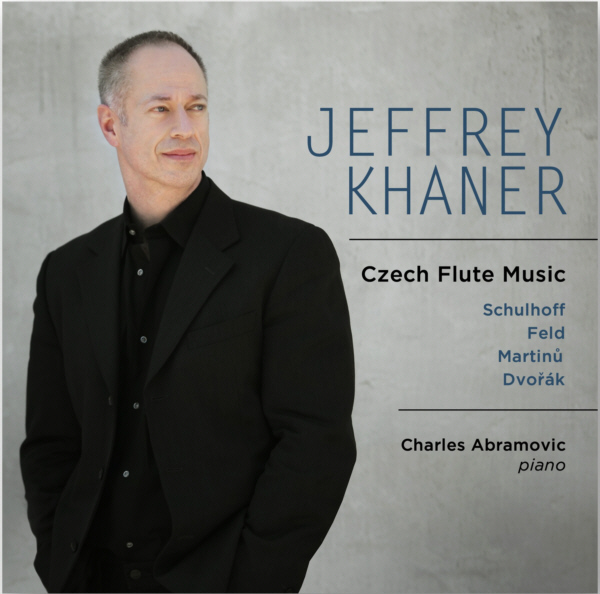
The overshadowed voices of the former Austro-Empire are also the subject of Czech Flute Music, the latest album of Philadelphia Orchestra Principal Flutist Jeffrey Khaner. The album features sonatas by Erwin Schulhoff, Jindrich Feld and Bohuslav Martinu as well as a Dvorák Sonatina that was originally written for violin but transcribed for both flute and viola following the work’s popularity. Schulhoff, who perished in a Bavarian concentration camp in 1942, represents the kind of musical eclecticism that, as Alex Ross writes in The Rest of Noise, was “effectively wiped out” between the wars. The composer synthesized the influences of everyone from Dvorak and Scriabin to the Second Viennese School, from the Dadaist painter George Grosz to jazz. This unself-conscious spirit of adventure also reveals itself in the other composers represented on the album, leaving the listener full of visions of how this music might have developed had twentieth-century politics taken a different turn.

Khaner and his accompanist Charles Abramovic perform exquisitely on all tracks, yet the Schulhoff leaves an indelible mark on the listener. According to liner notes by Malcolm MacDonald, the composer was at the height of his fame when he composed the sonata in 1927—a year before Erich Kleiber conducted his First Symphony in Berlin. Khaner takes a swift tempo in the opening Allegro moderato that gives the swirling melodic figures and vibrant rhythms just the right playfulness. This is music that never grows wearing, exulting in free lyricism with shades of polytonality that tease the ear. Khaner’s impeccable breath control in the elegaic line of the Aria movement ironically calls to mind an ‘endless melody,’ although the composer restores a sense of dance-like movement in the closing Rondo. The outer movements of the following sonata by Feld, written for the flutist Jean-Pierre Rampal in 1954, take this colourful, restless character a step further while revealing a taste for neo-classicism.

Martinu may be more of a household name than Schulhoff or Feld, but given the volume of chamber music he left behind, it is surprising that he is just starting to receive more attention in the western world. The rhythmic variety and structural freedom he takes in his Sonata No.1, written on Cape Cod in 1945, is fresh but soothing. As the flute chirps and muses with the piano as its anchor, Khaner and Abramovic move between the adamant and the serene with ease. Dvorak´s Sonatina in G evokes his American exile even more directly with references to Native American Indian and Negro spirituals, as the program notes explain, but clings to classical formulas that Martinu chose to overturn. The work provides a comforting familiarity but is also cast in a new light within the context of the album; the sighing melody of the Larghetto is tinged with an almost prophetic sadness before yielding to the folk-like Molto Vivace.

‘Czech Flute Music´ is currently available for purchase on Avie Records.

Yannick, the (Almost) Philadelphian

Wednesday, August 15th, 2012

by Sedgwick Clark

At Mostly Mozart on August 3, Yannick Nézet-Séguin’s largely direct, unfussy, and vigorous music-making was quite satisfying both on its own and as an augury of his future leadership of the embattled Philadelphia Orchestra. I’ve heard that curious Philly audiences have flocked to his appearances since he became music director-designate, and it was clear that this MM audience was energized by his leadership of Beethoven’s Second Symphony and Haydn’s “Nelson” Mass (a.k.a. “Mass in Time of War”). I had only heard him conduct previously twice, at the Met, in a Carmen whose frenzied Prelude alienated me instantly and a thankfully more judiciously paced Faust. But I wanted to hear him in concert, where I feel more at home.

Apart from the Mostly Mozart Orchestra’s whiny, vibrato-less string playing and slight relaxation for the Scherzo’s trio, I found the Beethoven exemplary, with the timpanist’s use of hard sticks impelling the music dynamically forward. The Haydn Mass, too, benefitted from fleet tempos and fine playing and singing. Yannick (pronounced “Yan-NEEK”), as I’m told he likes to be called, conveniently avoiding American mangling of his hyphenated French-Canadian surname, seems to thrive in vocal works, and for his first New York appearance with the Philadelphians, at Carnegie on October 23, he will lead Verdi’s Requiem.

While I suspend further judgment until we’re served with more rearguard Romantic rep—the orchestra’s beloved Tchaikovsky, Brahms, Rachmaninoff, etc.—this choice is infinitely more appropriate for this orchestra than the wayward Christoph Eschenbach. But one fact is undoubted: This great orchestra, which has just emerged from bankruptcy, stands at the top of its form thanks to its inherent esprit de corps and its interim leader of four years, Charles Dutoit. He knew how to get the best from these superb musicians, and in another month the ball will be in Yannick’s court.

The 30% Withholding Tax Isn’t Just For Performers!

Wednesday, August 15th, 2012

By Robyn Guilliams

Dear Law & Disorder Team –

We run an international competition that takes place in a different country every two years and each time we have to learn new lessons around taxation. What is the Withholding Tax situation around jury services or the teaching of master classes for non-US resident jury members? Are they also subject to the 30% Nonresident Alien (NRA) Withholding Tax or not?

As anyone in the U.S. who does business internationally will discover, dealing with tax withholding and other tax laws in foreign countries can be a drag, to say the least.  Every country has its own rules and procedures, and it’s often difficult to figure out those rules ahead of time, especially if you don’t speak the language.  I feel your pain!

As for the U.S. requirements for NRA tax withholding, the general rule is that any time a payment is made to a nonresident individual or business for services provided in the U.S., the 30% NRA withholding rule applies (i.e., you must withhold 30% of the gross payment toward the NRA’s possible tax liability.)  This rule applies not only to performers, but to ANYONE performing services in the U.S. – including those serving on competition juries and teaching master classes.

There may be an exemption from U.S. tax and withholding for a nonresident, however, if the nonresident meets certain requirements.  Generally, those requirements are as follows:

  • There must be a tax treaty between the U.S. and the nonresident’s country of residence (NOT their country of citizenship):
  • There must be a provision in that particular treaty that would exempt the nonresident from tax in the U.S.; and
  • The nonresident individual or business must have a U.S. tax identification number, and complete the appropriate form to claim the treaty exemption, and exempt themselves from withholding.

Whether or not a nonresident qualifies for a treaty exemption is very fact-specific.  And it’s important to be aware that each treaty is different!  Just because the U.S. tax treaty with France might exempt a French individual from tax for performing as a juror at a U.S. competition under certain circumstances doesn’t mean that the U.S. treaty with the U.K. would provide the identical exemption.

Fortunately, the IRS publishes a guide to understanding tax treaties, which goes by the catchy title of “Publication 901 – U.S. Tax Treaties.”  (You can download this publication here: http://www.irs.gov/pub/irs-pdf/p901.pdf.)  Table 2, which begins on page 39 of the current version of Pub. 901, includes a summary of the rules that apply to nonresident individuals who are performing services in the U.S., country by country.  When using this Table, be sure to review all of the information relevant to a particular country, including the footnotes!  (It’s all relevant to whether or not a withholding exemption applies.)

Finally, remember that a nonresident individual wishing to claim an exemption from withholding MUST have either a Social Security Number (SSN) or a U.S. Individual Tax Identification Number (ITIN) to do so.

And, as always, if you have any questions about visas or taxes for nonresidents working in the U.S., be sure to check out the Artists from Abroad website (www.artistsfromabroad.org) which has all of the information you could ever need on these topics!

________________________________________________________________

For additional information and resources on this and other legal and business issues for the performing arts, visit ggartslaw.com

To ask your own question, write to lawanddisorder@musicalamerica.org.

All questions on any topic related to legal and business issues will be welcome. However, please post only general questions or hypotheticals. GG Arts Law reserves the right to alter, edit or, amend questions to focus on specific issues or to avoid names, circumstances, or any information that could be used to identify or embarrass a specific individual or organization. All questions will be posted anonymously.

__________________________________________________________________

THE OFFICIAL DISCLAIMER:

THIS IS NOT LEGAL ADVICE!

The purpose of this blog is to provide general advice and guidance, not legal advice. Please consult with an attorney familiar with your specific circumstances, facts, challenges, medications, psychiatric disorders, past-lives, karmic debt, and anything else that may impact your situation before drawing any conclusions, deciding upon a course of action, sending a nasty email, filing a lawsuit, or doing anything rash!

AfricaViews, Part 2

Wednesday, August 8th, 2012

by Sedgwick Clark

By popular demand, I offer another baker’s dozen of Africa photos to tide over a humid summer. Our last two weeks of May were in South Africa’s fall season—very dry, with Kruger National Park’s brown grass sparsely green only near the river. The jungle foliage may have desiccated, but the bare bush gave us a better view of animals that, even then, blended into the background to an uncanny degree. In the morning the temps were around 40° Fahrenheit, and we dressed in five layers and bundled under blankets as the Land Rover whisked us to the bush to observe the changing of the wildlife guard. By 9 a.m. several layers had been shed, and at midday it was nearly 80°. Our late-afternoon return to the bush required that we dress in retrograde. The unexpected benefit of the season was that bugs were near nonexistent. Usually a magnet for their stingers, I didn’t get a single bite.

Photos: Sedge and Peggy Kane.

Once again, thanks to Stephanie Challener for her assistance in posting these photos.

Sunrise. The terrain is dotted with dead trees, stark and dramatic in the African sky. Peggy and our intrepid travel companions, Peter Clark and Jonathan Rosenbloom, would sigh in feigned frustration at my continued requests to stop the truck for a photo, but even Peter began snapping them after a while.

Our first day on safari began uneventfully. And then, as we turned a corner, there was a giraffe staring at us interlopers. We stopped. He stared. And when we stayed still he lumbered past us impatiently.

Look at those teeth! I was perfectly happy to let the camera do the close-up for this shot of a baboon demanding space for his family.

The most curvaceous horns in the jungle belong to the nyala antelope.

Talk about self confidence. This momma leopard allowed us to invade her territory without a flicker of concern. Of course she was well acquainted with the Land Rover and the respect of its inhabitants, but a foolish visitor might still be tempted to interpret her relaxed aplomb as an invitation. Not a good idea!

Mother elephant and child lunching in the bush. We were close up in this photo, but in many we took from afar we could barely distinguish the animals from their surroundings.

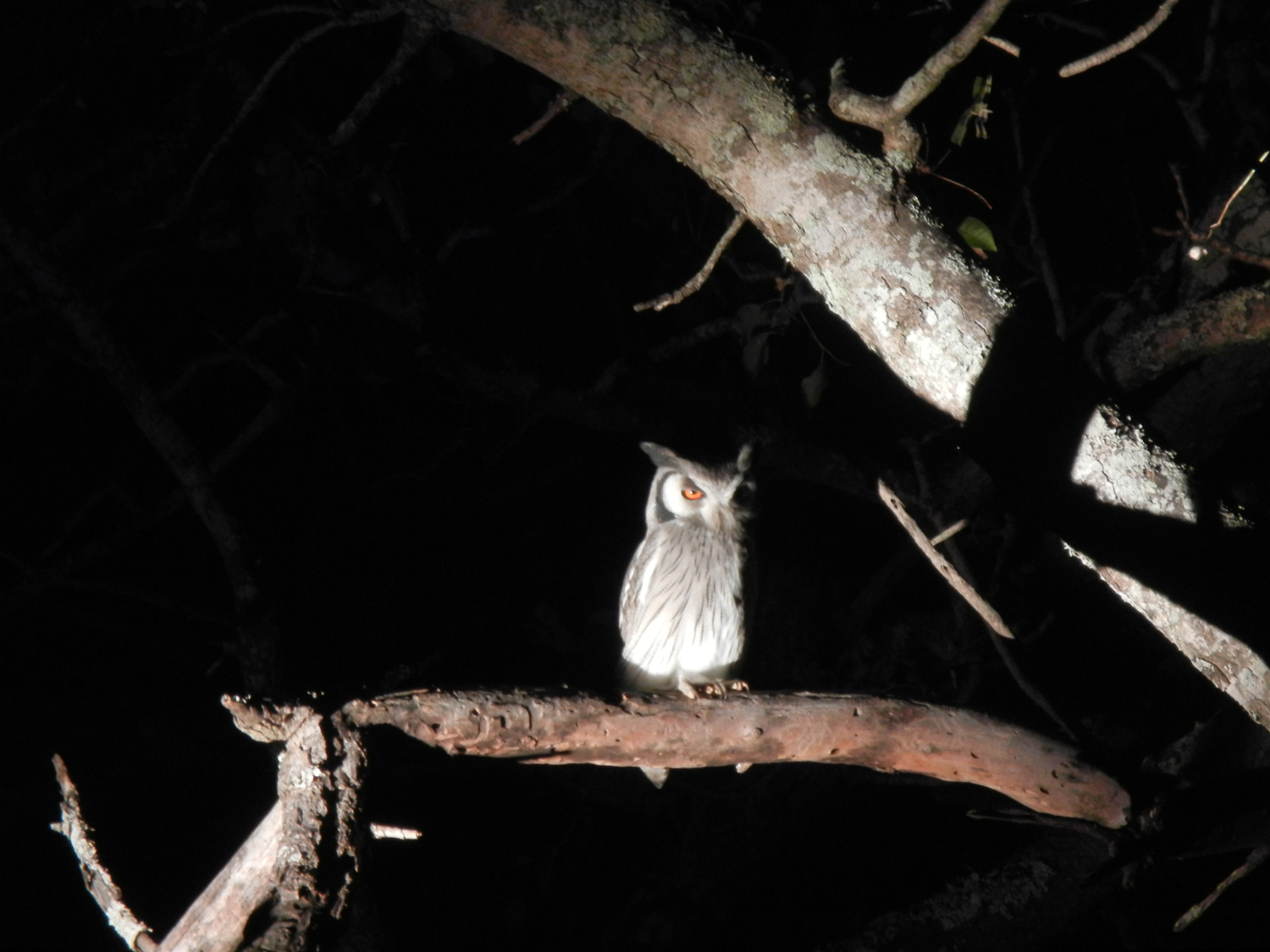
Who-o-o-o.

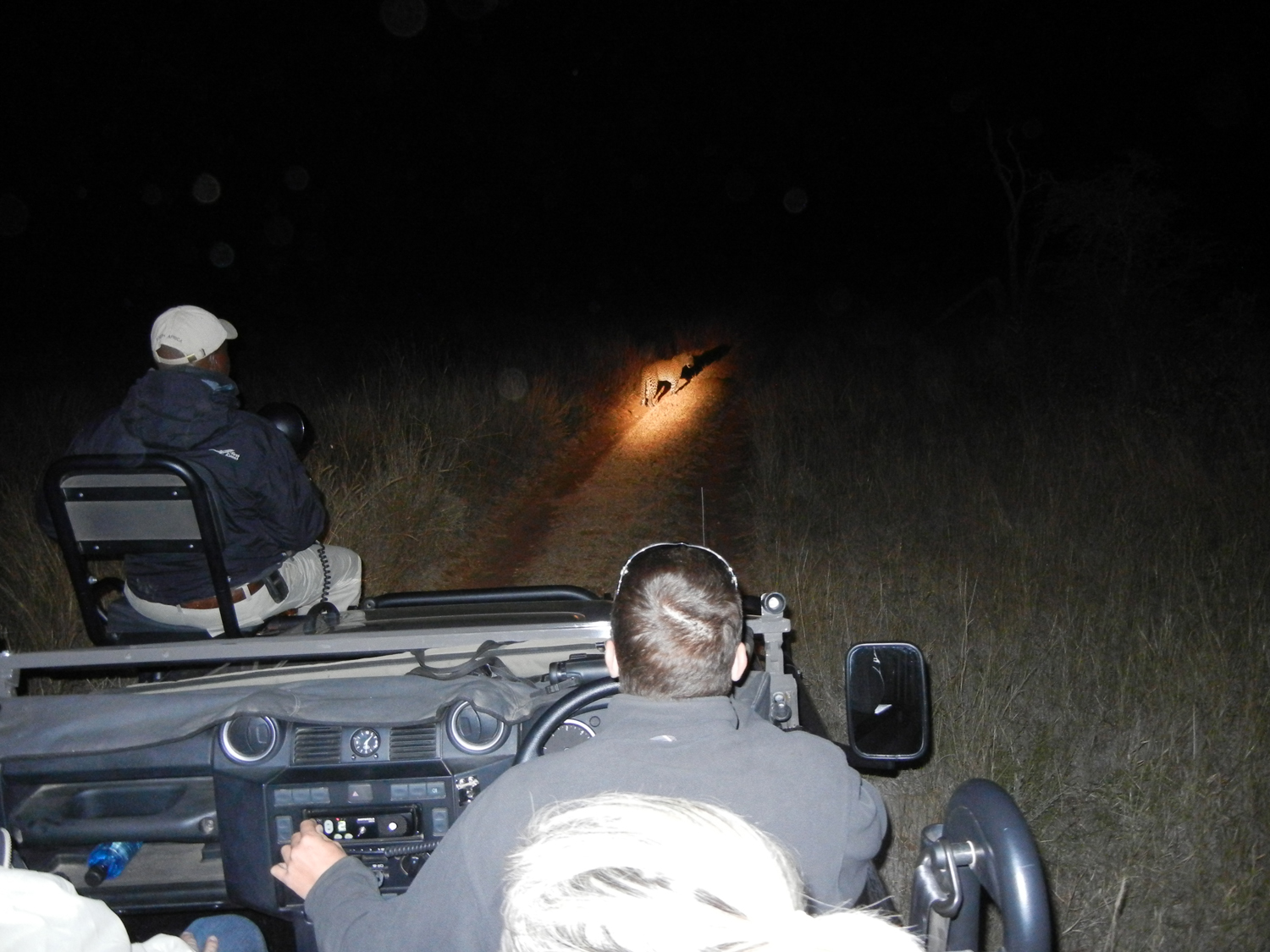
Tracking a leopard at night. We were on our way back to Lion Sands when, like a flash, a bush buck dashed across the road from the left, pursued immediately by a young leopard. We could hear a skirmish, but the buck got away and the leopard returned to the road, where our tracker pinpointed the cat in the spotlight. Our ever-competitive driver, Kyle, followed him into the bush, and we bumped and jostled in pursuit around the pitch black environs for nearly half an hour before returning to the camp.

Don’t tread on me. One of the Big 5 (a category of mammals most desired by hunters, including the lion, leopard, elephant, and rhino), the African buffalo is a very aggressive and dangerous animal, not to be messed with.

Not one of the Big 5 is the hippopotamus, perhaps due to its ungainly weight. This smiling hippo appears far happier in the cool water than did his grumpy, out-of-water sibling in last week’s photos.

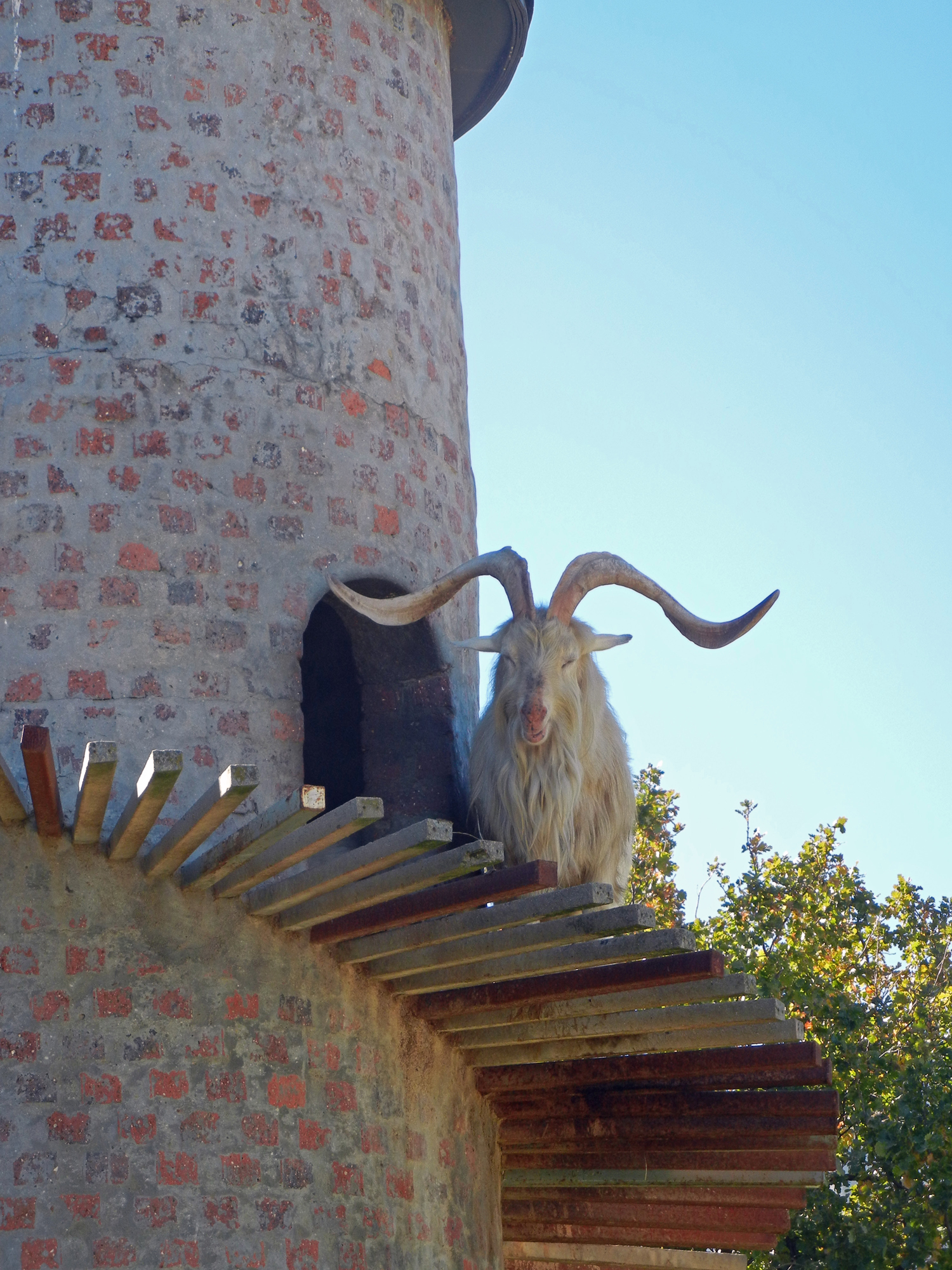
A mountain goat oversees the perimeter at a goat cheese farm.

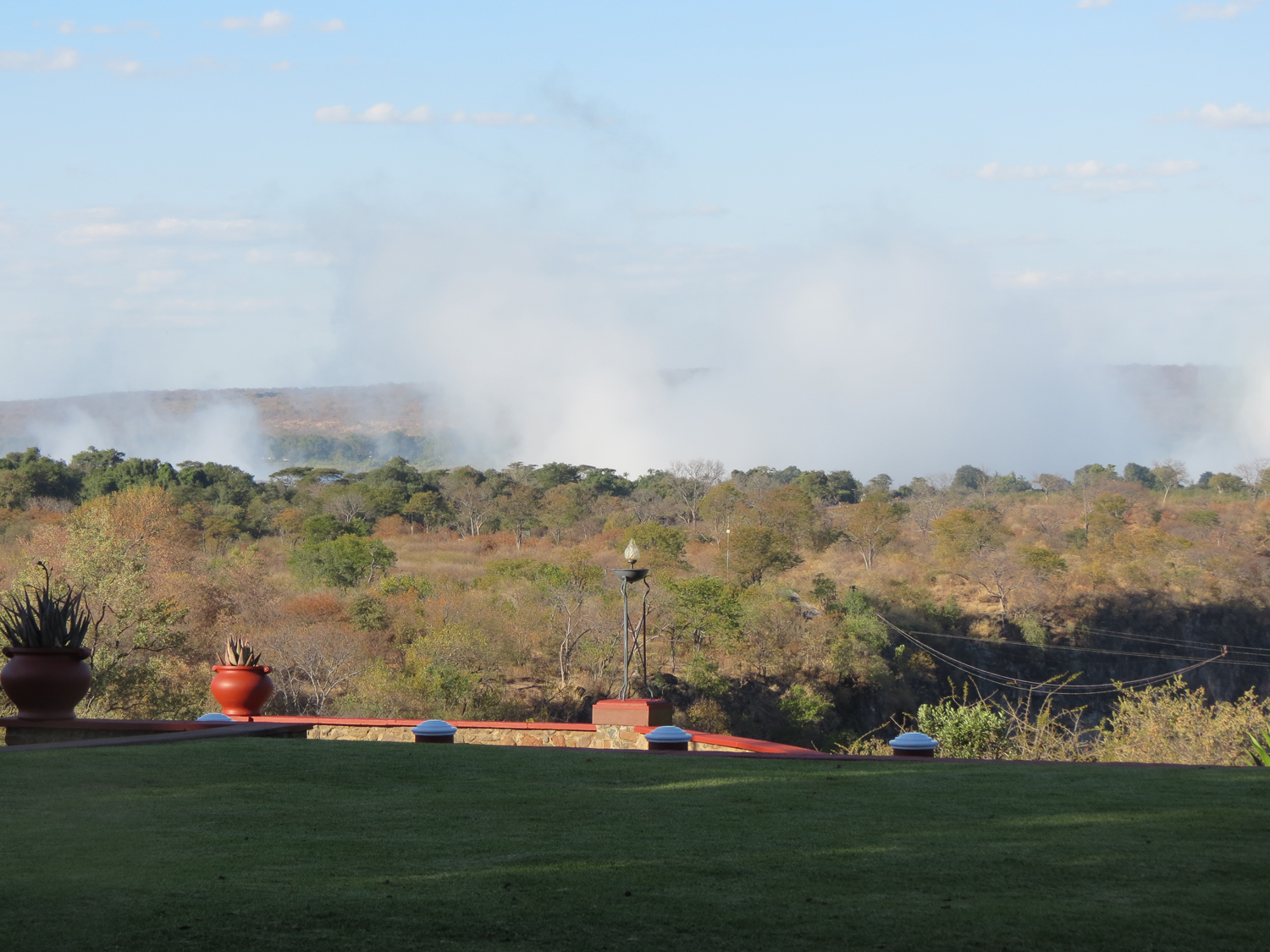
Only photos from the air could possibly capture the awesome immensity of Victoria Falls’ Seven Wonders of the World status. My photos were too close: It looked like merely another water fall. But Peter took a shot from the back yard of the Victoria Falls Hotel, where we stayed, and the cloud-like mist billowing in the distance suggests the falls’ wide-range power. Photo: Peter Clark.

It used to be thought that African elephants could not be trained. In fact, reported Robert Osborne last week when TCM showed all the Weissmuller-O’Sullivan Tarzan films in one day, MGM used the more docile Indian elephants, which have smaller ears, and attached fake, large ears to them! But the Elephant Back Safari program gives the lie to that old canard, for here’s Coco, with genuine ears flared, as Sedge and Peggy make friends with her before riding her. If you care to see us in Coco’s saddle, check out the photo in my May 30 blog, “Bwana Clark.”

Can Newspapers Charge To Quote Reviews??

Wednesday, August 8th, 2012

By Brian Taylor Goldstein

Dear Law & Disorder:

I recently came across the website of an artist management agency in Europe where they had posted the following: “The press review is temporarily not available. German newspapers Frankfurter Allgemeine Zeitung and Süddeutsche Zeitung recently started to pursue institutions and artists using texts (press reviews, interviews, commentaries etc.) published by those newspapers on their websites or in any other commercial context without having paid for them. We have been advised to remove all press quotations from our website as the same phenomenon seems to happen in other countries like Switzerland and Austria.” Is this a copyright trend that will spread to other European countries and the USA? Will agents, and artists have to start paying for the use of (press reviews, interviews, commentaries) used to promote an artists career? Also, if an American agency has press reviews, interviews, commentaries from Europeans newspapers on their websites, such as from the Frankfurter Allgemeine Zeitung and Süddeutsche Zeitung, will these agencies be liable for payment of the use for this information, as well, as it is being used in a commercial context? (Thank you for your column on Musical America, and I also thank Ms. Challener for her leadership in including such information in the weekly email Musical America updates.)

Newspapers and magazines have always owned the exclusive rights to the articles, reviews, editorials, and interviews they publish. Just like you can’t make copies of sheet music, CDs, books, and other copyrighted materials, you cannot make copies of articles and reviews and re-post them without the owner’s permission. Even if you are not “re-selling” an article or review, anything that is used to promote, advertise, or sell a product or service (ie: an artist!) is a “commercial” use.” While “quoting” or “excerpting” a positive review is most often considered a limited “fair use”, making copies of the entire article or review is not. While it should go without saying, you also cannot “edit” or revise articles and reviews in an effort to make a bad review sound more positive. (That’s not only copyright infringement, but violates a number of other laws as well!)

The website you encountered was in response to certain German newspapers, in particular, who began making significant efforts to require anyone who wanted to copy or quote their articles or reviews to pay a licensing fee. In the United States, for the most part, most newspapers and magazines have not actively pursued agents or managers who have quoted articles and reviews on their websites to promote their artists. However, I am aware of managers and agents who have been contacted by certain publications where entire articles have been copied and made available for download. In such cases, the publication has demanded that the copy either be licensed or removed. I also know of agents and managers who have posted unlicensed images on their websites and then been contacted by the photographers demanding licensing fees.

As for the ability of an American agent to quote or copy articles from the Frankfurter Allgemeine Zeitung and Süddeutsche Zeitung, under the applicable international copyright treaties, they could require American agents to pay as well. While I don’t necessarily see this becoming a trend among US publications, its certainly worthwhile to reflect that anytime an agent, manager, or presenter uses images, articles, videos, other materials to promote an artist or performance, there are copyright and licensing considerations that need to be taken into consideration.

________________________________________________________________

For additional information and resources on this and other legal and business issues for the performing arts, visit ggartslaw.com

To ask your own question, write to lawanddisorder@musicalamerica.org.

All questions on any topic related to legal and business issues will be welcome. However, please post only general questions or hypotheticals. GG Arts Law reserves the right to alter, edit or, amend questions to focus on specific issues or to avoid names, circumstances, or any information that could be used to identify or embarrass a specific individual or organization. All questions will be posted anonymously.

__________________________________________________________________

THE OFFICIAL DISCLAIMER:

THIS IS NOT LEGAL ADVICE!

The purpose of this blog is to provide general advice and guidance, not legal advice. Please consult with an attorney familiar with your specific circumstances, facts, challenges, medications, psychiatric disorders, past-lives, karmic debt, and anything else that may impact your situation before drawing any conclusions, deciding upon a course of action, sending a nasty email, filing a lawsuit, or doing anything rash!

A Procrastinator’s African Photo Log

Wednesday, August 1st, 2012

by Sedgwick Clark

I’ve been promising to run photos from our African vacation in this space almost since we returned two months ago. The lone dissenter (“You’re not really going to post photos from your Safari on Musical America.com!! Oy.”) was far outvoted. Only yesterday I ran into a friend who had seen photos posted in a decidedly more timely fashion on our fellow traveler Peter Clark’s Facebook page, and she expressed interest in seeing more. It was difficult to choose from all we took, and I may even have more next week.

The trip was planned by ROAR AFRICA, which we all agreed thoroughly lived up to advance praise. We flew to Johannesburg but after a four-hour layover continued to Cape Town rather than face the former’s notorious crime level. Both of the cities’ airports were strikingly up-to-date and clean, however. Once in Cape Town, we were met by ROAR AFRICA guide Andy Ward, a retired geography teacher, who had the answers for all of our questions and made us feel completely safe and at ease.

Exploring the wine lands and partaking in wine, goat cheese, and chocolate (!) tastings was a relaxed way to overcome 20-some hours of travel. We also visited the Spier Wine Estate, which houses a bird sanctuary and a Cheetah Outreach Program where over 20 of these beautiful, endangered cats live.

We also visited the Hout Bay Music Project, which I wrote about on May 24, while still in Africa. We took so many photos that I’ll put a few of them together in a future week of their own.

The first three photos cover our time in Cape Town before flying east to Kruger National Park, where more colorful beasts roam. All photos were taken by yours truly or Peggy Kane unless otherwise noted.

Many thanks to Stephanie Challener for her assistance in posting these photos.

(left to right) The intrepid travelers: Peter Clark, Sedge, Peggy Kane, and Jonathan Rosenbloom at the Cape of Good Hope.

Nelson Mandela’s prison cell for 18 years on Robben Island. The Dutch settled the Cape in the mid-1600s and established the island primarily as a prison. Since 1997 it has been a living museum and a focal point of South African heritage, with tours given by former prison inmates.

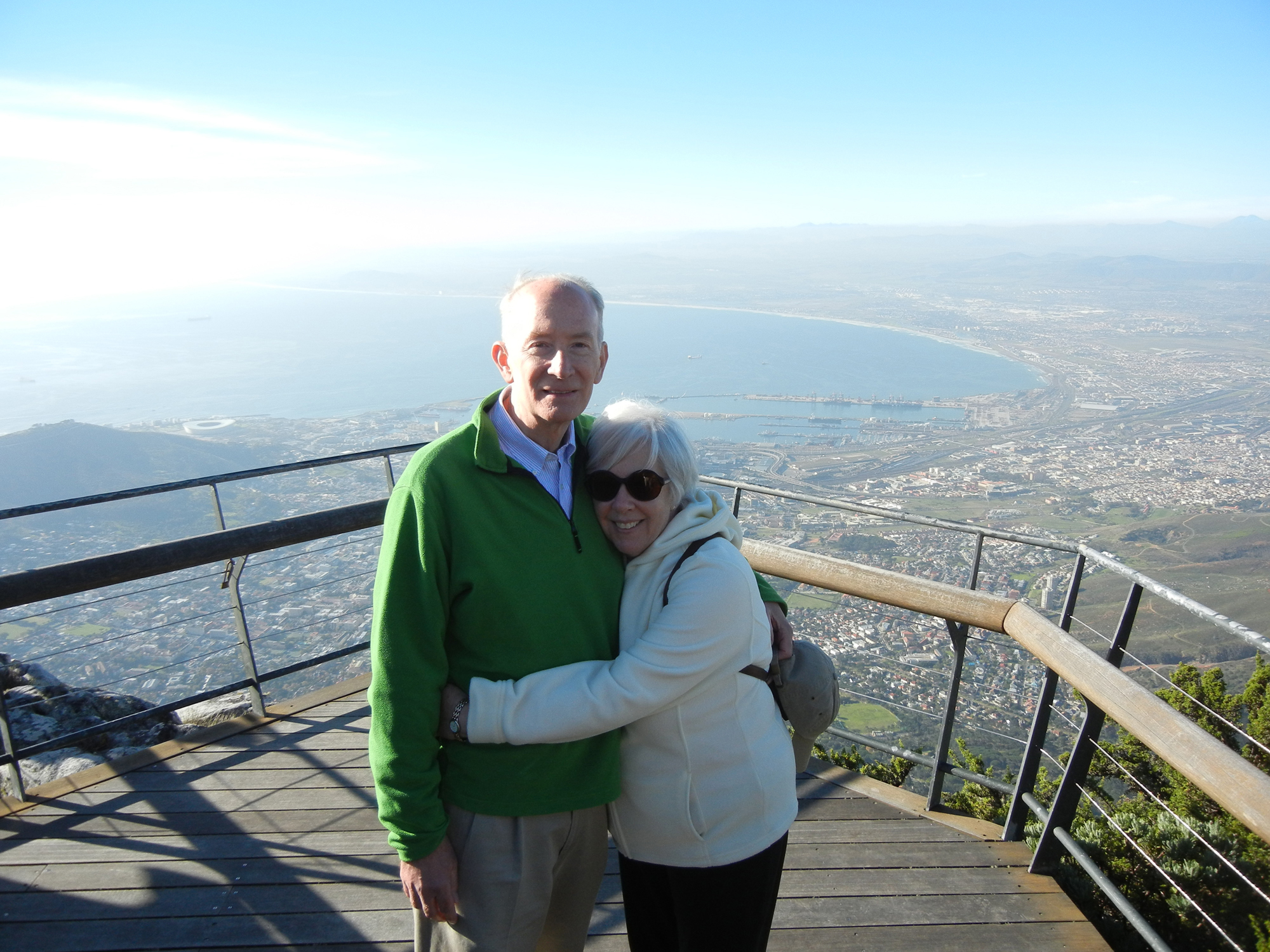
Sedge and Peggy on 3,000-foot Table Mountain with Cape Town in background to the west. Possessed of an unfortunate urge to jump from such heights, I dared venture no further out onto this overlook’s precipice, to Peggy’s amusement. Many young visitors would lean over the railing, presumably to enjoy the precipitous drop, but compelling me to head for center ground. On our 3,500-foot descent in the cable car, to avoid the 360-degree views afforded by the car’s revolving floor, I kept my cookies down by engaging our guide Andy in an eyes’-locked discussion about the upcoming American presidential election.

Safari at dawn with tree and crescent moon. Bush safaris in the Tinga and Lion Sands Game Preserves were from 6-9:00 a.m. and 4-7:00 p.m., returning to camp for breakfast and for dinner, respectively. In between, we could watch the elephants cavort in the Sabie River or take a nap.

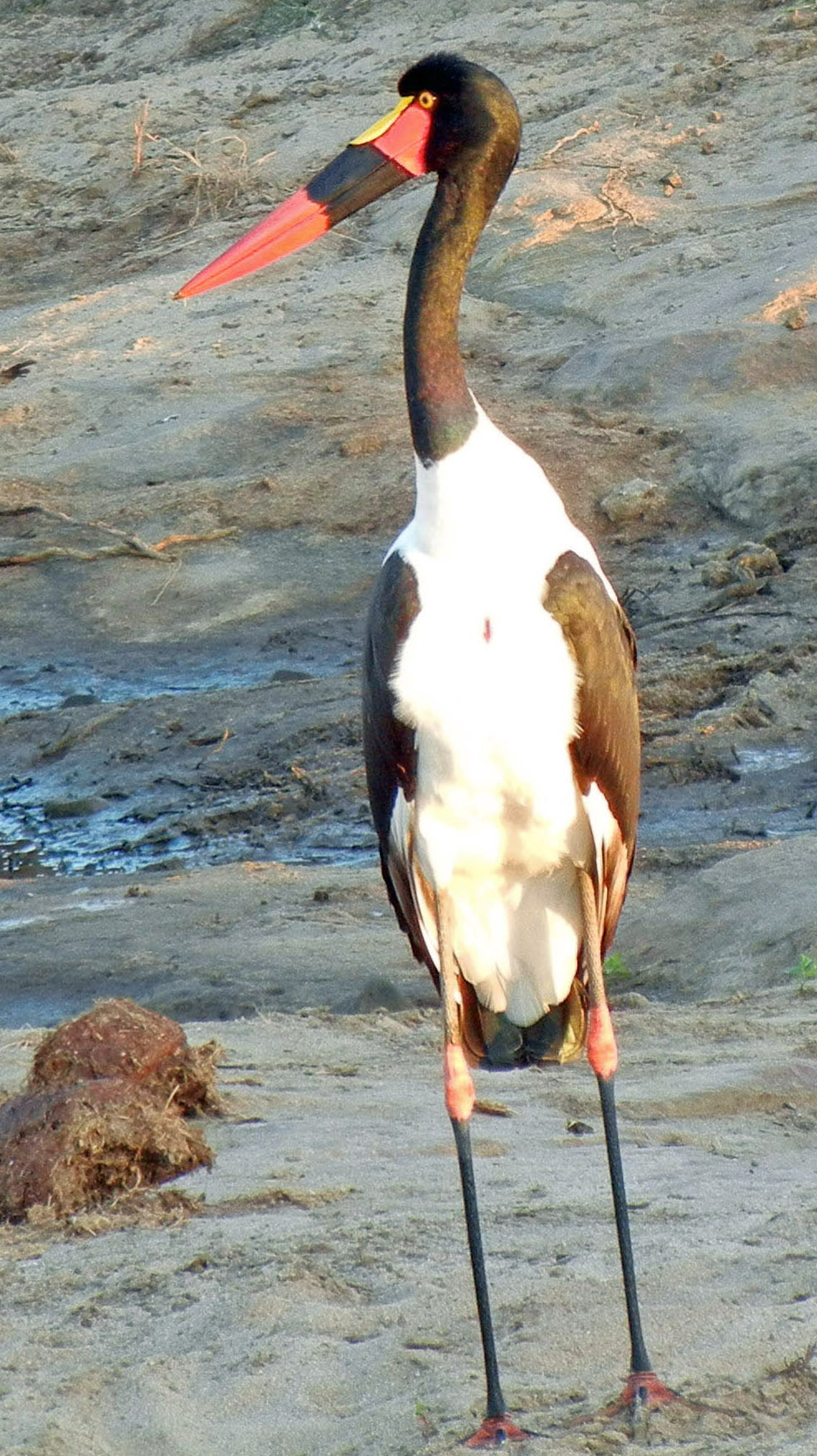
A red-billed stork with elephant flop.

It’s a matter of pride for the safari rangers and trackers to find the Big 5 (lion, leopard, elephant, rhino, and buffalo), as well as hippo and giraffe. A tip from a fellow ranger led us to this scene. The giraffe had been killed by different lions three days before, and these lions (pictured) had ventured out of their own territory from a neighboring park across the Sabie. Before we approached the kill, our ranger stopped the Land Rover and plucked fever bush leaves for each of us to smell. We were very grateful.

A hippo close-up on a walking tour. Unlike when we were safely seated in the Land Rover, our ranger and tracker each carried a rifle. We were warned that if he should turn on us and charge, the worst thing we could do would be to run! Fortunately he lumbered off into the river.

Of the Big 5, elephants are the most prolific. We have photos of them everywhere, crossing highways, jamming traffic as they lumber down dirt safari roads, knocking down trees to eat their roots, crossing the Sabie River.

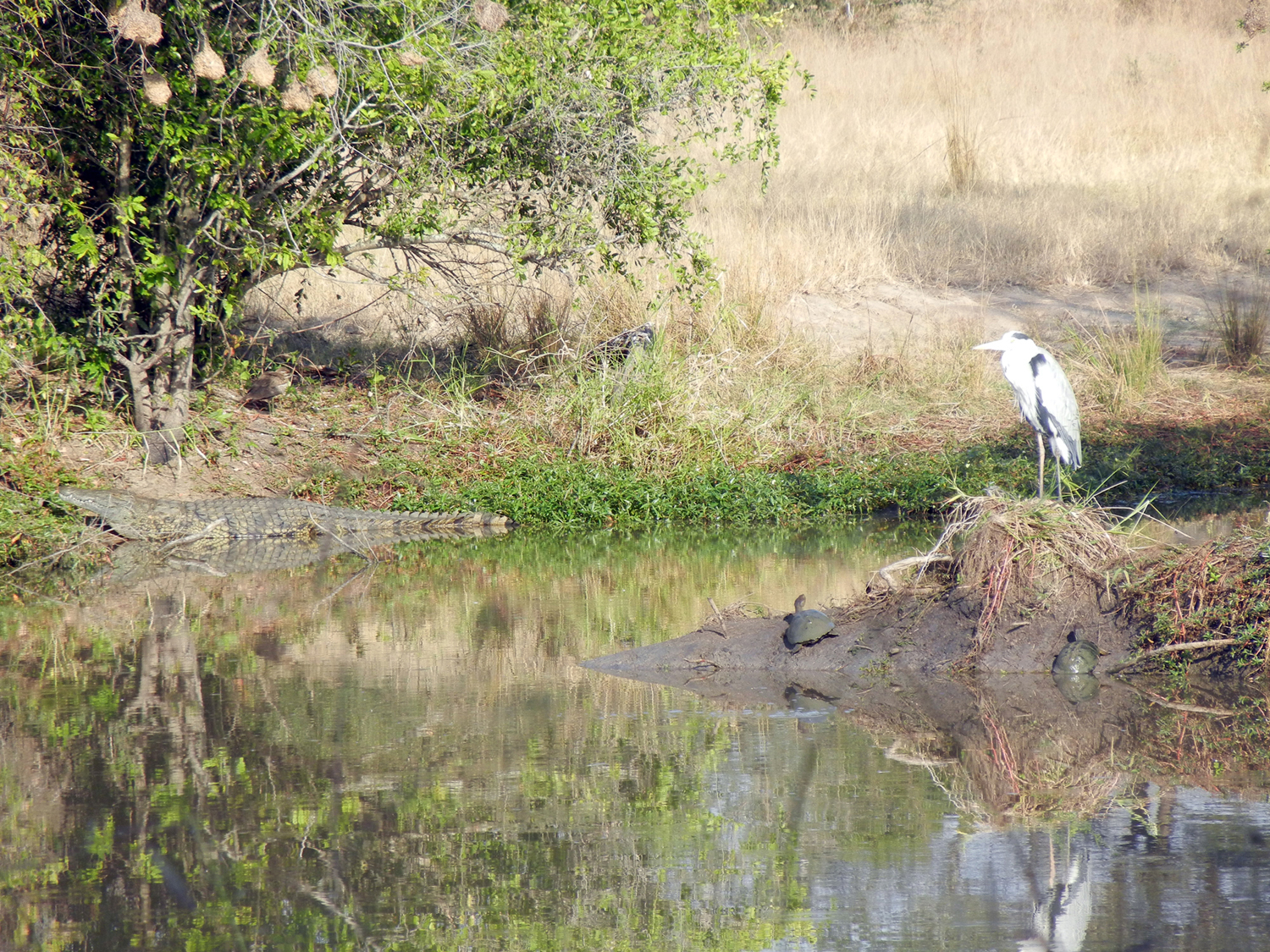
A crocodile lies in wait beneath weaver bird nests, while two terrapins clamber out of the water and a white heron keeps watch.

Two male impala fight, undoubtedly for the favors of a female.

After an elephant ride, Sedge and Peggy bond with Sylvester, the friendly cheetah.

Despite reassurance that this family of grazing rhinos was allowing us into its territory, being just 20 feet from this most prehistoric-looking of living animals generated a palpable sense of awe and danger.

A Magic Blurb

Wednesday, August 1st, 2012

By Brian Taylor Goldstein

We teach classes, put on concerts and run festivals.  At all of these events we take photos of the participants along with the members of our group. We want to be able to use the photos on Facebook and our website.  So I am looking for a “blurb” to put in our programs and registration forms that says we have their consent to use photos of them, without having to get actual signed releases from everyone who attends our events in case we end up using their photo.

I don’t know that there is one magic “blurb” that will cover all of these scenarios. The closest, most generic thing I can think of would be: “I understand and agree that, by participating or attending this event or program, my photograph may be taken and used to market and promote other programs and performances of _____________.”

Generally, you don’t need anyone’s permission to take a crowd shot or a photograph of someone attending a public event as there is no right of privacy when people attend public events. That would allow you to put the photograph on a website or facebook. However, if you liked a particular image of a particular individual (ie: close up or head shot) so much that you wanted to feature it alone on posters, billboards, postcards, or as part of a featured publicity campaign, then you may be intruding on rights of endorsement/publicity and would need specific permission. Also, as a general rule, if you want to take the photograph or video of audience members attending a concert, you want to put a sign or placard out front stating that photographs will be taken at this performance so that, by proceeding, they can make the decision whether or not to participate. Printing a release in the program which they may or may not even read until after the concert doesn’t accomplish anything. On the other hand, if someone is filing out a registration form for a class or workshop, that’s the perfect place to put in the necessary language so that they can actually provide their consent when they sign and return the form.

New Releases: ‘Almost Truths and Open Deceptions’; ‘Opus 1’

Friday, July 27th, 2012

By Rebecca Schmid

The New York-based composer Annie Gosfield is best known for her synthesis of industrial sounds and other unconventional sampling into rock-inflected, yet often intricately wrought, compositions. As a fellow at the American Academy in Berlin last semester, she researched encrypted radio broadcasts from World War Two—part of a long-standing fascination with archaic technology and its unusual sounds—for a new violin work that will premiere at the Gaudemaus Muziekweek in the Netherlands this September. Satellite transmissions, the clanking of junkyard metal, factory machinery, destroyed pianos, and detuned radios have all been repurposed in Gosfield’s repertory, to often surprisingly lyrical effect. Underlying many of these explorations is a highly personal thread. “Daughters of the Industrial Revolution” (2011), the most recent work on her upcoming album, Almost Truths and Open Deceptions, was inspired by her grandparents’ experience as immigrant workers on the Lower East Side. “I am a third generation daughter of the industrial revolution,” she writes in program notes, “linked to this history, not only genetically and geographically, but as a composer who often uses raw materials and transforms them into something new.”

The assembly-line rhythms, sampled from a factory in Nuremburg, unshackled electric guitar, ringing sampler melody and percussion in the approximately five-minute excerpt from this work create a punk rock-like fare that contrasts sharply with the album’s title work, a chamber concerto with a cello part written for Felix Fan at its center. The title “Almost Truths and Open Deceptions” refers to the movement of the entire ensemble toward “a mass of open D strings,” as Gosfield explains. At the end of the 24-minute work, the instruments settle through wilting glissandos into a decaying unison that fades ghostlike. The concerto opens with brash string attacks, wild circling motives and pulsing forward motion that settles down deceitfully, foreshadowing the piece’s conclusion, before ceding to a cello that implores and groans. Intimate, folky exchanges between the piano, violin, and cello ensue in the course of the work’s impending movement, propelled through variegated rhythms and animated melodic writing, with a percussive interlude that teases the listener as much as it creates suspense.
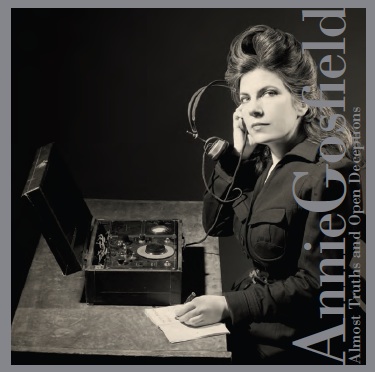
‘Almost truths’ would also seem to apply to the album’s first track, “Wild Pitch” (2004), with its double-entendre in reference to “a baseball game gone mad” as well as the musical sense of the word. Fan again takes center stage along with the members of his trio “Real Quiet,” scraping out both tuned and quarter-toned figures against eerie piano (Andrew Russo), also played from the inside with a steel guitar slide among other objects, and high strung percussion (David Cossin). The excitability yields intermittently to meditative stasis, given an authentic flair with Chinese cymbals and broken gongs. Gosfield’s ability to foreground and manipulate pure instrumental sounds emerges even more clearly in “Cranks and Cactus Needles” (2000), inspired by the sounds of the now obsolete 78 RPM records and commissioned by the Stockholm-based ensemble The Pearls Before Swine Experience. Ripping, scratchy timbres in the strings evoke a record player on its last legs, while flute and piano play unaffected. Gosfield herself takes the keyboard for “Phantom Shakedown,” composed specifically for the album in 2010, over cosmic whirring, satellite bleeps, detuned piano, and machine rhythms, the piano’s heavy, if at time monotonous, chords moving through the samples as if drifting through a tunnel.

Some subtleties in the frequencies of the samples may not be as palpable on recording as they are live, yet instrumental balance is generally well-struck throughout the album. The first minutes of the title track are excessively loud at first hearing, but upon grasping the music’s structural strains becomes an absorbing listen. The detoned shades of “Cranks and Cactus Needles” manage to carry through effectively, the keyboard deliberately raucous beneath ripping strings. Roger Kleier’s electric guitar grinds organically with the machine riffs in “Daughters of the Revolution,” while the technical and expressive range of Fan’s cello, featured in four of six tracks, provides visceral continuity throughout the spectrum of Gosfield’s endeavors. David Cossin’s percussion provides a full range of timbral variety and rhythmic energy, fueling this music’s appetite for lyrical noise.

‘Almost Truths and Open Deceptions’ is out Aug.28 on Tzadik Records and can be pre-ordered on Amazon.com.

Opus 1

At a time when young musicians are grappling with the demands of audience development and changing business models, the Israeli Chamber Project (ICP) has created a flexible format that combines high quality performance and outreach into a single mission. Founded four seasons ago by young musicians based in New York, Berlin and Tel Aviv—most of whom graduated from Juilliard or the Manhattan School of Music—the octet divides its time between the concert hall and educational tours to rural parts of Israel, some of which are mostly Arab, that have little or no exposure to classical music. “It’s a response to a social-economic situation where there’s a kind of brain drain,” explains pianist Assaff Weisman, who also serves as the group’s executive director. “No one is left to teach there.” In turn, the chamber music society hopes to bring something of its native musical culture abroad, championing emerging Israeli composers and including pre-concert demonstrations. The ensemble, with two pianists, a clarinetist, and a harpist alongside a quartet of string players, can expand or shrink to suit a wide range of repertoire and has won praise for its inventive programming. The group’s debut album Opus 1 features an originally-commissioned quartet by the Berlin-based composer Matan Porat alongside duets, trios and a sextet.

The selection gives equal measure to late French Romaticism and Eastern European modernism, providing a fitting stylistic context for Porat’s Night Horses (2007). Dreamy piano arpeggios and rhapsodic lines in the clarinet over nearly imperceptible slides and tremoli in the strings yield to tangled melodies that deliberately evoke Messiaen’s Quatuor pour la fin du temps, as liner notes by Laurie Shulman explain. The work was originally inspired by an eponymous lecture by Jorge Luis Borges about the ‘nightmare’ as a ‘night horse’ that invades the psyche. The second movement features moaning strings and emphatic interlocking melodies that seem desperate to escape as the piano gallops along until a soft, waking clarinet melody resolves the emotional turmoil. Martinu’s Musique de Chambre No.1, scored for clarinet, harp, piano and string trio, provides the ensemble with another outlet for vibrant, free-ranging yet highly idiomatic musicianship. Folk rhythms emerge spontaneously alongside neo-impressionist elements, while the mysterious timbre and meditative stasis of in the inner Andante movement underscores the music’s unusual instrumentation.
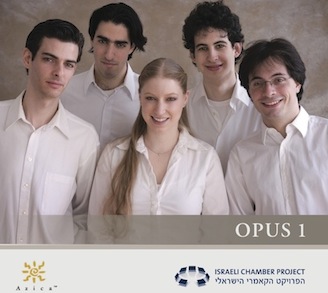
Bartok’s Contrasts for violin, clarinet and piano, the only chamber work in which the composer involved a wind player, also features a slow-fast rhapsodic structure with a Pihenö (Relaxation) inner movement. The late Bartokian fare can barely contain its energy in the final movement as both violinist and clarinetist respectively alternate between two instruments, a detuned fiddle adding a searing touch of nostalgia. The album is balanced with the soothing mood of duets according special prominence to the harp. ICP harpist Sivan Magen performs in his own arrangement of Debussy’s Sonata for Cello and Piano, originally written in the composer’s last years after a spell of paralyzing depression. The harp’s dry, rippling timbre is not so convincing in the accompanying chords of the Prologue or the aggressive plucks that bring the final movement to a close but achieves a more compelling blend in the inner Sérénade. The Fantaisie for Violin and Harp of Saint-Saens, who as the liner notes explain was one of the few pianist-composers to write idiomatically for the harp, demonstrates a more conventional, and ultimately more consistently pleasing, use of texture.

The members of the ICP perform with youthful energy and polished, expressive musicianship throughout the album. Magen reveals his mastery of the instrument in French repertoire and blends skillfully in Martinu’s Chamber Music No.1. Weisman anchors the ensemble sensitively in Porat’s Night Horses, while clarinetist and ICP Artistic Director Tibi Cziger nails the dance motives of the opening Verbunkos movement to Bartok’s Contrasts. The performance of this work stands out for its crisp, lively rhythms and effortless sense of structure. Violinist Itamar Zorman, winner of the 2011 Tchaikovsky Competition, also impresses in the thorny harmonics of the final movement. Balance problems between the contrasting timbres of the instruments emerge only in the Porat, where subtle violin timbres in the opening do not come through audibly enough. Such are the perils of recording contemporary music, although audio engineering could perhaps artificially address the problem. All considerations aside, ICP’s fresh approach to chamber music breathes life into an art form whose myriad possibilities often go underappreciated in mainstream classical music life.

Opus 1 is already available for download and will be released on Azica Records July 31.

Books: George Szell; the New York Philharmonic

Thursday, July 26th, 2012

by Sedgwick Clark

For a couple of years I’ve been putting off even mentioning some worthy books whose authors happen to be good friends. Perhaps I should have taken the old New Yorker answer to books by its contributors and simply listed them without comment. At this late date, I suggest you simply buy these books.

George Szell once told Time magazine that no one would ever write a biography of him: “I’m so damned normal.” No one who knew this podium tyrant believed his self-appraisal for a second. Certainly not his Cleveland Orchestra musicians, who called him “Cyclops,” only partly due to his Coke-bottle thick glasses. Nor Rudolf Bing, famed general manager of the Metropolitan Opera, who clashed with Szell in 1953-54 when he abruptly stormed out of his contract with the company. Someone said to Bing afterwards that Szell was his own worst enemy. Bing’s famous reply: “Not while I’m alive.”

Michael Charry’s George Szell: A Life of Music (Illinois, 2011) is the first book about one of history’s great conductors, and it is likely, given the current lack of commercial interest in classical music, to be the only one. So thank you Illinois Press, and thank you Michael Charry, who had a front-row-center view of this prickly musician for nine years as a member of the Cleveland Orchestra’s conducting staff and apparently remembered everything. His admiration for Szell never flags, yet he allows us to see the conductor’s cruelty to his players when they performed imperfectly as well as his kindness to such impressive young soloists as German violinist Edith Peinemann and American pianists Leon Fleisher, Gary Graffman, and John Browning. In the judicious balance of reported information and his own observations, Charry has crafted a biography worth waiting for. Importantly, a list of Szell’s repertoire and a complete discography are included—the last time in our computer age I expect to see this.

New York Philharmonic concertgoers over the past six decades will want to read John Canarina’s The New York Philharmonic: From Bernstein to Maazel (Amadeus Press, 2010), a sequel of sorts to critic and journalist James Huneker’s The Philharmonic Society of New York and Its Seventy-Fifth Anniversary (1917) and conductor/teacher Howard Shanet’s Philharmonic: A History of New York’s Orchestra (Doubleday, 1975). While I haven’t read the Huneker book, he was reportedly rarely without strong opinions; nor is Shanet, who uses his book to combat “the vast, and largely unjustified, inferiority complex that has oppressed American music throughout its history . . . .”

Unlike Shanet, Canarina has no “ax to grind.” He takes a historical tone, writing of what he considers the high points of concerts and important facts. Both authors had connections with the orchestra and conducted it—Shanet was a musical assistant to Leonard Bernstein in the early 1950s, and Canarina was an assistant conductor of the Philharmonic in 1961-62, during Bernstein’s tenure. Shanet ended his book before Pierre Boulez’s tenure began in 1972-73. Canarina, however, instead of beginning his book with Boulez, chooses to overlap with Bernstein’s directorship (1958-69), ending with Lorin Maazel’s tenure (2002-09).

It’s a fair but surprisingly dispassionate book, perhaps because conducting and teaching kept the author out of town during much of that time. Hence the reliance on what critics reported. It was Bernstein’s final season when I arrived in New York 44 years ago, and I enjoyed being transported back to the many Philharmonic concerts I have heard since that time. Canarina quotes many reviews with which I disagreed then and which annoy me still. That’s horse racing, to be sure, but I could have welcomed Canarina’s book even more if it had offered completely fresh opinions.