By Brian Taylor Goldstein, Esq. Dear Law and Disorder: We are a small classical music presenter. Several months ago, I booked an artist for a performance this fall. Recently, I received a phone call from the artist’s manager asking for a deposit. Usually, we don’t pay deposits, although, sometimes we will if it’s an artist or manager with whom we have never worked before. However, we’ve worked with this manager before and she’s never asked for a deposit before. When I asked her about it, she said that she (the manager) was having a slow summer and that she needed the money to give her some cash flow to “tide her over” until the fall. She threatened to cancel if I didn’t agree. Is this legal? As a general rule, I’m a big fan of deposits. They provide artists with some “leverage” in the event of a cancellation and they provide presenters with some assurance that an artist has, in fact, been “booked.” However, once all key terms have been negotiated and agreed upon, whether or not a written booking agreement has been signed, then a manager cannot retroactively “require” a deposit. The requirement of a deposit is a key term which needs to be discussed, negotiated, and agreed upon at the outset of discussions. If the artist were to cancel because you refused to pay a deposit you never agreed to pay in the first place, then the artist would be in breach of the booking agreement. But that’s not really the problem here. The problem is that the manager volunteered that she was asking for the deposit not for the benefit of the artist, but for the benefit of the manager herself. It would be different if the manager wanted the deposit to reserve airline tickets or advance costs to cover the artist’s out-of-pocket expenses. However, according to you, that’s not what the manager said. She said she wanted it to “tide her over” for the manager’s own cash flow purposes. Based on that statement, and her subsequent threat to cancel if you refused to pay the deposit, the manager’s actions are not only unethical and unprofessional, in my opinion, but, more importantly, highly illegal. Managers and agents are legally bound to act only on behalf of and in the best interest of their client (the artist) and not on behalf of themselves or anyone else. In legal terms, these obligations are called “fiduciary duties.” Managers and agents can take no actions which are not authorized by the artist and most certainly cannot treat the artist’s money as if it were their own—including asking for and using deposits to float themselves loans to cover their own cash flow needs. This is why, among other reasons, managers and agents are supposed to keep their own, personal operating accounts separate from their client’s (artist’s) accounts. This should not be confused with legitimate situations where managers and agents sometimes ask presenters to split an engagement fee into two payments and pay a commission fee directly to the manager or agent and the balance to the artist. While I find this to be an ill-advised and awkward business practice, it’s neither illegal nor unethical. While I suppose its entirely possible that, in this case, the manager was acting with her artist’s knowledge and authority, I seriously doubt it. This means that the manager was acting out of her own self-interest and not in the best interest of her artist, is in breach of her fiduciary duties, is no longer acting in her legal capacity as a representative of the artist, and, in the event of a cancellation, would be personally liable for the return of the deposit and any damages. Given the manager’s self-admitted cash flow problems, that’s probably a risk you don’t want to take. I’d like to think that the manager is acting out of a genuine confusion over the duties agents and managers owe to their artists. Sadly, this issue continues to confuse even experienced managers and agents who believe that their artists work for them and not the other way around. Regardless, in terms of red flags, this one is ten feet tall and on fire. Run away! __________________________________________________________________ For additional information and resources on this and other legal and business issues for the performing arts, visit ggartslaw.com To ask your own question, write to lawanddisorder@musicalamerica.org. All questions on any topic related to legal and business issues will be welcome. However, please post only general questions or hypotheticals. GG Arts Law reserves the right to alter, edit or, amend questions to focus on specific issues or to avoid names, circumstances, or any information that could be used to identify or embarrass a specific individual or organization. All questions will be posted anonymously. __________________________________________________________________ THE OFFICIAL DISCLAIMER: THIS IS NOT LEGAL ADVICE! The purpose of this blog is to provide general advice and guidance, not legal advice. Please consult with an attorney familiar with your specific circumstances, facts, challenges, medications, psychiatric disorders, past-lives, karmic debt, and anything else that may impact your situation before drawing any conclusions, deciding upon a course of action, sending a nasty email, filing a lawsuit, or doing anything rash!
Archive for 2013
A Manager’s Deposit of Trouble
Wednesday, July 17th, 2013Liederabend with Breslik
Tuesday, July 9th, 2013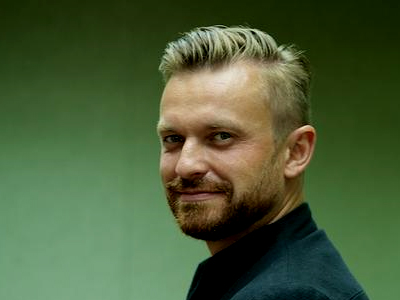
By ANDREW POWELL
Published: July 9, 2013
MUNICH — With the brightness of his voice working against him at every turn, Pavol Breslik blazed and sweated his way through Schubert’s Die schöne Müllerin last Friday (July 5) here at the Prinz-Regenten-Theater. By the end, drowned in Wilhelm Müller’s creek, he had somehow won over the packed house.
Tension built up often disagreeably. Six or seven of the twenty songs were rushed. Breaks for bottled water upheld a stagey tautness, and yes, nervousness. But in reflective settings, once the voice had warmed up, the neatly groomed lyric tenor found beauty and tonal variety. Des Müllers Blumen and Tränenregen, already at the cycle’s mid-point, introduced the first degrees of poignancy and due expression. Not until Der Müller und der Bach and the concluding lullaby, however, did Breslik imaginatively tap the tension instead of adding more, leading to rapt applause.
Born in Slovakia in 1979, with early training at the Academy of Arts in Banská Bystrica, this artist delivers a smooth Belmonte or ardent Lensky on other nights. He can immerse himself in a long musical line and endow it with supple legato phrasing. On this night he took no artistic shortcuts, betrayed no mannerisms, and seemed genuinely lost in the moment during much of the cycle. His sung German sounded fluent; he is clearly passionate about the words he sings. Only when he spoke (about bottled water) was an accent discernible.
Amir Katz, born in 1973 in Ramat Gan, Israel, provided cagey, fleet support, which seemed a reasonable approach — perhaps the only approach — given Breslik’s avid absorption.
Photo © Neda Navee
Related posts:
MPhil Bosses Want Continuity
Mélisande as Hotel Clerk
Liederabend with Hvorostovsky
Volodos the German Romantic
Verdi’s Lady Netrebko
Liederabend with Hvorostovsky
Tuesday, July 9th, 2013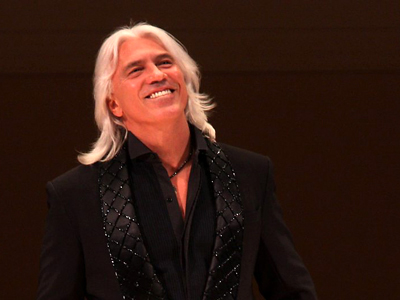
By ANDREW POWELL
Published: July 9, 2013
MUNICH — For years now Dmitri Hvorostovsky has been including in his recitals the same handfuls of songs by Sergei Taneyev and Nikolai Medtner. Colorful, intimately dramatic, and flattering to the baritone’s voice, they do not comprise cycles or alas make satisfying groupings — Hvorostovsky has shown more devotion to the music of Georgy Sviridov, performing integral works such as the Six Pushkin Romances of 1935 and the song cycle Petersburg of 1995 — but here they were again on Wednesday (July 3), five settings from each composer and all dating from 1903 to 1915, for a sold-out Prinz-Regenten-Theater.
Taneyev’s conversational Менуэт (Minuet), Op. 26/9, found the charismatic Siberian at his most engaging and natural, the voice relaxed and velvety. The somewhat clamorous Зимний путь (Winter Road), Op. 32/4, emerged free of strain. Medtner’s generally more ardent scores stretch the vocal line in awkward ways and require a few sustained tenor flights, but none of this seemed to phase Hvorostovsky, who rose robustly to the selected challenges. Long-held endings to Medtner’s unrelated Goethe settings Счастливое плаванье (Glückliche Fahrt), Op. 15/8, and Ночная песнь странника (Wandrers Nachtlied), Op. 6/1, wowed the crowd. Indeed, Hvorostovsky condoned applause after every song and seemed unfazed by flash photography. Ah, showmanship.
Ivari Ilja, a tall man of Churchillian gaze, matched the singing with audacious accompaniment. Still, his way with the relatively tranquil Ночная песнь странника left a congenial mark, and balances between the two artists proved ideal. Liszt’s Tre sonetti del Petrarca and disparate Rachmaninoff songs were slated for the second half of this recital. We ran for the train.
Photo © BBC
Related posts:
See-Through Lulu
Liederabend with Breslik
Verdi’s Lady Netrebko
Written On Skin, at Length
Kaufmann, Wife Separate
Bob Fosse’s Lasting Legacy?
Sunday, July 7th, 2013By Rachel Straus
To many, Bob Fosse’s style, with its pelvic thrust, razzle-dazzle hands, and slumped over set of shoulders, is immediately recognizable. Fosse championed the vaudevillian delinquent, the burlesque maven, the professional huckster. He bucked the post World War II musical theater tradition of happy boys and girls and their dancing feet. Yet despite Fosse’s unquestionable influence on musical theater dance, his most important contribution may be his film work. Fosse rejected the tradition, best exemplified by the dance numbers in Fred Astaire films, of capturing the dancing figure from head to toe. Press on the link below to see Astaire dancing and singing to Irving Berlin’s tune “No Strings (I’m Fancy Free)”; the camera is more or less stationary, and the dancing section of this scene looks like it was shot in one take: Astaire in Top Hat (1935)
In contrast to Astaire, Fosse dispensed with the notion that a good dance sequence had to be continuously shot, that dancers had to project bodily ease, and that the viewer was a good samaritan ready for some light entertainment. In Sweet Charity (1969) Fosse’s dancers appear as burlesque matrons. They barely move, and when they do, they look like zombies trying to be sexy. Through his directorial and choreographic choices in the film, Fosse makes the viewer complicit in the vulgarity of The Big Spender number. He shoots, in fast whiplash cuts, the dancers’ bodies from the perspective of one male customer, sitting in the front row and smoking a cigarette. By shooting their body parts in isolated shots, Fosse aggressively tenders the idea that these gals are broken. Bust and flanks, bones and flesh, brimstone and fire. That’s what Fosse captures. Take a look: Big Spender number in Sweet Charity (1969) No doubt, the Big Spender number is a brilliant conceived use of film and dance.
So what’s Fosse’s ultimate legacy? For my money it’s Fosse’s mature dance-film style, seen in the Big Spender number. Too many people have imitated it. His gestural-driven (and sleaze-riddled) dance numbers are completed by the camera’s close-ups and the subsequent multiple edits, which give one the sense of a hungry eye, roving from one dancer to the next. This pasting and cutting approach to filmed choreography became, after Fosse, the defacto tradition for mass media dance film. It can be seen in Michael Jackson dance videos, the famous Maniac (1983) dance number from Flash Dance, and in Maddona’s Vogue (1990). In each case, the choreography takes second place to the ingenious, energetic filming and editing. Jackson’s music video Bad may be the pinnacle of the Fosse dance-film style. The performers are shot from below (as though one is begging the gang members for mercy—underneath their very chins). The dancers’ pelvic thrust isn’t insouciant, as in the case of Fosse dancers, but outright aggressive. Jackson and his crew’s gestures are mechanical. The zombies have become machines.
Michael Jackson’s Music Video Bad (1987) In the next posting, I’ll explore how mass media dance, like So You Think You Can Dance and Bunheads, may not be doing much for the art of choreography, but they have shed the Fosse dance-film style. The powers that be have actually returned to the tradition of shooting the full dancing body instead of parts of it. What is conveyed, however, is not a integrated moving figure, but something quite different.
Stravinsky Stuff
Thursday, July 4th, 2013by Sedgwick Clark
The 2012-13 season began at New York City Ballet with a three-program mini-festival of Stravinsky-Balanchine works. It ended last week with Alan Gilbert and the New York Philharmonic in a “theatrical reimagining” at Avery Fisher Hall of Stravinsky’s Le Baiser de la fée (The Fairy’s Kiss) and Petrushka. May 29 was the 100th anniversary of the scandalous first performance of Le Sacre du printemps. I took on listening to 49 recordings in a pair of historical collections from Decca and Sony Classical. That took longer than the week I had anticipated, domestic matters and other deadlines being what they are, but the results of my listening sessions—with my new comments in blue—are finally posted in toto below.
Alan Gilbert’s Stravinsky—A Dancer’s Nightmare
In each of his four seasons so far, New York Philharmonic Music Director Alan Gilbert has ended with a Major Project. First, Ligeti’s opera Le Grand Macabre, then Janáček’s opera The Cunning Little Vixen, and last season a program of works for multiple orchestras at the Park Avenue Armory: Stockhausen’s Gruppen, Boulez’s Rituel, an excerpt from Mozart’s Don Giovanni, and Ives’s The Unanswered Question. All daring, to say the least, and all smashing successes with the public and critics.
Everyone’s doing Stravinsky this year due to the centennial of Le Sacre, so Gilbert coupled two ballets for his fourth extravaganza: the rarely performed Le Baiser de la fée (The Fairy’s Kiss) from 1928 and the enormously popular Petrushka (1911).
First, the good part. The musical portion of the program was first-rate. The Philharmonic musicians played beautifully, and Gilbert was at his best. He’s not a ballet conductor, and Baiser’s opening minutes meandered a bit, lacking point and accent. But the music quickly assumed its idiomatic Stravinskian rhythmic profile, and the ending, which in lesser hands can seem overlong, was quite lovely. Le Baiser is Stravinsky’s homage to Tchaikovsky, utilizing many of his lesser-known melodies (mainly piano works). A moment from the Fifth Symphony flashes by, but the only truly familiar piece borrowed for any length of time is Tchaikovsky’s song None but the lonely heart as the climax of the work. As for Petrushka, Gilbert elicited a magnificent performance. But the dance and staging portion of the evening was a perfect example to those who believe that orchestras should stick to orchestral music, for which they were created. Hard on the heels of Gilbert’s distinguished, straightforward concert presentation of Luigi Dallipiccola’s opera Il Prigioniero (6/6), this Stravinsky program, marketed as “A Dancer’s Dream,” was embarrassingly cutesy.
As I’ve admitted before, I’m not knowledgeable about the ballet; I go primarily when the music interests me. But the choreography, by Karole Armitage, struck me (and several others who are balletomanes) as amateurish and the use of New York City Ballet Principal Dancer Sara Mearns as a colossal waste of talent. I was astounded to read Alastair Macaulay in the Times: “The choreography, by Karole Armitage, could only have a limited effect in conditions so cramped, but individual phrases very much along Balanchine lines, beamed out powerfully.”
49 Recordings of Le Sacre du printemps – Finished at Last!
It may seem unnecessary to audition and report on 49 recordings of Stravinsky’s Le Sacre du printemps (The Rite of Spring) since 38 of them can be obtained only in a single set from Decca and another 10 from the Columbia and RCA catalogues in a set from Sony Classical. But if fellow Stravinskyites relish my Sacre orgy, they might be persuaded to acquire these sets too and have an equally pleasurable wallow. In a day when any professional orchestra can whiz through the piece without blinking, it’s fascinating to hear the oldest recordings and realize how daunting Le Sacre once was.
My preferred recordings in these sets are listed below, in order of preference.
Clark’s Top 6
• Columbia Symphony/Igor Stravinsky (1960; 31:35). Sony
• Boston Symphony/Pierre Monteux (1951; 31:25). Sony
• Cleveland Orchestra/Pierre Boulez (1969; 34:34). Sony
• Boston Symphony/Michael Tilson Thomas (1972; 34:00). Decca
• Chicago Symphony/Georg Solti (1974; 32:12). Decca
• Berliner Philharmoniker/Bernard Haitink (1995; 32:48). Philips
Sony Classical’s Centenary Releases of The Rite of Spring
Igor Stravinsky – Le Sacre du Printemps – 100th Anniversary Collection – 10 Reference Recordings
CD 1
Philadelphia Orchestra/Leopold Stokowski (1929/1930). Shocking! In our day of recorded perfection, it’s difficult to say which of Le Sacre’s first three recordings, is the worst played: Monteux, Stravinsky, or this Stokowski, all recorded within a year of each other. RCA’s 78s are more vivid sonically than this CD or any LP transfer I’ve heard—enough so that a recent spot check revealed the kind of sensuous details that separated him from nearly every conductor of the 20th century, and which I never noticed before. I’m glad Sony included it, but non-collectors may find listening a chore. (32:39)
CD 2
New York Philharmonic-Symphony Orchestra/Igor Stravinsky (1940). A very tight reading. One wishes he would relax a little and invest the music with more expressiveness at times, but the New Yorkers do well by the score, with only occasional imprecision, until they stumble over the rhythmic complexity of the concluding Danse sacrale. Still, it’s a huge improvement over his 1929 Paris recording. The 78s have notably more presence and tonal warmth. The recording date, by the way, is April 29, 1940, not April 4, as the back of the package states. (30:45)
CD 3
Boston Symphony/Pierre Monteux (1951). Monteux conducted the infamous first performance of Le Sacre. He made four recordings, and this is far and away his best. The BSO players seem to be playing on the edge of their seats with commitment, and a few scrappy moments—most in the Danse sacrale—hardly detract from this great, well-recorded performance. (31:35)
CD 4
Philadelphia Orchestra/Eugene Ormandy (1955). Ormandy reportedly maintained that he never conducted Le Sacre. It certainly isn’t his piece. Timpani are muffled throughout, and woodwind details are often obscured by Philly’s glamorous strings. This is its first release on CD, sounding rather dim from what I take to be its LP work tape rather than the master source. Too bad Sony didn’t include Ormandy’s Petrushka Suite from the LP, which is more his style. (29:49)
CD 5
Columbia Symphony/Igor Stravinsky (1960). The composer’s stereo recording of Le Sacre (as well as his 1940 mono recording with the New York Philharmonic-Symphony, which is only 50 seconds shorter) has unrivalled rhythmic accentuation, clarity, and balletic character. There are more exciting, splashily recorded versions, but this performance simply feels “right.” (31:35)
CD 6
Chicago Symphony/Seiji Ozawa (1968). I was at Ravinia, the CSO’s summer home, for the concert preceding the recording session. It was exciting then and it is now, even if the performance style is somewhat generalized. But it’s superbly played, and a sad reminder of the promise Ozawa had that was never quite fulfilled. He tightens the pace at the end as Monteux did, no less effectively. (32:46) Fireworks from the original LP is included first, as before.
CD 7
Cleveland Orchestra/Pierre Boulez (1969). The French conductor’s 1963 Paris recording was fast, fiery, and on its toes. But he came to feel, he said to me in an interview, that such febrile tempos trivialized the work. This Cleveland performance can seem a bit earthbound at times, but following the score reveals all sorts of details that other conductors gloss over and that Boulez reveals without calling attention to them, such as the three accented trumpet notes on page 31 that so many treat indifferently (but not Ormandy!). The players are at their best, and the recording is the utmost in clarity. (34:34)
CD 8
London Symphony/Leonard Bernstein (1972). The best thing about this Sacre is the faux Rousseau, pop art cover. It’s a surprisingly tepid Sacre from this most un-tepid conductor. Originally recorded for quad by producer John McClure, the wet acoustic obscures much detail. (35:29)
CD 9
Philharmonia Orchestra/Esa-Pekka Salonen (1989). Hopelessly flashy. The slow tempos are very slow, and the fast ones very fast in this absurdly bifurcated Sacre. It’s very exciting but counterproductive to any musical continuity and impossible to dance to. His later DG recording is more traditionally paced. (32:13) A fine Symphony in Three Movements is included from the original CD release.
CD 10
San Francisco Symphony/Michael Tilson Thomas (1996). MTT remains a master of Le Sacre with all the details so often missing in other performances right in place, superbly played and recorded. The Glorification and Evocation sections may seem a bit hasty, but they stir the blood. (34:54)
Stravinsky conducts Le Sacre du Printemps
CD 1
Le Sacre du Printemps (1960). See CD5 above.
Firebird Ballet Suite (revised 1945 version). Columbia Symphony Orchestra/Igor Stravinsky (1967). Stravinsky’s most popular and frequently performed piece is the 1919 Suite from The Firebird ballet. But it was not under copyright and he never made a dime from it. So in 1945 he arranged and reorchestrated a new suite, adding several dances from the complete ballet. Most orchestras continued to perform the 1919 suite, however, because they didn’t have to pay royalties for it. I listened to this “bonus” stereo recording directly after hearing his 1946 recording. What a difference in the expressiveness of his conducting; the music breathes with rubato, affection, and breadth, especially in the horn solo and strings of the Final Hymn, before the brass fanfare of Palace Merrymaking. It’s as if he knew it would be his final recording. And indeed it was. (29:24)
CD 2
Le Sacre du Printemps (1940). See CD2 above.
Firebird Ballet Suite (revised 1945 version). New York Philharmonic-Symphony Orchestra/Igor Stravinsky (1946). This new suite was hot off the presses when Stravinsky recorded it. But some transitions were abrupt—especially jarring between the Berceuse and Final Hymn—and before the score was printed he added three Pantomimes and brief transitional material, totaling about three minutes. It’s good that Sony decided to include these two Firebird suites and allow us to hear a great composer at work. (26:00)
Decca’s Complete Collector’s Edition: Le Sacre du printemps
CD 1
Concertgebouw Orchestra/Eduard van Beinum (1946). The oldest Sacre in this set, it is remarkably well played and conducted. Tempos are similar to the composer’s. It lacks the detail of modern recordings, of course, but it’s full of atmosphere. Timpani mostly inaudible. Fine transfer, with no audible 78 joins. (32:08)
L’Orchestre de la Suisse Romande/Ernest Ansermet (1950). Ansermet was one of Stravinsky’s great early champions, but his recordings are mere curios today. The insufficiencies of his Suisse Romande are all too clear, as are his devitalized interpretations. His 1957 stereo remake is no improvement. (33:56)
CD 2
RIAS Symphonie-Orchester Berlin/Ferenc Fricsay (1954). At last a recording of Le Sacre in which the timpani make their proper effect (even if the bass drum is weak)! An excellent performance, if perhaps bit too sane. (33:39)
Minneapolis Symphony/Antal Dorati (1954). A CD first. A driving, dynamic performance with all the crucial instrumental details powerfully captured in their correct acoustical space by Mercury Living Presence’s single mic. The Dance of the Earth and Danse sacrale are incredibly exciting, and the timpanist is on fire. The 1959 stereo remake is faster, seeming frantic and lightweight. (31:18)
CD 3
Orchestre des cento soli/Rudolf Albert (1956). The sleeper of the set. Decca couldn’t even find a photo of Albert! Well paced and played, it only flags a bit in the last pages of the Danse sacrale, as one imagines the exhausted virgin dancing herself to death would. The few instances of imprecise ensemble are of no concern. The German-born Albert was a contemporary-music exponent, and a few weeks after leading this recording he conducted the world premiere of Messiaen’s Oiseaux exotiques. (33:37)
Paris Conservatoire Orchestra/Pierre Monteux (1956). There are several pirate Monteux Sacres on the market, but this was his fourth and final studio recording and the only one in stereo, produced by John Culshaw. On paper it looks promising and authentic (French maestro who conducted the work’s first performance, French orchestra, recorded in Paris’s Salle Wagram), but the fact that it was recorded over a nine-day period may indicate that there were extra-musical reasons for the lackluster leadership and lax ensemble. The 1951 Boston on Sony is best. (32:57)
CD 4
L’Orchestre de la Suisse Romande/Ernest Ansermet (1957). (33:52) See CD1.
Minneapolis Symphony Orchestra/Antal Dorati (1959). (29:56) See CD2.
CD 5
Berliner Philharmoniker/Herbert von Karajan (1963). Stravinsky criticized this performance as “a pet savage rather than a real one . . . . There are simply no regions for soul-searching in The Rite of Spring. Berlin’s “sostenuto style is a principal fault,” he continues. “The music is alien to the culture of its performers.” It’s a fascinating performance, with many instrumental felicities, but it’s ultimately a curio, which goes for its 1977 remake as well. (33:48)
London Symphony/Colin Davis (1963). A young man’s Sacre—exciting, athletic, well played for its time. Well recorded. (30:29)
CD 6
Los Angeles Philharmonic/Zubin Mehta (1969). The first “modern” recording from these labels, with obvious multi-miking, deep bass drum, and exaggerated timpani, as if you were onstage. The Danse sacrale is exciting and well played, which characterizes the entire performance. It may not be your ideal seat in the concert hall, but “Wow!” (32:54)
Boston Symphony/Michael Tilson Thomas (1972). Excellent playing and conducting, recorded naturally in Symphony Hall’s gorgeous ambient warmth. If occasional detail is lost, the aura of a genuine concert makes up for it. Tilson Thomas told me soon after the sessions that this was the only recording, including the composer’s own, that followed the metronome marks precisely. Whatever the case, it remains one of the best. (34:00)
CD 7
London Philharmonic/Bernard Haitink (1973). The low-level volume is not all that needs a boost, despite careful instrumental balances. (34:07)
London Philharmonic/Erich Leinsdorf 1974). Stolidly conducted, with distracting Phase 4 balances. I wonder if Leinsdorf was standing in for another maestro taken ill, as I enjoyed his sumptuous Sacre with the Boston Symphony in fall 1968 at Lincoln Center. (33:26)
CD 8
Vienna Philharmonic/Lorin Maazel (1974). This version was panned for unidiomatic playing by the VPO and Maazel’s eccentricities, but over headphones the playing is mostly accurate and quite beautiful–perhaps not what one wants in a Sacre, but interesting nonetheless. Then there are those 11 fortissimo chords that lead into the Glorification of the Chosen One section, which Maazel has the Viennese play ludicrously slow and meaty, and several other yucky protractions of brass glissandi. Of interest to the curious. His New York Phil performance during his tenure was thankfully less vulgarized. (33:41)
Chicago Symphony/Georg Solti (1974). Superbly played, no eccentricities, closely recorded. Minor imprecisions in the Glorification section prove that the musicians are human, but no matter. This is a mind-blowing Sacre, truly virtuoso, highly recommended. (32:12)
CD 9
London Symphony/Claudio Abbado (1975). A fine performance, powerfully recorded, with plenty of excellent details from the LSO, such as a fast, sinister bass clarinet before the Danse sacrale. But as usual with Abbado, I don’t hear much character in the playing to complement the precision—certainly nothing approaching Solti/Chicago. (33:17)
Concertgebouw Orchestra/Colin Davis (1976). Unlike Davis’s fiery, if not always precise, LSO recording of 13 years before, the plush CGO sonority and reverberant hall cover detail, and the conducting is overly gentlemanly. Very beautiful if that’s what you want. A tape-editing error on LP repeated the four bars after number 192 in the Danse sacrale, but the CD is correct. (34:47)
CD 10
Berliner Philharmoniker/Herbert von Karajan (1977). (34:18) See CD5.
National Youth Orchestra/Simon Rattle (1978). The most memorable live performance of Le Sacre I ever heard was Boulez leading the 145-player National Youth Orchestra of Britain in London in spring 1977. Also on the program was Bartók’s MUSPAC, with 16 double basses and an equal complement of the other strings, and Berg’s Violin Concerto with Itzhak Perlman. Boulez was in ecstasy afterwards, for good reason. Rattle’s is a capable performance marred by a stodgy Glorification of the Chosen One and Danse sacrale. (33:33)
CD 11
Boston Symphony/Seiji Ozawa (1979). His lack of exaggeration is welcome. For instance, he resists the crass distention of the brass glissandi toward the end of Spring Rounds (number 53) that most conductors indulge in. Also positive are the BSO’s excellent playing and the ideally resonant Symphony Hall acoustics. But the vicious attacks in Part 2 are too well-upholstered, and the Danse sacrale flows too smoothly, too predictably, too much like Karajan’s pet savagery. (32:37)
Detroit Symphony/Antal Dorati (1981). The first digital recording in this set. The bass drum will blow you out of the room, and it’s clearly differentiated from the timpani. But it’s rather tired—as much an old man’s performance as his 1953 Mercury one was palpably a young man’s. (33:31)
CD 12
Israel Philharmonic/Leonard Bernstein (1982). No room for soul-searching, Lenny. Stick with the Royal Edition CD of the 1958 New York Philharmonic recording. (36:57)
Orchestre Symphonique de Montréal/Charles Dutoit (1984). Warm, glowing sonics, with plenty of space around the instruments. I wish he hadn’t emphasized the brass glissandi at number 53, but there are worse. (35:08)
CD 13
The Cleveland Orchestra/Riccardo Chailly (1985). Less soft-edged than than most of his Stravinsky recordings, and there is certainly no reticence from the battery, but it’s a superficial performance overall. (32:34)
The Cleveland Orchestra/Pierre Boulez (1991). Boulez’s third outing, recorded in the resonant Masonic Auditorium, has a more distant concert-hall balance in the DG tradition. Many details are less clear than on his 1969 Cleveland recording in the Sony box above—some shockingly so, such as the inaudible forte solo horn soon after the Dance of the Earth begins, specifically notated in the score and absolutely clear in the drier Severence Hall acoustic. Timpani, too, are not always as clear on DG in the Danse sacrale. But some may prefer this less detailed Sacre, for it is marginally more expressive and never seems studied, as the 1969 recording does on occasion. (33:15)
CD 14
Royal Concertgebouw Orchestra/Georg Solti (1991). Solti nails many details that other conductors either exaggerate or overlook, but the overall impression of this live recording is less than the sum of its parts. Occasional scrappy moments mar the generally fine ensemble, and the sound is a bit pallid. Moreover, the Danse sacrale plods, with no rhythmic lift. In concert, without competition from such superior versions as Solti’s own Chicago recording, this might not seem so bothersome. (33:55)
The MET Orchestra/James Levine (1992). A brutish Le Sacre. Many percussion details are clear at last, but then the timpani and trombones at the beginning of Ritual of the Rival Tribes are (like several others) not quite together. The Dance of the Earth’s buildup gains in volume but not excitement; compare it with the 1953 Dorati and 1951 Monteux who increase the tempo and raise you off your seat. Likewise, the Danse sacrale is just noisy and percussive.
CD 15
Deutsches Sinfonie-Orchester, Berlin/Vladimir Ashkenazy (1994). Very quiet introduction. Fine timpani playing. But in Part 2, Glorification of the Chosen One is surprisingly tame. Ritual Action of the Ancestors is admirably steady, and the bass clarinet before the Danse sacrale is frightening. But the Danse itself is dogged rather than relentless; there’s no build and terror. Still, it’s worth a listen. (34:29)
Orchestre de Paris/Semyon Bychkov (1995). Unexceptionable, with good details here and there, but nothing to compel relistening. (32:29)
CD 16
Berliner Philharmoniker/Bernard Haitink (1995). The Dutch conductor’s second Sacre is, again, by the letter of the score. But this time he has at hand the peerless Berliners instead of the workmanlike London Philharmonic (see CD7), and all sorts of details reveal themselves by sheer dint of individual instrumental virtuosity and eloquence. Producer Volker Straus seems, as well, to be more liberal with spot mics than 22 years ago, when Philips’s recording philosophy was more a photograph than a sonic creation in itself. This is a superior rendering of what Stravinsky composed. (32:48)
Kirov Orchestra, St. Petersburg/Valery Gergiev (1999). This is touted as a uniquely Russian interpretation in some circles, but I wonder if it’s just uniquely Gergiev, with the usual not-quite-precise Mariinsky playing. It’s certainly quite unlike the composer’s transparent textures and crisp accentuation. The introduction is slow and expressive. The young girls heavily stamp the Augurs of Spring, and the Spring Rounds are ponderous, with grossly exaggerated trombone glissandi. (I wonder if he had Fantasia’s dinosaurs in mind.) The Dance of the Earth is exciting but thick-textured, and Gergiev oddly appears to pull up slightly on the last note. In Part 2, moderate tempos in the Evocation and Ritual Action of the Ancestors and the Danse sacrale are very effective. The timpani playing is unlike any other performance I’ve heard, alternating between loud thwacks and inaudibility, and the final two chords are played after a very long pause. (34:35)
CD 17
Los Angeles Philharmonic/Esa-Pekka Salonen (2006). Unlike his 1989 Sony recording, tempos are traditional. Still, there’s nearly always something in a Salonen performance that pulls me up short and makes me think, “Why the hell did he do that?” At the end of Part 1’s Dance of the Earth he has the horns hold their note longer than the cutoff of the rest of the orchestra. It was all I could do to force myself to listen to the rest of the recording. (32:59)
Orchestre Philharmonique de Radio France/Myung-Whun Chung (2007). A fine performance, often exciting, but unexceptionable, without challenging my favorites.
CD 18
Simón Bolívar Youth Orchestra of Venezuela/Gustavo Dudamel (2010). Not only a young conductor’s performance: The engagement of every last Venezuelan instrumentalist is palpable in every note. It may not be the ideal Sacre: For that, get an old man’s performance, the composer’s recording.
Four hands: Bracha Eden, Alexander Tamir (1968). Not bad overall, but there’s little personality to the reading, and of course Le Sacre for four hands—even as transcribed by the composer—is but a study. (34:05)
CD 19
Four hands: Güher and Süher Pekinel (1983). As faceless as Eden and Tamir are, the Pekinel twins are personality personified. But it’s an alien personality, with expressive shading, prim rhythms, and lightweight tone that emphatically do not belong in this piece. (33:22)
Four hands: Vladimir Ashkenazy, Andrei Gavrilov (1990). Of these three four-hand piano transcriptions, this is the one that sounds like a genuine interpretation of the piece, with tempos and textures that one who knows the orchestral version would recognize. Its only drawback is the Danse sacrale, which is played so fast that it seems insubstantial. (33:34)
CD 20 – Bonus CD
Violin Concerto
Samuel Dushkin violin, Lamoureux Concert Orchestra/Igor Stravinsky (1935). To no surprise, Stravinsky’s first recording of his Violin Concerto has the same interpretive parameters as his 1961 recording with Isaac Stern. Also, to no surprise, Stern plays the slow movement with more juice. Both recordings are welcome. (20:59)
Kaufmann Sings Manrico
Friday, June 28th, 2013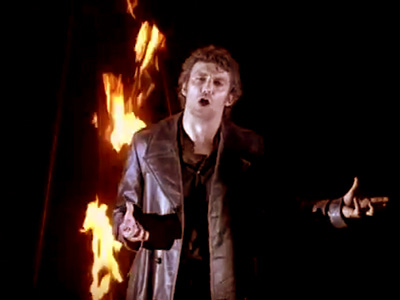
By ANDREW POWELL
Published: June 28, 2013
MUNICH — It helps when two of Caruso’s “four greatest singers” live nearby, the more so when they act as capably as they sing. That was the edge enjoyed by Bavarian State Opera in restaging Verdi’s Il trovatore to open its 138-year-old Munich Opera Festival yesterday, one of no fewer than 17 operas by Verdi and Wagner to be given here in the next 35 days. But leave it to Nikolaus Bachler — gifted narrator, sometime actor, and guiding light at this, Germany’s richest and busiest opera company — to OK a staging scheme that substitutes Age of Steam vaudeville and farce for 15th-century Aragón and Vascongadas melodrama, black-on-black sets and glaring white-neon slashes for Latin color, rootless stand-ins for impassioned characters.
French régisseur Olivier Py “focuses on the darkness, nightmare and horror of the story,” making use of a rotating four-level unit set, with add-ons and modular subtractions as events unfold. Engaging for a while, the unit unavoidably out-twirls its welcome and by Parts III and IV, bereft of sufficient new dramaturgical thought, it is largely shunted aside. Sooner than that, however, Py’s translocation trivializes the tale. Ferrando’s story-setting — the sleeping babies, the gypsy hag and all — plays on a vaudeville stage-within-the-stage to men in suits and ties. After an Anvil Chorus sparked by hammerings on a steam locomotive, all depart, leaving Azucena to wail her own backgrounder (Stride la vampa!) with no audience. Leonora’s rescue from a convent future misfires as a result of action split onto two non-competing levels, and Manrico’s execution confounds all situational logic. Ah well, at least there is Azucena’s nude mom-ghost as constant company.
Those locals, Anja Harteros* and Jonas Kaufmann, made their scenic role debuts amid this nonsense. It was her night, not so much the troubadour’s, but both sang with consistent beauty of tone and expressive point. Aided by conductor Paolo Carignani, the Greek-German soprano delivered a luxuriant, pleasingly inflected Tacea la notte placida and later fairly milked D’amor sull’ali rosee, bringing down the house. Then Carignani, otherwise robust of purpose, failed to inject tension for the Miserere and Leonora’s ensuing stretta fell flat. Kaufmann traversed his seventh Verdi role with power to spare. Ah sì, ben mio, sung against a reflecting board, drew best use of his bronzed timbre and deft messa di voce. On the phrase O teco almeno he mustered (to these ears**) a high B‑flat and held it without strain for four seconds. He refused to push for volume in the All’armi! — a smart Manrico, no mad thriller.
Caruso’s quartet found completion in relative veterans Elena Manistina and Alexey Markov, an Azucena and Conte di Luna pairing at the Met this past January. She unquestionably has the chops for the gypsy — contralto with an extended top, more than mezzo-soprano as marketed — but she did not yesterday convey terror, horror or motherhood. After an impeccable Il balen del suo sorriso, Markov’s unified, rich baritone seemed to fade. He came nowhere near to matching Harteros in the sexually charged sequence Mira, di acerbe lagrime … Vivrà! contende il giubilo, the evening’s one serious musical setback. Years of Bayreuth duty have sadly lodged a beat in Kwangchul Youn’s warm and solidly trained bass. Still, as Ferrando on that vaudeville stage, he gamely and vividly introduced the story (Di due figli vivea padre beato) to Py’s implausible audience.
Carignani lifted Verdi’s lines and mostly kept the rhythms alive and taut. He favored light textures, kindly supporting the voices but depriving the string sound of bottom and resonance. The Bavarian State Orchestra played well for him; the chorus sang in unclear Italian with fair discipline. During intermission, Manistina and Kaufmann silently indulged the director in an onstage magic-trick box-sawing of the tenor’s body. Fortuitously, maybe, this passed with little notice, as the well-dressed premiere throngs were still out sipping wine, munching canapés and spooning Rote Grütze mit Vanillesoße.
[*Munich is artistic home for the soprano. She lives in Bergneustadt.]
[**For Associated Press, Mike Silverman reports a B-natural in his interview-cum-review. Annika Täuschel, reporting for BR Klassik, claims Kaufmann actually sang a high C yesterday: “Er singt es, das hohe C!”]
Still image from video © Bayerische Staatsoper
Related posts:
Safety First at Bayreuth
Manon, Let’s Go
Boccanegra via Tcherniakov
Time for Schwetzingen
Busy Week
Musicians’ Airline Blues
Thursday, June 27th, 2013by Sedgwick Clark
The friendly skies appeared less so the past week, especially to musicians. The prelude was Diane Sawyer showing a YouTube video on ABC Nightly News of airport workers unloading cargo in, shall we say, a less than careful manner.
Then, on Sunday (6/23), a report appeared on Musical America’s web site about our 2013 Instrumentalist of the Year Wu Man’s favorite pipa being damaged two days before, while en route to a performance. The $50,000 instrument would not fit in the storage compartment of her commuter plane, so the flight attendant offered to store it in the coat closet up front. (Due to the pipa’s weight, I was informed by Wu’s publicist, it was in a soft carrying case.) Carelessly handled, it was damaged, and Wu was given the option of having it stored in cargo below or getting off the plane. She disembarked, of course, located another pipa, and her show went on. Now she has to hire a lawyer to deal with U.S. Airways.
And then there is Virgin Atlantic Airways. I received the following e-mail a couple of days ago from a friend, the conductor Sybille Werner, which she had received from a violinist, Audrey Morse:
“Attention all musicians: “Virgin Atlantic Airways has carry-on luggage size restrictions of 9″x14″x 22″. An average violin case is 31″ in length and exceeds their dimensions for carry-on luggage. A Virgin Atlantic representative I spoke to today said that no exceptions will be made for musical instruments, which means that violins can’t travel as they cannot be placed in checked luggage.
“Please spread the word amongst the musical community about this airline’s ridiculous policy.”
Roger!
Looking Forward
My week’s scheduled concerts (8:00 p.m. unless otherwise noted):
6/27 at 7:30. Avery Fisher Hall. New York Philharmonic/Alan Gilbert; Giants Are Small/Doug Fitch, director/designer, Edouard Gataz, producer. Sarah Mearns, dancer; Eric Owens, bass-baritone; Anthony Ross Costanzo, countertenor. Stravinsky: Le Baiser de la fée (The Fairy’s Kiss). Petrushka.
7/2 at 7:30. Metropolitan Opera House. American Ballet Theatre. Tchaikovsky: The Sleeping Beauty.
Who’s Responsible For Performance Licenses?
Wednesday, June 26th, 2013By Brian Taylor Goldstein, Esq. Dear Law and Disorder: In all of my artist’s booking contracts, the presenters are required to obtain ASCAP, BMI and SESAC licenses. I recently received a contract back from a venue in which they crossed out that language. They told me that their policy is not to get these licenses and that the artist is responsible for obtaining them. It was my understanding that it was always the venue’s or presenter’s responsibility to obtain the performance licenses from ASCAP, BMI, and SESAC. Am I wrong? You’re not wrong, but you’re not entirely correct either. The truth is that it is the legal responsibility of all parties to make sure that the proper licenses have been obtained for a performance. Which party actually obtains them and who bears the costs is a matter for negotiation. Whether it’s a festival, a school, a nightclub, or a large performing arts center, non-profit or for-profit, it’s the legal responsibility of the owner/operator of a performance space/venue to ensure that the necessary rights and licenses have been obtained with respect to all copyrighted music which is performed at that venue. (Actually, this legal responsibility is not limited to performance rights, but extends to dramatic rights, synchronization rights, broadcast rights, and all other required rights and licenses which pertain to music, images, trademarks, recordings, images, or other protected rights or materials which are used as part of the performance.) However, it’s equally the legal responsibility of the artist, and in some cases, the producer and promoter, to ensure that they have all of the required rights and licenses, including performance licenses from ASCAP, BMI and SESAC. Why? Because if an unlicensed song is performed at a venue, then the US Copyright Act allows all the parties involved in the performance—the artist as well as the venue/presenter, the producer, the promoter, and anyone else involved in the performance—to be sued by the publisher or copyright owner. Stealing a song is like robbing a bank: the entire gang is arrested; regardless of who broke open the safe, who drove the get away car, or who simply served as look out, they all participated in the robbery. I am familiar with many venues which do not want to be burdened with the perceived cost and difficulty of obtaining performance licenses (which, depending upon the specific circumstances, may be neither costly nor particularly difficult), refuse to do so, and insist on the artist obtaining the licenses. However, in my opinion, for reasons I have written about in earlier blogs, this is a foolish policy. In practice, it’s simple easier for venues and presenters to obtain ASCAP, BMI and SESAC licenses than the artist. The venue can purchase a blanket license from each organization that permits all of the music in their catalogs to be performed by any artist at the venue during the license period. These licenses can cover an entire year or just a specific festival or event, and are priced based on numerous factors, including number of performances, ticket prices, size of the venue, etc. With the blanket licenses in place, the artist simply needs to show up. If a venue or presenter prefers not to obtain such licenses, then the artist or performer can certainly do so themselves. However, if no one obtains the licenses, then everyone is liable. Quite simply, whether the venue/presenter requires the artist to obtain the performance licenses or the artist insists that the venue/presenter obtains the performance licenses, passing the responsibility on to another party will not relieve either party from ultimate responsibility if the other party fails to do so. In other words, there is no contract, release, or any other document which will protect you from liability should the necessary licenses not be obtained. This is why, among other reasons, if I operated a venue, I would much rather rely on myself to obtain the licenses than depend upon another party to do so. In your case, if the venue refuses to obtain the ASCAP, BMI or SESAC licenses, then you and your artist have two options: either the artist agrees to obtain the licenses or the artist refuses to perform. Electing to proceed under the expectation that no one will get caught or the publishers and copyright owners will not sue small artists or struggling non-profits is not an option; that’s the same as robbing a bank and hoping the police won’t find you. Not to mention, in an industry where so many purport to operate under the noble purpose of promoting the value of art and artists, I can’t imagine the rationalization of stealing it for any purpose, regardless of how noble. _________________________________________________________________ “Law and Disorder: Performing Arts Division” will be taking a break between July 1 – July 14. Our next post will be on July 17. _________________________________________________________________ For additional information and resources on this and other legal and business issues for the performing arts, visit ggartslaw.com To ask your own question, write to lawanddisorder@musicalamerica.org. All questions on any topic related to legal and business issues will be welcome. However, please post only general questions or hypotheticals. GG Arts Law reserves the right to alter, edit or, amend questions to focus on specific issues or to avoid names, circumstances, or any information that could be used to identify or embarrass a specific individual or organization. All questions will be posted anonymously. __________________________________________________________________ THE OFFICIAL DISCLAIMER: THIS IS NOT LEGAL ADVICE! The purpose of this blog is to provide general advice and guidance, not legal advice. Please consult with an attorney familiar with your specific circumstances, facts, challenges, medications, psychiatric disorders, past-lives, karmic debt, and anything else that may impact your situation before drawing any conclusions, deciding upon a course of action, sending a nasty email, filing a lawsuit, or doing anything rash!
The Hip-Hop Charleston
Friday, June 21st, 2013By Rachel Straus “Shucks!” Clark grunted. “Do you good to step out. You don’t have to dance—just get out there on the floor and shake.”—Tales of the Jazz Age (1922) Three years after F. Scott Fitzgerald wrote this dialogue, the author immortalized America’s obsession with free spirit-ness in The Great Gatsby. Though Fitzgerald made no specific mention of the ultimate free-spirited trot—The Charleston—it was this dance that became synonymous with the “Roaring Twenties.” And it is the Charleston’s kinetic craziness that film director Baz Luhrmann channels in The Great Gatsby (2013). Actually John O’Connell, the film’s choreographer, creates a Charleston on Crack. It’s intravenously fueled with hip-hop and it looks as if it’s been injected into The Gatsby’s decadent partygoers, who riotously flail in the opening scenes. Thanks to Luhrmann’s team, the partygoers’ dancing and dress bear a greater resemblance to Kostume Kult, the underground New York party organization with roots in Burning Man, than a 1920s Long Island soiree. And that is Luhrmann’s point. He fashions a bad-ass party, an orgy of writhing bodies. Luhrmann isn’t interested in conjuring white folks in cream-colored gowns and black tuxedos, doing a watered down version of the famous 1920 dance—even though that would be closer to the historical truth. To see what I mean about Luhmann’s dancing scenes and costumes, check out this clip: The Great Gatsby In these party scenes, Lurhmann hardly focuses on the dancing (or the dialogue, or characters for that matter). He’s interested in making us blurry eyed, as though we are drunk on hooch. Lurhmann wants us to revel in, or be disturbed by, the decadence of this scene—just as 1920s folks reveled in or were disgusted by the Charleston, back in 1923 when the all-black Broadway revue Runnin’ Wild brought the dance to widespread attention. The traditional Charleston features “peekaboo, now-you-see-it-now-you-don’t opening and closing of the legs,” writes dance historian Sally Sommer (International Encyclopedia of Dance). And like most American social dances, its true development stemmed from improvisations made by great dancers. To see what I mean, check out this clip of Al Minns and Leon James doing the Charleston. They transform the four-step dance into a symphony of limbs. They look like jazz musicians riffing on a melody: The Charleston It’s not said (or written about) enough how the great American vernacular dances, like the Charleston, originated with African-Americans dancers. They combined the rhythmically complex and looser-limbed style of West African dance traditions with European dances like the waltz, which privileged upright torsos and couple dancing. Unfortunately, during the 1920s and 30s, mostly white actors and dancers were filmed performing the vernacular dances created by African-Americans. As a consequence, the Charleston isn’t clearly associated with African-American dancing. Here, for example, is Ginger Rogers dancing the Black Bottom and the Charleston in her role as Roxie Hart in Chicago. She’s not bad: Ginger Rogers Last words: A good definition of the Charleston: The Charleston is a fast-paced and strongly syncopated American social dance that was especially popular in the 1920s. It took its name from Charleston in South Carolina, and was originally performed by African-Americans as a solo dance. By 1926 it was accepted as a ballroom dance. — The Oxford Dictionary of Dance (2010)
Something to Prove at the NYPhil
Thursday, June 20th, 2013by Sedgwick Clark
Lionel Bringuier, an exuberant 26-year-old Frenchman with an apparent need to prove something, conducted the Philharmonic last Thursday (6/13) in an entertaining program of conservative 20th-century music at Avery Fisher Hall. The cartoonish side of Dukas’s The Sorcerer’s Apprentice was appropriately raucous, but the achingly slow, rubato-laden treatment of the Assez lent intro would have been better suited to the Tristan Prelude. Prokofiev’s Second Violin Concerto, with Leonidas Kavakos the exemplary soloist, received a fine accompaniment. Kodály’s Dances of Galánta seemed more stop and go than usual; the tempo changes are in the score, to be sure, but the older Hungarian conductors on record had more convincing ebb and flow in their blood. Stravinsky’s 1919 Firebird Suite was a crowd pleaser, as always.
Still, I wonder if the Philharmonic players liked their young conductor? The violins were accurate but coarse in tone throughout. Perhaps his just-ending, six-year tenure as resident conductor of the LAPhil in the velvety acoustic of Disney Hall didn’t prepare him for Fisher Hall’s uningratiating fortissimos. Moreover, the orchestra’s virtuoso French horn player Philip Myers, reverting to his misbehaving pre-Masur days, was at least four times too loud in his f espr. solo on the second page of the Kodály, and parts of the Firebird sounded like a horn concerto. None of the musicians applauded until Bringuier asked the woodwinds to stand for final bows.
A colleague who heard the Friday afternoon concert of the identical program reported that the objectionable details above appeared to have been toned down overnight, but that the Dukas was deficient in humor and the Kodály in gaiety.
Happy Birthday, James Levine
Having celebrated James Levine’s 40th year at the Met last year with 21 DVD and 32 CD box sets of his hand-picked performances, the company is lighting candles for his 70th birthday this weekend with 14 of his favorite performances on Met Opera Radio, Sirius XM Channel 74.
Saturday, June 22, 2013
6 a.m. ET. Un Ballo in Maschera (Verdi) from January 26, 1991. Levine conducts Aprile Millo (Amelia), Luciano Pavarotti (Riccardo), Leo Nucci (Renato), Florence Quivar (Ulrica), Harolyn Blackwell (Oscar).
9 a.m. ET. Salome (Richard Strauss) from January 5, 1974. Levine conducts Grace Bumbry (Salome), Ragnar Ulfung (Herod), Regina Resnik (Herodias), Lawrence Shadur (Jochanaan), William Lewis (Narraboth).
12 p.m. ET. The Ghosts of Versailles (Corigliano) from January 4, 1992. Levine conducts Teresa Stratas (Marie Antoinette), Håkan Hagegård (Beaumarchais), Gino Quilico (Figaro), Marilyn Horne (Samira), Graham Clark (Bégearss), Renée Fleming (Rosina).
3 p.m. ET. Fidelio (Beethoven) from January 6, 2001. Levine conducts Karita Mattila (Leonore), Ben Heppner (Florestan), Sergei Leiferkus (Don Pizarro), René Pape (Rocco), Hei-Kyung Hong (Marzelline), Matthew Polenzani (Jaquino).
6 p.m. ET. Falstaff (Verdi) from April 5, 1975. Levine conducts Cornell MacNeil (Sir John Falstaff), Evelyn Lear (Alice Ford), Thomas Stewart (Ford), Fedora Barbieri (Dame Quickly), Benita Valente (Nannetta), Douglas Ahlstedt (Fenton).
9 p.m. ET. Die Zauberflöte (Mozart) from February 9, 1991. Levine conducts Kathleen Battle (Pamina), Francisco Araiza (Tamino), Luciana Serra (Queen of the Night), Kurt Moll (Sarastro), Manfred Hemm (Papageno), Barbara Kilduff (Papagena).
12 a.m. ET. Pelléas et Mélisande (Debussy) from January 22, 1983. Levine conducts Dale Duesing (Pelléas), Jeannette Pilou (Mélisande), José Van Dam (Golaud), Jerome Hines (Arkel), Jocelyne Taillon (Geneviève).
Sunday, June 23, 2013
6 a.m. ET. La Forza del Destino (Verdi) from March 12, 1977. Levine conducts Leontyne Price (Leonora), Plácido Domingo (Don Alvaro), Cornell MacNeil (Don Carlo), Martti Talvela (Padre Guardiano), Rosalind Elias (Preziosilla), Renato Capecchi (Fra Melitone).
9 a.m. ET. Carmen (Bizet) from March 21, 1987. Levine conducts Agnes Baltsa (Carmen), José Carreras (Don José), Ileana Cortrubas (Micaëla), Samuel Ramey (Escamillo).
12 p.m. ET. Idomeneo (Mozart) from December 21, 1991. Levine conducts Ben Heppner (Idomeneo), Dawn Upshaw (Ilia), Susanne Mentzer (Idamante), Carol Vaness (Elettra), Peter Kazaras (Arbace).
3 p.m. ET. I Vespri Siciliani (Verdi) from March 9, 1974. Levine conducts Montserrat Caballé (Elena), Nicolai Gedda (Arrigo), Sherrill Milnes (Guido di Monforte), Justino Díaz (Giovanni da Procida).
6 p.m. ET. The Rake’s Progress (Stravinsky) from January 17, 1998. Levine conducts Jerry Hadley (Tom Rakewell), Dawn Upshaw (Anne Trulove), Samuel Ramey (Nick Shadow), Stephanie Blythe (Baba the Turk).
9 p.m. ET. The Bartered Bride (Smetana) from December 2, 1978. Levine conducts Teresa Stratas (Marenka), Nicolai Gedda (Jeník), Jon Vickers (Vasek), Martti Talvela (Kecal).
12 a.m. ET. Stiffelio (Verdi) from March 5, 1994. Levine conducts Plácido Domingo (Stiffelio), Sharon Sweet (Lina), Vladimir Chernov (Stankar), Paul Plishka (Jorg), Peter Riberi (Raffaele).
Looking Forward
My week’s scheduled concerts (8:00 p.m. unless otherwise noted):
6/20 at 7:30. Avery Fisher Hall. New York Philharmonic/Alan Gilbert; Emanuel Ax, piano. Haydn: Concerto No. 11 in D major. Christopher Rouse: Symphony No. 3. Wagner (arranged by Alan Gilbert, after Erich Leinsdorf) A Ring Journey.