100 YEAR AGO IN MUSICAL AMERICA (429)
November 26, 1921
Page 17
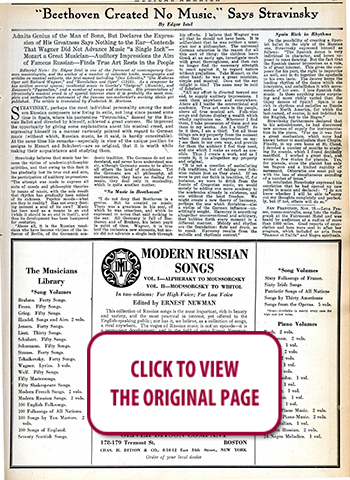
Beethoven Created No Music Says Stravinsky
Admits Genius of the Man of Bonn, But Declares the Expression of His Greatness Says Nothing to the Ear—Contends That Wagner Did Not Advance Music “a Single Inch” —Mozart a Great Musician—Auditory Impressions the Aim of Famous Russian—Finds True Art Rests in the People
By Edgar lstel
Editorial Note: Dr. Edgar Istel is one of the foremost of contemporary German musicologists, and the author of a number of valuable books, monographs and articles on musical subjects, the first-named including “Das Libretto,” “Die Moderne Oper seit Richard Wagner,” and “Revolution und Oper” (1919). As a composer he has written several operas; incidental music to Goethe’s “Satyros” (Munich), and Rousseau’s “Pygmalion,” and a number of songs and choruses. His presentation of Stravinsky’s musical creed is of special interest since it is probably the most complete and authoritative statement of the famous neo-modernist’s working ideals yet published. The article is translated by Frederick H. Martens.
STRAVINSKY, perhaps the most individual personality among the modern Russian composers now living in exile, not long since passed some time in Spain, where his pantomime “Petrouchka,” danced by the Russian Ballet and directed by himself, achieved a great success. He improved the opportunity by giving some explanations anent his musical creed, and expressing himself in a manner curiously pointed with regard to German music (without which, Russian music, be it said, is hardly conceivable). At the same time his remarks—especially in view of the unique position he assigns to Mozart and Schubert—are so original, that it is worth while making their acquaintance and studying them.
Stravinsky believes that music has become the victim of academic-philosophic activities, and that owing to this fact it has gradually lost its true end and aim, the participation of auditory impressions. “The attempt was made to express all sorts of moods and philosophic theories by means of music, with the sole result that rhythm has gradually been robbed of its richness. Psychic moods—what are they in reality? Has not every fleeting moment a soul of its own? Music has been used as a means to an end (while it should be an end in itself), and thus its development has been hampered for centuries.
“Above all, it is the Russian musicians who have become victims of the influence of Berlin, of the Germanic academic tradition. The Germans do not understand, and never have understood music, although Germany seems to be above all others the land of musicians. Yet the Germans are all philosophy, all mathematics, they have no feeling for music, they deal only in musicality, which is quite another matter.
“No Music in Beethoven”
“I do not deny that Beethoven is a genius. But he created no music. There was a greatness in his soul, of which he was conscious, and which he expressed in notes that said nothing to the ear. All Germany is full of Beethoven and of Brahms, his latest pupil in point of time. Wagner, it is true lent the orchestra new elements, but music did not advance a single inch through his efforts. I believe that Wagner was all that he should not have been. It is evident that he was neither a musician nor a philosopher. The universal German education is the reason f or all this sort of thing: the children learn Greek at an early age, investigate much with great thoroughness, and then can no longer find the necessary strength to react against it, to regard nature without prejudices. Take Mozart, on the other hand: he was a great musician, simple and musical. Does not the ear delight in him? The same may be said of Schubert.
“All my effort is directed toward one end, to supply auditory impressions. I seek them anywhere and everywhere. Above all I loathe the conventional and academic. True art rests in the people, above all true musical art. Folk-wise songs and dances display a wealth which wholly captivates me. Wherever I find them, I take possession of them and use them in my works. Am I a thief? So be it then, I am a thief. Yet all these things are my property from the moment when they make an impression on me: I see them in my own way, and provide for them the ambient I feel they need, and one which I make as exact as possible. Thus I create a work, and as I create it, it is altogether my property and original.
“It is not a question of assimilating folk traditions, but of taking over folk-wise values just as they stand. If we were to put our faith in tradition, if, for instance, we were to drink from the founts of Gregorian music, we would merely be adding one more academy to the academies already in existence, and one without the least freedom. We might create a new theory of harmony, perhaps the one which Scriabine—also a victim of the German influence—unwittingly sought. Harmony is something altogether unconventional and arbitrary, that bubbles forth every moment in a different manner. Melody and rhythm are the foundation: flute and drum, so to speak. Harmony results from the melodic and rhythmic context.”
Spain Rich in Rhythms
On the possibility of creating a Spanish ballet in the style of the Russian one, Stravinsky expressed himself as follows: “The Spanish dance is very individual in character, and hence opposed to mass dancing. But the fact that the Spanish dancer improvises as a rule, is of great interest. This gives the composer for his part, the right to improvise as well, and to fit together the spectacle to his own taste. The dancer keeps the leading rhythm of the dance which she interprets and embellishes it with movements of her own. I love Spanish folk-music. Is there anything more surprising and more richly varied than the Gipsy dances of Spain? Spain is as rich in rhythms and melodies as Russia and as North America, for which the last-named, of course, is not indebted to the English, but to the Negro.”
Stravinsky furthermore declared that to his astonishment, he had discovered new sources of supply for instrumentation in the piano. “For me it was first a great mechanism, which none had known better to manipulate than Chopin. Finally, in my own home at St. Cloud, I devoted a number of months to studying its sounds, which I found decidedly manifold. I worked a great deal, and wrote a few études for pianola. Yes, for pianola, since the pianist has only ten fingers and a limited rapidity of movement. Otherwise one must put up with the loss of simultaneous sounding of a number of tones.”
In conclusion Stravinsky expressed his conviction that he had opened up new paths in music and declared: “I do not know whether I will be able to carry out my thoughts completely and perfectly, but if not, others will do so.”

 RENT A PHOTO