Reviews
Nixon Is Testament to WNO's Resiliency
WASHINGTON, D.C.—We’re approaching the 40th anniversary of Nixon in China, whose premiere was itself separated by only 15 years from Richard Nixon’s historic visit to Communist China in 1972. But today’s convulsive politics have cast John Adams’s operatic debut in a disquieting new light. The timing could hardly have been more pointed for Washington National Opera’s November 14 opening of its production directed by Elkhanah Pulitzer and newly tailored for DAR Constitution Hall.
The opera’s Washington connections extend even to its genesis. In 1984, while establishing the short-lived American National Theater at the Kennedy Center, Peter Sellars brought Adams and librettist Alice Goodman together to develop his idea for Nixon in China. After premiering at Houston Grand Opera, the original Sellars production of this Kennedy Center co-commission reached its Opera House in 1988. Now WNO, under the brave artistic leadership of Francesca Zambello, is presenting Nixon in its first season in exile from that very institution—just a 10-minute walk or so from the White House, its perimeter now ringed by expanded security fencing and barricades.
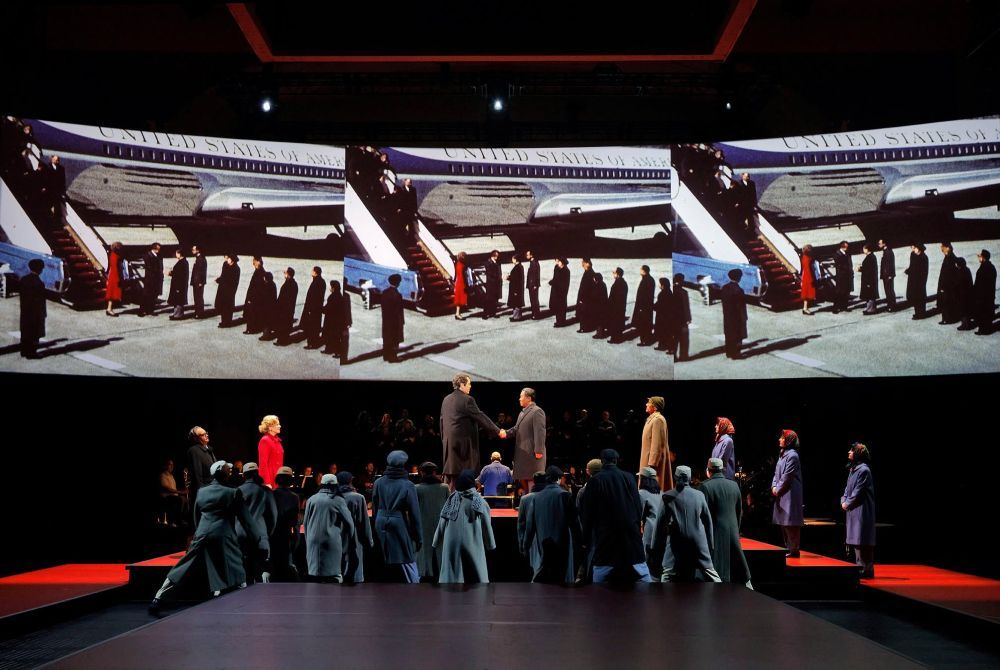
The Nixons are greeted upon landing in Beijing in Elkhanah Pulitzer's staging for the WNO
Having secured five venues to salvage its season, WNO opened its Constitution Hall residency with Madama Butterfly and Nixon in China. It was an especially inspired choice to revisit Pulitzer’s multimedia staging, first presented by the Los Angeles Philharmonic in 2017. Her collaboration with filmmaker Bill Morrison offered a way to exploit the hall’s unconventional layout rather than struggle against its limitations.
Low, interconnected platforms formed the playing area, with a few patrons at floor-level tables near the action and most of the audience seated around three sides—almost in the round. The Washington National Opera Orchestra and Chorus remained in full view behind the singers, with Music Director Robert Spano conducting.
Physical scenery was minimal in Alexander V. Nichols’s design—essentially chairs and tables—while Bill Morrison’s projections, complemented by Duane Schuler’s bold lighting, dominated the visual field. A giant cube suspended overhead was the principal projection surface, supplemented by screens around the auditorium. Smaller screens relayed live close-ups of Spano, making even the conductor part of this mediated spectacle. Surtitles appeared in English and Mandarin.
The projected images drew on a quirky mix of official press footage and Super 8 material from Nixon’s inner circle. They showed the actual Spirit of ’76 departing and later arriving in Beijing, the Nixons descending the aircraft steps, close-ups of Mao and Chou En-lai, and world leaders raising glasses at a banquet.
Elisabeth Scott’s period costumes closely mirrored the clothing in the archival footage, contrasting the regimented dress of the Chinese Communist leadership with Nixon’s and Kissinger’s Western business suits. Pat Nixon’s signature red wool coat echoed the bright red floors of the playing platforms, creating an almost Technicolor contrast and tension with the grainy archival images. In a program note, Pulitzer described them as hovering above the stage like “a kind of collective memory,” while the human beings beneath are “still moving, changing, performing.” By Act III, the images had grown fragmentary, giving way to fleeting wintry landscapes and the snowy static of an old television.
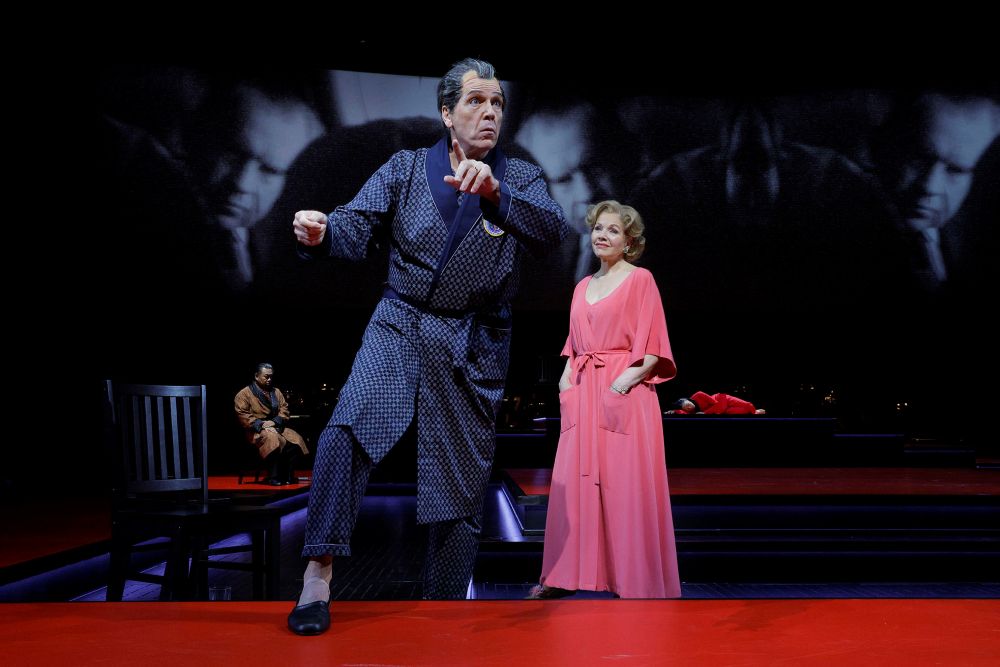
Thomas Hampson and Renée Fleming as Richard and Pat Nixon
Alice Goodman’s remarkable libretto probes the human uncertainties beneath the carefully choreographed displays of political power, giving the opera renewed resonance today. Thomas Hampson and Renée Fleming showed a keen understanding of the expressive possibilities of Goodman’s densely poetic language. Hampson’s near-spoken inflections exposed Nixon’s paranoia, particularly in the “News” aria’s image of rats chewing the sheets. He also conveyed an idealism entangled with the president’s appetite for publicity.
Pat Nixon has proved a particularly rewarding addition to Renée Fleming’s late-career repertory. Beneath the First Lady’s shy, somewhat colorless public demeanor, she traced an increasingly independent emotional life, above all in her searching account of “This Is Prophetic.” Her rapport with Hampson deepened in the final act as the couple shed their ceremonial identities.
John Matthew Myers made Mao an imposingly unpredictable presence, veering between mischief and menace in his riddling exchanges with Nixon and attacking the high notes that jut so abruptly from Adams’s vocal line with assurance. Kathleen Kim’s diamond-hard coloratura flashed with Queen-of-the-Night precision, embodying Madame Mao’s savage, dictatorial temperament. Joo Won Kang portrayed Chou En-lai with a lyrical dignity that culminated persuasively in his searching final solo: “How much of what we did was good?” The ascending string lines at the close resembled a succession of unanswered questions.
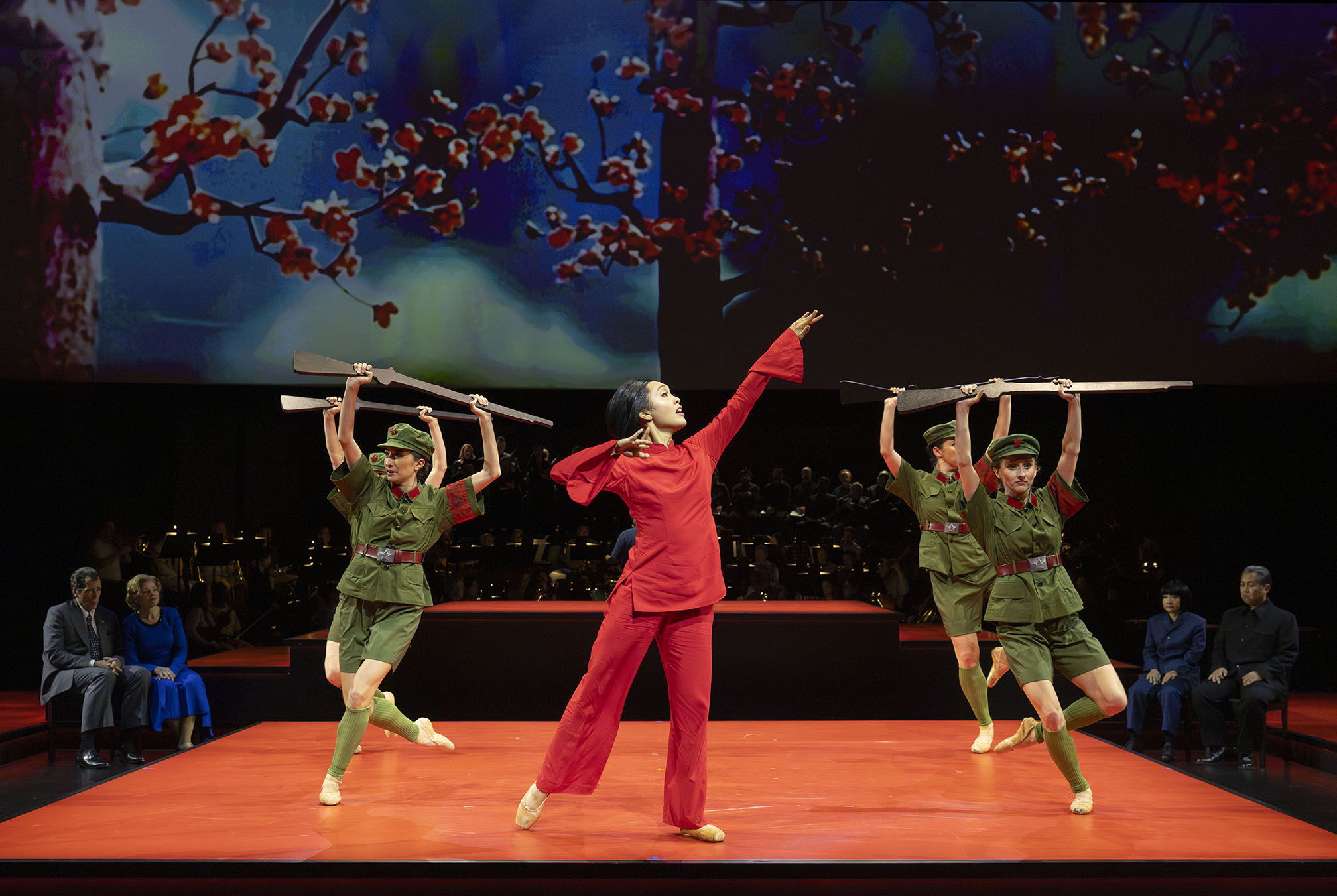
Kayla Mei-Wan Thomas and dancers entertain the Nixons
Robert Pomakov found a sinister streak beneath Kissinger’s buffo exterior, especially as the oppressive landlord in Jessica Lang’s vividly choreographed propaganda ballet-within-the-opera. Mao’s three secretaries—Veronica Siebert, Anna Maria Vacca, and Cecelia McKinley—formed an appealing ensemble, though their vocal interplay with Mao was often difficult to discern due to the acoustics.
A stalwart champion of American music, Spano commanded Adams’s vast expressive spectrum and frequent shifts of stylistic register, from the reverberant saxophones and swing-era echoes to the early rock ’n’ roll of Nixon’s “News” aria, the sweep of Romantic lyricism, and the enigmatic harmonies of Act III. He shaped the high-intensity approach and booming landing of the Spirit of ’76 into an exhilarating climax.
Equally striking was his precision in the details: syncopated accents gained extra definition through glints of color from the brass, winds, and tuned percussion. His rhythmic exactitude coexisted with lyrical flexibility, especially in Act III, where Spano let the music breathe and expand into elegiac reflection.
Although Adams himself specifies amplification, the sound in Constitution Hall’s reverberant space frequently blurred the balance between voices and orchestra. The WNO Chorus suffered particularly, its sound inadequately balanced against the orchestra and its words and individual lines difficult to distinguish in passages crucial to the public spectacle of the first two acts. Some of the finer details of the orchestration were also obscured.
Still, the production’s theatrical ingenuity and musical commitment made this a compelling encounter with Adams’s contemporary classic. For a company forced to reinvent itself under such difficult circumstances, the artistic ambition on display was heartening.
Photos by Cory Weaver

 FEATURED JOBS


 RENT A PHOTO