Reviews
The Critic, the Donor, and the Resurrection of Giants...
SIOUX FALLS, S.D.— What transpired in Sioux Falls last weekend was a testament to the power of words.
In 2022, New Yorker music critic Alex Ross praised the South Dakota Symphony Orchestra (SDSO) as “bolder and savvier in its programming than all but a handful of American ensembles,” despite a skinny $2.3 million budget—less, he noted, than Riccardo Muti’s salary at the Chicago Symphony. After reading Ross’s report, Dean Buntrock—a South Dakota native and himself the namesake donor of a Chicago Symphony event and rehearsal space —and his wife Rosemarie doubled the audacious orchestra’s coffers with a donation of $2 million.
Practically overnight, SDSO was freed to pursue its most ambitious project yet: resuscitating American composer Douglas Moore’s opera Giants in the Earth, about 19th-century Norwegian immigrants to the Dakota Territories. The opera won the 1951 Pulitzer Prize, aligning with Music Director Delta David Gier’s longstanding initiative to put a Pulitzer-winning piece on every SDSO season. Giants in the Earth has seen just one revival since its premiere; SDSO’s semi-staged redux, on April 26 and 27, necessitated a new performing edition adapted from Moore’s own revised manuscript. SDSO also recorded the weekend’s concerts for a forthcoming commercial recording, Giants’s first.
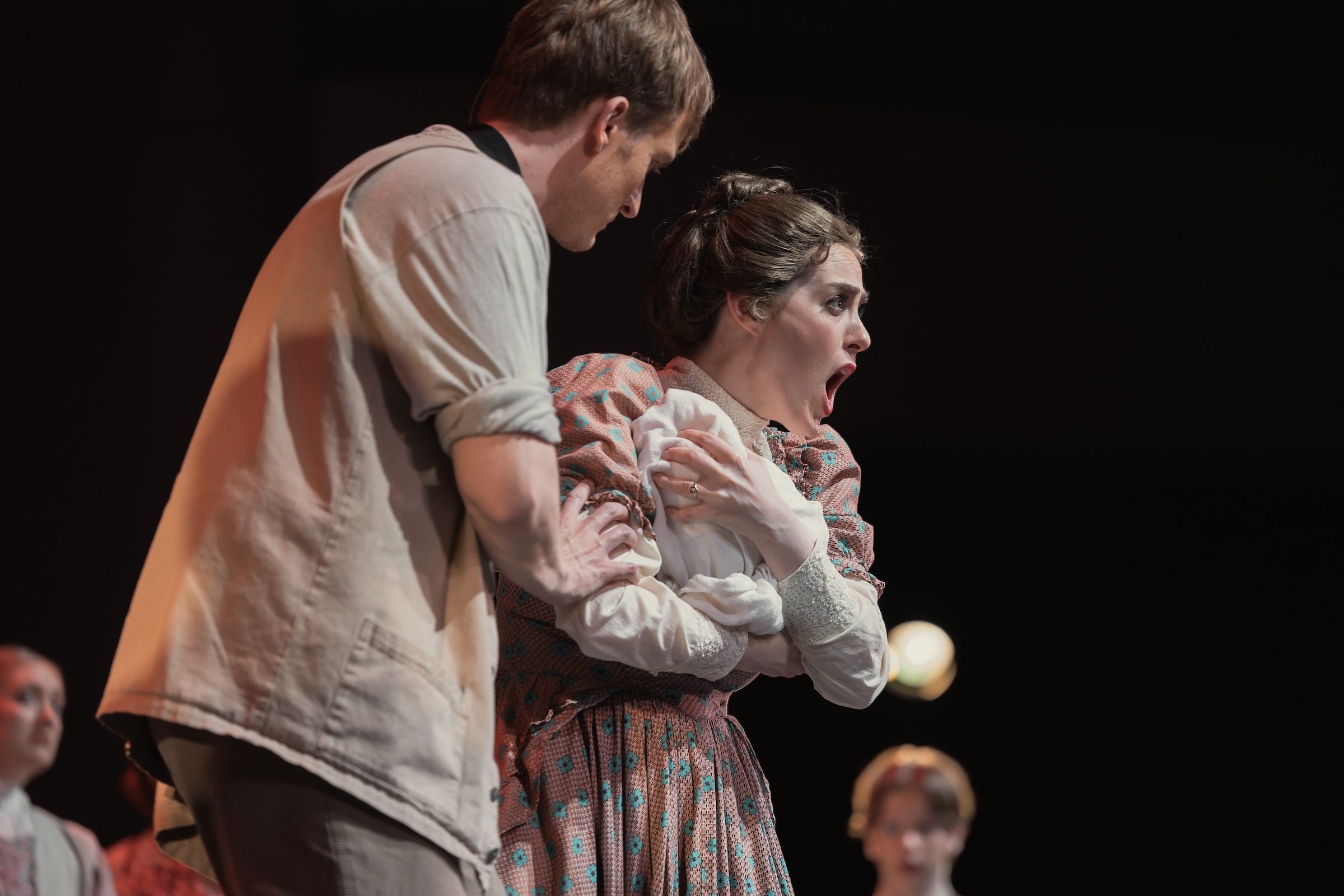
Per (Michael Hawk) tries to comfort the raving Beret (Meredith Lustig) in South Dakota Symphony's semi-staged Giants in the Earth
The opera derives from the 1925 novel of the same name by Ole Edvart Rølvaag, himself a Norwegian immigrant to the upper Midwest. Rølvaag is now obscure outside the region but a local hero within it: The campus of Augustana University hosts the cabin in which he wrote Giants of the Earth and its two sequels, and the book was once required reading in South Dakota schools. (Before Saturday’s show, Gier asked preconcert talk attendees if they had read Giants. About 95 percent of attendees over the age of 70—the vast majority—raised their hands.)
Rølvaag’s novel, as well as its operatic adaptation, at first seems to be a blustery frontier tale. In truth, it’s a domestic drama, and a deeply ambivalent one. Meredith Lustig starred as Beret, the matriarch of the homesteading Hansa family who can’t shake her homesickness for Norway. Beret’s mental health and marriage—to the brash Per, sung by baritone Michael J. Hawk—deteriorate over the course of the narrative.
Giants lifts off when Beret discovers they’ve unwittingly made their home on a Native American burial ground. Another homesteader, Syvert (a comic role, uncompromisingly embodied by live-wire tenor Dylan Morrongiello), breezily wonders if the decaying bodies bode well for the soil. Beret is horrified by his callousness. “They become like animals here,” she tells Per when he returns home, describing fellow newcomers.
The Native Americans in Rølvaag’s original novel get sympathetic if one-dimensional portrayals. They are scrubbed away completely in Moore’s opera, save for this scene. The conspicuous absence of Native people—living ones, anyway—would seem antithetical to SDSO’s 20-year-strong Lakota Music Project, its ongoing collaboration with local Indigenous groups. But from this correspondent’s vantage, the opera is deeply in dialogue with the Lakota Music Project because of that absence. Beret alone recognizes the fledgling United States as a nation founded on bloodshed and forced removal; she is alone, too, in her inability to reconcile that brutal truth with her family’s newfound prosperity.
The rest of Giants grapples with similarly potent questions of assimilation, place-hood and ownership. A major plot point hinges on Per’s impulsive theft of some rival homesteaders’ land stakes (menacingly led by Steve Pence, a leonine bass). Whether Giants is universal enough to be taken up by other companies for a fully staged revival remains to be seen. Its themes, evergreen though they are, get muddled by librettist Arnold Sundgaard’s inelegant and wordy prose.
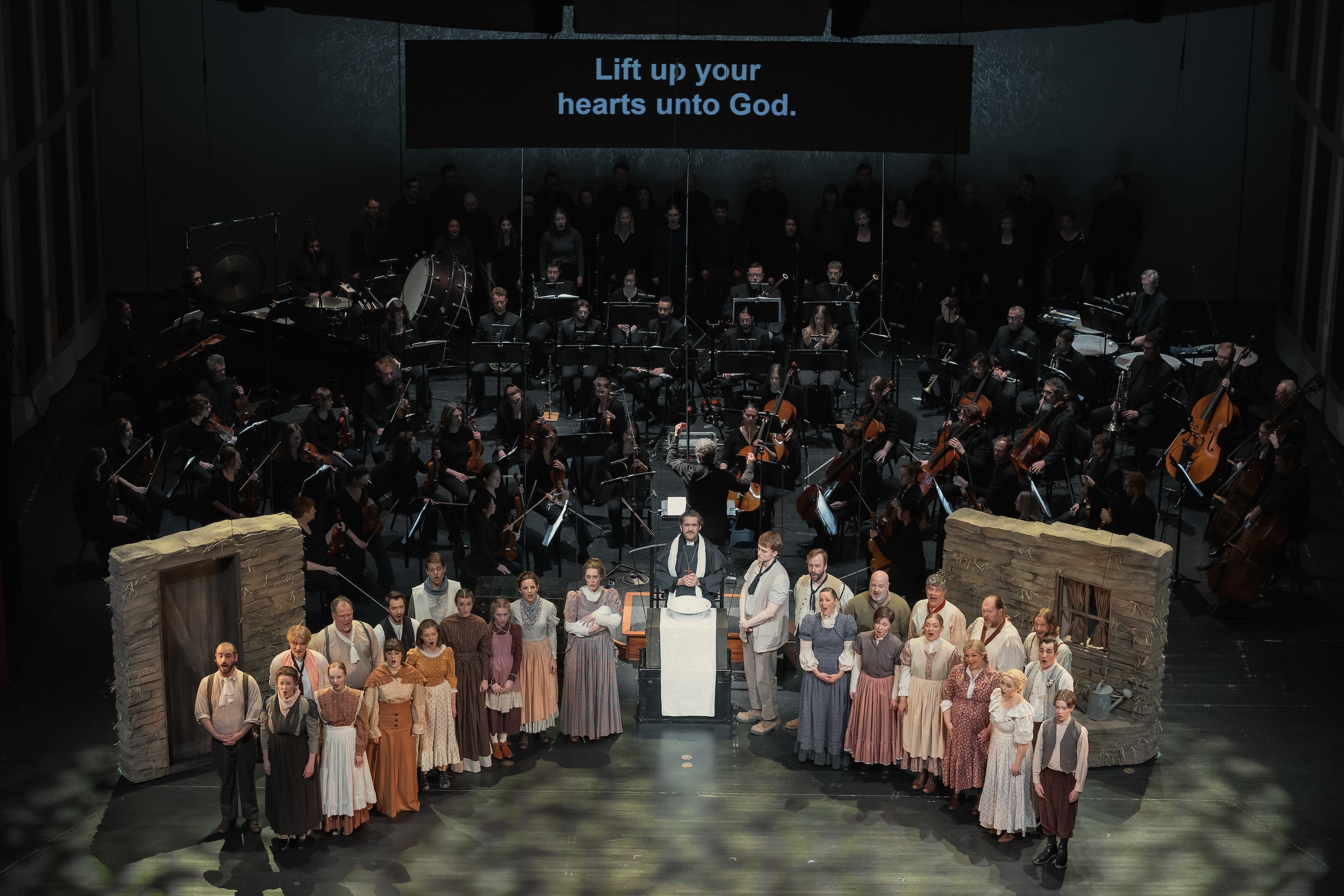
A baptism in Act III, scene 1,shows the stage setup for Douglas Moore's Giants in the Earth
That’s a shame, as Moore’s music is ravishing and often remarkable. Giants’ diegetic music—music within the world of the plot—is so organic as to sound quoted rather than invented, whether it be a countermelody to the Norwegian national anthem (Act I), an invented church hymn (Act III, Scene 1), or a made-up drinking song (Act III, Scene 2). Moore also deftly handles Giants’ frequent bursts of humor, with caesuras and cheeky instrumental interjections. (Moore and Sundgaard would lean into these comic chops seven years after Giants with Gallantry, a one-act sendup of TV soaps.) With no breaks except between acts and scenes, Giants skillfully threads its opening motives through the entire work: The theme handed around the orchestra in the opera’s first few bars is taken up in a minor key by the viola just before the final scene, over an anxiously syncopated accompaniment. The SDSO corps captured all these details with notable polish and commitment.
As foreshadowed by that minor-key solo, both opera and novel end tragically. Director Robert Neu’s otherwise effective semi-staging—one needs little more from an opera that unfolds on a wide-open prairie—fumbles here, relying on heavy-handed projections to relay the story’s ending twist. His direction is more attentive elsewhere: The land stakes become an effective recurring prop, and early on, Beret can be spotted knitting the same hat Per wears for Giants’ wrenching climax.
 Beret’s slow spiral makes the opera essentially one long mad scene for its lead soprano — a daunting task. Lustig didn’t quite meet the moment, her sound glinting but static, leaning on an overactive vibrato. Her acting was better honed: As the opera progressed, Beret’s fleeting moments of joy rang hollower and hollower in Lustig’s face, her smile tight and vacant.
Hawk also came just short of convincingly fleshing out Per, though the fault was not all his. In Rølvaag’s novel, Per is charismatic and endearingly righteous, but the opera reduces him to a swaggering hothead. Making Per lovable thus becomes a heavy lift, to lukewarm results. Hawk’s baritone was handsomely pillowed but, like Lustig, less rangy than ideal for such a dynamic role.
Hawk and Lustig were flanked by a supporting cast that punched well above its share of the libretto. Ebullient soprano Megan Koch matched Morrongiello’s wattage as Syvert’s wife Kjersti, more or less a soubrette role. The broad palette of Andrew Gilstrap’s bass-baritone and the dramatic verve of Sarah Nordin’s mezzo were likewise well-matched as Hans and Sorrine Olsa, the homesteading couple who convince the Hansas to move to the Dakota Territories. Even in his too-brief appearance as the Preacher, bass Joshua Jeremiah stood out for his vocal magnetism and finesse. The same could be said for iridescent soprano Abby Brodnick, as Dagmar, an ingenue bit role. Benjamin Dutcher landed some of the run’s biggest laughs as her besotted match Henry Solum, even if his tenor tipped a bit into musical-theater treacle.
As box offices everywhere limp back from the pandemic, it was beyond heartening to see both Giants shows—a Saturday evening and Sunday matinee, the latter atypical for SDSO—sell out the Washington Pavilion’s 1,800-seat Mary W. Sommervold Hall. That turnout didn’t happen in a vacuum. The SDSO built anticipation for Giants over the course of several months, with panel discussions, conference talks, a local book club, and even an affiliated recital at New York City’s Scandinavia House, co-hosted by the Douglas Moore Fund.
That “bolder and savvier” plaudit? At the SDSO in 2025, it’s truer than ever.

 FEATURED JOBS


 RENT A PHOTO