Reviews
Turnage's Festen Is a Triumph
LONDON—Where to begin with Festen, the explosive new opera by Mark-Anthony Turnage? At the end, perhaps, when a dazed first-night audience staggered to its collective feet to applaud a tour de force? Or the moment in the 100-minute evening when tenor Allan Clayton as the central character outed his father as a child abuser, an aria during which you’d swear no one breathed? Or maybe we should return to the source material, an intense 1998 movie of the same name by Thomas Vinterberg that was the first film to obey the tenets of the Danish avant-garde filmmkaing movement Dogme 95…?
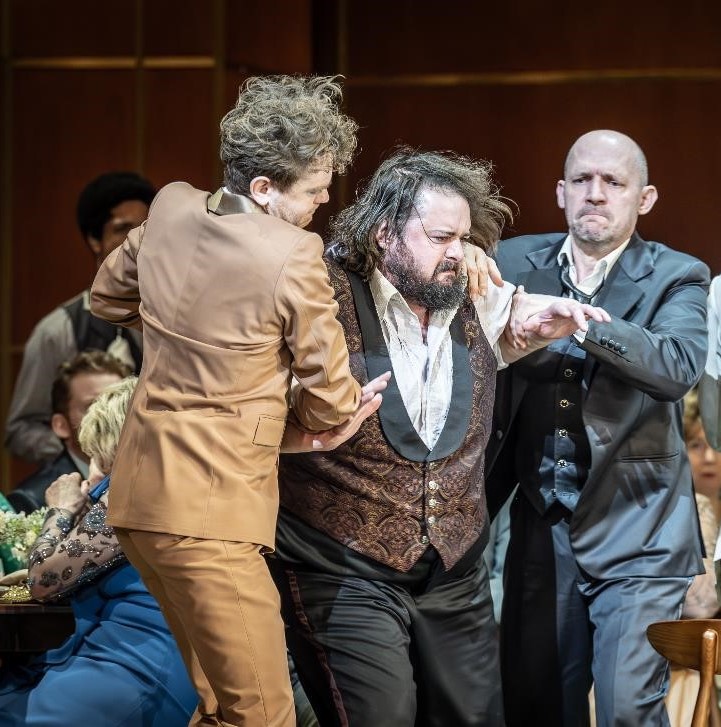
Allan Clayton as Christian and Stéphane Degout as Michael in Festen
No, none of the above. The work follows Vinterberg’s scenario faithfully enough but it also adds an extra dimension that more than justifies the decision to turn it into an opera. This is where we should start. Not only do Turnage and his librettist, Lee Hall (writer of Billy Elliot, both the film and the stage musical) have something else in their armory—a chorus—but they weave it in subtle ways throughout the intimate story they tell. The choristers are also us, the audience, as we witness shocking revelations and sit with gritted teeth, outwardly cool but inwardly shaken, throughout the onstage trauma. The chorus, and by implication the rest of us, do what we can to keep up appearances and in so doing we fall into an abyss of our own: that of hypocrisy, like a collective of bad Samaritans turning a blind eye. The opera ends on the biggest chill of all, echoing the villagers of Britten’s Peter Grimes when the following morning an ostensibly cheery company of guests greet the appalling father with a litany of ‘‘Good mornings.”
Festen is Turnage’s fifth opera but it has more in common with his third, the sumptuously trashy Anna Nicole, than the others. He is a serious composer blessed with headspace for all manner of musical styles and he draws on these with a sure ear. Thus Helge, the father, celebrates his 60th birthday within a sound world that embraces the cacophony and chaos of a plausible family party. Narrative similarities to the late Kaija Saariaho’s opera Innocence are hard to miss, but where that tale was restrained, this one grows increasingly raucous as wine flows and tongues loosen. The moment when the revellers jeer a racist chant of Baa Baa, Black Sheep at a new arrival (the outstanding Black baritone Peter Brathwaite) sent as many chills down the spine as Clayton had done in his ‘‘tribute’’ to Gerald Finley’s Helge.
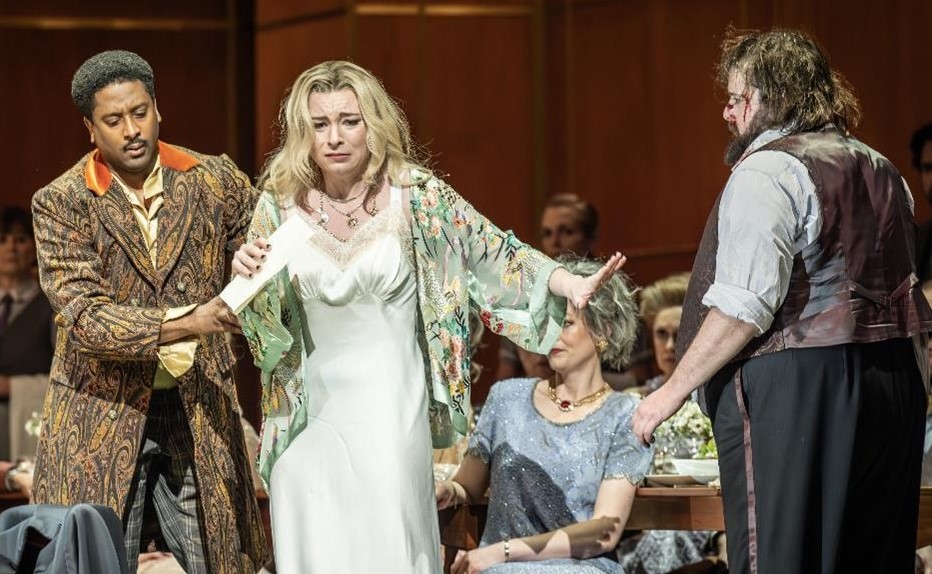
Peter Brathwaite as Gbatokai, Natalya Romaniw as Helena, and Allan Clayton as Christian
A huge cast of 25 named characters, together with several supernumeraries as well as the intrepid Royal Opera Chorus, meant the Covent Garden stage didn’t just buzz with life, it teemed. Curse words abounded yet always with a purpose—and however ludicrous such vocabulary may sound when sung in the grand style, that itself was the point. As an initially genteel gathering descended into ugliness, verbal niceties were the first thing to go out of the window.
The opera makes immense demands on its performers, not all of them musical. Understandably, therefore, the Royal Opera filled the cast with high-end talent, all of which delivered stunning work. Aside from Clayton’s Christian, Helge’s other children were sung by Stéphane Degout as the emotionally unstable Michael, Natalya Romaniw as his nerve-shredded sister Helena and, in a departure from the source film’s scenario, Marta Fontanals-Simmons as Christian’s dead twin Linda in a scene where she rises up like a figure from a Japanese horror film to haunt her brother’s mind. Rosie Aldridge effectively portrayed Helge’s wife Else as a woman on the edge, while Sir John Tomlinson contributed a movingly funny cameo as his elderly father, faculties waning, who struggles pathetically to tell a joke to the assembled partygoers. Susan Bickley as his wife, Grandma, gave a tender speech aria, rendered all but inaudible (intentionally so) by the counterpoint of a no-holds-barred fist fight among the tables.
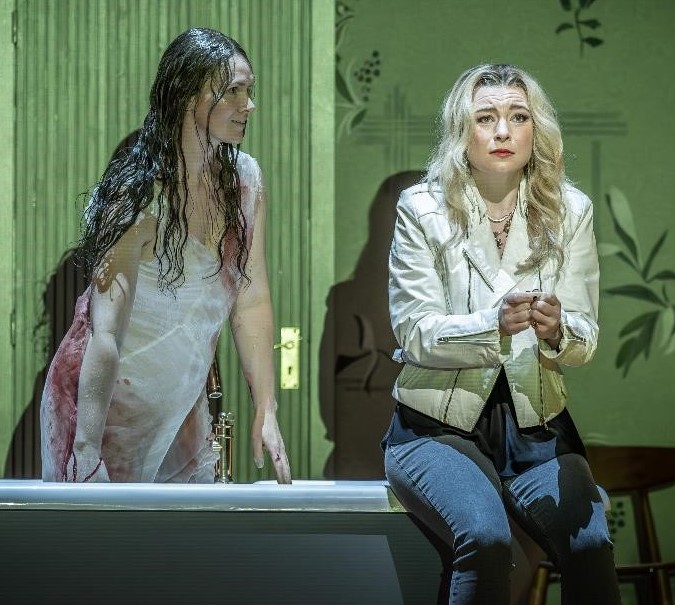
Marta Fontanals-Simmons as Linda and Nataya Romaniw as Helena in Festen at ROH
Richard Jones can manage a large ensemble like few other directors working in the U.K. and he wrangled his company with a sure hand. Despite the size and kinetic chaos of this madding crowd, the eye was consistently drawn where it needed to look. Miriam Buether’s necessarily spacious designs were limited to three locations: the hotel lobby, with all its comings and goings to provide vital exposition for the spectator; the banqueting suite where the nightmarish party unfolded; and a composite of a hotel bedroom and kitchen divided by the sitting room in which the father’s assaults had taken place years earlier.
The eclectic nature of Turnage’s writing should not be mistaken for frivolousness; indeed, a single hearing was enough to confirm Festen to be the strongest of all his stage scores, with a maturity of structure and ambition that encompasses everything from modern jazz to thickly symphonic writing. Depending on the dramatic mood of the moment the ear was either assaulted or seduced by his invention, but every note was earned and brilliantly applied to serve the drama. Everyone excelled in the enterprise, and despite the strong flavors of this theatrical feast not a boo was heard amid the final curtain cheers. That in itself was a surprise given the Royal Opera’s traditionally conservative audience, but a packed house had nothing but acclaim for this courageous, complex new work.
Photos by Marc Brenner

 FEATURED JOBS


 RENT A PHOTO