All material found in the Press Releases section is provided by parties entirely independent of Musical America, which is not responsible for content.
Press Releases
Aug 22: Jupiter String Quartet Makes Debut at Music Mountain - In-Person and Livestreaming
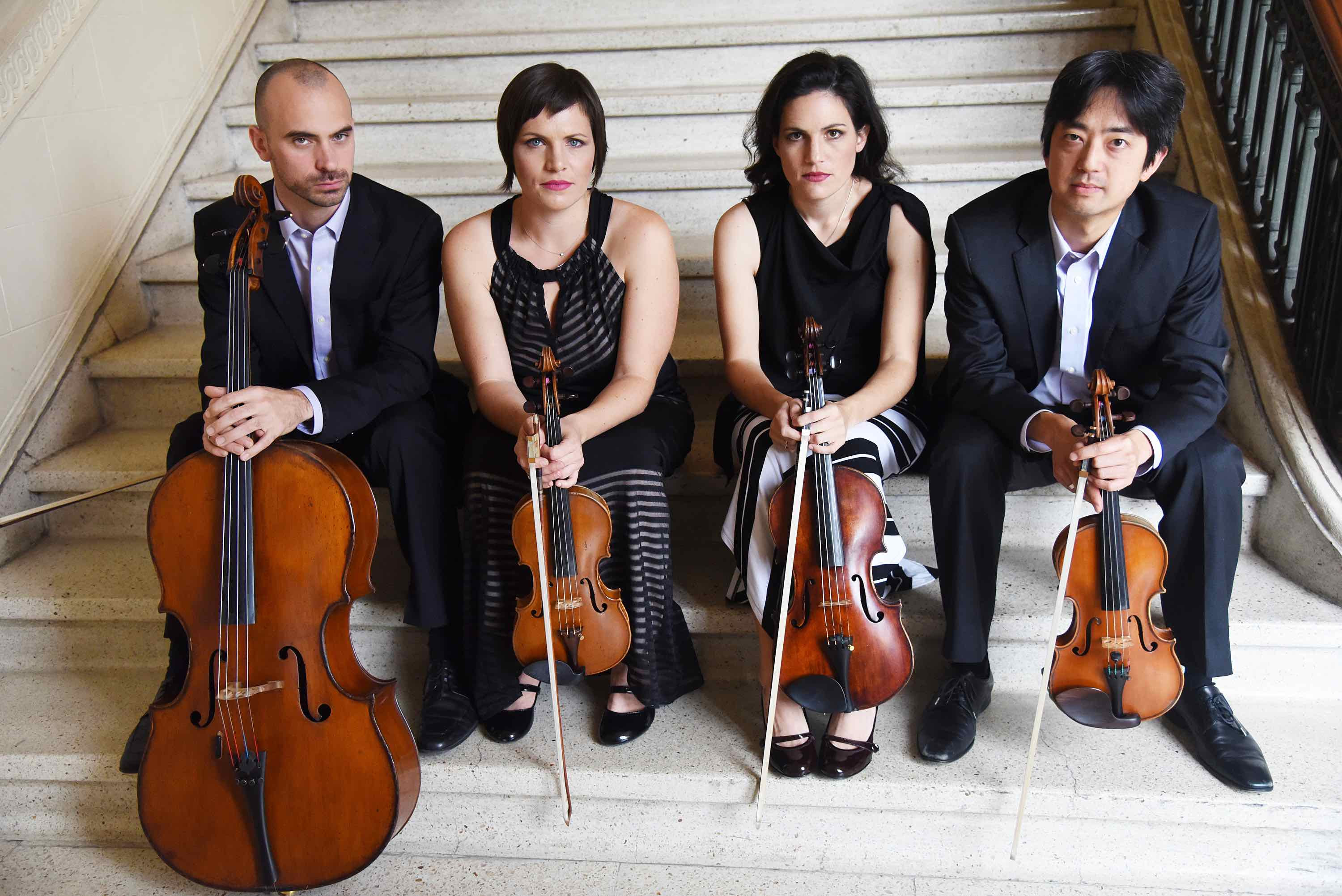
[Note: Photo by Sarah Gardner available in high resolution at www.jensenartists.com/jupit
FOR IMMEDIATE RELEASE
Press contact: Maggie Stapleton, Jensen Artists
646.536.7864 x2, maggie@jensenartists.com
Jupiter String Quartet Makes Debut at Music Mountain Performing Music by Fanny Mendelssohn, Florence Price, Felix Mendelssohn, and Judd Greenstein
Sunday, August 22, 2021 at 3pm ET
225 Music Mountain Road | Falls Village, CT
Presented In-Person at Gordon Hall and Livestreamed Online
In-Person Tickets ($45 Gordon Hall / $30 Lawn General Admission) available at www.musicmountain.org/event-
“The Jupiter String Quartet, an ensemble of eloquent intensity, has matured into one of the mainstays of the American chamber-music scene.” – The New Yorker
www.jupiterquartet.com
Falls Village, CT – On Sunday, August 22, 2021 at 3pm ET, the Jupiter String Quartet (Nelson Lee and Meg Freivogel, violinists; Liz Freivogel, viola; and Daniel McDonough, cello) makes its debut at Music Mountain performing a program with works by Fanny Mendelssohn, Florence Price, Felix Mendelssohn, and Judd Greenstein. The concert will be presented for a live, in-person audience and as a free livestream online, available to watch at www.musicmountain.org in real time and for one week after the performance.
Fanny Mendelssohn’s Quartet in E-flat Major was composed in 1834 and is one of the first surviving string quartets written by a woman. Felix Mendelssohn’s Quartet in F minor, Op. 80 – his sixth and final string quartet – was composed in 1847 and is the composer’s last major work completed before his death that same year. Stricken with grief after the loss of his beloved sister Fanny, he wrote this dramatic and heartrending piece as an homage to her memory. Florence Price’s Five Folksongs in Counterpoint features complex and rich interpretations on simple folk tunes, and of his Four on the Floor, Judd Greenstein notes, “I ask the quartet to sound like a sextet, or perhaps an octet, through the frequent use of double stops (where players play on more than one string at once). The result is a thick texture that’s constantly moving and shifting while the staggered rhythms drive the piece forward. It’s ridiculously virtuosic, requiring remarkable individual energy and endurance and a degree of precision that only a top-rate string quartet can provide.”
About the Jupiter String Quartet: The Jupiter is a particularly intimate group, consisting of violinists Nelson Lee and Meg Freivogel, violist Liz Freivogel (Meg’s older sister), and cellist Daniel McDonough (Meg’s husband, Liz’s brother-in-law). Now enjoying their 19th year together, this tight-knit ensemble is firmly established as an important voice in the world of chamber music. The New Yorker writes, “The Jupiter String Quartet, an ensemble of eloquent intensity, has matured into one of the mainstays of the American chamber-music scene.”
The Jupiter has performed in some of the world’s finest halls, including New York City’s Carnegie Hall and Lincoln Center, London’s Wigmore Hall, Boston’s Jordan Hall, Mexico City's Palacio de Bellas Artes, Washington, D.C.’s Kennedy Center and Library of Congress, Austria’s Esterhazy Palace, and Seoul’s Sejong Chamber Hall. Their major music festival appearances include the Aspen Music Festival and School, Bowdoin Music Festival, Cape Cod Chamber Music Festival, Rockport Music Festival, the Banff Centre, Virginia Arts Festival, Music at Menlo, Maverick Concerts, Caramoor International Music Festival, Lanaudiere Festival, West Cork (Ireland) Chamber Music Festival, Skaneateles Festival, Madeline Island Music Festival, Yellow Barn Festival, Encore Chamber Music Festival, the inaugural Chamber Music Athens, and the Seoul Spring Festival, among others. In addition to their performing career, they have been artists-in-residence at the University of Illinois in Champaign-Urbana since 2012, where they maintain private studios and direct the chamber music program.
Their chamber music honors and awards include the grand prizes in the Banff International String Quartet Competition and the Fischoff National Chamber Music Competition; the Young Concert Artists International auditions in New York City; the Cleveland Quartet Award from Chamber Music America; an Avery Fisher Career Grant; and a grant from the Fromm Foundation. From 2007-2010, they were in residence at the Chamber Music Society of Lincoln Center’s Chamber Music Two.
The Jupiter String Quartet feels a particular connection to the core string quartet repertoire; they have presented the complete Bartok and Beethoven string quartets on numerous occasions. Also strongly committed to new music, they have commissioned works by Syd Hodkinson, Hannah Lash, Dan Visconti, Mark Adamo, Pierre Jalbert, and Kati Agócs.
The quartet’s latest album a collaborative recording with the Jasper String Quartet, was released in February 2021 on Marquis Classics. It features the world premiere of Dan Visconti’s Eternal Breath along with Osvaldo Golijov’s Last Round and Mendelssohn’s Octet in E-flat, Op. 20. Their recent album, Metamorphosis (Marquis Classics, 2020), includes Beethoven’s Quartet Op. 131 and Ligeti’s Quartet No. 1 “Métamorphoses nocturnes.” Other recordings on Marquis include Alchemy with Australian pianist Bernadette Harvey (2019), Shostakovich & Britten (2007), and Mendelssohn & Beethoven (2009). The quartet’s discography also includes releases on Azica Records and Deutsche Grammophon.
The Jupiters place a strong emphasis on developing relationships with future classical music audiences through educational performances in schools and other community centers. They believe that, because of the intensity of its interplay and communication, chamber music is one of the most effective ways of spreading an enthusiasm for “classical” music to new audiences. The quartet has also held numerous masterclasses for young musicians at Northwestern University, Eastman School of Music, the Aspen Music Festival, Encore Chamber Festival, Madeline Island Music Festival, and Peabody Conservatory.
The quartet chose its name because Jupiter was the most prominent planet in the night sky at the time of its formation and the astrological symbol for Jupiter resembles the number four. They are also proud to list among their accomplishments in recent years the addition of seven quartet children: Pablo, Lillian, Clara, Dominic, Felix, Oliver, and Joelle. You may spot some of these miniature Jupiters in the audience or tagging along to rehearsals, along with their grandparent babysitters. For more information, visit www.jupiterquartet.com.
About Music Mountain: Since 1930 generations of music lovers have come to Music Mountain for an exceptional concert experience and, today, audiences continue to praise the outstanding quality and consistency of the events at Music Mountain, the exceptional acoustics of air-conditioned Gordon Hall, and the beauty and peaceful serenity of Music Mountain’s mountaintop grounds. Recent concertgoers see Music Mountain as “a peaceful green oasis” and highlight its “amazing venue, ambience, and experience.”
Music Mountain, a 501(c)3 nonprofit organization, began as the unique vision of Jacques Gordon, Chicago Symphony concertmaster from 1921 to 1930 and the founding first violinist of the Gordon String Quartet, one of the leading quartets of its time. The buildings at Music Mountain form a well-designed campus in the Colonial Revival style. They were built by Sears, Roebuck & Company’s pre-fabricated housing division and are listed on the National Register of Historic Places.
Today, artistic director Oskar Espina-Ruiz and Music Mountain’s dedicated board of directors steer Music Mountain through a period of continued growth.
Music Mountain is supported in part by the Connecticut State Department of Economic and Community Development Office of the Arts, the Peter N. Krysa Fund of Berkshire Taconic Community Foundation, and two funds of the Northwest Connecticut Community Foundation, Inc.: the Khurshed Bhumgara Fund, and the Lucia Tuttle Fritz Fund.
# # #

 FEATURED JOBS


 RENT A PHOTO