Reviews
Yuval Sharon's Tristan Is a Conundrum
 The new production of Tristan und Isolde is the Met’s hottest ticket of the year, and with good reason. The company has not presented Tristan in a decade––far too long, considering the work’s seminal importance. Isolde is the star soprano Lise Davidsen, in her first Met foray into Wagner’s hochdramatische repertoire. This Tristan also marks the Met debut of hotshot director Yuval Sharon, slated in upcoming seasons for a Ring des Nibelungen, with Davidsen as Brünnhilde.
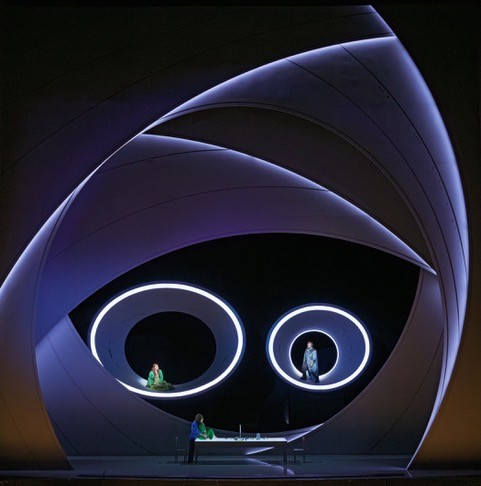
Sharon has devised a picture-puzzle of a Tristan, full of semiotic elements for the audience to decode. Es Devlin’s unit set is a proscenium-height off-white wall, which serves as a projection surface for a salmagundi of images, courtesy of projection designer Jason H. Thompson and video designer Ruth Hogben. Some of these are decipherable (the ocean that bears the lovers toward Cornwall), others less so (a giant moth flying toward a flame). A camera-iris mechanism at the center of the wall, ten feet above the stage, opens onto a series of floating cones, which serve as playing areas for much of the action. This positions the singers at a frustrating distance from those of us in the audience, undercutting their visceral impact and their voices in favor of the production team’s imagery.
Davidsen and Michael Spyres form just one of Sharon’s three pairs of Tristans and Isoldes; at the end of Act I the singers’ presences are echoed by a set of doubles and by projected images of yet another pair. The Met program includes a program note from the director in which he quotes Schopenhauer: “I carry within myself the possibility of innumerable individualities.” The presence of the doubles indicates a dissolving of individual identity: Tristan and Isolde are here less protagonists in an opera than embodiments of mythic archetypes, refracted through multiple incarnations. But the tactic engenders some distinctly clumsy moments, especially in Act III, when Spyres, singing much of the act from one of the Devlin’s cones, has to switch off with his double, lying on his sickbed.
The production takes its most baffling turn at its conclusion, when Isolde gives birth to a baby, presumably the product of her liaison with Tristan. According to Sharon's program note, this staging is meant to illustrate the Schopenhaurian concept of “rebirth”; the action is haunted by the death of Tristan’s mother in childbirth, long before the events of the opera unfold. Such ideas are all but impossible to discern in an innocent viewing: in fact they are often unintelligible without reading Sharon's study guide in the program.
In a more distinguished musical performance, Wagner’s mythos, the nub of Sharon’s inventions, would have taken hold more securely. But conductor Yannick Nézet-Séguin failed to tell the story coherently. Tristan is an extraordinary work of large-scale architecture: this is, after all, a piece in which a dissonance in the first phrase finally gets resolved, five-plus hours later, in the final measures. But you would never have know this from Nézet-Séguin’s reading, which thoroughly lacked tension, impetus, and coherence. His Tristan proceeded as a haphazard series of more or less impressive orchestral sounds. More than occasionally, these overwhelmed the singers: As so often, Nézet-Séguin appeared not to comprehend the collaborative nature of opera conducting.
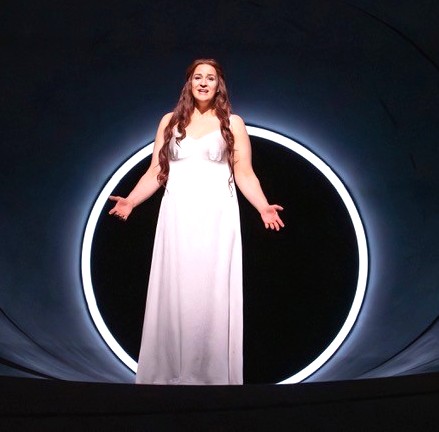
Most damagingly, he seemed misaligned with his Isolde. This is the role Davidsen has clearly been destined for; her ability to ride the work’s climaxes with outpourings of unforced, beautiful sound has not been heard since the heyday of Birgit Nilsson. Here, though, the impact of the stupendous voice was often undercut by her lack of support from the conductor’s podium. Her Liebestod offered no catharsis, since Nézet-Séguin’s didn’t allow for it. Meanwhile, her attempts at piano singing were sometimes nearly inaudible, the conductor achieving the remarkable feat of drowning her out. Davidsen is palpably the Isolde of her generation, but in this context, her assumption seemed like an extraordinarily promising work in progress.
 Spyres’s Tristan, on the other hand, was an unalloyed triumph. His casting at first seemed questionable: the American “baritenor” has built his reputation in the bel canto repertoire—that is, at a considerable remove from Wagner. His voice doesn’t roar in the heldentenor tradition, but the metal at its core gave it consistent presence, even during the loudest orchestral outbursts. Most remarkably, though, his singing retained its bel canto virtues even in this unfamiliar territory. Nothing was screamed or shouted: even in Tristan’s brutally long and difficult third-act delirium scene, Spyres sang the role through.
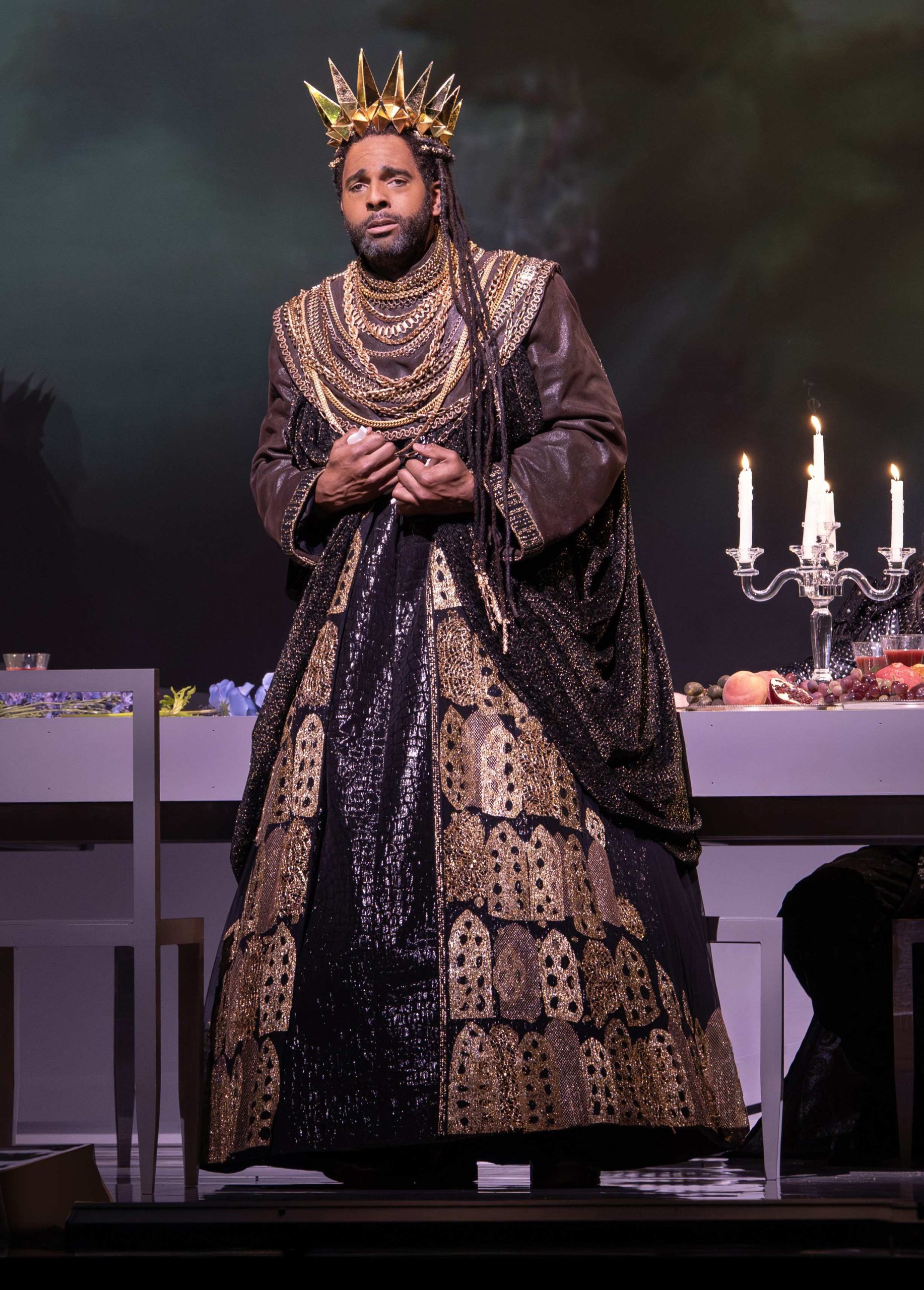
Mezzo Ekatarina Gubanova’s prominence over two decades of the Met’s casting has long been perplexing; her Brangäne here––edgily sung, with uncertain legato and scant command of the Wagnerian line––did little to clear up the mystery. Kurwenal was sung by Tomasz Konieczny; even if the veteran baritone’s voice offered more vinegar than honey, his sure command of the Wagner style allowed him to create a complete and convincing portrayal of Tristan’s loyal friend. The power of Ryan Speedo Green’s bass-baritone and the plangency of his tone made his King Marke a figure of both authority and touching vulnerability.
Ben Reisinger, singing from the auditorium’s balcony, sent his clarion tenor ringing through the house in the Sailor’s Act I song. Tenor Jonas Hacker was the sympathetic Shepherd in Act III, his touching work amplified by English hornist Pedro R. Diaz’s evocative playing of “die alte Weise,” the shepherd’s mournful song.
From the top: Lise Davidsen as Isolde; Davidsen and Michael Spyres (Tristan); Ryan Speedo Green as King Marke
Photos by Karen Almond
Lise Davidsen was Musical America's 2024 Artist of the Year
Yuval Sharon was Musical America's 2023 Director of the Year

 FEATURED JOBS


 RENT A PHOTO