People in the News
New Artist of the Month: Saxophonist Estel Vivó Casanovas
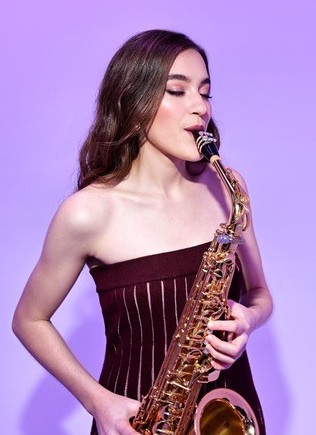
The offstage manner of the Estel Vivó Casanovas is modest and calm, but with an instrument in her hands, the 24-year-old Spanish saxophonist becomes a warrior. You can see it in the video of her winning performance at the 2025 Young Concert Artist auditions. Playing an excerpt from Mi Bailaora, by her compatriot David Salleras, she is uses circular breathing to sustain impossibly long phrases. She slap-tongues her alto sax, turning it into a percussion instrument. A bout of foot-stomping adds another layer of percussive sound. Through it all, Casanovas seems to be living inside the music, her sax an extension of her very being.
“I always ask myself the question, how can I communicate with the audience?” Casanovas says, in a recent Zoom interview. “How do I make things more expressive? I’m a big movie and book person––I once considered being an actress––and though some people might think it’s a little foolish, it really helps me to imagine a story.”
Casanovas’s parents were not professional musicians, but her mother, a teacher and music lover, made sure that her children took lessons. Her older sister Suzanne took up the saxophone, and Estel followed in her footsteps. (The two women now sometimes perform together.)
“I had many ideas in my head of which instrument to pick, and I kept switching every week,” Casanovas says. “I really looked up to my sister, so when it came time to decide, it made sense for me to play the saxophone, like her. When I got older and learned more about music history, I thought ‘Wait—there’s all these other instruments that I didn’t know existed!’ But by that time, I had fallen in love with the saxophone, and it didn’t make sense to switch.”
As an undergraduate at Barcelona’s Liceu Conservatory, Casanovas took over the Matadepera Wind Orchestra, the resident band for the town of Matadepera, 25 miles north of Barcelona. “I knew some of them, and they couldn’t find a new conductor after Covid,” she explains. She took over as their leader, learning on the job while taking private conducting lessons—and helping the ensemble grow in size and stature.
When she was 20, she got a scholarship at the Eastman School of Music and moved overseas. “Coming to the U.S. made a lot of sense,” she says. “I always loved English. I had visited a lot of European countries with my parents, and I wanted to explore something different. I had seen a lot of TV shows that were filmed in America, and I was surprised when I got here that so many things were so accurate. The street signs! The school busses! I thought ‘This is insane!’”
At Eastman, she studies with Singapore-born Chien-Kwan Lin. “He used to be a violinist, so his way of teaching is a little bit different from a regular saxophonist,” Casanovas says. “You have to give a lot of energy to the violin, otherwise it doesn’t work. I try to bring that to my saxophone playing.”
Casanovas’s process for choosing repertoire is typically thoughtful. “I imagine myself in a chair in the auditorium,” she says. “How would it be if I heard someone else play this? Would I be excited?” She’s her own best critic: “I have to say, I get bored easily.
“I always try to find original works, because it’s important to keep playing them, keep giving them life,” she continues. “But I’m not afraid of looking for pieces written for other instruments.” Case in point: Falla’s Siete canciones populares españolas, two of which she played at her YCA audition, with a soulfulness and expressivity that made it seem as if Casanovas were indeed singing.
As she continues her saxophone studies, she is also working on a doctoral thesis. (This will align her Eastman doctorate with the guidelines in her home country, where equivalent degrees reflect a research component.) Her subject: avant-garde music in the Franco era—a period which most Spaniards, she feels, would just as soon forget. “It’s obviously in the past now, but my parents were alive during the regime,” she says. “The country’s generational trauma is still alive. Other countries that had fascist regimes, they explain their history—I don’t want to say without shame, but without trying to hide it or embellish it.
“There’s a lot of non-research going on,” she continues. “Some of our greatest poets were killed during the Civil War, and we still haven’t found their bodies. I realized I didn’t even know which composers were around during the fascist era. I kept asking myself questions, and thought this was a topic I could explore.”
In her thesis, she is looking at the tactics composers of the era used to deliver covert political messages. She offers as an example Cristóbal Halffter, whose Elegia a la Muerte de Tres Poetas Españoles, are settings of texts by dissident poets Antonio Machado, Miguel Hernandez, and Federico García Lorca. The piece was written in 1975, shortly before Franco’s death. Casanovas has not uncovered any saxophone music in her research—but given her fondness for transpositions, she is looking for ways to perform some of the works she’s uncovering. “I want to dig in,” she says.
Casanovas’s YCA victory has brought with it a number of performance opportunities. In coming months, she will be appearing at the Honest Brook Music Festival in upstate New York and in Alabama with the Huxford Symphony Orchestra. The YCA Award also brings a recital opportunity this summer at the Serge Rachmaninoff Foundation’s Villa Senar, in Weggis, Switzerland.
When asked about her future plans, Casanovas envisages folding teaching and research, as well as performing, into her career. “But the first thing that comes to mind is going back to Spain,” she says. “I think I would like to live in Barcelona.”

 FEATURED JOBS


 RENT A PHOTO