Reviews
Storied Orchestra, Classy Update
ST. LOUIS—It’s not uncommon for orchestras to mark a milestone with a fanfare. On Sept. 26, the St. Louis Symphony Orchestra (SLSO) opted for three.
This orchestra has much to celebrate. It spent two seasons roving from local venue to venue while its century-old home base, Powell Hall, underwent a $140 million renovation. That fundraising push exceeded expectations, and the orchestra made off with $173 million in total—the largest capital campaign in its history.
When symphony President and CEO Marie-Hélène Bernard took the stage on Sept. 26—the first non-gala concert in the new hall—she was met by nearly a minute of overwhelming applause. After coming to St. Louis from Boston’s Handel & Haydn Society in 2015, Bernard made the renovation her rallying cry. Some of the most enthusiastic cheers came from the stage—unusual in an industry where musician–executive relations range from ambivalent to fractious. (A recently ratified four-year contract, cementing progressive raises for the players, probably stoked that enthusiasm.)
Had the SLSO only commissioned Powell Hall’s curving, sleek building additions—courtesy of Snøhetta, the Norwegian architecture firm behind the Norwegian National Opera building and the 9/11 Memorial Museum Pavilion—that alone would have been worthy of musicians’ applause. The backstage of Powell Hall was once a cramped nightmare. Now, a newly built-out network of wide hallways include ample practice spaces and storage rooms, as well as a sleek, cozy musician lounge sure to be the subject of nationwide envy. The hall is fully built out with audiovisual capabilities, whether for radio broadcast or video simulcast.
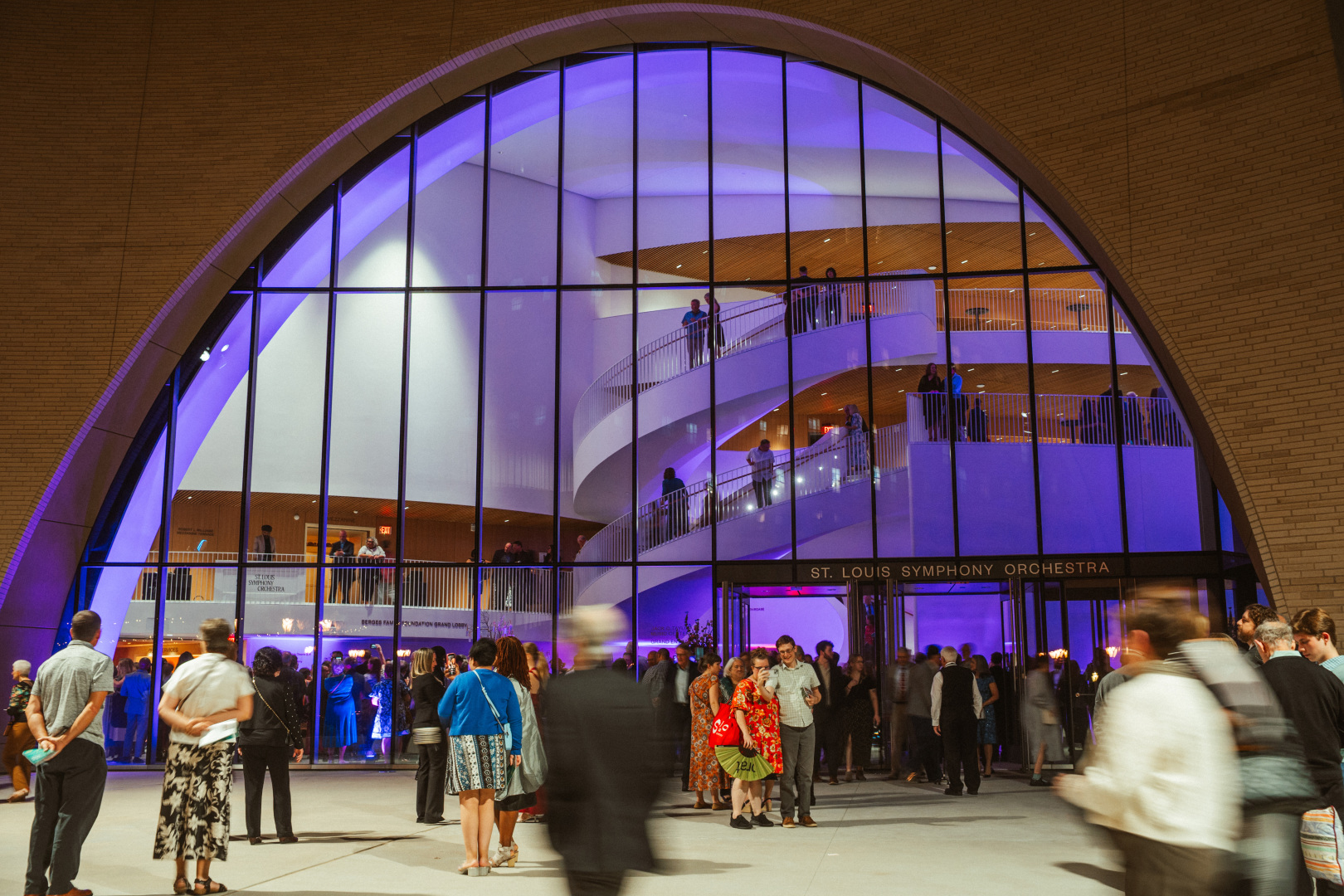
 The players’ contentedness is sure to be reflected on the audience side. Lobby and concession areas have more than doubled. A new “education and learning center” has even added a second venue to the complex: a multipurpose event space, capable of hosting rehearsals, recording sessions, banquets, and more. The spaciousness paid off on Sept. 26: The common spaces never felt crowded, even at capacity. (Entering and leaving the hall was a different story: Other construction on Grand Boulevard completely backed up the two-lane thoroughfare leading to and from the parking lot.)
The project also necessitated a touchup of Powell Hall itself. Following nationwide attendance trends, the SLSO traded seating capacity for comfort: Wider, deeper, plusher chairs brought its new seat count to 2,158 from 2,683. It is also easier to traverse for patrons with mobility aids, the slopes inside and outside the hall both gentler and wider.
Longtime backstage and front-of-house challenges aside, Powell Hall, built in 1925 as a movie palace, boasts an acoustic remarkably conducive to orchestral performance. If anything, Music Director Stéphane Denève fretted that any tweaks might sully a fine hall.
“The main thing for me was to preserve the acoustics,” he told me in a backstage interview.
With an assist from Kirkegaard Associates, a Chicago-based acoustical design firm, the SLSO did just that. Curved reflectors were added to the main floor to address dead spots in the center-orchestra section, and the stage was outfitted with a new white-oak floor. The doors into the hall itself were also redone to better insulate from street sound. (Powell Hall sits on the ambulance route of a nearby hospital.)
During rehearsals and at the Sept. 26 matinee, I sat in four different places: in the formerly dead space in the center orchestra, in the low-ceilinged mezzanine loge, in the coveted dress circle boxes, and all the way up in the last row of the upper balcony. All were rewarded with a ravishing acoustic, haloed by a handsome resonance. Sound snowballs the higher you climb—in fact, the upper balcony is, by decibels and potency, the best seat in the house.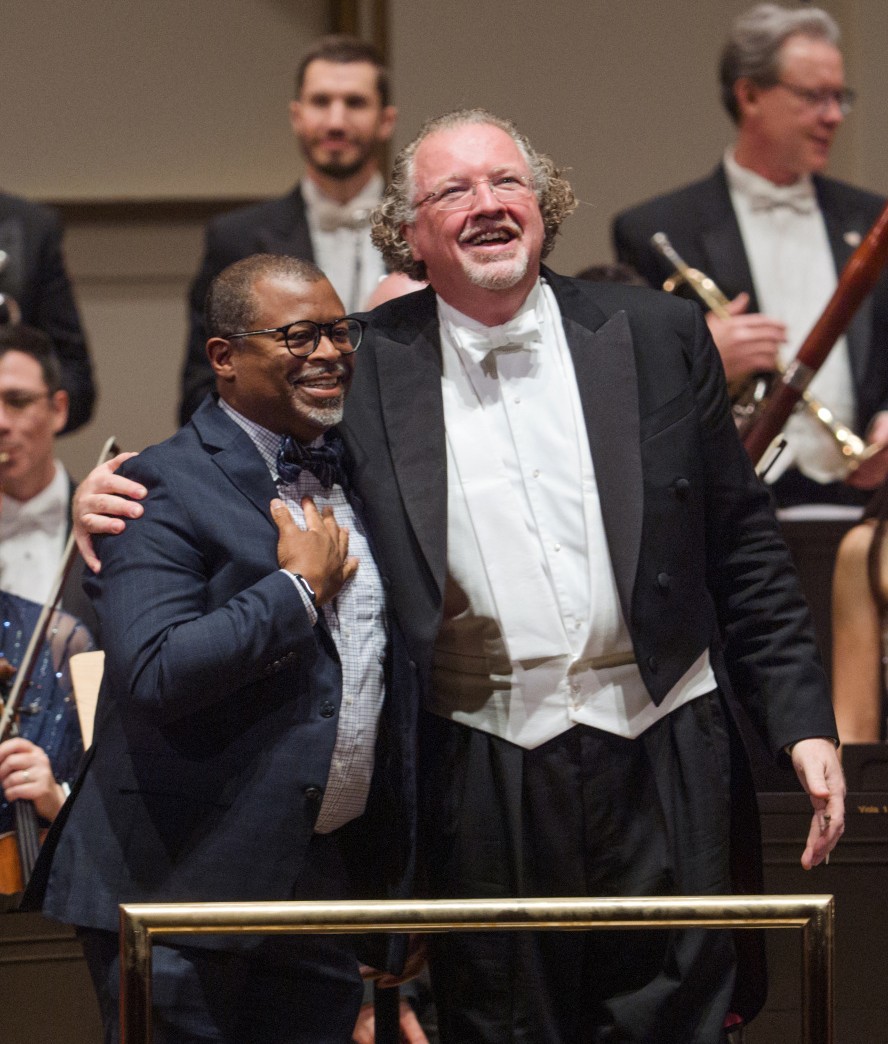
Denève finds the new acoustic “slightly more joyous and clear.” To demonstrate, he played me a video from a recent choir rehearsal. In the clip, he enthuses off-camera about the hall’s sound to St. Louis Symphony chorus director Erin Freeman—and his effusive comments, delivered from the back of the hall, are heard crisply on the stage.
Indeed, the hall’s acoustic goes both ways. Audience disturbances carry just as easily as the sound onstage, whether ringtones or chatter. And when someone sneezed a few rows away from me in the very-live upper balcony, that, too, registered fortissimo.
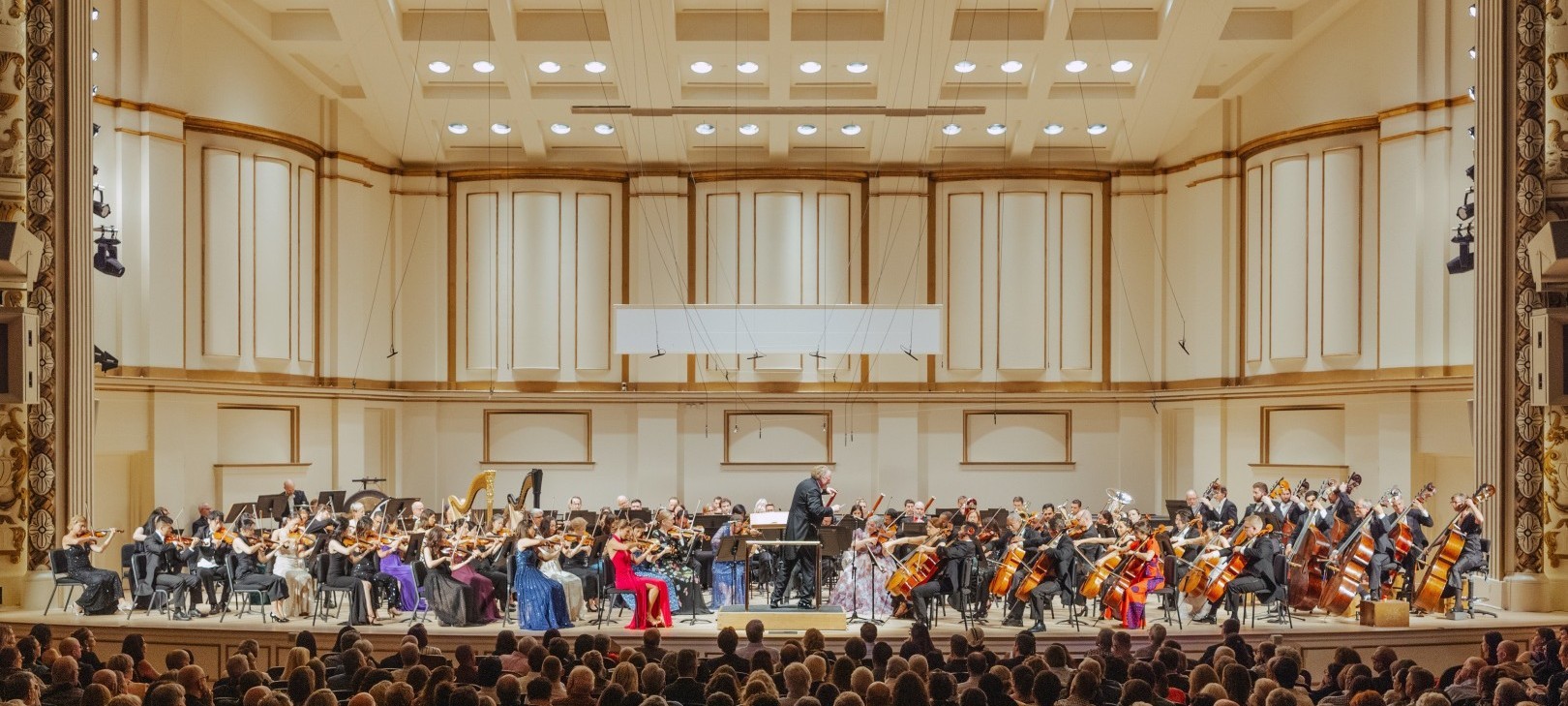
An exceptional hall doesn’t mean much without an exceptional orchestra to fill it. The opening program played to the St. Louisans’ sensibilities, with its tilt towards contemporary American fare and broad-shouldered Romanticism. The brass are first among sterling equals in this ensemble: Trumpets were so unified in Copland’s Fanfare for the Common Man and Joan Tower’s Fanfare for the Uncommon Woman that they sounded like one instrument, and horns blended creamily. Likewise, the low brass met heft with dazzle, as if polished I-beams holding up the ensemble.
.
The group’s collegial qualities were especially manifest in Strauss’s Ein Heldenleben. String principals’ eyes flickered up to meet one another; woodwinds interlaced choreographically. After an injury sidelined concertmaster David Halen, associate concertmaster Erin Schreiber stepped in, her solos marrying moxie with sparkling precision.
Because this orchestra doesn’t do anything small, it commissioned two world premieres for its homecoming: the appropriately named House of Tomorrow by Kevin Puts, SLSO composer-in-residence this season, and James Lee III’s Fanfare for Universal Hope, the third of those three fanfares.
 Both works will likely enjoy long lives beyond this salutatory occasion. Striding and syncopated, Lee’s fanfare sprouts organically from Copland and Tower’s, as though continuing what those composers started. Unlike his predecessors, Lee brings in the strings and woodwinds, the orchestra’s massed brilliance driving the piece to a determined conclusion.
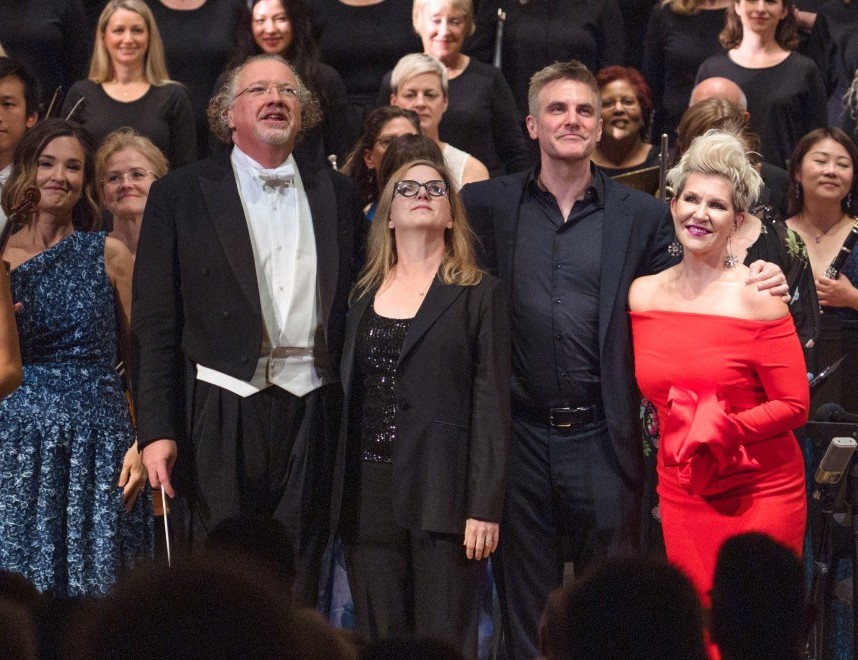
Set to verses from Kahlil Gibran’s The Prophet, Puts’s House of Tomorrow, featuring mezzo-soprano Joyce DiDonato and the St. Louis Symphony Chorus, brings the stylistic tics of the Baroque oratorio into the 21st century. The work is one of Puts’s strongest to date: gorgeous, often achingly so; effectively set for solo mezzo-soprano and chorus; and cogent end-to-end, without a wasted minute. Where some ensembles might falter in a 20-minute new work, the SLSO and its chorus approached Puts’s oratorio with decisiveness and élan, matching DiDonato’s vocal resplendence.
“Does not your house dream?” the soloist asks in the final movement, in a hopeful, almost imploring ascending line. This one does—and its dream came true.
Photos from the top:
Music Director Stéphane Denève conducts Ein Heldenlaben; Stéphane Denève, Chorus Director Erin Freeman, composer Kevin Puts, Joyce DiDonato; James Lee III, Stéphane Denève; guests at the new entrance to Powell Hall, aka the Jack C. Taylor Music Center
Photos by Virginia Harold

 FEATURED JOBS


 RENT A PHOTO