Industry News
Top 10 Pandemic Pivot No. 8: A Small Café in London Books Big Name Talent
The U.K.’s first lockdown cut off the oxygen supply for lovers of live music from March 16 until well into June with advice on social distancing making it well-nigh impossible for most venues with any financial sense to open until at least September. Most, but not all. Tucked away in London’s trendy Clerkenwell district, the Fidelio Orchestra Café decided to risk returning to live performance in July thanks to bold leadership and the enthusiastic support of a string of high-profile musicians.
“When the government announced they would lift the lockdown there was a lot of uncertainty about what was possible and what wasn’t,” explains Fidelio Orchestra Café founder Raffaello Morales. “The guidelines were very vague. In particular there was this infamous clause stating that indoor venues should not permit live entertainment. But we live in a country that has built its reputation over the centuries differentiating between ‘must’ and ‘should’ so we decided to simply take the plunge.”
Jack of all trades
An Italian pianist, conductor, and all-round entrepreneur, Morales was born in Rome but put music aside on moving to London in 2009 to study physics at Imperial College and earn a PhD in mathematics at King’s College. A further change of direction saw him become an investment banker for five years.Then, in the summer of 2019, he gave it all up and founded the Fidelio Orchestra, an ensemble of professional and highly accomplished amateur musicians. In December of last year, he opened a café (named for his orchestra, although they actually perform at a nearby church). Performances were accompanied by a three-course dinner created by chef Alan Rosenthal with whom Morales shares a passion for music and food.
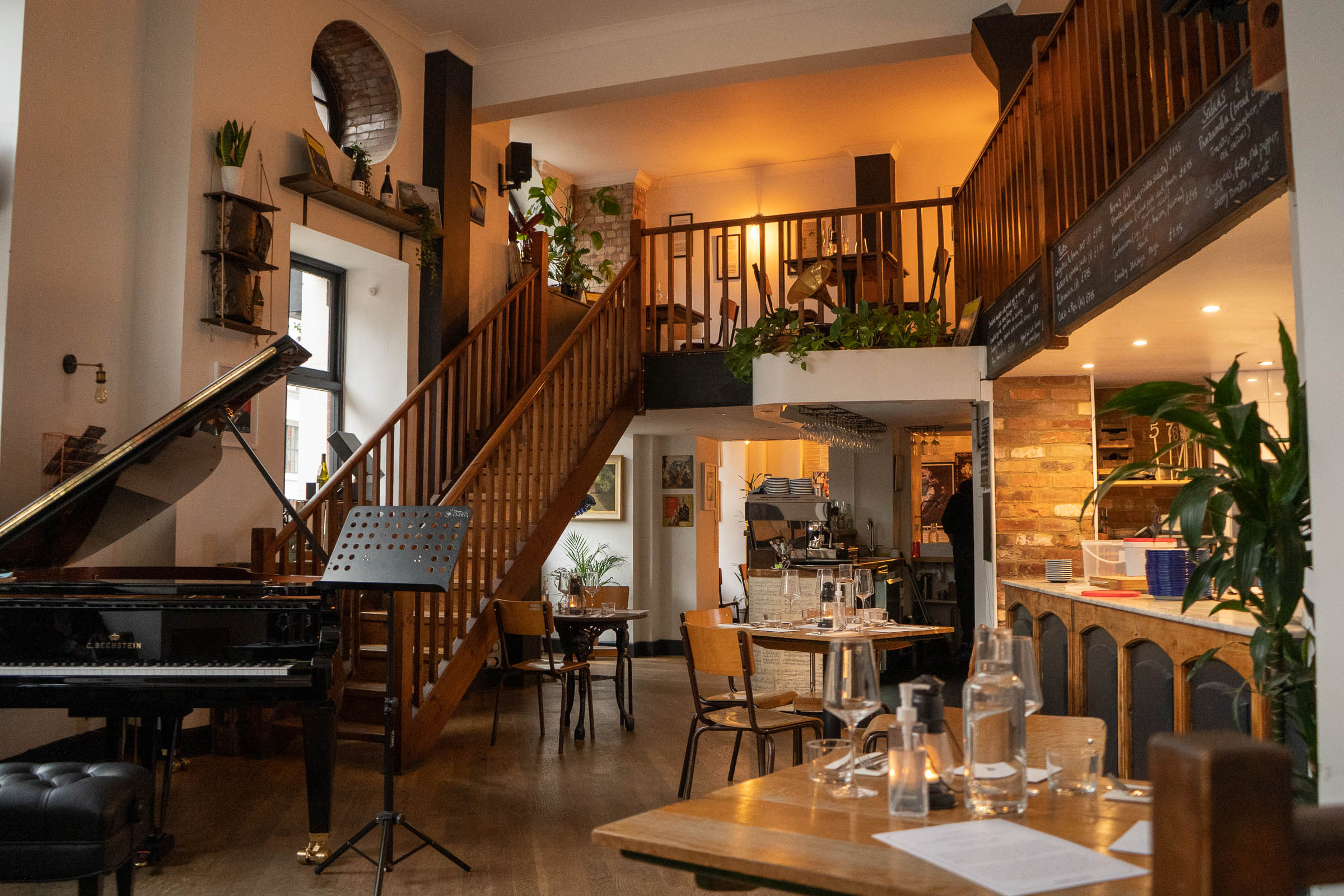 Fidelio Orchestra Café
Lockdown forced the café to close in March but by June it was clear to Morales that few were stepping in to fill the cultural void. “It was depressing to see how little imagination the arts sector showed in tackling the difficulties,” says Morales who comes across as a born provocateur.
Considering fears surrounding indoor dining, Morales was taking a considerable risk re-opening his doors. Cutting capacity by almost 50 percent meant the venue would be down to 25 people a night. Nevertheless, he committed to a summer season of six programs, each repeated five times to enable a decent-sized audience. “The whole season sold out,” he reports. “People were starved for live entertainment. Of course, there was skepticism, but the names involved helped.”
An easy sell to the (usually) hard-to-get
Morales reached out to musicians personally and was delighted with the results. “Most of the artists didn’t know much about us as we were a young brand,” he says. “I did have to talk about the legitimacy of the whole thing but they were excited that someone was producing something concrete and so they joined pretty happily.”
Cellist Steven Isserlis was the first to come onboard. “A few years ago, I made the firm decision never to play a Bach suite in public again—it’s too terrifying,” Isserlis stated in the concert’s promotional materials. “But these are extraordinary times, so I’m daring to play suites Nos. 1 and 3 just for these special occasions.”
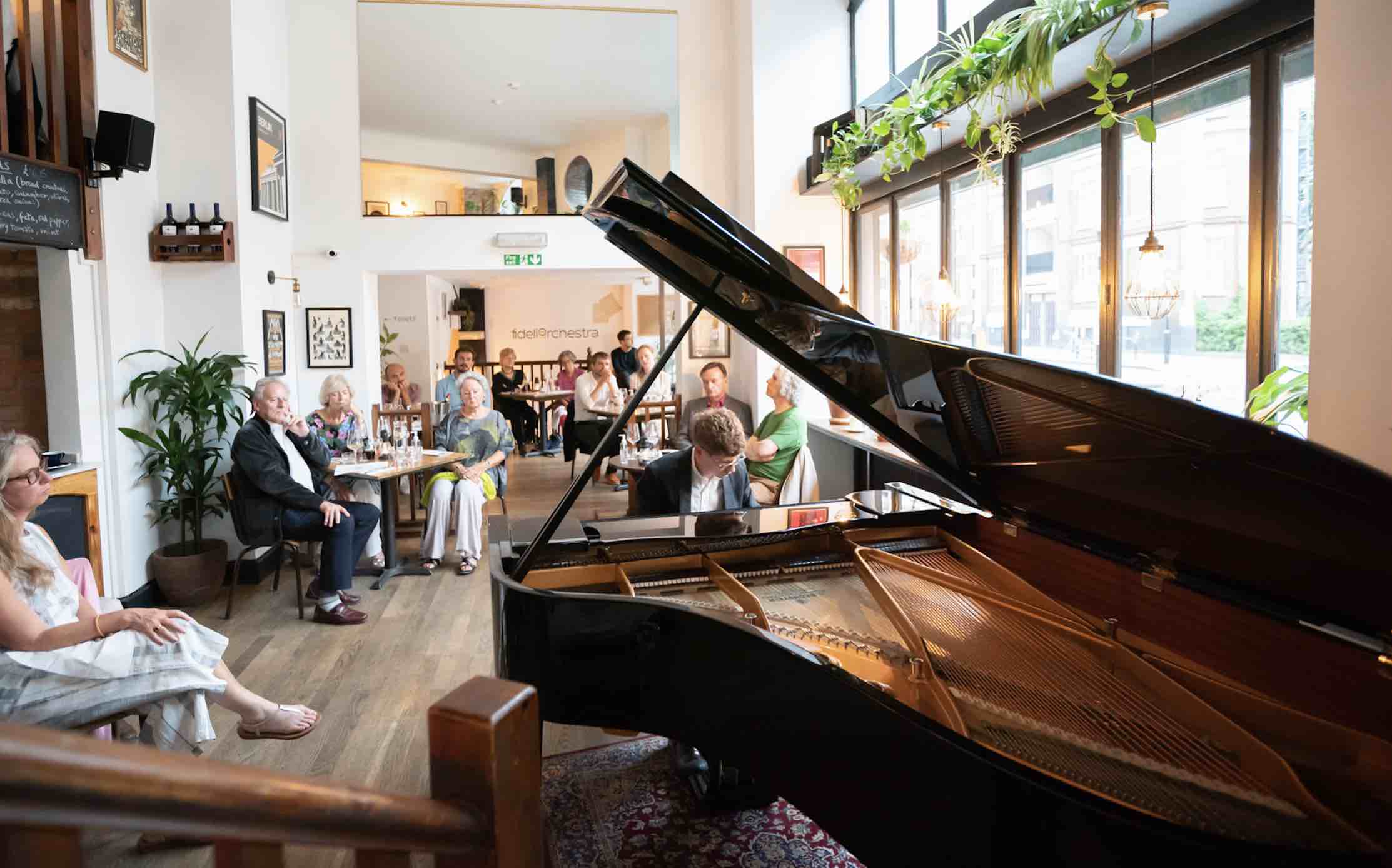 Pianist Pavel Kolesnikov at the Fidelio Orchestra Café
A stellar line-up followed that included pianists Pavel Kolesnikov and Imogen Cooper and violinists Alina Ibragimova and Tamsin Waley-Cohen. Actor Simon Callow put on his acclaimed Evening with Charles Dickens. By mid-December Morales had presented over 70 concerts with the final fortnight running at six concerts a week. A true jack of all trades, he found himself multitasking as concert booker, café manager, maître d', and occasional page turner.
“I don’t feel like we are a promoter—it’s more like a circle of friends,” he maintains. “We make the concerts happen the way the musicians want, which for them is a sweet deal as you get to do what you’d like to do without any fuss.”
£100 for food, fellowship, and great music
The whole series was designed to be self-sustaining. An aperitif, the concert, and a three-course meal costs £100 with the option to buy further drinks on top of that. The evening starts at 7 pm with drinks and nibbles. The hour-long performance without interval follows at 7:30 pm and then the dining. Before the evening finishes at 11 pm there’s always more music. “The artists have dinner alongside the audience and then they play some more,” Morales explains. “It’s spontaneous, more improvised. We’ve even had sightreading. Imagine, people of that caliber saying, ‘I’ve never played this sonata but maybe we could try it?.’”
The café employs a staff of 12 with Morales taking care of artist relations and stage management. Such intimate performances make for a highly personal musical experience and concerts are invariably followed by talk and the chance for some socially distanced mingling with the artists.
The concerts themselves are not intended as money-makers, and although the café has a modest marketing budget, Morales doesn’t want the emphasis to be commercial. “First and foremost, this is a way to benefit the musicians. If I focused on the fine dining the profit margins would be much higher,” he declares. “I want this to be different—human—so we’ve been very careful in the way we advertise. It is challenging, but the press has been very positive so far.”
With London now in tier 4—the U.K.’s highest level of restrictions—the Fidelio Orchestra Café is closed once again. However, the plan going forward is to make the concerts even more accessible by reserving ten seats for under-30s at £50 and offering reduced view standing or sitting tickets at £10 (no dinner but drinks and nibbles can be purchased). Musicians tentatively booked for January and February include violinist Nicola Benedetti, pianists Stephen Hough and Angela Hewitt, and the Doric String Quartet. Lockdown or no lockdown, Morales’s idea looks like it’s going places.

 FEATURED JOBS


 RENT A PHOTO