Industry News
Top 10 Pandemic Pivot No. 7: The NY Phil Bandwagon
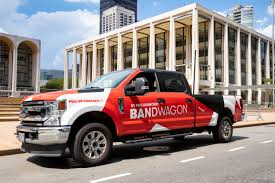 In June, countertenor Anthony Roth Costanzo and Deborah Borda, president and CEO of the New York Philharmonic, got together over Zoom to chat, and their conversation turned to an idea Costanzo had about musicians giving concerts from the back of a truck. “It wasn’t a particularly original idea,” he said in a recent interview, “but I thought that if we could reinvent the concertgoing ritual and execute it in an exciting way, it would be meaningful for people to experience live music during the pandemic.”
Borda loved the idea, which spawned the NY Phil Bandwagon, with Costanzo as host and producer. “It was the biggest little project the Philharmonic ever did,” said Borda. “People were captivated by the idea of a pickup truck driving around the five boroughs with musicians hopping off to give a concert and then going on to the next place.”
With a rotating cast of between two and five Philharmonic musicians per program, plus Costanzo on vocals, the Bandwagon – a bright red Ford F-250 truck -- presented 81 free concerts over nine weekends in August, September, and October, when the city was emerging from a shutdown. Each weekend featured a different program, with repertoire ranging from several world premieres to a Beethoven string trio to an arrangement of Marvin Gaye’s “What’s Going On.” It was the first time the musicians had played in person with their colleagues for audiences since March.
Not as simple as it sounds
“The complications were myriad,” Borda said. “We had to get permits from the city, especially when we were playing in a city-controlled area like a park. We had to get permits for the truck. We were very strict about protocol and had to get all of our musicians and crew Covid-tested on a regular basis. We had to form a bubble during the performances so that everyone inside it had been tested. Everybody wore masks, and everything was wiped down between concerts.”
Because of public health rules, the times and locations of concerts were kept secret so that people wouldn’t gather in a specific place and form a contagious crowd. The Bandwagon played at three different sites each day. “The concerts were never announced – not even tweeted, like a food truck would do before showing up with tacos,” Costanzo said. “We just pulled up, unloaded in about 15 minutes, set up speakers and lights, and started playing. Sometimes only two or three people were watching in the beginning, but almost every time, this mass of people – distanced, masked – would gather halfway through the first piece. People were just drawn to it. Kids would drag their parents, delivery guys would pull over, cars would stop, people in buildings would open their windows and applaud. It was like a West Side Story moment.”
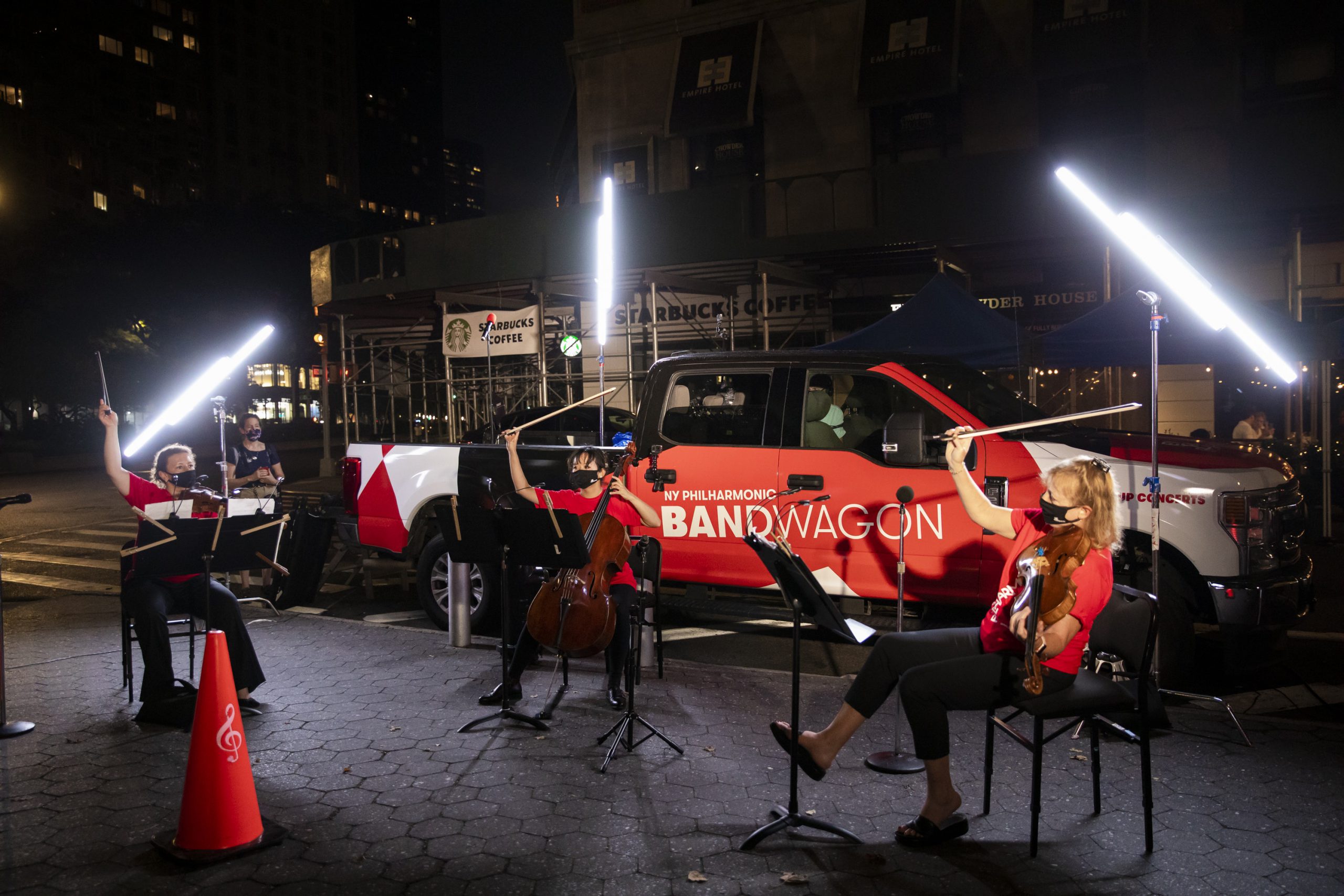
String trio from the NY Philharmonic performs a sidewalk soiree
The concerts could be emotional, with musicians and audience together experiencing live, in-person music again. “I did ‘Dido’s Lament’ a lot, and in the midst of Black Lives Matter protests, singing the line ‘Remember me but forget my fate’ felt very powerful,” said Costanzo, who kept a mask on while singing. “We often ended with ‘I Got Rhythm,’ and that was a joy. The live performance meant so much to everyone.”
As part of the Philharmonic’s 2020-21 budget of $52.6 million (down from a pre-pandemic projection of $85 million), the Bandwagon was a bargain, costing $200,000, according to Borda. It’s slated to return to the streets in spring.
Asked what lesson she learned from the Bandwagon’s first tour, Borda said: “Hang loose. You have to roll with the punches with a process like this. You can’t control the weather. You can’t control if there’s a crazy person in the crowd. Sometimes you can’t even control where you’re playing – you have to go someplace else because somebody took your parking spot. You have to go with what happens, and that’s a good life lesson for all of us.”

 FEATURED JOBS


 RENT A PHOTO