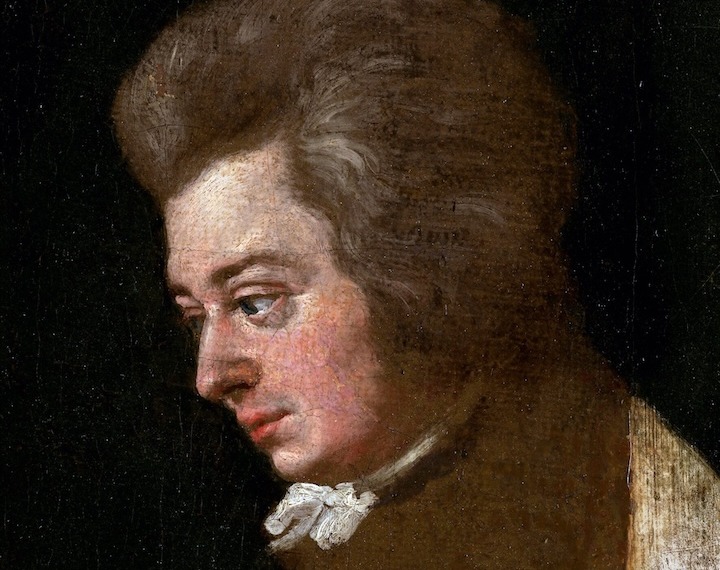
(Annandale-on-Hudson, July 2026) — On Friday, August 7, the Bard Music Festival returns with an intensive two-week exploration of “Mozart and His World.” In eleven themed concert programs, the festival’s 36th season examines Wolfgang Amadé Mozart, arguably the most celebrated and recognized name in classical music, first considering The Perils of Genius (Weekend One: August 7–9), then investigating the composer’s standing as The Universal Musician (Weekend Two: August 13–16). Aside from Program Six, presented in nearby Rhinebeck, all concerts take place in the stunning Frank Gehry-designed Fisher Center for the Performing Arts and other venues on Bard College’s idyllic Hudson River campus. Six programs will also stream live to home audiences worldwide on the Fisher Center’s virtual stage, and chartered coach transportation from New York City will be available for the final performance (see details below). Presented as a centerpiece of the 23rd Bard SummerScape festival, the Bard Music Festival once again offers “part boot camp for the brain, part spa for the spirit” (The New York Times).
Festival founder and co-artistic director Leon Botstein serves as music director of both the American Symphony Orchestra (ASO) and The Orchestra Now (TON), Bard’s unique graduate training orchestra. In a concert with commentary by Botstein, he and TON help open the festival with Mozart’s Sinfonia concertante in E-flat and delightful “Paris” Symphony [Program 1], before joining pianists Simone Dinnerstein – “an artist of strikingly original ideas and irrefutable integrity” (Washington Post) – for Mozart’s Piano Concerto No. 18 in B-flat and Gramophone Award winner George Xiaoyuan Fu for the composer’s Piano Concerto No. 5 in D, together with his “Prague” Symphony and works by his older Bohemian contemporaries Christoph Willibald Gluck and Josef Myslivecek [Program 3]. Botstein and the ASO interpret two of Mozart’s mature orchestral works – the sophisticated “Linz” Symphony and Concerto for Two Pianos, featuring Andrew Wolf Chamber Music Award winners Michael Stephen Brown and Orion Weiss – together with examples by members of the composer’s inner circle: his friend Maria Theresia von Paradis, who lost her sight at an early age; Marianna Martines, at whose musical soirées he was a frequent guest; Franz Xaver Wolfgang Mozart, his youngest child; and Franz Xaver Süssmayr, the friend, student, and assistant best-remembered for his posthumous completion of Mozart’s Requiem [Program 9].
With the Bard Festival Chorale, Botstein and the ASO anchor a semi-staged concert performance of The Abduction from the Seraglio (“Die Entführung aus dem Serail”), the opera with which Mozart made his breakthrough in Vienna. Starring Pavarotti International Competition winner Minghao Liu, Metropolitan Opera National Council grand finalist Jana McIntyre, and Grammy winner Aaron Blake, this will be directed by Marco Nisticò, Opera Producer of the Fisher Center at Bard [Program 11]. Led by choral director James Bagwell, the Bard Festival Chorale also performs Michael Haydn’s Requiem alongside two of Mozart’s own religious choral works and an all-too-rare live account of his Davide penitente, a cantata combining a specially created cadenza and two new arias with original text settings of his personally selected highlights from the unfinished Great Mass in C minor [Program 7].
Bard presents Aaron Blake, Katrina Galka, Jennifer Zetlan, and the Bard Festival Ensemble conducted by Dorian Bandy in selections from two one-act operas that were originally commissioned for competing, back-to-back premieres: Antonio Salieri’s Prima la musica, poi le parole (“First the Music, then the Words”) and Mozart’s Der Schauspieldirektor (“The Impresario”). This marked one of two occasions when the Habsburg Emperor Joseph II pitted Mozart against his Italian peers in historic contests. The other took place when Mozart and pianist-composer Muzio Clementi were invited to compete at the piano, in a musical duel that will be brought back to life by pianists Danny Driver, a Gramophone Award nominee, and Piers Lane, for whom “no praise could be high enough” (Gramophone) [Program 5]. These six orchestral, operatic, and choral programs will all be livestreamed.
As in previous seasons, the festival presents a wide range of chamber music. The Cleveland Quartet Award-winning Ariel Quartet interprets Joseph Haydn’s String Quartet in C, Op. 33, No. 3, nicknamed “The Bird,” and takes part in accounts of Mozart’s String Quintet in G minor, a profound, dark-hued masterpiece [Program 8], and of the String Sextet from Capriccio by Richard Strauss (the composer of this season’s SummerScape opera, The Egyptian Helen), in whom Mozart’s influence ran especially deep [Program 10]. Other chamber and keyboard highlights see oboist Alexandra Knoll, clarinetist Shari Hoffman, bassoonist Gina Cuffari, horn player Karl Kramer, and pianist Danny Driver join forces for Mozart’s masterly Quintet in E-flat for Piano and Winds, which he famously considered his best composition [Program 1]; Paolo Bordignon, harpsichordist of the New York Philharmonic, perform the “Sonata d’intavolatura” by Italian composer Giovanni Battista Martini, who mentored Mozart as a child [Program 2]; and organist Alexander Pattavina play an Epiphany anthem by his student Thomas Attwood on the recently renovated organ of the Episcopal Church of the Messiah in nearby Rhinebeck [Program 6].
To complete the lineup, Lisa de Alwis investigates popular Viennese theater traditions in a concert with commentary, for which vocalists Catherine Creed, Aaron Blake, and Devon Russo will be accompanied at the piano by festival favorite Anna Polonsky. Excerpted works include Das Donauweibchen (“The Nymph of the Danube”), a popular opera by prolific Austrian composer Ferdinand Kauer, and from Der Stein der Weisen (“The Philosopher’s Stone”), a Singspiel based on the same fairy tales as The Magic Flute, and collaboratively created by the same team, with music by Mozart in tandem with Emanuel Schikaneder (The Magic Flute’s commissioner, librettist, and first Papageno), Benedikt Schack (its first Tamino), Franz Xaver Gerl (its first Sarastro), and Johann Baptist Henneberg (its first conductor) [Program 4].
Supplementary events and companion book
Besides the eleven concert programs, there will be two free panel discussions: “Gottlieb or Amadé? Who Was Mozart?,” moderated by co-artistic director Christopher H. Gibbs (August 8), and “The Age of What?: Absolutism and Enlightenment or Revolution and Romanticism,” moderated by Bard’s 2026 Scholar-in-Residence Simon P. Keefe (August 15). These will be supplemented by informative pre-concert talks — all free to ticket-holders — by scholars such as Byron Adams, Elaine R. Sisman, and Larry Wolff. Bard SummerScape also presents a rare new production of The Egyptian Helen (“Die ägyptische Helena”) by Richard Strauss, heir to the German-language opera tradition that originated with Mozart (July 24–August 2). Published by the University of Chicago Press, the companion book Mozart and His World is edited by Scholar-in-Residence Simon P. Keefe, James Rossiter Hoyle Chair of Music at the University of Sheffield, whose Cambridge University Press publications include Mozart’s Requiem: Reception, Work, Completion and Mozart in Context.
Round-trip bus transportation from New York City
Chartered bus transportation from New York City is available for the festival finale, Program Eleven (August 16). This may be ordered online or by calling the box office at 845-758-7900, and the meeting point for pick-up and drop-off is at Lincoln Center on Amsterdam Avenue, between 64th and 65th Streets. More information is available here.
SummerScape tickets
Tickets for mainstage events start at $25 and livestreams are $20. Panel discussions are free of charge and open to the public. For complete information regarding tickets, series discounts, and more, visit fishercenter.bard.edu or call Bard’s box office at (845) 758-7900.
Program details of Bard Music Festival, “Mozart and His World”
All performances (except Program Six) are in the Fisher Center and other locations on Bard College campus, Annandale-on-Hudson, which is accessible by regular Amtrak trains. Program Eleven is serviced by round-trip bus from Manhattan: see above for details.
WEEKEND ONE: The Perils of Genius
PROGRAM ONE: The Many Facets of Mozart
Friday, August 7
Sosnoff Theater
7pm performance with commentary (plus livestream); with Joshua Blue, tenor; Catherine Creed, soprano; Gina Cuffari, bassoon; Shari Hoffman, clarinet; Alexandra Knoll, oboe; Karl Kramer, horn; Grace Park, violin; Barry Shiffman, viola; Danny Driver, Kayo Iwama, Piers Lane, and Anna Polonsky, piano; The Orchestra Now, conducted by Leon Botstein, music director
Wolfgang Amadé MOZART (1756–91)
Sonata in D, K381 (1772)
Symphony No. 31 in D, “Paris,” K297 (1778)
Sinfonia concertante in E-flat, K364 (1779)
Quintet in E-flat for Piano and Winds, K452 (1784)
Ch’io mi scordi di te?, K505 (1786)
Kleine deutsche Kantate, K619 (1791)
PANEL ONE: Gottlieb or Amadé? Who Was Mozart?
Saturday, August 8
Olin Hall
10am–12 noon
Christopher H. Gibbs, moderator; Leon Botstein; Scott Burnham; Elaine R. Sisman
Free and open to the public.
PROGRAM TWO: Fathers and Sons
Saturday, August 8
Olin Hall
1pm preconcert talk: Byron Adams
1:30pm performance: Paolo Bordignon, harpsichord; Catherine Creed, soprano; Luosha Fang, violin/viola; Alexandra Knoll, oboe; Karl Kramer, horn; Grace Park, violin; Raman Ramakrishnan, cello; Lisa Marie Rogali, mezzo-soprano; Michael Stephen Brown, Kayo Iwama, and Anna Polonsky, piano; and others
Wolfgang Amadé MOZART (1756–91)
String Quartet in F, K168 (1773)
Sonata in C, for piano and violin, K296 (1778)
Songs and arias
Giovanni Battista MARTINI (1706–84)
Sonata No. 2 in D, “Sonata d’intavolatura” (pub. 1742)
Carl Philipp Emanuel BACH (1714–88)
Piano Sonata in A, “Prussian Sonata No. 6,” Wq 48/6 (1740–42)
Leopold MOZART (1719–87)
From Twelve Duets, for two violins (1770)
Johann Christian BACH (1735–82)
Sextet in C, Op. 3, W.B78 (pub. 1785)
PROGRAM THREE: Mozart and Prague
Saturday, August 8
Sosnoff Theater
6pm preconcert talk: Elaine R. Sisman
7pm performance (plus livestream): Jana McIntyre, soprano; Theo Hoffman, baritone; Simone Dinnerstein and George Xiaoyuan Fu, piano; Karl Kramer, horn; The Orchestra Now, conducted by Leon Botstein, music director
Wolfgang Amadé MOZART (1756–91)
Exsultate, jubilate, K165 (1773)
Piano Concerto No. 5 in D, K175 (1773; rev. 1777/78)
Piano Concerto No. 18 in B-flat, K456 (1784)
Symphony No. 38 in D, “Prague,” K504 (1786)
Overture to La clemenza di Tito, K621 (1791)
Works by Christoph Willibald GLUCK (1714–87) and Josef MYSLIVECEK (1737–81)
PROGRAM FOUR: Theatrical Life in Vienna: Hanswurst, Leporello, and Papageno
Sunday, August 9
Olin Hall
11am performance with commentary by Lisa de Alwis, with Aaron Blake, tenor; Catherine Creed, soprano; Devon Russo, bass-baritone; Anna Polonsky and Victoria Schwartzman, piano
Works by Wolfgang Amadé MOZART (1756–91); Ferdinand KAUER (1751–1831); Johann Baptist HENNEBERG (1768–1822); Emanuel SCHIKANEDER (1751–1812); Paul WRANITZKY (1756–1808); Josepha AUERNHAMMER (1758–1820); and others
PROGRAM FIVE: Rivalries and Conspiracies
Sunday, August 9
Sosnoff Theater
2pm preconcert talk: Dorian Bandy
3pm performance (plus livestream): Aaron Blake, tenor; Katrina Galka, soprano; Jennifer Zetlan, soprano; Theo Hoffman, baritone; Danny Driver and Piers Lane, piano; Bard Festival Ensemble, conducted by Dorian Bandy, harpsichord
Wolfgang Amadé MOZART (1756–91)
8 Variations on “Dieu d’amour” from Les mariages samnites by Grétry in F, K352 (1781)
Der Schauspieldirektor, K486 (1786)
Giovanni PAISIELLO (1740–1816)
From The Barber of Seville (1782)
Antonio SALIERI (1750–1825)
From Prima la musica, poi le parole (1786)
Muzio CLEMENTI (1752–1832)
Piano Sonata in B-flat, Op. 24, No. 2 (1789)
Antonio SALIERI, Wolfgang Amadé MOZART, and CORNETTI
Per la ricupate salute di Ofelia, K6477a
WEEKEND TWO: The Universal Musician
PROGRAM SIX: I live with God ever before me: Mozart’s Religion
Thursday, August 13, at 7pm
Church of the Messiah, Rhinebeck
Performance: Margaret Tigue, soprano; Katherine Lerner Lee, mezzo-soprano; Jun Mo Yang, tenor; Devon Russo, bass-baritone; Alexander Pattavina, organ; Bard Festival Ensemble and Chorale, conducted by James Bagwell, choral director
Wolfgang Amadé MOZART (1756–91)
God is Our Refuge, K20 (1765)
Church Sonata No. 6 in B-flat, K212 (1775)
Church Sonata in D, K245 (1776)
Vesperae solennes de Confessore, K339 (1780)
Gregorio ALLEGRI (c. 1582–1652)
Miserere mei, Deus (1661)
George Frideric HANDEL (1685–1759)
Chandos Anthem No. 4, “O sing unto the Lord,” HWV 249b (1718)
Johann Sebastian BACH (1685–1750)
Fürchte dich nicht, BWV 228 (1726)
Joseph HAYDN (1732–1809)
Missa brevis in F, Hob. XXIII:1 (1749)
Thomas ATTWOOD (1765–1838)
O God, Who by the Leading of a Star (1814)
PROGRAM SEVEN: Beauty, Charity, and Reason
Friday, August 14
Sosnoff Theater
6pm preconcert talk: Jessica Waldoff
7pm performance (plus livestream): Tyler Duncan, baritone; Joshua Blue, tenor; Katrina Galka, soprano; Jennifer Zetlan, soprano; Lisa Marie Rogali, mezzo-soprano; Bard Festival Chorale; The Orchestra Now, conducted by James Bagwell
Wolfgang Amadé MOZART (1756–91)
Masonic Funeral Music in C minor, K477 (1785)
Laut verkünde unsre Freude, “Little Masonic Cantata,“ K623 (1791)
Davide penitente, K469 (1785)
Michael HAYDN (1737–1806)
Requiem in C minor, MH155 (1771)
PANEL TWO: The Age of What?: Absolutism and Enlightenment or Revolution and Romanticism
Saturday, August 15
Olin Hall
10am–12 noon
Simon P. Keefe, moderator; Karen Barkey; Michael P. Steinberg; Jessica Waldoff
Free and open to the public
PROGRAM EIGHT: The Pinnacle of Achievement
Saturday, August 15
Olin Hall
1pm preconcert talk: Simon P. Keefe
1:30pm performance: Ariel Quartet; Keith Bonner, flute; Luosha Fang, violin/viola; Tommy Mesa, cello; Lisa Marie Rogali, mezzo-soprano; Piers Lane and Erika Switzer, piano
Wolfgang Amadé MOZART (1756–91)
String Quintet in G minor, K516 (1787)
Songs
Piano Concerto No. 24 in C minor, K491 (1786/1831); arr. J. N. Hummel
Joseph HAYDN (1732–1809)
String Quartet in C, Op. 33, No. 3, “The Bird,” Hob. III:39 (1781)
PROGRAM NINE: Friends, Family, and Students
Saturday, August 15
Sosnoff Theater
6pm preconcert talk: Christopher H. Gibbs
7pm performance (plus livestream): Michael Stephen Brown and Orion Weiss, piano; American Symphony Orchestra, conducted by Leon Botstein, music director
Wolfgang Amadé MOZART (1756–91)
Concerto for Two Pianos in E-flat, K365 (1779)
Symphony No. 36 in C, “Linz,” K425 (1783)
Marianna MARTINES (1744–1812)
Symphony in C (1770)
Maria Theresia von PARADIS (1759–1824)
Overture to Der Schulkandidat (1792)
Franz Xaver SÜSSMAYR (1766–1803)
Sinfonia “Turchesca,” in C, SmWV.403 (ca. 1790)
Franz Xaver MOZART (1791–1844)
Sinfonia (1808)
PROGRAM TEN: A Lasting Influence: Mozart’s Legacy
Sunday, August 16
Olin Hall
11am preconcert talk: Richard Wilson
11:30am performance: Ariel Quartet; Keith Bonner, flute; Luosha Fang, violin/viola; Lun Li, violin; Tommy Mesa, cello; Michael Stephen Brown, Danny Driver, and Orion Weiss, piano
Wolfgang Amadé MOZART (1756–91)
Fantasia No. 3 in D minor, K397 (ca. 1782)
Ludwig van BEETHOVEN (1770–1827)
7 Variations on “Bei Männern, welche Liebe fühlen,” WoO 46 (1801)
Anton REICHA (1770–1836)
18 Variations on a Theme from Mozart’s Le nozze di Figaro, Op. 51 (1804)
Franz LISZT (1811–86)
Réminiscences de Don Juan (1841)
Pyotr Ilyich TCHAIKOVSKY (1840–93)
From Mozartiana, Suite No. 4, Op. 61 (1887; arr. piano)
Pablo de SARASATE (1844–1908)
Fantasy on Mozart’s The Magic Flute, Op. 54 (ca. 1900)
Richard STRAUSS (1864–1949)
String Sextet from Capriccio, Op. 85 (1940–41)
PROGRAM ELEVEN: “Too beautiful”: Mozart’s Abduction from the Seraglio
Sunday, August 16
Sosnoff Theater
2pm preconcert talk: Larry Wolff
3pm performance (plus livestream): Jana McIntyre and Catherine Creed, soprano; Minghao Liu and Aaron Blake, tenor; Harold Wilson, bass; Bard Festival Chorale; American Symphony Orchestra, conducted by Leon Botstein; video projection design by John Horzen; directed by Marco Nisticò
Wolfgang Amadé MOZART (1756–91)
The Abduction from the Seraglio, K384 (1782)
Round-trip transportation from New York City is available for this performance.
SummerScape 2026: other remaining dates
Until July 19
Opera: Suddenly Last Summer
(world premiere of new Fisher Center LAB Civis Hope commission)
Until August 15
Spiegeltent: live music and dancing
July 24–August 2
Opera: Richard Strauss’s The Egyptian Helen
(new production)
All programs subject to change
The Fisher Center is generously supported by Jeanne Donovan Fisher, the Henry L. Kimelman Family Foundation, Rebecca Gold Milikowsky, Daniel Shapiro, Stephen E. Simcock, the Martin and Toni Sosnoff Foundation, Felicitas S. Thorne, the Advisory Board of the Fisher Center, Fisher Center members and general fund donors, The Shubert Foundation, and the New York State Council on the Arts with the support of the Office of the Governor and the New York State Legislature. The Bard Music Festival is generously supported by Helen and Roger Alcaly, the Bettina Baruch Foundation, Jeanne Donovan Fisher, the H&L Family Foundation, Edna and Gary Lachmund, the Marstrand Foundation, Denise Simon and Paulo Vieira da Cunha, Felicitas S. Thorne, the Wise Family Charitable Foundation, the Bard Music Festival Board, and Bard Music Festival members.
|
|||
|

 FEATURED JOBS


 RENT A PHOTO