Reviews
Countertenor, by Countertenor
LONDON—Countertenors are a fascinating breed. As a musical phenomenon, they command our attention for many good reasons and a handful of bad ones. First, there’s the pure beauty of the voice, a stream of ethereal sound that touches on something ancient, and yet in many respects is thoroughly modern. As a stage voice, it lay forgotten from the age of Rossini until the middle of the last century, but now it’s back and if anything, more popular than ever. Then there’s the rich history associated with the castrati, the preening superstars of the Baroque and Classical periods that inspired the likes of Handel, Gluck, and Mozart to create some of their most spectacular music.
And yet there’s something horrifying about a culture in which young boys were regularly neutered to preserve a pristine soprano sound, usually in the hope they would bring in a pretty penny for their grasping parents. It was a practice that lasted in Italy (and it only ever happened in Italy, that doyen of Roman Catholic countries) for almost 300 years.
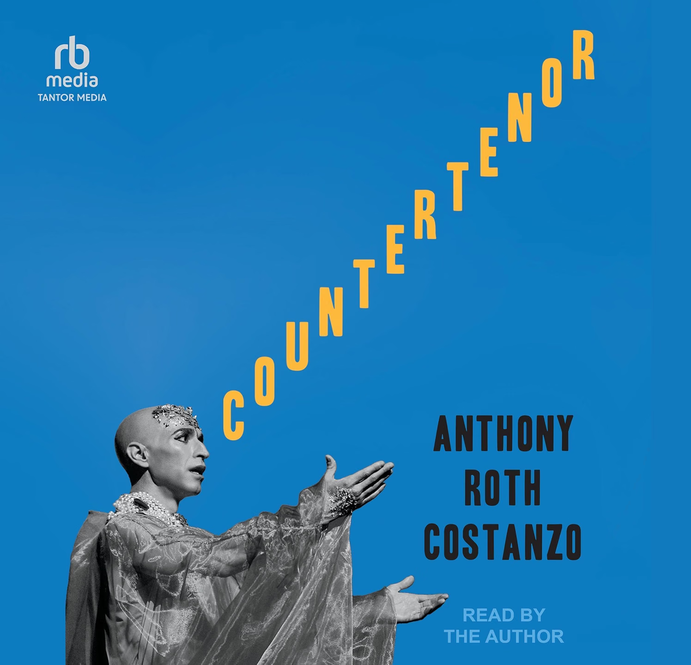
Anthony Roth Costanzo is one of them—a countertenor, not a castrato—who has done more than most in the U.S. to draw attention to his voice type. There was a Best Opera Grammy for the Metropolitan Opera’s staging of Philip Glass’s Akhnaten, in which he played the title role, and a series of self-produced musical events where he’s drawn attention to the breadth of repertoire the voice can accommodate. A tireless entrepreneur and, since 2024, a successful arts leader as general director & president at Opera Philadelphia, he now adds author to his list of accomplishments. Countertenor is part autobiography, part social and musical history. Most importantly, it’s an engrossing read for musicians and non-musicians alike.
“Would you consider entering naked?” is the book’s opening gambit, a question put to Costanzo by director Phelim McDermott on day one of rehearsals for English National Opera’s 2016 production of Akhnaten. Costanzo, a born showman, has a knack for grabbing the attention and ensuring the reader remains glued to the page. His prose is chatty, generally light-hearted, yet aways to the point.
It’s also frequently surprising. For Glass’s opera, for example, he recalls weighing up the virtues of shaving his head versus a bold cap (“I had never seen the shape of my head and found myself pingponging between giddy and mournful”). He goes on to tell us how he achieved his chiseled physique by reaching out on the male dating app Grindr where he discovered the delights of electrical-stimulation workouts (“I woke up two days after my first session feeling as if I had done a thousand sit-ups”). And then there was a session with a professional waxer (“’Do you want the full Hollywood?’ he asked flatly. I didn’t know what that was. Deadpan, he said, ‘Balls and shaft.’ …Okay, I thought, the full Hollywood it is”).
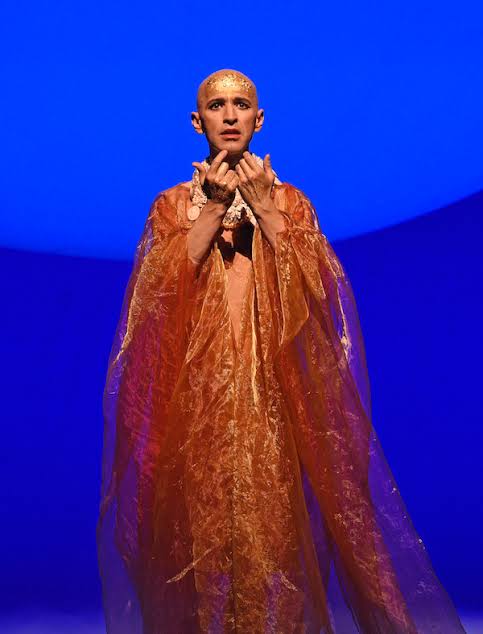 Theatrical anecdotes—delivered with a healthy dose of Costanzo’s self-deprecating humor—abound in Countertenor, but they also illuminate the singer’s art. His early battle with thyroid cancer is perhaps not for the squeamish, but it speaks to his resilience. The chapter on his vocal training with soprano Joan Patenaude-Yarnell is priceless (at one point she claimed he sounded like a munchkin from The Wizard of Oz). “No, dear. Don’t try. ALLOW,” sounds like a maxim that all of us should live by.
He’s also revealing about what it feels like to possess an instrument that for him seems perfectly natural but that others dismiss as a freak of nature. Even in the 17th and 18th centuries, at the very heart of their popularity, the castrati were caricatured as gigantic eunuchs with tiny heads perched atop their vast bodies (a genuine side effect of a testosterone-free adolescence).
The curious cultural history of the voice takes up a substantial part of the book, from the Papal ban that kept women from the early operatic stages, to the backstreet barbers who would do the deed on the quiet, and the shameless fathers who would take their mutilated offspring along to the Italian Conservatories and tell the music teachers their child had been nipped by a savage goose. Alongside descriptions of the kind of music written for these men, he considers the shifting gender politics of the day and speculates, as we all must in the absence of recordings, about what a castrato voice in its prime really sounded like.
Best of all is his determination to write outside of the box, to look at the world today and suggest what might link the historical castrato voice to, for example, Disney’s evolution of the voice of Mickey Mouse, or the falsettists of modern pop culture.
The book is complemented by an album of the same name ranging from arias by Glass through Mozart, Vivaldi, and Monteverdi. There’s a song about dildos by Thomas Morley and a cover of the Four Seasons “Walk Like a Man.. It’s all very Costanzo. Recordings aside, however, anyone interested in the history of opera, the revival of the countertenor voice, or simply the art of making art will find much here to enthrall and entertain.
Countertenor
By Anthony Roth Costanzo
Farrar, Straus and Giroux, HB, 320pp
ISBN: 9780374614669
Anthony Roth Costanzo was Musical America's 2019 Vocalist of the Year

 FEATURED JOBS


 RENT A PHOTO