Reviews
At Aix, Kosky's Die Frau Is a Revelation
If there were any doubts about the Festival d’Aix-en-Provence’s commitment to new work following the unexpected death in 2025 of General Director Pierre Audi they were laid to rest this year. Francesco Filidei’s Accabadora, seen July 10 at the Théâtre du Jeu de Paume, proved a very fine piece of music theater. Alongside a musically alert concert performance of Bartók’s Bluebeard’s Castle (July 11) and Barrie Kosky’s remarkable new staging of Richard Strauss’s Die Frau ohne Schatten—seen July 12 at the Grand Théâtre de Provence—things got off to a flying start.
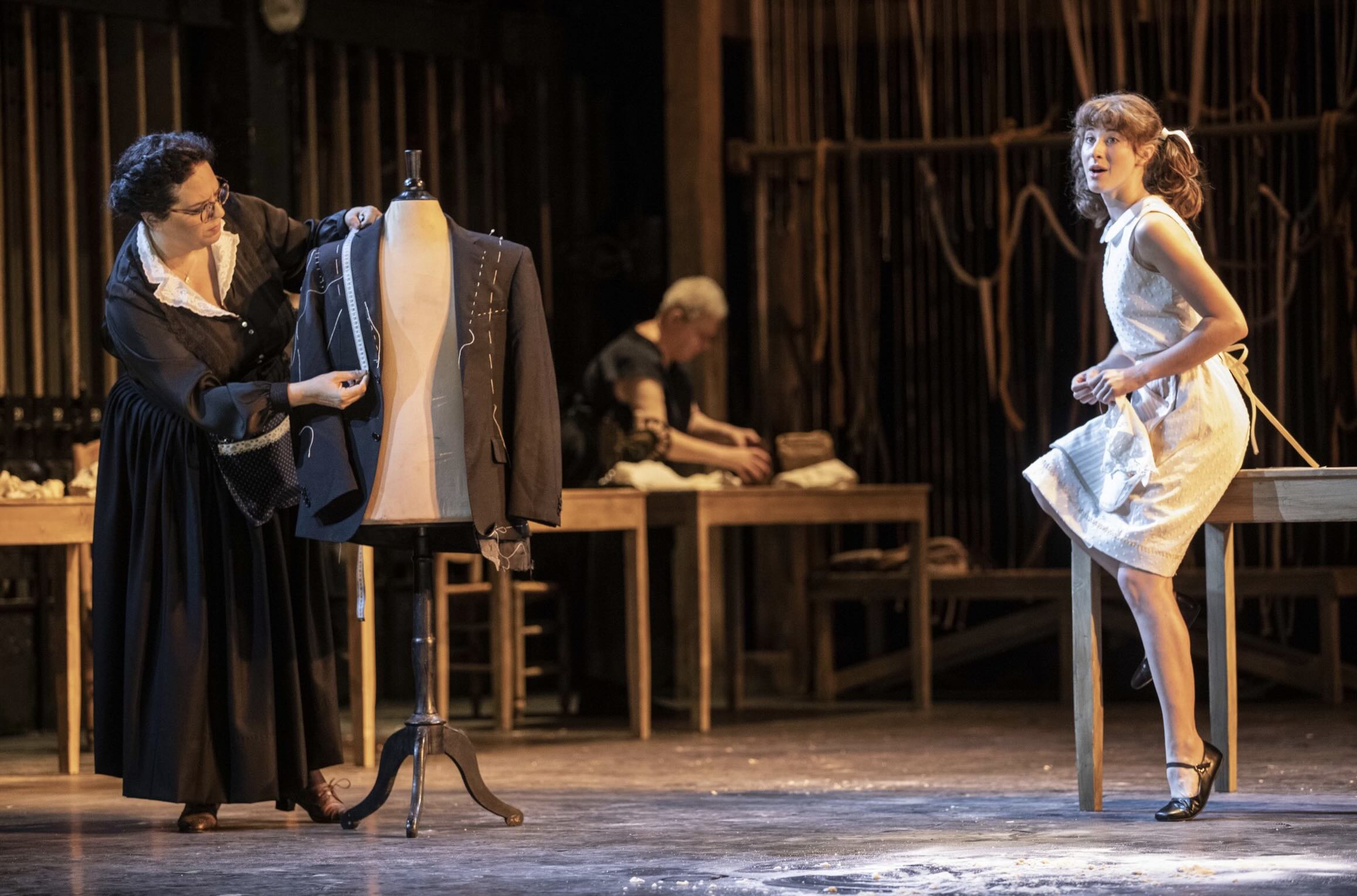
Noa Frenkel (Tzia Bonaria) and Rachel Masclet (Maria) in Accabadora
Based on Michela Murgia’s celebrated 2009 novel, Filidei (b.1973) has hinged his opera on a pair of timeless Sardinian traditions. The first is the custom of giving away the youngest infant in a poor family to someone who is childless. The second is the role in the community of the mysterious accabadora (the word means “angel of mercy”), a woman invited in to terminate the suffering of those whose lives are approaching their natural end. Both book and opera address important topics such as adoption, euthanasia, and the right to die with dignity.
The composer, whose adaptation of Umberto Eco’s The Name of the Rose proved a significant hit at La Scala last year, clearly has an ear for musical texture and color as well as a nose for drama. Evocative washes of sound conjure the Sardinian landscape with imaginative rhythmic gestures while imaginative percussion brings the action to life (a bicycle bell, for example, accompanied two singers mending a puncture). Rachel Masclet was a touching Maria, adopted as a child by the well-to-do Tzia Bonaria whose secret position as the village accabadora lies at the story’s heart. In the latter role, Noa Frenkel’s rich lower register came to the fore in an intense and dramatic performance.
The Festival’s principal guest ensemble was the Orchestre de Paris under its Music Director Klaus Mäkëla. In Bluebeard’s Castle, it brought a French impressionistic sheen to Bartók’s pungent Hungarian harmonics. With the exception of an inflexible rush into the majestic opening of the fifth door, Mäkëla’s pacing was mightily assured, the 30-year-old Finn teasing out the music’s shimmering pallet of colors. Gerald Finley was both implacable and inscrutable as the sinister bridegroom with Irene Roberts an impetuous, if ultimately vulnerable Judith.
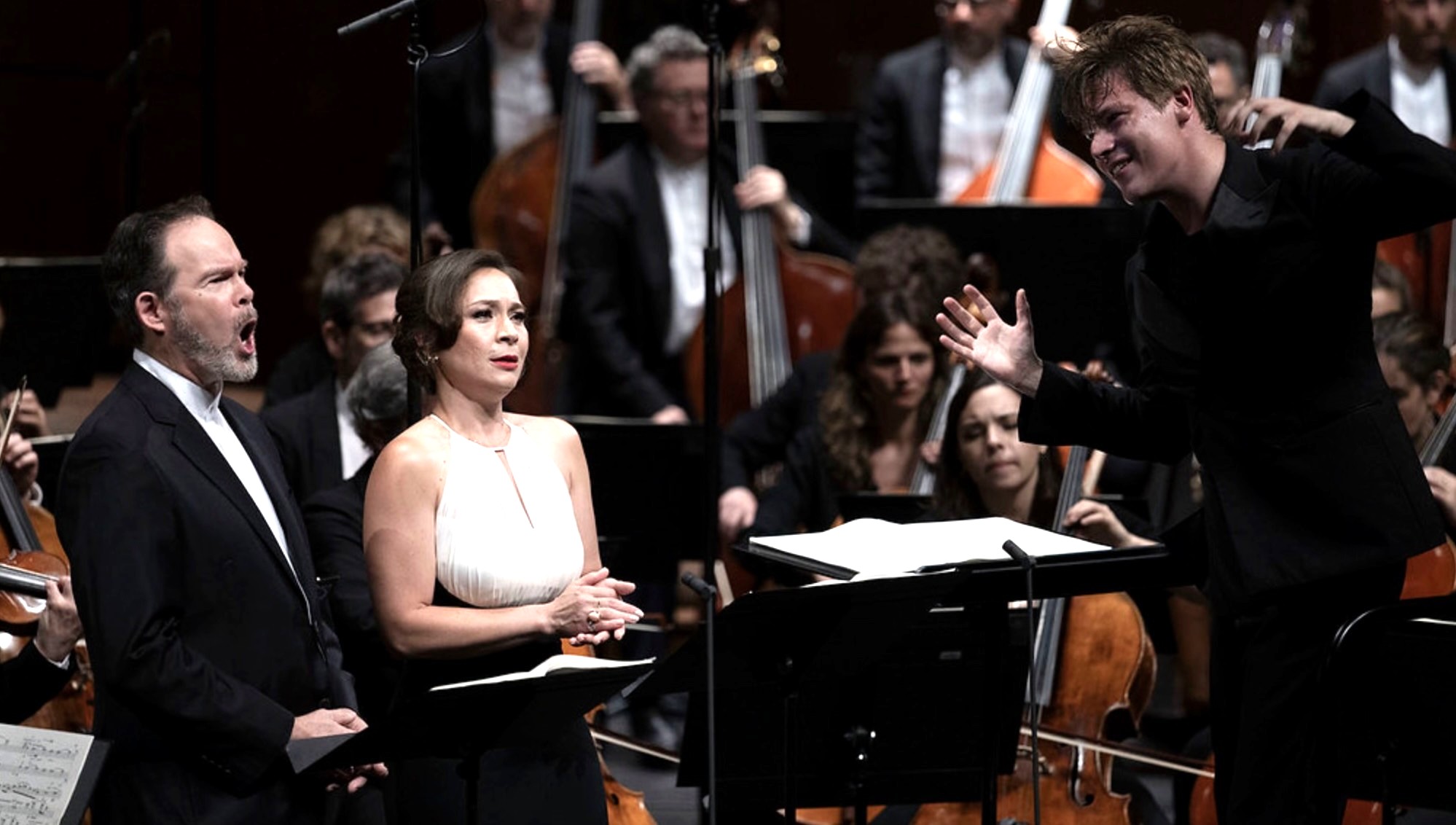
Gerald Finley, Irene Roberts, and Klaus Mäkëla in Bluebeard’s Castle
The Festival also presents a series of vocal recitals and Michael Spyres’s July 13 appearance was a highlight. The American ‘’baritenor’’ was in terrific form with a program of songs more typically sung by women. His performance of Wagner’s Wesendonck Lieder, which includes substantial quotes from Tristan, was particularly apt given Spyres’s recent successes in the role. Performed in the intimate recital hall at the Conservatoire Darius Milhaud, the thrill of experiencing such a plush and substantial voice up close and personal was palpable. The range required to carry off Mahler’s Lieder eines fahrenden Gesellen renders it a tough sing for a man. Spyres’s upper extension clearly met the challenge. Striding forth from behind the music stand he really inhabited the composer’s torrid tale of lost love. A Berlioz encore—Le Spectre de la rose—rounded off an absorbing evening.
Unfortunately, the same could not be said for Sonya Yoncheva’s Aix debut in the Grand Théâtre de Provence, a program of early music from Spain, Italy, and England that rubbed shoulders with traditional and popular song from medieval Bulgaria to ABBA. Leonardo García-Alarcón and the musicians of Cappella Mediterranea were the highlight here, their alert playing bringing joie de vivre to Baroque dance music. The vocal repertoire was a nod to Yoncheva’s days as a vocal student in Basel, but these days her voice has spread and much of her singing struggled to remain steady and in tune. It didn’t help that the concert felt under-rehearsed with tentative exits and reentrances and a great deal of fiddling with dress and hair. She got into her stride towards the end, but it was too little too late.
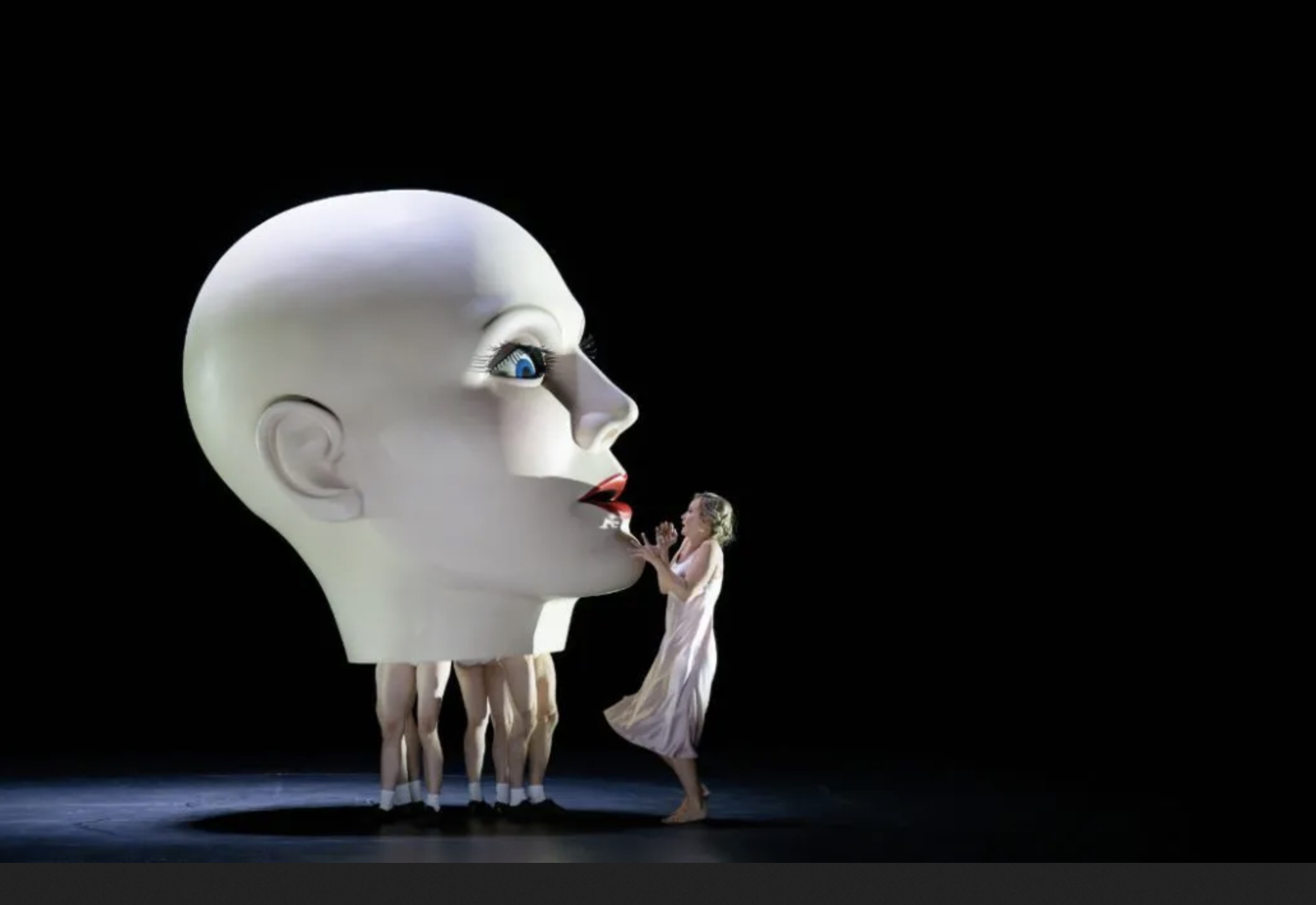 The festival’s undisputed hit, however, was Barrie Kosky’s new production of Die Frau ohne Schatten. Strauss’s symbolist opera is a tricky work to pull off, its inconsistent storyline full of dramatic red herrings. In the wrong hands, the suggestion that a woman is defined solely by her capacity for bearing children can sink an interpretation. The Australian director clearly understood that the opera is about a great deal more than that and his staging brilliantly explored ideas of love, respect, trust, and what it is to be truly human. Michael Levine’s minimalistic set—a white or black box with a congested scaffolding tower emphasizing the claustrophobic living conditions of Barak and his family—was offset by Victoria Behr’s brightly colored costumes. Ever the showman, Kosky’s use of a giant head on legs and decapitated mannequins brandishing knives offered moments of pure theater.
Musically Die Frau is a tough nut to crack as well, requiring a supersized orchestra and five of the world’s most indefatigable singers. Mäkëla was a bit of a revelation here, his only previous opera experience being Kosky’s Magic Flute. Not only was his dramatic pacing astute, his sensitivity to voices was apparent throughout. Spyres was a heroic Emperor, singing alongside Lithuanian soprano Vida Mikneviciute who blossomed as the Empress, her ringing soprano dominating the second and third acts. Brian Mulligan’s warm, sturdy baritone highlighted the plight of the kindly Barak, with Canadian soprano Ambur Braid outstanding in the wide-ranging role of his wife. Nina Stemme, suffering from laryngitis (though you’d never know) channeled Mrs. Danvers as a coldhearted yet complex Nurse.
Acting and singing were exceptional here, but it was Kosky’s approach to character and storytelling that made this such a night to remember. I really cannot recall seeing so many people in tears after a Strauss opera (Rosenkavalier included). Die Frau is a coproduction with Belgium’s La Monnaie / De Munt and Greek National Opera. When future dates are announced, you’d be well advised to sell your shadow for a ticket.
Bottom photo: Vida Mikneviciute as the Empress in Die Frau ohne Schatten
Photo credits from the top:Jean-Louis Fernandez; Vincent Beaume; Monika Rittershaus

 FEATURED JOBS


 RENT A PHOTO