People in the News
New Artist of the Month:
The Esmé Quartet
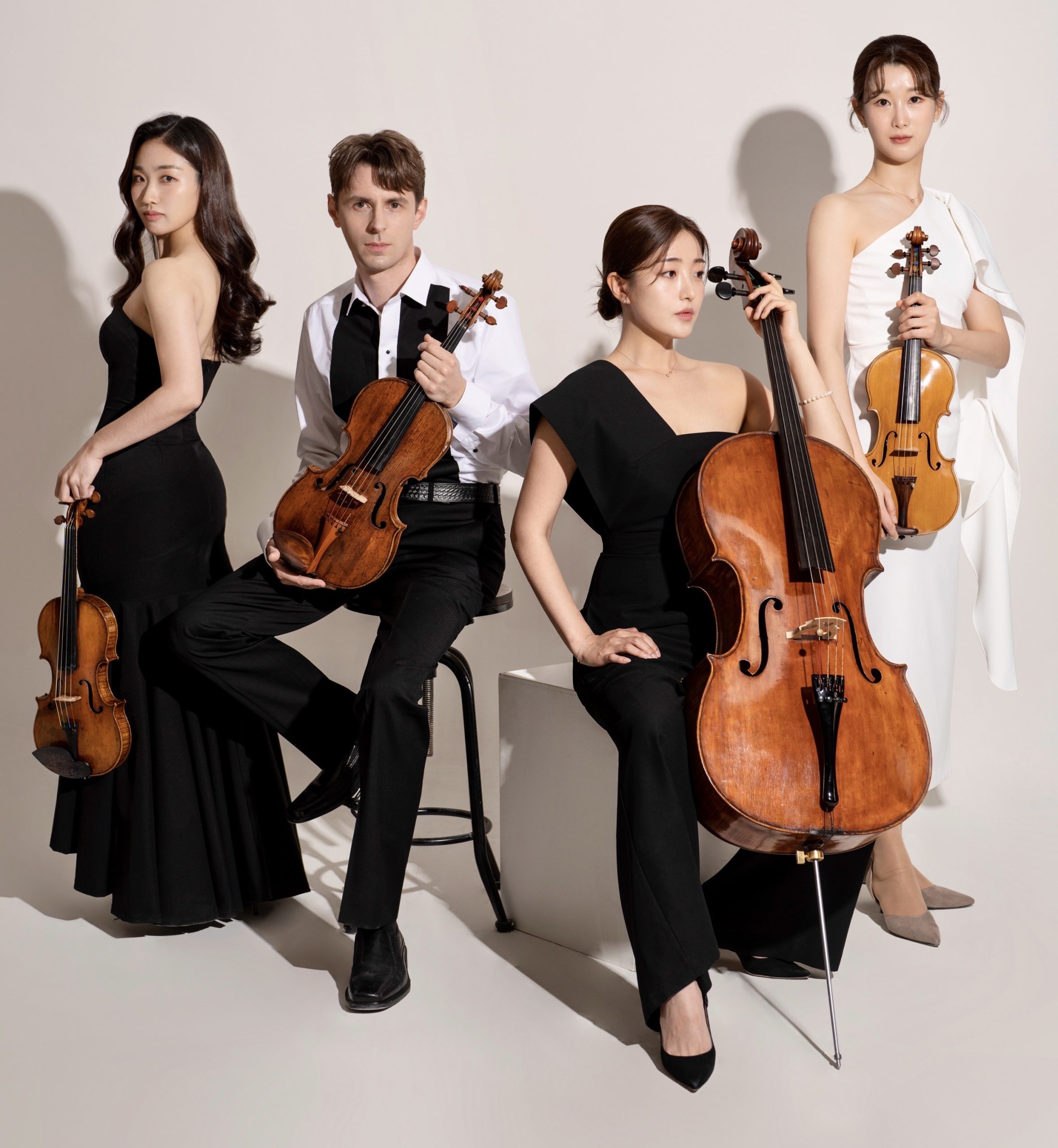
The Esmé Quartet celebrates a significant birthday this year, a decade after four young Korean women—Wonhee Bae and Yuna Ha, violins, Jiwon Kim, viola, and Yeeun Heo, cello—founded the quartet in Cologne, Germany.
Studies had taken each of them from South Korea to the U.S., Germany, and France before they came together in 2016. Just two years later, the Esmé Quartet won the 2018 Wigmore Hall International String Quartet Competition, following such prominent ensembles as the Danish, Alexander, Hagen, and Takács quartets as victors.
As the Esmé, a French proper name that means “beloved,” grew more established, it became known for its commitment to performing works by Asian women composers, including Unsuk Chin, Soo Yeon Lyuh, Juri Seo, and Kui Dong. Each of its recordings has featured a work by a female composer. Frustratingly, the group has also encountered institutional resistance to being all-women, including managers who wouldn’t represent the quartet because its members might eventually have families.
The Esmé has been through some typical changes, including Kim’s departure to pursue an orchestra career in Germany. At the time, the quartet was about to embark on a U.S. tour and needed to find a new violist in a hurry.
Bae was already acquainted with the Belgian-American violist Dimitri Murrath—they met at the Seiji Ozawa International Academy in 2007—and reconnected with him in search of a recommendation to fill Kim’s spot. The players were apprehensive about recruiting the right person because of the difficulty of the tour’s repertory, whose ten works included Fanny Mendelssohn’s only quartet, Ligeti’s String Quartet No. 1, Métamorphoses nocturnes, and Beethoven’s Große Fuge, Op. 133.
Murrath’s response was to suggest himself, even though, he says, “I hadn’t played the Borodin quartet” or the Ligeti. “I practiced like crazy for two weeks before that first rehearsal.”
The rehearsal went so well that, chatting about it afterward, Bae, Ha, and Heo looked at each other and said, “This is very special. We have to ask him to join us.” Meanwhile, Murrath had similar thoughts, telling his wife—who is Korean—“Oh, you know, this could be a more permanent thing. Let's think about it, just in case.” He has been with the group since 2023.
Another change is that as of this fall, the quartet members are not all in the same city. Bae and Heo are still based in San Francisco—where they all resided for two years—and are on the faculty of the San Francisco Conservatory of Music. Murrath, associate dean of artistic administration at the New England Conservatory, is in Boston, while Ha, who teaches at Sungshin Women’s University, lives in Seoul.
The San Francisco connection remains strong, however; the group is ensemble-in-residence at San Francisco Performances (SFP), succeeding the Alexander Quartet, which disbanded in 2025.
In that role, the Esmé plays on the long-running Saturday morning series, which combines lectures by Dr. Robert Greenberg, SFP’s music historian-in-residence, with performance. For its first season in residence, the quartet played late Schubert, including several of his quartets and the cello quintet with Kronos Quartet’s Paul Wianko as guest cello. This is where I first heard the Esmé; its transparent, refined sound made a strong impression.
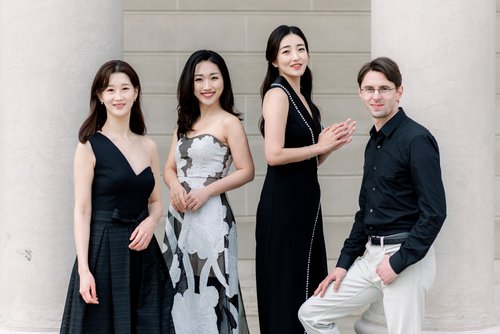
The Esmé Quartet: Yuna Ha, Wonhee Bae, Yeeun Heo, Dmitri Murrath
“One of the things that struck me when joining the group is how sensitive every member is to balance,” Murrath says. “Sometimes the group doesn't have the biggest sound, the most volume, but we'll choose to have something more balanced and more sensitive to bring the listener in.”
The upcoming season will feature works by 20th-century Americans and composers who came to the U.S. as guests or immigrants. Repertoire includes pieces by Beach, Dvorák, Kreisler, Korngold, Stravinsky, Milhaud, and Schoenberg. In March, 2027, the Esmé begins an evening Beethoven cycle at SFP, performing all 16 of the quartets over two seasons. “We are very keen to play our version of Beethoven,” says Wonhee Bae. “A lot of people have a bit of a bias about a younger-generation quartet playing late Beethoven—like you have to have lived for a long time to understand or express something. But I think there is no such thing as being too young to play this or that. This is our current version of how we feel about that music and Beethoven.”
Esmé is a relatively young group, ranging in age from 34 to 44, but its members are eager to pass along their accumulated knowledge. “We started thinking about education, being a teacher,” Ha said, when Murrath joined. “All of us are educators at this point. It is also very important for us as a quartet, when we tour, to give master classes, to train the next generation of really top classical chamber musicians,” says Murrath.
The Esmé’s recently released album, Nui, includes a new Juri Seo piece the group co-commissioned with the San Francisco Conservatory, river at the end of the mind. It is based on the Korean folk song “Mother, sister,” a connection to the composer and quartet’s Korean heritage. Also included are quartets by siblings Felix and Fanny Mendelssohn. River at the end of the mind is the quartet’s first commission, but it won’t be the last—more are in the pipeline. This dynamic ensemble is sure to travel far.

 FEATURED JOBS


 RENT A PHOTO