People in the News
New Artist of the Month:
Baritone Theodore Platt
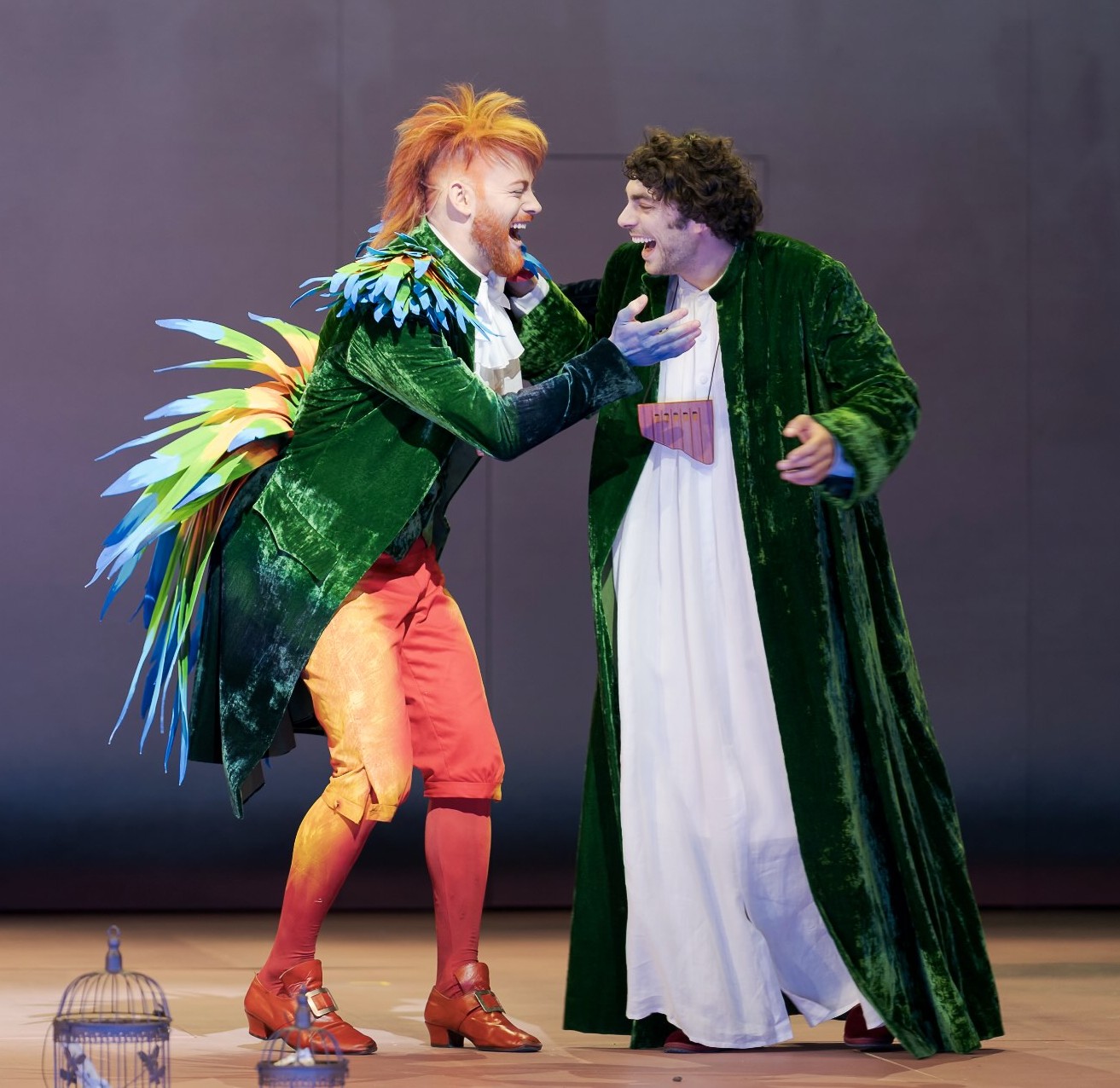
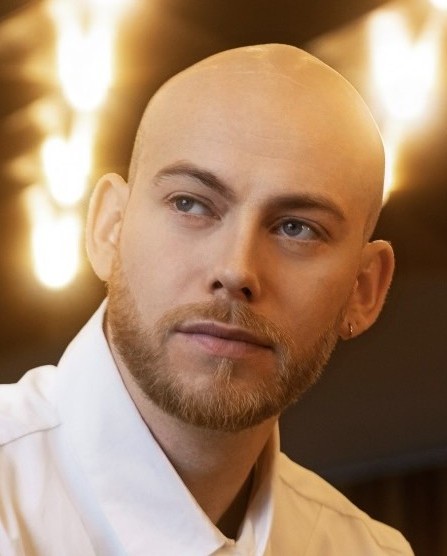 LONDON—Clad in an emerald waistcoat with spiky orange wig and turquoise tailfeathers, Theodore Platt was hardly going to go unnoticed. But there were plenty of other reasons why the British-Russian baritone stood out in The Magic Flute at this year’s Salzburg Mozartwoche. First off, he was a hugely charismatic Papageno, his easy-going physicality complementing a talent for understated humor. Then there was the voice, a bright yet velvety instrument with plenty of heft at top and bottom and a natural way with both sung and spoken text.
Being directed by Rolando Villazón, himself a noted practitioner of Mozart’s rambunctious birdman, must have been daunting, but it certainly didn’t show. “The great thing about working with Rolando, and he's brought me to his festival a few times, is that there is always a concept, but by his own admission that concept is fluid,” Platt recalls, chatting over Zoom from Copenhagen where he has just made his role debut as Dr. Malatesta in Donizetti’s Don Pasquale. “He's the most incredible communicator, constantly challenging me to bring new things to my Papageno. Just by being in the room with him, I felt like my body was becoming more and more fine-tuned.”
Platt, age 31 and resident in Berlin for the past six years, is one of the most promising young baritones of his generation. A natural stage animal, it comes as a surprise to learn that he kept opera at bay for quite some time. Born in London, he grew up in Oxford in a family with a love of classical music. “My Dad was a pretty decent pianist who really loved his music,” he explains. “My mom, who grew up in the Soviet Union before my amazing, formidable grandmother managed to get her and her sister out of there against all the odds in the early 1980s, was singing in choirs, which is such a part of the cultural fabric. So, both of them appreciated what music has to offer kids.”
Violin lessons from the age of three-and-a-half and singing from the age of six led to him join Oxford’s prestigious Christ Church Cathedral Choir. “Before I knew it, we were touring the world, and I was a professional singer,” he laughs. “Not in the way I am now, but suddenly I was earning a modest amount, going to America, singing on the radio, and all these exciting things.”
A choral scholarship took him to St. John’s College, Cambridge, rather than going down the more common conservatory route. “I was firm in the belief I wanted to go to university, do a ‘normal degree,’ quote, unquote, make ‘normal friends,’ quote, unquote,” he explains. “Looking back, my wife, who is a non-musician, I met at university,” where he also befriended other “normal” individuals. “I'm not saying that I wouldn't have had that had I gone to music college, but I think that the diversity of our friendship group and the influences we take from them in life are so much greater.”
 Of course, Platt was always aware of opera and, as he puts it, “dipped his toe” into it at university. In the end, he was simply putting off the inevitable. Three subsequent years at the Royal College of Music included two on the opera course. A masterclass with Edith Wiens led to his being invited to her summer program in Germany and an introduction to Tobias Truniger, Director of the Opera Studio at the Bayerische Staatsoper.
Platt made his professional debut in Munich as Uncle Yakuside in Madama Butterfly—“one of the most questionable costumes I've ever worn,” he chuckles—with Roberto Alagna and Aleksandra Kurzak playing the leads. “It was a very small role, but being surrounded by those kinds of people, you just learn so much,” he says.
As he describes it, there was no one-off career break, just a steady progress to more substantial roles and occasional awards, including the prestigious Borletti-Buitoni Trust fellowship. “It's been a twisting and turning path,” he says, “but as a lower voice, I'm constantly being told to be patient with things, and I'm accepting of that.”
Right now, his feet are planted firmly on the ground with half an eye on vocal longevity. “I want to be a fully formed baritone when I hit my peak years, which are not my early 30s,” he says. “My voice has changed immensely, but I'm singing the same roles, just a lot better and a lot more convincingly.”
A list of recent credits includes Belcore in L’elisir d’amore at Glyndebourne Opera Festival and the title role in Guillaume Tell at St. Gallen. He sang the jailor in Barrie Kosky’s Dialogues des Carmélites at both Glyndebourne Festival and the BBC Proms, the Night Watchman in Die Frau ohne Schatten under Kirill Petrenko, and Rossini’s Figaro in concert performances in Munich. As well as a Deutsche Grammophon STAGE+ online recital, you can hear him on disc in Stravinsky’s Threni with Vladimir Jurowski and the London Philharmonic, and as Marcello on Jonathan Tetelman’s Deutsche Grammophon album, The Great Puccini.
This month he will deliver an imaginatively crafted recital program at in Leeds Song in the U.K. followed by a return to Don Pasquale in Copenhagen. Further down the track there’s a revival of the Villazón Magic Flute in Santander, performances as Albert in Werther, and his first Harlequin in Ariadne auf Naxos at La Monnaie in Brussels.
For now, Berlin retains its attraction. “I have a kid and we miss our family, but we wouldn't be prepared to give up the freedoms we earned as people who moved to Europe before Brexit kicked in,” he says. “I'm happy building my core repertoire but I think I will try my first Wolfram and my first Onegin in the coming couple of seasons, so there are things penciled in that will really explore where the voice could go.”
Above: Platt with Vitus Denifl as Mozart in Villazon's The Magic Flute at Salzburg Mozartwoche
Photo credits Chris Gonz (top), Werner Kmetitsch

 FEATURED JOBS


 RENT A PHOTO