Industry News
Nelsons & the BSO Wow New York
 The recent Carnegie Hall performances by Andris Nelsons and the Boston Symphony Orchestra (BSO) drew the kind of rapturous response they’ve been receiving since news broke that Nelsons’s contract as music director would not be renewed. The crowd-pleasing April 9 program included two high-powered vocalists—soprano Renée Fleming and baritone Thomas Hampson—performing excerpts from John Adams’s Nixon in China and Antonin Dvorák’s Symphony Number 9, From the New World.
Writing in The Boston Musical Intelligencer, Steve Landrigan paid scant attention to the music itself, choosing instead to focus on the audience’s receptive response to Adams’s work and its “utterly rapturous” reaction to the Dvorák.” The foot-stomping and loud cheering, he continued, “shook the rafters,” leading Clive Gillinson, the executive and artistic director of Carnegie Hall to comment, “I have never seen anything like this in my 20 years here.”
[The April 10th Greig Piano Concerto with Lang Lang and Sibelius Symphony No. 1 won an equally grateful response, the latter including rhythmic clapping with attempts to draw Nelsons back to the podium. He just kept pointing to the musicians.]
The two concerts were the conductor’s last with the BSO until July at Tanglewood. His support from the musicians in the BSO and the public, signified here by the players (and conductor) and a number of audience members wearing red carnations, seems to be growing.
Throughout the last few weeks, Nelsons has avoided criticizing the BSO board’s decision, electing instead to emphasize his love for the players and his commitment to the music. At the concert afterparty, he told the BSO musicians in attendance, “Whatever happens, my prediction is positive. Whatever happens we keep playing the music we love and you love and you play it so amazingly…. You are extremely professional and amazing performers, but you also have a really big heart and that combination makes the best opportunity to make the best music.”
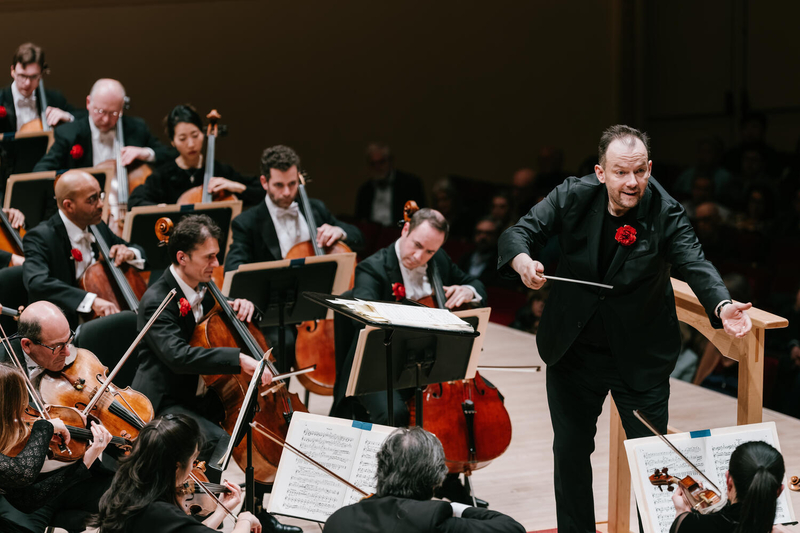
Absent from that gathering were several of the BSO trustees and CEO Chad Smith, who had attended the concert and been acknowledged from the stage by Nelsons at the its end. Smith has come in for harsh criticism from some corners for the manner in which the decision to end Nelsons’ tenure was handled.
The ultimate impact of the outpouring of support—coming from the likes of Sir Simon Rattle, as well—remains to be seen. Having made so public a decision to move forward without him, the BSO’s board and senior leadership would be hard pressed (or too proud) to reverse course. And the inept manner in which the decision was presented as well as the ineffectual efforts to justify it, in combination with Nelsons’s high regard in the profession, may prove detrimental to efforts to attract the kind of talent an ensemble of Boston’s stature requires.
Boston’s dilemma seems to have no ready answer that will satisfy all concerned—a sad state of affairs for a great orchestra.
The Boston Music Intelligencer
Photo: Fadi Kheir

 FEATURED JOBS


 RENT A PHOTO