|
By
Johanna Keller
They are three distinguished soloists who made their official debut as a piano trio 25 years ago at the White House for President Carter's inauguration. Today, after a quarter century, they continue to bring to worldwide audiences their expressive and exhilarating interpretations of the trio literature.
What's in a name? A great deal of significance when the name is that of a chamber music ensemble. When an ensemble labels itself, it defines-or at least hints at-its philosophy, aesthetic, origin, repertory, and aspirations. If we knew nothing else, we could intuit the differences between the Beaux Arts Trio, the Juilliard String Quartet, and eighth blackbird, merely by how they chose to identify themselves.
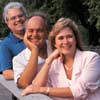
Twenty-five years ago, three musicians-pianist Joseph Kalichstein, violinist Jaime Laredo, and cellist Sharon Robinson-joined their talents and their names. Dubbing themselves the Kalichstein-Laredo-Robinson Trio was a mouthful, but the moniker announced that this was a chamber ensemble of equal players, soloists in their own right, who would retain their individual identities. In a sense, this choice points up the intriguing and central paradox posited in the ideal of the art of chamber music: The solo voice can be heard even while it coheres in the collective. To listen to the Kalichstein-Laredo-Robinson Trio in performance or on CD is to experience this paradox, for, after a quarter-century of making music together, they seem to inhabit one another's phrasing and intentions. To take one example, in their performance of the Ravel trio (available on Arabesque Recordings), their elegantly supple rubato appears effortless and inevitable. And while each voice remains distinct in dialogic passages, at other moments, the three sound as one, creating a shifting perspective of consciousness between the parts and the whole.
They began at the top. The Trio made its official debut at the White House for President Carter's inauguration in January 1977. In the ensuing years, worldwide tours, commissions, and recordings have made the Kalichstein-Laredo-Robinson Trio arguably the foremost trio with the greatest longevity (while the Beaux Arts was founded in 1955, only pianist Menachem Pressler remains of the original threesome). But despite the Trio's success, the players have maintained busy solo careers and split their time equally between ensemble and solo engagements.
While Kalichstein, Laredo, and Robinson were born on three different continents, all were child prodigies. Joseph Kalichstein, from Tel Aviv, came to New York as an already accomplished pianist at age 16 to study at the Juilliard School with Edward Steuermann and Ilona Kabos. Jaime Laredo, born in Bolivia, made his orchestral debut at age 11 with the San Francisco Symphony. And Texas-born Sharon Robinson gave her first concert at 7 and at 14 appeared with the Houston Symphony under Sir John Barbirolli. Laredo and Robinson are also husband and wife.
Sharon Robinson has often said, "The Y is our home, our birthplace"-and indeed the genesis and the history of the Trio is entwined with the chamber music activities at the 92nd Street Y Tisch Center for the Arts in New York City. A season before the Trio's White House engagement, Omus Hirshbein, then artistic director of the music program at the Y, had a cancellation and invited Laredo and Robinson to put together a trio program with another pianist, which they did. The following year, Joseph Kalichstein came aboard and the Trio was officially launched. Jaime Laredo was appointed artistic director of the "Chamber Music at the Y" series, which is now in its 27th season. Concert after concert, the Kalichstein-Laredo-Robinson Trio accumulated a loyal following at the Y, making it a cornerstone of the Y's programming. The enviable durability of the Trio's chamber music series at the Y, wherein one ensemble is presented by a major venue consecutively for so many seasons, is unprecedented in New York City. Hanna Arie-Gaifman, director of the Tisch Center since February 2000, has become familiar with the Trio's audience and finds it unique.
"The trio has created a very faithful and longstanding audience of genuine lovers of chamber music," Arie-Gaifman said. "This audience is extremely knowing and attentive and listens actively. I think we sometimes underestimate audiences, even in traditional repertoire, but they will come for stimulating and difficult works that are well played. And the Trio? Well, they are simply lovely, generous people who are easy to work with-and maybe that is obvious onstage when they play."
As they have done in the past, this season the Kalichstein-Laredo-Robinson Trio will invite guests to participate in the Y series. For 2001-02, they are joined by members of the string quartet community: the Orion Quartet's Daniel Phillips and Steven Tenenbom, the Emerson Quartet's Philip Setzer and Lawrence Dutton, the Guarneri Quartet's Arnold Steinhardt and Michael Tree, and the Juilliard Quartet's Joel Smirnoff and Samuel Rhodes.
The words "chamber music repertory" usually bring to mind the vast tracts of string quartet literature, but, as the performances of the Kalichstein-Laredo-Robinson Trio demonstrate, the piano trio repertory is no less rich. Trios by Beethoven, Brahms, Dvovrák, Fauré, Haydn, Mendelssohn, Mozart, Ravel, Schubert, Schumann, Shostakovich, and Tchaikovsky are their meat and potatoes, while they spice up their programs with commissioned works. This impressive list includes new trios by Richard Danielpour (A Child's Reliquary, 1999), Haflidi Hallgrimsson (Metamorphoses, 1993), Leon Kirchner (Trio No. 2, 1993), Arvo Pärt (Adagio for piano, violin, and cello, 1992), Stanley Silverman (In Celebration, 1989), and Ellen Taaffe Zwilich (Trio, 1987). In addition, the Trio commissioned and performed two new triple concertos-by Zwilich in 1996 and David Ott in 1997.
This year, a new trio is in the offing. In May 2002, at the University of Maryland, the Kalichstein-Laredo-Robinson Trio will perform the premiere of a work by David Del Tredici, his first purely instrumental chamber work (sans voice or narration). Though Del Tredici had not been personally acquainted with the musicians, in a conversation in late August, the composer said he has a personal connection that dates back 40 years. When he was a teenager and a virtuoso pianist, Del Tredici remembers hearing Jaime Laredo, then 11, perform with Arthur Fiedler and the San Francisco Symphony. So he was especially delighted to become personally acquainted through this commission.
"What's unique about the Kalichstein-Laredo-Robinson Trio is their unanimity of expression-it's just breathtaking," Del Tredici said. "They play with a lot of rubato-a flexible, expressive rubato, and I am writing a trio that will give them the freedom to do that."
In this silver anniversary year of the Kalichstein-Laredo-Robinson Trio, we can expect from these performers that unified diversity of expressiveness in their expert and exhilarating interpretations of the masterpieces of the piano trio literature. We can also look forward to new commissioning projects-the next new piano trio, by Joan Tower, is slated for 2003. But above all, it is a measure of their dedication as individual musicians and as an ensemble that these names-Joseph Kalichstein, Jaime Laredo, and Sharon Robinson-combine so harmoniously after 25 years.
Johanna Keller is former editor of Chamber Music magazine (1997-2001) and received a 2001 Fellowship in Cultural Journalism at The Banff Centre as well as a 2000 ASCAP-Deems Taylor Award for essays in The New York Times.
|



 ENSEMBLE OF THE YEAR

 RENT A PHOTO