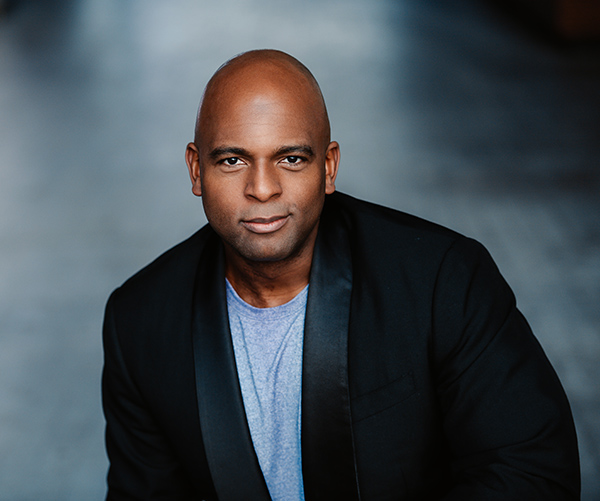
© Jiyang Chen
Ryan Speedo Green is a patient man. He’s now at an age—40—when many a once-promising singer has suffered a too-much-too-soon burnout. But Speedo (“If you know me, that’s what you call me”) has taken his time—and put in a lot of hard work—to become the in-demand opera star he is today.
The story of his youth—growing up angry in a Virginia trailer park, hauled off to juvenile detention at twelve, turning his life around through music—has been told and retold, most notably in Sing for Your Life, The New York Times bestseller of 2016. A 300-page biography of a 30-year-old bass-baritone? But Speedo didn’t let that distinction go to his head.
By that time, he was a familiar presence at the Metropolitan Opera. In 2011 he was a winner of the Met’s National Council Auditions, in which he’d initially been reluctant to compete: He’d been told, at his one prior competition, that his voice would never generate a prize. Luckily, a wise woman had other ideas: Ellie Caulkins of Opera Colorado, where Speedo was a member of the young artists program. “‘I’ve been a part of the Met competition for twenty-something years,’ she told me, ‘and I know a Met voice when I hear one!’” The first music he sang on the Met stage was Banquo’s aria from Macbeth—and fifteen years later he’ll be playing Banquo in a new production on the upcoming season’s opening night.
He made his official company debut in September 2012, in the small part of the Mandarin in Turandot. “My dream had been to sing at the Met, and I was very happy to be playing small roles there—every one was an opportunity to grow.” But during his second Met season he got another piece of sage advice, this time from the company’s then-music director, James Levine. “‘Speedo,’ he said, ‘you could be a phenomenal comprimario singer at the Met and have a great career doing it. But with your voice and stage presence, I think you could do so much more. You have to leave here and immerse yourself in the language and the culture of the roles you sing.’”
Speedo “let those words marinate,” and in September 2014 found himself in Vienna, singing Angelotti in Tosca at the venerable Staatsoper. His one-year contract eventually got extended to six; over the course of those seasons, he sang more than thirty roles. “I may have been a fly on the wall, but I was a very lucky fly, on the wall for some really amazing productions.” His move to Vienna was a milestone in his personal life, too. His girlfriend in New York, the German-born Irene Fast, made the trip with him to help ease the culture shock. They were married in 2016 and now are the parents of two young sons.
His patience and mounting experience began to pay off. In 2021, he helped reopen the post-pandemic Met with a supporting role in Terence Blanchard’s Fire Shut Up in My Bones; three years later he was playing the lead. In between, looking every inch the tall, handsome prizefighter, he was the charismatic centerpiece of Blanchard’s Champion. (Recordings of those operas earned him two of his three Grammys.) And in the fall of 2025 he took swaggering command of the Met stage as Mozart’s Don Giovanni.
But none of that reflects his latest career turn: his powerful voice uncowed by orchestral fortes, he’s been working his way into Wagner’s great Heldenbariton roles. He debuted his Das Rheingold Wotan in Los Angeles in January 2024, his Klingsor in Parsifal at Glyndebourne in June 2025 (he brings it to the Met in May), and his Die Walküre Wotan in Santa Fe that July.
Coming up this December is his first Dutchman—appropriately, at the Dutch National Opera in Amsterdam. And looming farther ahead, beginning in the 2027–2028 season, he’ll be ruling Valhalla in the Met’s much-anticipated new Ring. “It’s been a steady climb, step by step, getting to Wotan—the mountaintop of my voice type.”
He’s quick to acknowledge the people who’ve helped him get there: Caulkins, Levine, Brian Zeger of the Met’s Lindemann Young Artists Development Program, his grade-school teacher Bette Hughes. But his “biggest hero” remains Hughes’s husband, Leon, head of the Virginia arts school he attended as a teen. “He embodies everything a man should be—devoted to his family, to his friends, to
his students, to his art form, which is education, and always going the extra mile,” Speedo says. “You’ll never meet a person who knows Leon Hughes who doesn’t think he was the greatest colleague you could have.”
Hughes’s example imbued him with a sense of the importance of collegiality. “I don’t consider myself the greatest voice; I don’t consider myself the greatest artist,” he says. “But I would love to be known for being a great colleague, and for working hard.”
Speedo’s modesty, like his patience, is laudable, but he’s apt to be remembered for a good deal more than that. •
Patrick Dillon, an operagoer since age 12, has written about music for a wide variety of American, Canadian, and European newspapers and magazines.


