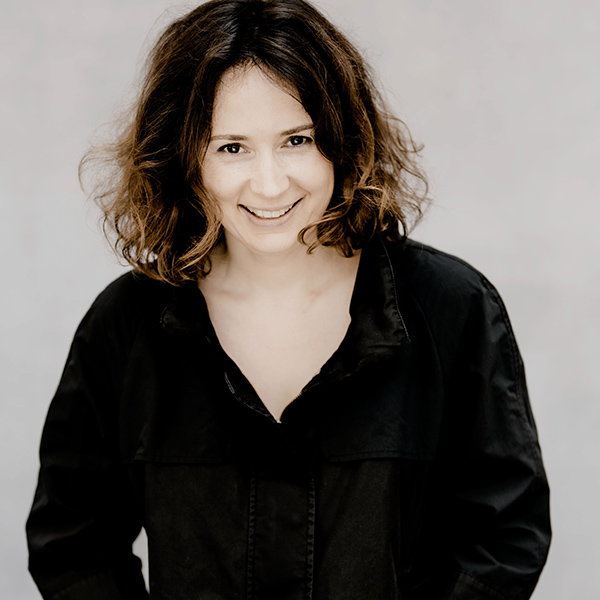
© Marco Borggreve
“I’m not a violinist, not at all.” It seems an odd statement from a musician who has effectively reinvented the art of violin playing. But it’s true that Patricia Kopatchinskaja does far more than fiddle.
Instead of “violinist,” Kopatchinskaja likes to describe herself with the German term Bühnentier—“stage animal.” It encapsulates all of the different identities she has taken on besides violinist: composer (under the moniker “PatKop”), vocalist, concert producer, and most recently, conductor. Like an actor, she’s constantly changing roles.
Kopatchinskaja was born to touring folk musicians in Moldova, then a Soviet state. Raised by her grandparents in the village of Orhei, she grew up hearing Moldovan folk music. “It’s a music that has a function, whether it’s for a wedding, a dance party, or a funeral,” she says. “Music had a meaning.”
During the Soviet unrest of 1989, Kopatchinskaja fled with her family to Austria, where she was granted citizenship. She later became a Swiss citizen as well, and continues to divide her time between the two countries. She traveled back to Moldova only to visit her grandfather, but has not returned since his death. “In a way, we all are exiles,” she muses. “Music is our home; borders are just geographic lines on paper.”
As a developing violinist, Kopatchinskaja cultivated an eccentric artistic persona: her way of shaking up classical music. She largely avoids 18th- and 19th-century standards, with the exception of Beethoven and Schumann. Instead, her “bread-and-butter” composers are modernists: Bartók, Stravinsky, Schoenberg, Shostakovich, Prokofiev, and Ligeti. And she has zealously championed the
music of living composers like Michael Hersch, Márton Illés, and Francisco Coll. “What is most interesting to me is now and today,” she emphasizes. “What are the sounds that are relevant to myself? I’m not interested in repeating known repertory which doesn’t say anything.”
For Kopatchinskaja, music-making is a form of conversation. She considers a piece a living entity with “a body, its own eyes, its own movements.” Performance becomes a dialogue with this sentient musical being: “You learn to communicate with the piece, and then you let it speak.”
Collaboration is integral to her artistic identity. Her albums are consistently credited to “Kopatchinskaja and...”—the blank filled with names of longtime partners like pianist Fazil Say or cellist Sol Gabetta. “They must be strong personalities,” she explains. “I couldn’t play with a pianist who just accompanies me in the way I like. I appreciate musicians who can change my mind.”
A few years ago, a remark by her then-adolescent daughter Alice realigned Kopatchinskaja’s attitude toward performing. “She told me, ‘You classical musicians are faceless—you are like frozen zombies from yesterday,’” Kopatchinskaja says. Since then, she has worked to create thematic concerts with contemporary relevance. Her program “Dies Irae”—juxtaposing George Crumb with John Dowland, Gregorian chant and an actual coffin—is a kind of funeral requiem for the planet. “Maria Mater Meretrix,” a collaboration with soprano Anna Prohaska, explores representations of women across ten centuries.
“It’s not just a concert; it’s not theater; it’s a genre that allows the musician to say something,” Kopatchinskaja says. “My main goal is to create astonishment.”
She plays an 1834 violin by master luthier Giovanni Francesco Pressenda. “It’s my voice, it’s my vocabulary, it’s my heart, it’s my sickness, it’s my happiness, my friend, my animal, my body,” she says. The timbres she draws from it are occasionally rough. “I have no ‘neutral’ in my playing,” she explains. “I would never have vibrato all the time so that it’s beautiful and perfectly played. Every note I consider for itself.”
In another break with tradition, Kopatchinskaja sometimes weaves her voice into performance, including in her own compositions. Her unique rendition of Ligeti’s Mysteries of the Macabre includes passages where she sings and plays simultaneously. And in Schoenberg’s Pierrot Lunaire, she ditches the fiddle entirely: reciting the Sprechstimme vocal part in full costume, a ruff around her
neck and her face painted moonlight white. Kopatchinskaja explains that the Pierrot persona offers a possibility ofliberation. “He’s like an empty page—he can be anyone,” she says. “When I go onstage as a fool, I don’t take myself seriously—but what I do, I take very seriously. As a fool, I am allowed to have my freedom.” •
Joe Cadagin is a musicologist who serves as Audience Education and Communications Manager at Houston Grand Opera. You can read more of his writing at clippings.me/joecadagin.


