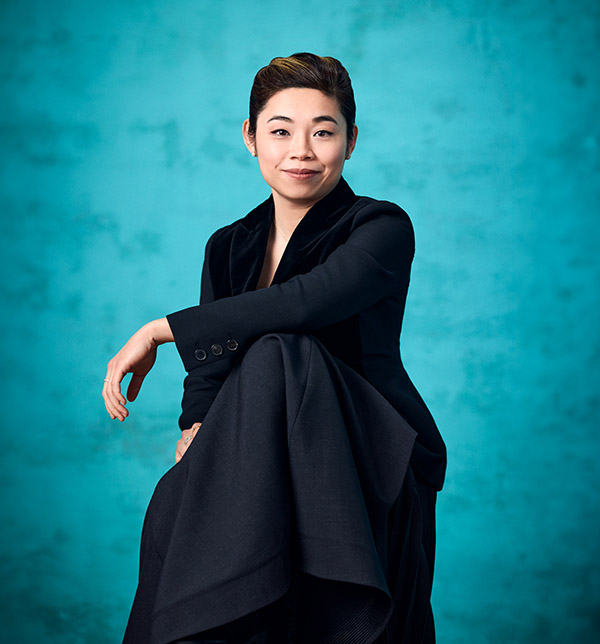
© Cody Pickens
When Elim Chan was appointed in May to be the next music director of the San Francisco Symphony, the decision wasn’t entirely unexpected. The Hong Kong native had made a series of three guest appearances with the orchestra over the previous three seasons, each more exciting and illuminating than the one before. She brought a level of physical dynamism to a range of music—not just the familiar orchestral showpieces, but the new works that figure prominently in her repertoire—and the orchestra seemed to respond enthusiastically to her leadership. Music director appointments have
been built on less.
At the same time, though, there was room for the announcement to land as a surprise, especially for patrons and observers who hadn’t been following things closely. Chan was the least well-known conductor in 40 years to take the reins in Davies Symphony Hall. Her three predecessors—Herbert Blomstedt, Michael Tilson Thomas, and Esa-Pekka Salonen—had all arrived in San Francisco with established reputations and long experience. Chan, at 39, is practically a novice by comparison; there’s no way to spin the orchestra’s decision as anything but an enlightened gamble.
Chan knows it, too, and also knows that this puts her on familiar turf. As a young, physically diminutive Asian woman, she’s used to being underestimated on the podium. She loves to tell the story of her first encounter with this orchestra or that—the skeptical glances, the mistrustful mumbles, and then the revelation that yes, she actually knows what she’s doing up there.
It even happened during her recent guest appearance in San Francisco: a program of Wagner, Berlioz, and Debussy that marked her first collaboration with her new partners since the announcement.
“I was so happy with how every piece came together,” she recalls. “But I think they were also a little surprised that I was able to talk with them about the specifics of things like string bowings. Some of the string players came to me afterwards, and said ‘You can actually talk about string technique!’ I said, ‘Of course I can. You just need to give me time to pull all my tools out.’”
Chan grew up as the eldest of three children in a family that was cultured but not especially musical. Her first exposure to classical music, she says, was listening to the records that her father, a professor of graphic design, would play in his studio. She sang in a children’s choir and studied cello and piano, but when she left Hong Kong to attend Smith College as an undergraduate, she had no particular professional ambition in mind. She studied literature, Italian, and biology; she took courses in criminology in case she decided to act on the impulse to become a private detective.
All of that changed in an instant, in the middle of an undergraduate rehearsal of Verdi’s Requiem. The conductor had gone into the hall to check on some vocal balances, and asked Chan, a member of the chorus, to lead the ensemble. It was, she says, a “thunderbolt” moment.
“I felt it so strongly—the sensation that this was the place I needed to be. It’s as if a voice said to me, ‘What else are you waiting for?’”
Now armed with a clear sense of purpose, Chan went on to earn advanced degrees in conducting from the University of Michigan, and to win the Donatella Flick Conducting Competition in London—still the only woman to do so, as she likes to observe with a tart chuckle. She launched her professional career as music director of the Antwerp Symphony Orchestra, but the timing was unfortunate; she had completed barely half a season in the job before the 2020 Covid lockdown put a stop to any musical activities. The years since then have been spent as a guest conductor with major orchestras across the U.S. and Europe.
At the moment, Chan is house-hunting in the Bay Area; she lives in Amsterdam with her husband, percussionist Dominique Vleeshouwers, but intends to relocate in time for the beginning of her tenure. And she’s busily making long-range plans for her San Francisco seasons, most of which are still not for public consumption. (Programming for the orchestra’s 2027-2028 season is due to be announced in March.)
But even a short conversation reveals how ambitiously she approaches the assignment, and how urgently she feels a desire to put her stamp on the coming years. “I want to come in and breathe new air. I want to break up the tired old three-part formula for a concert. Of course, I love the standard repertoire—I love my Mahler, and Tchaikovsky, and the rest. But I feel the need to expand and shift and change the format. That’s the kind of performing artist I am.” •
Joshua Kosman was the San Francisco Chronicle’s classical music critic for 36 years. He writes about music and the performing arts at On a Pacific Aisle.


