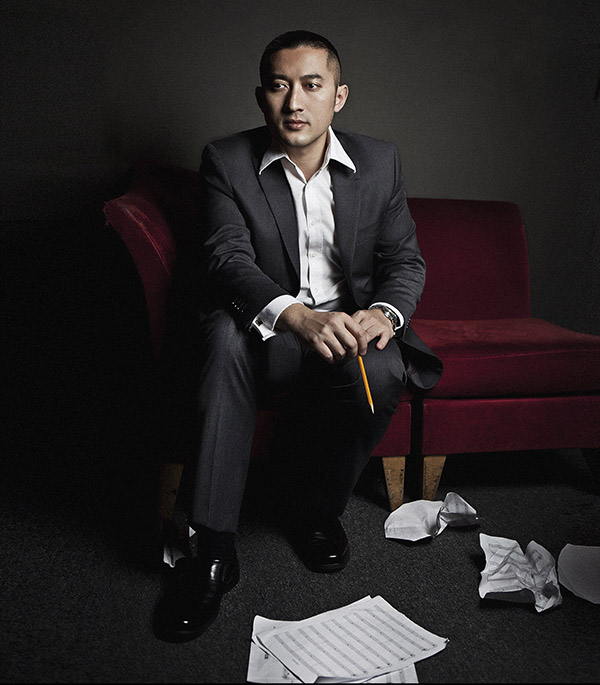
© Wenjun Miakoda Liang
Huang Ruo rejects genre limits. His ten operas burst traditional boundaries: his 2020 Book of Mountains and Seas uses a troupe of puppeteers, along with a chamber choir and two percussionists, to bring ancient Chinese texts to life. Huang’s instrumental works are similarly creative. His 2024 orchestral work City of Floating Sounds—which since its 2024 premiere has been performed in locales as
unalike as Amsterdam, Taipei, and Manchester, England—is different wherever it’s done. It sends audience members on various paths through the city and toward the concert hall, broadcasting the music with their phones, before gathering inside to hear the score in live performance. The idea is to break down walls between what is music and what is not.
“I see myself as a conceptual artist,” he says. The roots of Huang’s openness are deep. Born in China in 1976 at the end of the Cultural Revolution, his experience of traditional Chinese music—especially the all-night Hainanese operas that he attended with his grandmother—was mixed with hefty doses of western classical music. The thick harmonies of a Brahms symphony and the spikiness of Stravinsky seemed equally strange and new. China was changing fast. “It was like the wild West,” he says. “Some places were so advanced, and some still rural. Growing up in that environment gave me the courage to try things differently, and to not ask if it is high art or low art.”
After studying music in Shanghai as a teen, Huang went to Oberlin Conservatory, where his teacher Randy Coleman’s embrace of composers like John Cage and Morton Feldman expanded his horizons still more. The conservatory’s dance, theater, and jazz departments, all very experimental, were similarly formative. “Those four years gave me the voice of who I am, and who I want to be.” Oberlin prepared him well for graduate studies at Juilliard. “It was not intimidating to me,” he says “I already walked on the path.”
Now a U.S. citizen based in New York City, Huang’s music layers all those influences to create a voice that is uniquely his. “When I write instrumental music, I sing every instrumental line,” he says. “If it’s a piccolo, I imitate a very high sound; if it’s tuba, a low sound. And when I write opera, I sing all the characters plus the orchestra and the chorus.”
Taught by his childhood exposure to Hainanese opera, Huang imbues even his instrumental music with theater. For instance, in his 2008 cello/piano/percussion piece Shifting Shades, he says “the instruments are singing and creating a plot.” When he embarked on his first opera, Dr. Sun Yat-Sen (2011), he suddenly realized that he felt at home. “This was so familiar to me, that precious memory from when I was a little kid, this idea of putting words into music and telling a story.” He aims to make every vocal line tell its story, even to audiences who might not understand the words.
Huang’s most recent opera, the brilliantly anarchic The Monkey King, based on an ancient Chinese tale about a rebellious monkey, sold out all eight performances at its world premiere at the San Francisco Opera in 2025. Half of the single-ticket buyers were new to SFO and a group of new, high-level donors came into the fold. Devised with two trusted collaborators—Huang’s long-time librettist David Henry Hwang and puppetry artist Basil Twist—Monkey King hit a theatrical sweet spot. “There’s a historic, deep-rooted narrative and a set of stories and myths that underpin it,” says Matthew Shilvock, SFO’s general director. “I think it reaffirms that audiences are incredibly hungry for this kind of epic, emotional storytelling.” More outings in marquee houses around the globe are under discussion. There may even be sequels: the opera’s source, the 16th-century novel Journey to the West, contains enough material for a whole Monkey Ring.
Seattle Opera recently named Huang composer-in-residence; his three-year-appointment begins with the company’s 2027–2028 season, opening with a production of his 2022 M. Butterfly. The company will eventually also mount his up-coming work The Wedding Banquet, based on the 1993 Ang Lee film.
He is also in the initial stages of The Weeping Camel, an opera based on a 2003 docudrama about a Mongolian camel and newborn albino baby. “The camel will sing, but what is a camel sound in opera?” Huang Ruo asks excitedly. “We could have two voices, to create the Mongolian throat singing effect—suddenly you enlarge this unique sound world, which is like the landscape. I’m so inspired, to see the many ways this could go.” •
Heidi Waleson writes on opera for the Wall Street Journal. She is the author of Mad Scenes and Exit Arias: The Death of the New York City Opera and the Future of Opera in America (Metropolitan).


