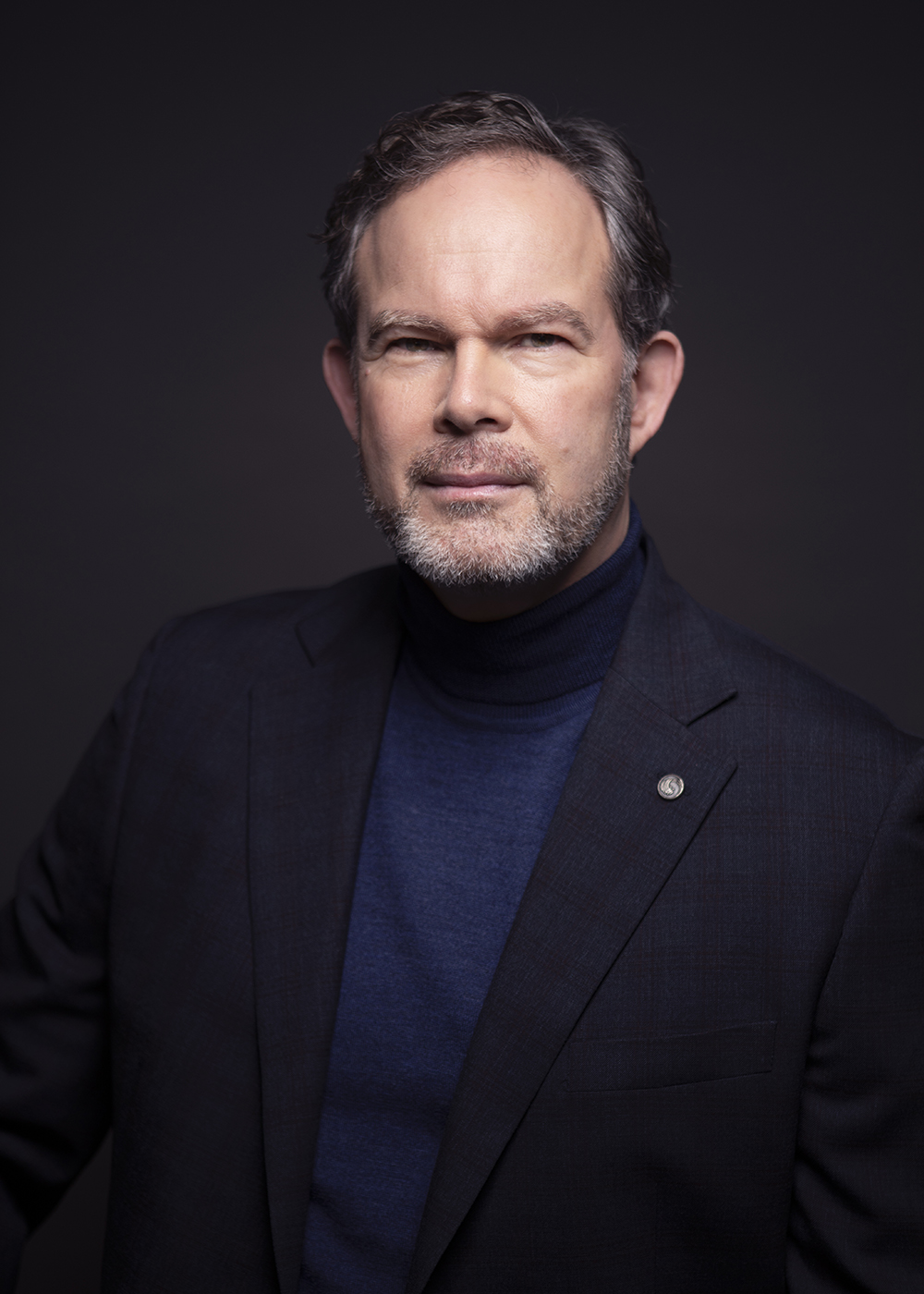
© Marshall Light Studio
Gerald Finley is not one to rest on his laurels. At an age when many singers are transitioning into teaching or simply enjoying retirement, the Canadian bass-baritone, 65, continues to move from strength to strength. Remarkably, his burnished bronze voice is more resonant and replete with overtones than ever.
“I’m getting stronger—that’s the weird thing,” Finley says. “I feel like the stamina is increasing, and that has meant that I can look at repertoire I had never imagined. Hans Sachs, Macbeth, Iago—these are demanding beasts, but with supervision I have found a way my voice can incorporate them. I have a singing teacher I’ve worked with as my voice has grown and changed. We never stop refining.”
In a career that now tops four decades, Finley has enjoyed an artistic trajectory that has taken him from early success as everyone’s favorite Papageno (an observation that causes him to throw back his head in delighted laughter) to some of the most arduous roles in the canon: Verdi’s Shakespeare-inspired trio of Falstaff, Iago, and Macbeth; the title roles in Rossini’s Guillaume Tell and Reimann’s Lear, Wagner’s Dutchman and Sachs. He has also given extraordinary service to contemporary opera, creating roles in Doctor Atomic, and Antony and Cleopatra for John Adams, The Silver Tassie and Festen for Mark-Anthony Turnage, and Fantastic Mr. Fox by Tobias Picker, to name only a few. He has also built a reputation, on the recital stage and on CDs, as a leading singer of songs.
Along the way he has picked up Grammy and Juno awards and has been appointed an Officer of the Order of Canada, and Commander of the Order of the British Empire. In 2024 he was accorded the title of Kammersänger by the Bayerische Staatsoper. In 2017, a Canadian postage stamp depicted him in full musical cry.
He was born in Montreal. His early musical interests were encouraged by his great-uncle Sir William McKie, who was a former organist at Westminster Abbey and an associate of Sir David Wilcox, the head of the Royal College of Music in London. Finley sang in choruses as a boy, then later studied at King’s College, Cambridge before going on to the Royal College and National Opera Studio. Upon graduation he auditioned for various young artist programs (“No one wanted me,” he says bluntly) then turned down a principal artist contract in Hamburg in order to join the chorus at Glyndebourne, which was to become a primary artistic home and nurturer of his talent. He subsequently went on to appear in virtually every important opera house in the world, initially establishing himself as a quintessential Mozart singer.
Speaking about his extraordinary career, Finley’s manner is courtly: he has an easy elegance infused with warmth and authenticity. He points to several reasons for his longevity. “I’ve got good genetics,” he explains, “Good northern Scottish island, almost Viking heritage. I have been lucky that the repertoire I’ve chosen has never taken the capital of the voice away. It’s about delving into
bigger repertoire, then coming out to do recitals, which are fantastically useful, then getting back to Mozart—the core of my work and such a happy vocal tonic.”
When he is asked about high points of his storied career, he makes clear that singing is about the creative process for him, not applause. He harkens back his chorus days, when he worked with two great Canadian artists: Jon Vickers and Maureen Forrester. And he recalls the excitement of preparing his very first Figaro. “Figaro has been very good to me,” he beams. He is especially eager to highlight his contribution to song literature, however; especially the three albums of Schubert lieder he recorded for Hyperion, now happily part of the Decca streaming catalogue.
“It’s very unusual for me to look back,” Finley says. “I have done quite a few things, but I’m still looking forward. There are still people I want to work with; still music I want to sing.” His 2025–2026 schedule reflects this outlook. It encompasses Puccini’s Scarpia at Covent Garden, Scarpia, Don Alfonso in Così fan tutte at La Scala, Macbeth in Munich, and a number of oratorio and recital appearances, along with a handful of his signature roles: Golaud in Pelléas et Mélisande (Opéra de Monte Carlo), Amfortas in Parsifal (Vienna State Opera), the Figaro Count (Bavarian State Opera).
“I remember looking at my seniors in my formative years and wondering how they managed to keep at it and still have the joy of it,” Finley says. “I know what that’s about now. It’s the sheer excitement of being a musician and sharing all that incredible music.” •
Mark Thomas Ketterson was the long-term Chicago correspondent for Opera News. He has written for Opera, Playbill, the Chicago Tribune, Atlanta Journal Constitution, and the publications of Lyric Opera of Chicago, the Chicago Symphony, Houston Grand Opera, the Ravinia and Edinburgh festivals, and Wolf Trap.


