© Ian-Ehm
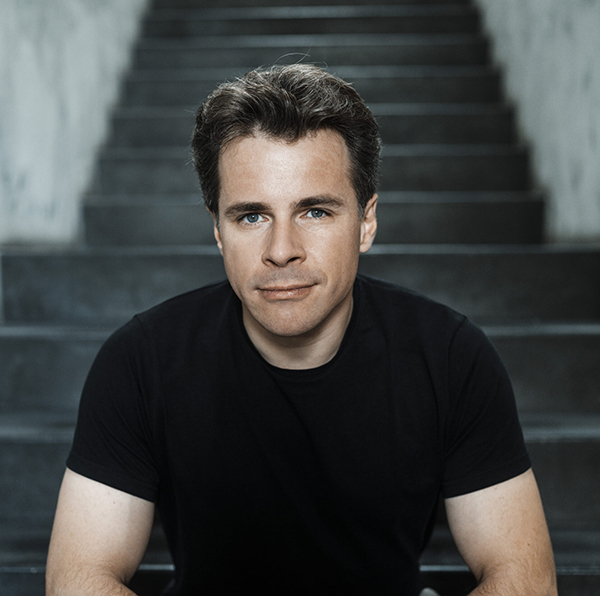
At 44 years of age, Jakub Hruša has the world at his feet. In September 2025, the Czech-born conductor succeeded Antonio Pappano as music director of London’s Royal Ballet. A few months earlier, the Czech Philharmonic announced his appointment as music director of the Czech Philharmonic, starting in 2028. Given his background, this must surely count as Hruša’s dream job.
He grew up in a family of music lovers, though none were in the profession. “In a way, it was the best environment because there was no presumption or even duty to become a musician,” he explains, remarkably relaxed for someone who has just emerged from rehearsals for Tosca, his inaugural Covent Garden production. “I think the exposure was the most important thing, and the support when they saw it was something I was naturally inclined to do and for which I had some talent.”
In conversation, Hruša exhibits a quiet, thoughtful demeanor, yet you sense a steeliness beneath the calm exterior, inevitable perhaps in a man whose world was turned on its head by the Velvet Revolution. “It was an absolutely decisive turning point in my life,” he says. “I was only an eight-year-old child, but I had experienced the preceding lack of freedom of speech and movement with a full realization. The year 1989 meant the gaining of a human right that had been denied for 40 years and was automatically taken for granted in the West. Whoever has lived without freedom and then regained it will never lose sight of how important it is.”
Growing up in Brno, the family’s subscription to the Janácek Theater exposed young Jakub to both concerts and opera. “Some were exciting, some not so—I remember how bored I was listening to Bruckner in rather dry acoustics,” he smiles. “I also remember important events on TV, like the opening of the Prague Spring Festival, which I have been privileged to do twice. Watching the same piece, Má Vlast played every year by different conductors and orchestras from around the world, I realized what it is to make distinction between interpretations.”
As a boy, he learned trombone, but while he often found himself called on to conduct student ensembles, it wasn’t until he was 18 that he decided against history, literature or languages and in favor of music as a profession. Enrolling at Prague’s Academy of Performing Arts, his teachers included the late Jirí Belohlávek. Hruša speaks eloquently of the older man’s kindness and clarity of leadership—“a beautiful combination of generosity and strictness”—he calls it.
“I had observed him a lot, so I think I sucked in his style intuitively,” he reflects. “When I started studying with him, it felt for both of us like not much needed to be explained.” Hruša’s appointments to date have included, from 2008 to 2015 chief conductor of the Prague Philharmonia, chief conductor of the Bamberg Symphony since 2016, principal guest conductor from 2017 of the Philharmonia
Orchestra, and, from 2021, principal guest conductor of the Orchestra dell’Accademia Nazionale di Santa Cecilia.
He has always been passionate about opera, but the inconsistent performance standards he encountered in his student days put him off the art form. “I felt so much compromise, you know?” he says. “It was only later [touring] with Glyndebourne that I had a chance to spend time with a company where detailed quality was at hand every day.”
Hruša made his Covent Garden debut in 2018, with Carmen. He did not truly consider himself as a candidate for Pappano’s successor, but his 2022 Lohengrin convinced the company otherwise. When the Royal Ballet and Opera came knocking, Hruša admits it was a surprise. “As soon as [the musicians and I] dived into Lohengrin I was aware of the love of each other in the process,” he shares. His
worked garnered raves; Seen and Heard International said “[his] attention to detail, and ability to inspire his players, is without peer.”
In September, he launched his first season as music director in with Anna Netrebko in Tosca: a decision that generated a small amount of controversy. Talking to The Times of London, he explained that casting the Russian soprano came from his “need to have an absolutely first-class artistic approach.”
“I always thought opera must be a part of my career, where I make sure not to do it routinely, but always with a fresh mind and the utmost inspiration,” Hruša says. “If there is a place where I imagine opera can be done like that permanently, it’s here.”
The Czech Philharmonic job is the icing on the cake. “They have a strong background not just in music making, but as a cultural beacon,” he says. “I touch wood and hope nothing spoils it, because the connection between the orchestra and its community, and the importance of what the orchestra does in Czechia and in the world really excites me.”
Reflecting on the future, Hruša clearly comes from the ‘if it ain’t broke, don’t fix it’ school. “It would be funny if I wanted to change anything now that I have two homes in two amazing cities and this opportunity to lead the most amazing musical institutions,” he declares. And personally? What does he hope these opportunities might bring? “Maturity, I think,” he replies, “without losing the freshness of innocence.” •
Clive Paget is an arts writer and critic. A former editor of Australia’s Limelight, he writes and reviews for, among others, Musical America, The Guardian, and BBC Music Magazine. Prior to his move to Australia, he was a director and dramaturg developing new music theater projects for London’s National Theatre.