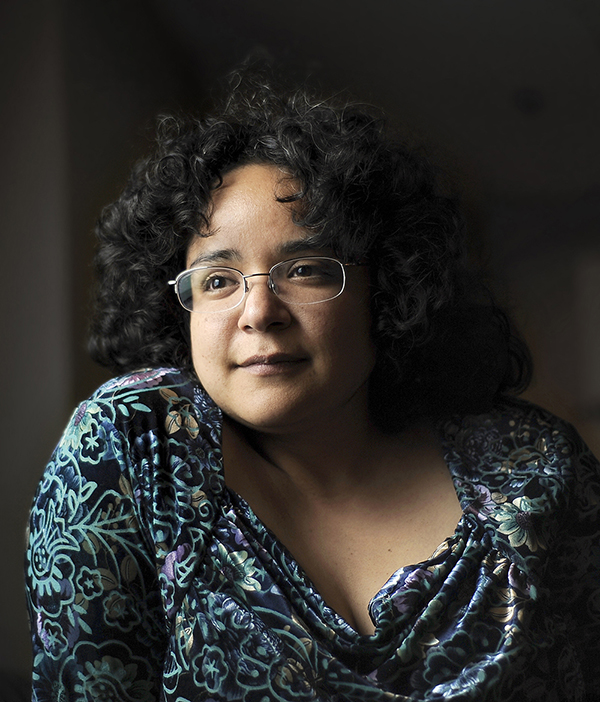
© Mariah Tauger
Gabriela Lena Frank sees herself as a storyteller. She started young: as children in Berkeley, CA, she and her brother wrote stories for their father, a Mark Twain scholar,to critique. Her polyglot ancestry is a tale in itself—her Lithuanian Jewish father met her Peruvian Indigenous/Chinese mother when he was a Peace Corps volunteer—and mother/daughter journeys to Peru incubated musical narratives.
That deep well of inspiration from Latin America has spawned a rich body of work in forms ranging from solo piano (Frank’s instrument) and chamber music to orchestra and opera. In recent years, they have evolved to encompass a deep concern about the environment. “It’s hard to talk about environmental decline if it’s just statistics,” Frank says. “Scientists haven’t been able to get the message across; that’s where the artist comes in.”
A new group of Frank’s orchestral songs has a libretto by J. Drew Lanham, whose writing on ecological themes draws connections between race and birds; Lanham is also writing a text about the pioneering ecologist Rachel Carson for a string quartet piece with narrator. In 2018, when Frank embarked on the tone poem Picaflor—her final project as composer-in-residence at the Philadelphia
Orchestra—she planned it as a chronicle of Peru’s origin myth. But subsequent history changed its focus. “I thought, ‘What happens to this mythology if I put it in the future, after a time of troubles?’” she explains.
Frank’s first opera, El Último Sueño de Frida y Diego was in the works for 15 years before it was finally staged in San Diego in 2022. A haunting exploration of the fraught love of Frida Kahlo and Diego Rivera with a Spanish libretto by playwright Nilo Cruz, the project challenged Frank to be true to her voice in an operatic context. “I wanted to write music for the opera so that if you removed all the
words and just listened to the singers and the orchestra colors, you could tell what the scene was about. I wanted to make the music a rich scaffolding for the words, not just a conveyer belt. It took me a while to figure it out; composers don’t get dramaturgical training. Some will simplify so much that they lose their voice.” The work arrives at the Metropolitan Opera in May. Frank and Cruz
are meanwhile working on a second opera—a commission from Houston Grand Opera.
Frank’s trajectory as a composer has been as unconventional as her oeuvre. In kindergarten, she was diagnosed with profound hearing loss and fitted with hearing aids. In college at Rice and graduate school at the University of Michigan, she rejected the conservatory practice of giving pieces abstract names like Fractal No. 4. Her first big piano work, from 2000, is titled Sonata Andina and incorporates elements from Andean folk music. She rejected the careerist route of competitions and summer festivals and instead went to Peru with her mother, visiting her large extended family, many of whom speak Quechua, and exploring the country’s music.
A meeting, at age 19, with the late Fran Richard of ASCAP turned out to be crucial. “We pen-palled for 10 years, and she threatened to break my arm if I didn’t apply for the ASCAP Young Composer award,” Frank reports. Her string quartet Leyendas: An Andean Walkabout (2001) won an award, and led Susan Feder, VP of Schirmer, to offer her a contract. Soon after, Frank was stricken with Graves disease, and found herself barely able to work for the next eight years; through that whole period, her publisher stuck by her side.
Today, she is paying forward that care and attention. A violent encounter with a white supremacist in a truck rest stop in the wake of the 2016 election jolted her into action. “He was looking at me like I didn’t belong in his country. I remember thinking, it’s not enough to represent through my music; I’ve got to do something more.” Frank and her husband had recently moved to a 16-acre farm north of the Bay Area. Within a week, she had assembled a diverse cohort of young composers and musician friends and devised a residency for them: the roots of the Gabriela Lena Frank Creative Academy of Music.
The project has mushroomed since its initial 2007 iteration. It now includes ongoing mentorship, via Zoom, and a robust commissioning program for alumni. Former fellows number over a hundred (Carlos Simon among them); 20 new ones were recently chosen. “I built this thinking about what I would really have loved in my twenties. The diversity is breathtaking not just demographic but in style. We’re getting jazzers and people from non-western traditions.”
Now 53, and in the full force of her powers, Frank feels her energies shifting. She’s dabbling in creative writing and thinking differently about her work. “It’s important to slow down, to compost ideas over time. I have to think about what’s a necessary piece of music for me to write.” But she adds, “I definitely have a few more stories to tell.” •
Heidi Waleson writes on opera for the Wall Street Journal. She is the author of Mad Scenes and Exit Arias: The Death of the New York City Opera and the Future of Opera in America (Metropolitan).